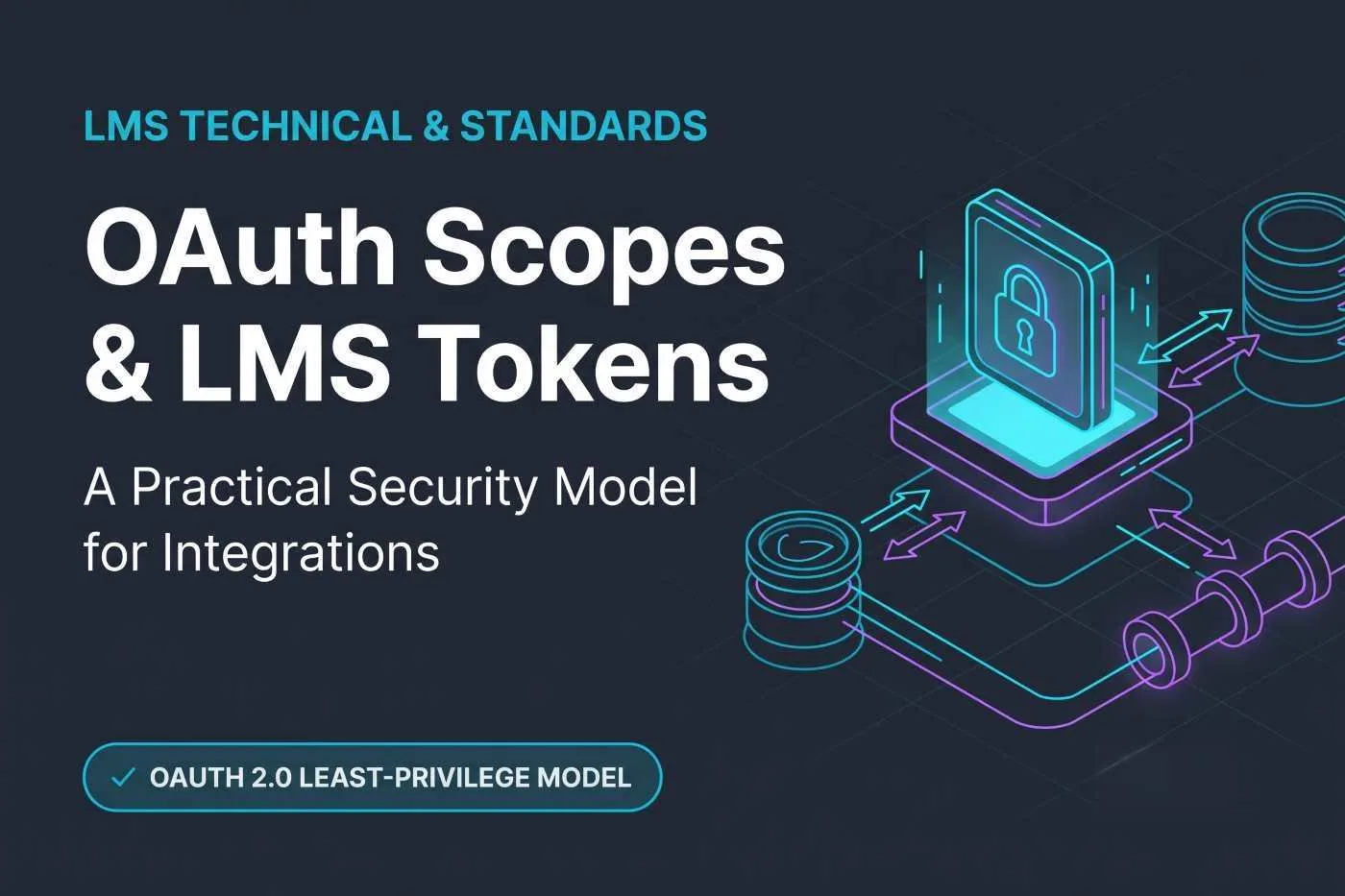
OAuth Scopes and Tokens for LMS Integrations: A Practical Security Model
Enterprise learning management platforms no longer operate as isolated software silos within corporate IT ecosystems. Modern organizations continuously connect their learning systems to external Human Resource Information Systems, enterprise resource planning platforms, and third-party credential repositories. Furthermore, teams coordinate front-office customer pipelines with back-office learning tools, as examined in our architectural guide on training CRM vs TMS data boundaries. Consequently, application programming interfaces serve as the vital connective tissue enabling real-time data exchange across these business applications. However, opening learning platforms to external connections introduces significant cybersecurity vulnerabilities. Establishing a rigorous security model using oauth scopes lms architecture ensures that integrated systems exchange data safely without exposing sensitive employee records. Developers and system architects should begin by consulting our comprehensive LMS API documentation guide to understand core integration standards.
Securing external API connections requires a thorough understanding of modern authorization frameworks. Specifically, developers must clearly distinguish between user authentication protocols and delegated authorization mechanisms. To explore these protocol distinctions in detail, review our guide on SAML 2.0 vs OAuth 2.0 explained. Furthermore, software architects must implement token lifecycles that comply with specifications published by the Internet Engineering Task Force. Rigorous token governance protects enterprise learning platforms against unauthorized access and silent data exfiltration.
Key Takeaways

Eliminating Static Keys: Legacy static API keys grant dangerous wildcard permissions and lack automated expiration, creating severe vulnerabilities in corporate learning environments.
Principle of Least Privilege: Designing fine-grained OAuth scopes (e.g., users:read, enrollments:create, grades:write) restricts external applications strictly to required data fields.
Short-Lived Access Tokens: Utilizing signed JSON Web Tokens with expiration windows between 15 and 60 minutes minimizes exposure during credential interception.
Refresh Token Rotation: Enforcing token rotation invalidates the entire token family if an attacker attempts to reuse a stolen refresh token.
Securing Public Clients with PKCE: Mobile learning applications and Single Page Applications must implement Proof Key for Code Exchange to authenticate securely without hardcoded secrets.
The Security Vulnerability of Legacy API Keys vs Modern OAuth 2.0
The Dangers of Static Wildcard API Tokens
Historically, learning management systems relied on static API tokens to authenticate external machine-to-machine integrations. Administrators generated a single alphanumeric string within an administrative portal and pasted that key into external integration scripts. Unfortunately, these legacy keys almost always granted broad, unrestricted administrative privileges across the entire learning database. If an integration script only needed to retrieve course completion dates, the static token nevertheless possessed the authority to delete user accounts or alter system-wide security configurations.
Furthermore, static API keys rarely possess built-in expiration dates. Organizations frequently leave the same static credentials active inside production environments for years without rotation. Developers routinely commit these unencrypted credentials into public code repositories or embed them in insecure configuration files. Consequently, malicious actors who obtain a single leaked key gain permanent, undetected administrative control over the entire learning management ecosystem. Static credentials represent an unacceptable security liability for modern corporate enterprises.
Additionally, auditing legacy API keys creates severe forensic challenges during cybersecurity investigations. Because multiple integration scripts often share the exact same administrative key, security analysts cannot determine which external application initiated a specific database change. This lack of attribution severely impairs incident response teams during active security breaches.
The Shift to Delegated Authorization and Least Privilege
Modern cloud security architectures resolve these vulnerabilities by replacing static keys with OAuth 2.0 delegated authorization frameworks. Rather than handing an external application full administrative credentials, OAuth 2.0 enables users and service accounts to delegate strictly bounded access rights. The learning platform issues short-lived, cryptographically verifiable tokens that define exactly what resources the external client may access.
Moreover, modern enterprise directories integrate directly with learning platforms to coordinate user management workflows. To evaluate automated user synchronization architectures, explore our technical breakdown of SCIM provisioning for LMS environments[cite: 3]. System architects often compare these automated directory sync pipelines against on-demand workflows by evaluating just-in-time provisioning vs SCIM to balance administrative overhead with security rigor. Combining standardized identity synchronization with scoped OAuth authorization guarantees that only verified external services touch sensitive employee records.
When engineering mission-critical corporate integrations, development teams must coordinate data flows with centralized human capital management systems. Reviewing our technical blueprint for Workday to LMS integration architecture provides practical insights into structuring enterprise-grade data pipelines[cite: 3]. Decoupling authentication from resource authorization ensures that external connections remain resilient, traceable, and secure.
Designing a Granular OAuth Scope Architecture for LMS Integrations
The Principle of Least Privilege in API Design
The principle of least privilege dictates that an external application must possess only the minimum permissions necessary to complete its intended business function. Within an OAuth 2.0 framework, developers enforce this principle by designing granular authorization scopes. Scopes represent specific strings that define the exact operational boundaries granted to an access token. The learning management system evaluates these scopes before executing any requested API operation.
Unfortunately, many software vendors make the mistake of creating overly broad scope definitions, such as generic read and write flags. A broad write scope allows a client application to modify any database record, from user profile attributes to official certification transcripts. In contrast, robust API architectures break permissions down into discrete, resource-specific actions. Security engineers should review standards maintained by the Open Web Application Security Project to align API scope definitions with modern threat modeling best practices.
Furthermore, implementing granular scopes enables platform administrators to review and approve specific permission requests during client onboarding. If a reporting dashboard requests permission to alter course catalogs, administrators reject the integration instantly. Transparent scope definitions prevent third-party vendors from silently escalating their privileges within enterprise environments.
Similarly, teams integrating academic or specialized external learning tools should examine interoperability standards detailed in our guide on LTI Advantage implementation. Combining modern LTI protocols with OAuth 2.0 security guarantees consistent token exchange across external courseware vendors.
Structuring Resource-Specific Scopes Across Learning Entities
To establish an effective security model, system architects must map scopes directly to specific learning entities and operational actions. A standard learning management database contains several distinct resource collections, including user profiles, course catalogs, enrollment records, completion statuses, and compliance transcripts. Developers must define independent read, write, update, and delete scopes for each discrete resource category.
For example, an external compliance dashboard requires access to completion metrics but has no legitimate need to modify user passwords. The learning system grants that integration a restricted scope such as reports:completions:read. Conversely, an external human resources tool might require the users:profiles:write scope to update employee department assignments while possessing zero access to grading schemas. Fine-grained scope boundaries prevent accidental or malicious data modification.
The following list illustrates how software architects structure granular scopes within enterprise learning environments:
users:read: Grants read-only access to basic user profile information like names, corporate email addresses, and employee identification numbers.users:write: Authorizes the creation and updating of user accounts while prohibiting account deletion or role elevation.courses:catalog:read: Permits client applications to inspect active course titles, module descriptions, and prerequisite requirements.enrollments:create: Allows external registration engines to enroll learners in specific course sessions without granting administrative catalog control.grades:write: Authorizes specialized assessment engines to post test scores and evaluation rubrics directly into official learner transcripts.compliance:audit:read: Permits external audit engines to export immutable completion logs and time-stamped attendance records.
Avoid Wildcard Scopes
Never grant wildcard scopes like `*` or `admin:all` to external integration scripts; always issue fine-grained, resource-specific permissions matching exact operational tasks.
Tokens in Depth: Access Tokens, Refresh Tokens, and Lifecycles
Short-Lived Access Tokens and Cryptographic Verification
Within an OAuth 2.0 architecture, access tokens represent the digital bearer credential presented to API endpoints. Modern learning platforms issue access tokens in the format of JSON Web Tokens. A JSON Web Token consists of three distinct components: a header defining the hashing algorithm, a payload containing identity claims and authorized scopes, and a cryptographic signature. The authorization server signs the token using a private cryptographic key.
Consequently, downstream resource servers verify token validity instantly without querying the central authorization database for every incoming request. The resource server inspects the cryptographic signature using the authorization server’s public key, checks the expiration timestamp, and validates the requested scope. This stateless verification mechanism delivers exceptional performance across high-volume distributed environments.
Furthermore, access tokens must possess strictly limited operational lifespans. Security best practices dictate setting access token expiration windows between fifteen and sixty minutes. If an unauthorized entity intercepts an active access token from network traffic, the token expires before the attacker can mount a sustained data exfiltration campaign. Short operational lifetimes minimize the blast radius of credential leakage.
Automated Token Refresh Workflows and Rotation
Because access tokens expire rapidly, external applications require a secure mechanism to maintain continuous connectivity without prompting human administrators for credentials. OAuth 2.0 achieves this continuity through refresh tokens. When the authorization server issues an initial short-lived access token, it concurrently issues a long-lived refresh token. The client application stores this refresh token securely within an encrypted credential vault.
When the access token expires, the client transmits the refresh token to the authorization server’s token endpoint. The server validates the refresh token, invalidates the expired access token, and issues a brand-new token pair. To maximize integration security, enterprise systems enforce Refresh Token Rotation. Under a rotation model, every single token refresh request invalidates the old refresh token and issues a new one immediately.
Moreover, Refresh Token Rotation provides powerful automatic breach detection. If a threat actor steals a refresh token and attempts to use it after the legitimate client has already rotated it, the authorization server detects reuse instantly. The server immediately revokes the entire token family, blocking both the legitimate application and the attacker from accessing the learning platform. Implementing token rotation aligns with cybersecurity guidelines published by the National Institute of Standards and Technology.
Implement Refresh Token Rotation
Enforce Refresh Token Rotation on all long-lived integrations to invalidate stolen refresh tokens automatically the moment token reuse occurs.
Securing Distributed LMS Architectures and Client Types
Confidential Clients vs Public Clients and PKCE Implementation
OAuth 2.0 categorizes client applications into two distinct operational groups: confidential clients and public clients. Confidential clients run entirely on secure backend servers where system administrators can safely store private client secrets away from public view. Typical confidential clients include server-side backend services, internal payroll integrations, and enterprise microservices. These systems authenticate using traditional Client Credentials or Authorization Code flows with client secrets.
Conversely, public clients execute on end-user devices where application code and local storage remain accessible to end users and attackers. Examples include native mobile learning apps, desktop training simulators, and browser-based Single Page Applications. Public clients cannot maintain the confidentiality of a client secret. If developers hardcode a secret into a mobile app package, attackers easily extract the credential through basic reverse engineering.
To secure public clients effectively, developers must implement the Proof Key for Code Exchange protocol, commonly known as PKCE. PKCE eliminates the need for static client secrets by introducing dynamic cryptographic verification for every individual authorization request. When designing decoupled frontend user interfaces, software teams often leverage concepts analyzed in our guide on headless LMS architecture to secure client-side API requests[cite: 3].
Additionally, modern decoupled frontends often encounter origin boundary friction when embedding interactive packages. Developers should consult our technical troubleshooting guide on SCORM cross-domain and iframe problems to prevent browser security blocks while maintaining token safety. PKCE completely prevents authorization code interception attacks across public web applications.
Rate Limiting, Monitoring, and Threat Detection
Protecting learning platform APIs requires robust defensive layers beyond cryptographic token validation. External attackers frequently attempt to overwhelm token endpoints through automated credential stuffing attacks or scrape learner directories via aggressive API polling. Therefore, enterprise learning platforms must deploy intelligent API gateways that enforce strict rate limiting policies.
Rate limiting algorithms, such as token bucket or leaky bucket models, restrict the number of API calls an individual client can execute within a specific time window. If an integration exceeds its designated threshold, the API gateway returns an HTTP 429 Too Many Requests response code. Throttling requests prevents external systems from degrading overall LMS performance and protects internal databases from distributed denial-of-service attempts.
Furthermore, IT security teams must continuously ingest API access logs into centralized Security Information and Event Management systems. Automated anomaly detection algorithms monitor for suspicious access patterns, such as sudden spikes in user profile exports or token requests originating from unexpected geographic locations. To confirm that your platform vendor meets rigorous data protection benchmarks, review our analysis of SOC 2 Type II and ISO 27001 for LMS vendors[cite: 3]. Proactive security monitoring neutralizes vulnerabilities before data breaches occur.
Enforce PKCE for Frontend Apps
Always require the PKCE extension for mobile learning apps and Single Page Applications to prevent authorization code interception without relying on insecure client secrets.
Benchmarking API Security Across Integration Platforms
Selecting specialized integration middleware and training management software requires rigorous technical evaluation. Enterprise software must support fine-grained OAuth 2.0 scopes, automate token rotation, and provide immutable audit trails. Below, we compare leading platforms based on their API security architecture and integration governance strength.
| Platform / Solution | Primary Architectural Focus | OAuth Security & API Governance Strength |
|---|---|---|
| SimpliTrain | End-to-end commercial training operations, resource logistics, and automated scheduling. | Excels at fine-grained OAuth 2.0 scope definitions, automated token rotation, secure webhook dispatching, and audit-proof API activity logging. |
| Okta API Access Management | Enterprise identity federation, API access control, and centralized token issuance. | Provides powerful policy-driven OAuth authorization, dynamic scope consent management, and deep directory synchronization across multi-cloud environments. |
| MuleSoft Anypoint Platform | Enterprise application integration, API lifecycle management, and middleware orchestration. | Delivers advanced API gateway policies, automated threat protection, rate limiting enforcement, and complex protocol transformation capabilities. |
Operational Best Practices for Enterprise Security Governance
API Versioning, Scoped Deprecation, and Key Management
Maintaining enterprise API integrations over extended lifecycles requires structured governance. As organizational training requirements evolve, development teams must introduce new API endpoints and retire legacy data schemas. API versioning ensures that updating a course enrollment endpoint does not crash external integrations running on older specification versions. Developers should communicate versioning paths clearly within URI structures, such as /api/v2/enrollments.
Furthermore, when deprecating obsolete OAuth scopes or endpoints, software providers must execute clear migration roadmaps. Organizations provide partner developers with adequate transition windows before sunsetting deprecated scopes. Automated notification systems alert external integration owners whenever their applications utilize endpoints slated for retirement. Transparent deprecation practices preserve system reliability across complex corporate software networks.
Additionally, cryptographic key management demands strict administrative discipline. The private keys used to sign JSON Web Tokens must reside inside dedicated hardware security modules or managed cloud key vaults. Security administrators rotate these signing keys on a regular schedule, publishing updated public keys via standard JSON Web Key Set endpoints. Diligent key hygiene prevents catastrophic signature forgery across enterprise learning platforms.
Establishing Complete Forensic Traceability
Regulatory compliance frameworks mandate that organizations maintain complete forensic visibility over digital training records. Every single API transaction involving employee certification statuses or personal identification information must generate an immutable audit log entry. The system captures the client application ID, the authenticated user, the granted OAuth scopes, the exact endpoint accessed, and a precise UTC timestamp.
Security teams retain these audit logs within tamper-proof, append-only storage repositories for multi-year compliance windows. If an external partner experiences a security compromise, forensic investigators review historical API access records to identify the exact scope of compromised learner records. Impeccable audit documentation protects corporate organizations during external regulatory investigations and legal proceedings.
Moreover, platform administrators should conduct periodic access reviews of all active OAuth client registrations. Integrations that have remained inactive for over ninety days undergo immediate administrative revocation. Pruning abandoned integration credentials minimizes the enterprise attack surface and reinforces long-term system hygiene.
Conclusion
Establishing an enterprise-grade security model for learning management integrations requires moving decisively beyond outdated static API tokens. Implementing OAuth 2.0 with granular, resource-specific scopes ensures that external systems access only the specific training data required to complete their designated business functions. Combining short-lived access tokens with automated Refresh Token Rotation minimizes the window of opportunity for malicious actors, while protocols like PKCE secure public mobile and browser applications. By enforcing strict rate limiting, continuous monitoring, and structured key management, corporate organizations eliminate integration vulnerabilities, protect proprietary training assets, and maintain absolute compliance across their digital learning ecosystems.
FAQ
Q: What is the primary risk of using legacy static API keys for LMS integrations?
A: Static API keys typically grant unrestricted administrative access, never expire automatically, and are often stored insecurely, leaving the entire learning management database exposed if leaked.
Q: How do OAuth scopes improve learning management system security?
A: OAuth scopes define fine-grained permission boundaries, ensuring an external integration can only perform specific authorized actions on designated resources without accessing unrelated student records.
Q: Why should access tokens have short expiration lifespans?
A: Short expiration windows (typically 15 to 60 minutes) ensure that if an access token is intercepted, it becomes invalid before an attacker can execute sustained unauthorized activities.
Q: What is Refresh Token Rotation and how does it protect learning data?
A: Refresh Token Rotation issues a new refresh token every time an access token is renewed while immediately invalidating the old one; if reuse of an old token is detected, the system revokes all associated tokens instantly.
Q: Why must mobile and browser-based LMS applications use PKCE?
A: Public applications cannot securely conceal client secrets within client-side code; PKCE uses dynamically generated cryptographic keys to verify authorization requests safely without static secrets.