Skilljar vs Thought Industries: The Ultimate SaaS Customer Education Platform Comparison
For modern Software as a Service companies, customer education is no longer a luxury. It is a critical growth engine. When users understand how to navigate your software effectively, they adopt features faster, submit fewer support tickets, and renew their subscriptions at significantly higher rates. To build a world-class training academy, software companies must invest in a dedicated saas academy platform. In the enterprise customer education market, two absolute heavyweights dominate the conversation: Skilljar and Thought Industries. Modern learning operations require robust digital environments to succeed. Therefore, leaders must audit their technical architecture continuously.
Choosing between these two platforms requires a deep understanding of your organizational goals. Are you trying to integrate training data directly into your customer success workflows to prevent churn? Or are you looking to build a highly customized, monetized learning business that sells complex B2B training cohorts? Conducting a rigorous customer education platform comparison reveals that while both systems look similar on the surface, their underlying architectural philosophies are vastly different.
Before committing to a multi-year enterprise contract, you must evaluate how these systems handle content authoring, CRM integrations, and certification management. For a broader view of the enterprise software landscape, you can review our guide on the best training management software. Furthermore, enterprise buyers should cross-reference vendor capabilities against a comprehensive benchmark of core training management system features to avoid functional integration gaps. Today, we will dive deep into the skilljar vs thought industries debate, comparing their technical capabilities, integration limits, and total cost of ownership to help you select the perfect engine for your SaaS academy.
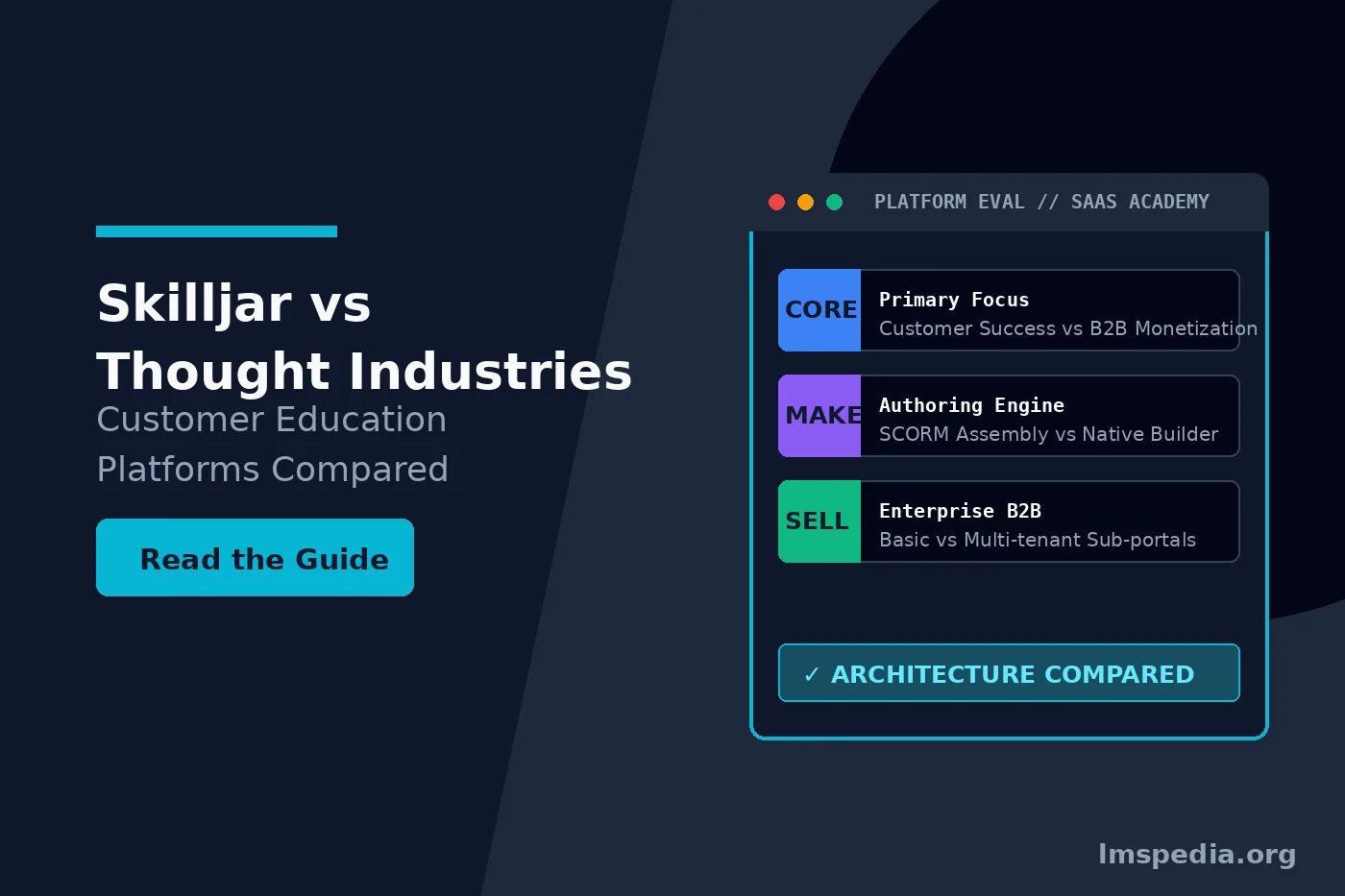
Define Your Primary Use Case: Choose your platform based on your ultimate goal. Skilljar excels at driving product adoption and reducing churn, while Thought Industries dominates the B2B training monetization space. Authoring Philosophies Differ: Skilljar acts as an assembly tool, requiring you to import SCORM packages and videos created elsewhere. Thought Industries features a powerful, native authoring engine to build interactive courses directly in the browser. Salesforce Integration is Critical: Skilljar provides arguably the tightest out-of-the-box Salesforce integration in the industry, seamlessly syncing learning data with customer health scores and revenue metrics. B2B E-Commerce Requires Hierarchies: If you plan to sell bulk training licenses to corporate clients and provide them with their own branded sub-portals, Thought Industries offers superior multi-tenant architecture. Certifications Drive Brand Advocacy: Both platforms serve excellently as a certification program platform, but Skilljar’s frictionless LinkedIn credential sharing creates powerful organic marketing for SaaS companies.
Key Takeaways

The Core Philosophies: Skilljar vs Thought Industries
To understand which platform fits your business, you must understand the core philosophy driving their development teams. Both platforms cater to external audiences, meaning they are designed to train customers and partners rather than internal employees. However, their primary use cases diverge significantly.
Skilljar: The Customer Success Engine
Skilljar was built from the ground up to be an extension of your customer success and revenue retention strategies. Its entire architecture is designed to map learning data to customer health scores. If a user completes an onboarding pathway in Skilljar, that data instantly flows into your CRM, allowing your Customer Success Managers to see exactly who is engaged and who is at risk of churning. According to data from the Technology and Services Industry Association, trained customers renew at substantially higher rates, and Skilljar is designed to prove that exact metric.
Thought Industries: The B2B Monetization Powerhouse
Thought Industries approaches customer education from a commercial perspective. It was designed for organizations that view their training programs as direct revenue generators. If you want to sell bulk training licenses to corporate clients, manage complex B2B sub-portals, and build a highly customized, branded learning experience from scratch, Thought Industries provides a massive suite of native e-commerce and authoring tools.
Authoring and Content Management Capabilities
How your instructional designers build and update courses will dictate the agility of your education program. The authoring approaches between these two platforms are fundamentally different.
Skilljar’s Content Assembly Model
Skilljar relies on an assembly model. It assumes that you are building your content outside of the platform using rapid authoring tools like Articulate Storyline or Adobe Captivate. You then upload those SCORM packages, videos, and PDFs into Skilljar, where you arrange them into learning paths. If you need a technical refresher on how external content packages communicate with learning systems, review our foundational guide answering what is SCORM. Additionally, instructional designers can review insights from AI course authoring tools compared to evaluate alternative production methods.
-
Pros: Incredibly fast deployment if you already have existing SCORM content. The interface is clean, intuitive, and allows administrators to assemble complex learning paths easily.
-
Cons: Skilljar lacks a robust, native authoring tool. If you want to build highly interactive, branching scenarios directly inside the LMS browser window, you will be disappointed. You must rely on external third-party software.
Thought Industries’ Native Authoring Engine
Thought Industries takes the opposite approach. It features a highly advanced, native authoring environment built directly into the platform. Instructional designers can build beautiful, responsive, interactive courses without ever leaving the browser.
-
Pros: You do not necessarily need to purchase expensive third-party authoring software. The native tool allows you to create interactive flip cards, branching video scenarios, and complex assessments natively.
-
Cons: The platform can feel overwhelmingly complex for beginner administrators. The sheer volume of customization options results in a steeper learning curve for new training teams.
Enterprise Integrations and Data Syncing
A saas academy platform cannot exist in a vacuum. It must communicate flawlessly with your CRM, marketing automation tools, and customer success software.
Salesforce and CRM Connectivity
Skilljar offers arguably the most seamless Salesforce integration in the customer education market. It pushes training data, course completions, and certification statuses directly into standard Salesforce objects. This allows revenue teams to build dashboards correlating training engagement directly to annual recurring revenue. If you rely heavily on Salesforce, Gainsight, or ChurnZero, Skilljar is engineered to integrate with them perfectly. Furthermore, industry guidance from analysts at Gartner further highlights enterprise software evaluation standards.
Thought Industries also offers strong Salesforce integration, but its true strength lies in its API flexibility. Thought Industries supports advanced headless LMS architectures, allowing developers to decouple the front-end user experience from the back-end learning engine. This is ideal for enterprise companies wanting to embed training seamlessly into their proprietary software interfaces. When connecting these massive data lakes, organizations must ensure their API calls are stable. You can learn more about avoiding integration failures by reading our guide on why HRIS data syncs break.
| Integration Category | Skilljar Capabilities | Thought Industries Capabilities |
| SimpliTrain | Automated user synchronization and role mapping. | Seamlessly connects CRM profiles with enterprise learning schedules. |
| CRM Integrations | Exceptional native Salesforce, HubSpot, and Zendesk apps. | Strong Salesforce sync with robust custom API capabilities. |
| Customer Success | Deep, out-of-the-box integrations with Gainsight and ChurnZero. | Standard webhook connections for CS platforms. |
| Data Analytics | Excellent native reporting tied to customer retention metrics. | Highly customizable BI dashboards using Snowflake architecture. |
| Tracking Standards | SCORM 1.2, SCORM 2004, and basic web tracking. | Advanced tracking capabilities. See our SCORM vs xAPI guide for details. |
Audit Data Syncs
First, test your CRM webhook connections in a sandbox environment. Ensuring flawless data write-backs prevents customer engagement score discrepancies.
E-Commerce and B2B Monetization
Many SaaS companies offer free onboarding training to drive adoption. However, as maturity grows, these companies often launch paid premium training tiers, instructor-led masterclasses, and certified professional programs. This requires robust e-commerce functionality.
Skilljar handles basic B2C e-commerce well. You can attach a Stripe or PayPal account to your academy, allowing individual users to purchase a course with a credit card easily. It supports promo codes, subscriptions, and bulk seat purchases.
However, when evaluating a partner training portal comparison for complex B2B sales, Thought Industries is the undisputed leader. Thought Industries allows you to create completely white-labeled tenant portals for your corporate clients. You can sell a master license to a massive enterprise client, allowing that client to manage their own users, customize their own branding, and track their own analytics within a secure sub-portal. If your business model relies on selling commercial training packages to large organizations, exploring the best TMS for open enrollment training businesses will show you why hierarchical licensing is so critical.
Building a Certification Program Platform
Software certifications are incredibly valuable. When a user becomes a certified administrator of your software, they become a brand champion. Both platforms excel as a certification program platform, but they execute the features differently.
Skilljar integrates beautifully with LinkedIn, allowing users to publish their verified digital credentials directly to their professional profiles with one click. This creates massive organic marketing for your SaaS product. Skilljar also automates expiration dates and recertification pathways seamlessly. Furthermore, maintaining compliance documentation through resources like our guide on LMS for compliance training and audit evidence ensures institutional readiness.
Thought Industries offers deep proctoring integrations and highly rigorous assessment engines. If your certification requires secure browser lockdown features, timed exams, and complex randomized question banks, the native testing engine in Thought Industries provides slightly more academic rigor than Skilljar.
Pricing Models and Total Cost of Ownership
Neither Skilljar nor Thought Industries publicly lists their pricing on their websites, which is standard for enterprise SaaS products. Both platforms operate on custom annual contracts that generally start in the tens of thousands of dollars.
Skilljar typically bases its pricing on the number of active learners interacting with the platform monthly. This makes it highly scalable for companies offering free training, as you only pay for users who actually consume the content.
Thought Industries often structures its pricing around administrative seats, tenant portals, and overall platform bandwidth. Because Thought Industries replaces the need for third-party authoring tools and complex e-commerce plugins, its total cost of ownership can sometimes be lower for highly complex commercial training businesses, despite a potentially higher initial software fee.
Calculate Total Cost
When comparing vendor proposals, factor in the licensing costs of third-party authoring tools required for assembly platforms like Skilljar.
Final Verdict: Which Platform is Right for Your SaaS?
The skilljar vs thought industries decision ultimately comes down to your primary business objective. There is no universally superior platform; there is only the right platform for your specific strategy.
Choose Skilljar if: Your primary goal is customer success, product adoption, and churn reduction. If your training team relies heavily on Salesforce and Gainsight, and you want to prove the exact dollar value of training on customer retention, Skilljar is the perfect, streamlined assembly engine for your academy.
Choose Thought Industries if: You are building a complex, monetized commercial training business. If you need a robust native authoring tool, highly customizable B2B client portals, and the ability to sell hierarchical training licenses to enterprise partners, Thought Industries provides the architectural depth required to scale a profitable education business.
FAQ
Q1. What is the main difference between Skilljar and Thought Industries?
The primary difference is their strategic focus. Skilljar is optimized for customer success, aiming to increase product adoption and reduce churn through deep CRM integrations like Salesforce. Thought Industries is optimized for commercial training, offering robust native authoring, B2B e-commerce, and multi-tenant sub-portals for selling training packages.
Q2. Does Skilljar have a built-in course authoring tool?
No, Skilljar does not have a comprehensive native authoring tool for building complex, interactive slides. It uses an assembly model where you upload existing videos, PDFs, and SCORM packages created in third-party tools like Articulate Storyline, and organize them into learning paths.
Q3. Which platform is better for selling courses to corporate clients?
Thought Industries is generally better suited for complex B2B sales. It offers advanced multi-tenancy, allowing you to spin up completely white-labeled, secure sub-portals for individual corporate clients so they can manage their own employees’ training and analytics.
Q4. Can both platforms integrate with Salesforce?
Yes, both platforms offer strong Salesforce integrations. However, Skilljar is widely recognized in the industry for having an exceptionally seamless, out-of-the-box Salesforce application that maps training engagement directly to customer health scores and retention metrics effortlessly.
Q5. Do these platforms support technical certification programs?
Absolutely. Both function as a robust certification program platform. They offer timed assessments, passing thresholds, automated certificate generation, and expiration tracking to manage complex SaaS administrator or partner certification tiers.