SCIM LMS Provisioning: Automating the Enterprise Identity Lifecycle
Enterprise software ecosystems are expanding at an unprecedented rate. Large organizations deploy dozens of distinct cloud applications to manage their daily operations. Consequently, IT departments face a massive administrative burden when managing employee access across these diverse platforms. When a new employee joins the company, the IT helpdesk must manually create accounts in the email system, the human resources portal, and the corporate training platform. This manual approach to user identity management is incredibly slow, highly prone to human error, and fundamentally insecure. To solve this massive operational bottleneck, modern IT architects rely on automated scim lms provisioning. Furthermore, enterprise buyers should cross-reference vendor capabilities against a comprehensive benchmark of core training management system features to avoid functional provisioning gaps.
Managing the flow of user identities into your learning platform is just as critical as managing the training content itself. If an employee cannot access their mandatory compliance modules on day one, they cannot legally begin working. Conversely, if a terminated employee retains access to your proprietary training materials, your organization faces a severe data breach. You must secure the entire identity lifecycle. To understand how automated provisioning fits into broader authentication strategies, you should review our comprehensive technical comparison in our LMS SSO SAML vs OIDC guide. In this detailed technical reference, we will explore exactly how scim 2.0 user provisioning automates your entire user lifecycle and protects your organizational data.
Standardized Automation: SCIM 2.0 is an open, standardized protocol that allows your central Identity Provider to automatically create, update, and suspend user accounts in your learning platform without requiring custom API coding.
Solves the JIT Flaw: While Just-In-Time (JIT) provisioning is great for creating accounts during login, it cannot delete users. SCIM actively pushes deactivation commands in the background, making it far superior for corporate security. Automates the Complete Lifecycle: SCIM perfectly handles the Joiner, Mover, and Leaver processes. It creates accounts before a new hire’s first day, updates their training curriculum when they get promoted, and instantly revokes access upon termination. Enhances Security Compliance: Automated user deprovisioning guarantees that terminated employees lose access to proprietary training data immediately, satisfying the strict requirements of security audits like ISO 27001 and SOC 2.
Synchronizes Group Memberships: Beyond individual users, SCIM can automatically push entire organizational group structures (like departments or regional teams) directly into the LMS, ensuring training assignments and reporting remain perfectly accurate.
Key Takeaways

Understanding the Basics of SCIM 2.0 User Provisioning
The acronym SCIM stands for the System for Cross-domain Identity Management. It is an open, standardized protocol designed specifically to simplify the management of user identities in cloud based applications and services. The Internet Engineering Task Force published the SCIM 2.0 standard to create a universal language for identity communication. You can read the official technical specifications of this protocol on the IETF RFC 7644 documentation page.
Before SCIM existed, every single software vendor created their own proprietary Application Programming Interface (API) for user creation. If a company wanted to connect their central directory to five different software platforms, their developers had to write five completely different custom integration scripts. This was incredibly expensive and difficult to maintain. SCIM 2.0 solves this problem by providing a standardized schema. When your central Identity Provider speaks SCIM, and your Learning Management System speaks SCIM, they can communicate perfectly without any custom coding.
The Dangers of Manual Identity Lifecycle Management
When organizations rely on manual processes for their identity lifecycle lms strategy, they expose themselves to significant operational risks. Manual identity management typically involves downloading a massive spreadsheet from the human resources software and uploading it into the learning platform via a CSV file. This process is inherently flawed for several reasons.
First, manual uploads are rarely executed in real time. IT departments typically batch process these files once a week. This delay means new hires sit idle for days waiting for their training accounts to activate. Second, manual processes inevitably lead to data transcription errors. A misspelled email address will prevent a user from receiving critical compliance notifications. Finally, manual management creates massive security vulnerabilities during the offboarding process. When an employee leaves the company under negative circumstances, their access must be revoked within seconds. Waiting until Friday to process a CSV upload gives a disgruntled former employee ample time to download proprietary corporate training videos.
SCIM vs JIT: Understanding the Critical Differences
When discussing automated user creation, software vendors often throw around two different acronyms. They talk about SCIM and they talk about JIT. You must clearly understand the scim vs jit debate to architect a secure learning environment.
JIT stands for Just In Time provisioning. This technology is usually bundled directly with Single Sign On protocols like SAML. When an employee clicks the login button on your training portal, the portal checks to see if they have an account. If they do not have an account, the JIT protocol instantly creates a brand new profile for them using the data passed through the SSO login token. Just In Time provisioning is fantastic for quickly creating new accounts because it requires very little setup. However, it possesses one massive, fundamental flaw.
Just In Time provisioning only triggers when a user actively attempts to log in. Therefore, JIT cannot delete or suspend users. If an employee quits, they simply stop logging into the platform. Because they never trigger a new login event, the JIT protocol never tells the learning platform to deactivate their account. This creates orphan accounts sitting permanently active in your system.
SCIM operates completely differently. It is an active, continuous synchronization engine. SCIM does not wait for a user to log in. Instead, the central Identity Provider constantly pushes updates to the learning platform in the background. If the human resources department terminates an employee in the central directory at 2:00 PM, the SCIM protocol sends a deletion command to the learning platform at 2:01 PM. The account is deactivated instantly, regardless of whether the user is trying to log in or not. Leading identity providers like Okta provide excellent breakdowns on why SCIM is the enterprise standard for secure identity management.
| Provisioning Metric | SCIM (System for Cross-domain Identity Management) | JIT (Just-In-Time Provisioning) |
| Execution Timing | Continuous background sync in real time. | Triggered only when a user logs in. |
| Account Deactivation | Instant automated deprovisioning on termination. | Fails to deactivate users who stop logging in. |
| System Architecture | Robust client-server protocol via dedicated endpoints. | Embedded assertion within SAML or OIDC tokens. |
Prioritize SCIM for Compliance
First, deploy SCIM instead of relying solely on JIT provisioning. Real-time background deprovisioning prevents terminated staff from accessing sensitive training modules.
Automating the Joiner, Mover, and Leaver Processes
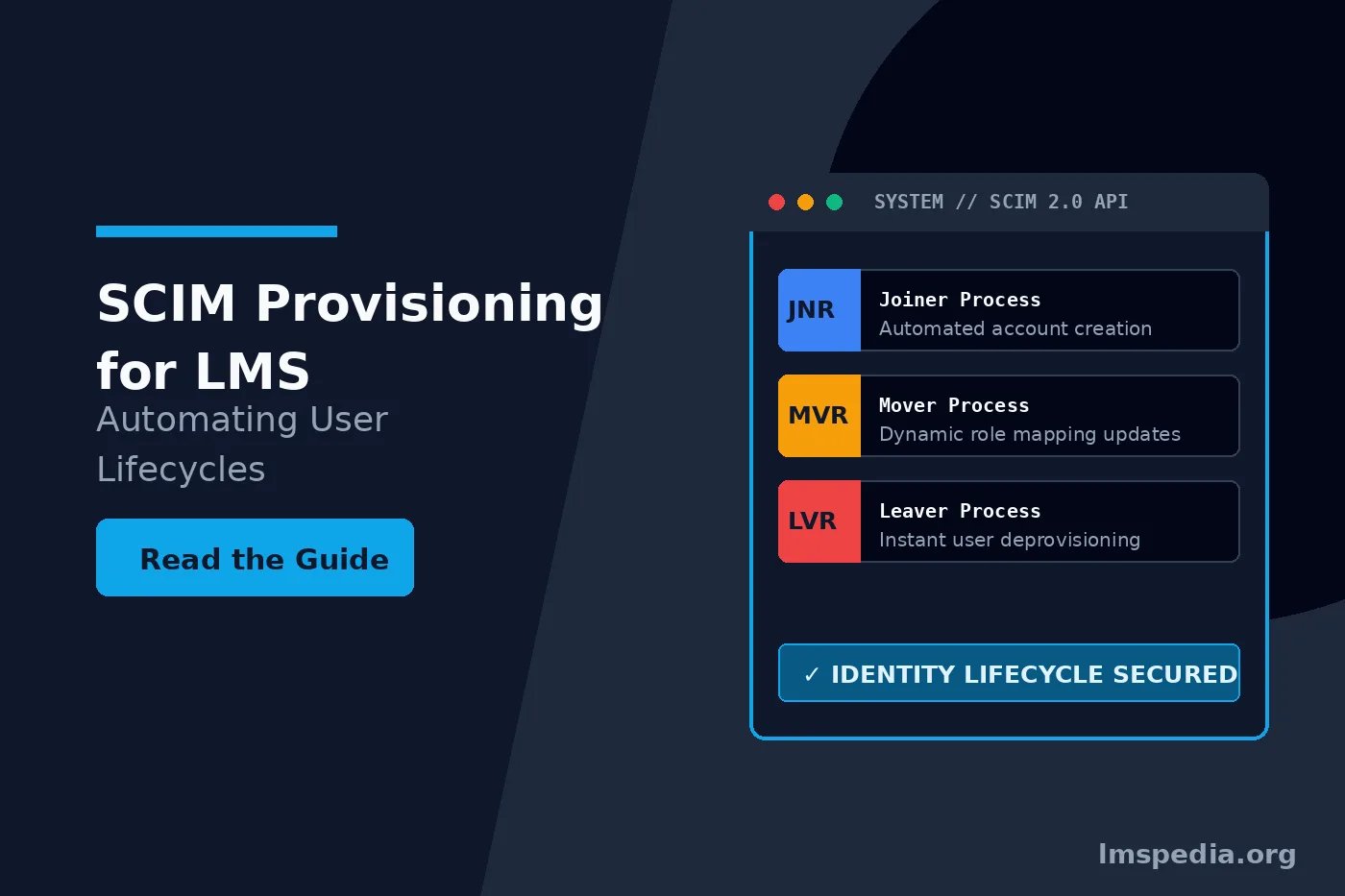
The corporate identity lifecycle is universally categorized into three distinct phases. These phases are the Joiners, the Movers, and the Leavers. A robust scim lms provisioning integration completely automates the administrative tasks required for all three of these operational stages. Furthermore, supporting advanced headless LMS architecture ensures these identity workflows integrate cleanly into custom portals.
The Joiner Process: Frictionless Onboarding
The Joiner process occurs when a company hires a new employee. In a modern enterprise architecture, the human resources team enters the new hire data into their core HR software like Workday or BambooHR. This HR software automatically pushes the new identity into the central Identity Provider like Microsoft Entra ID or Okta. The Identity Provider then uses the SCIM protocol to push that user data directly into the Learning Management System.
This entire chain reaction happens seamlessly in the background before the employee even arrives for their first day of work. When the new hire opens their laptop on Monday morning, their training account is already active. Furthermore, because SCIM transmits detailed attribute data, the learning platform knows exactly what department the employee belongs to. The platform can use this data to automatically assign the correct initial onboarding curriculum.
The Mover Process: Dynamic Role Updates
Employees rarely stay in the exact same role for their entire tenure. They receive promotions, they transfer to different regional offices, and they switch departments entirely. This is known as the Mover process. Managing Movers manually is a nightmare for training administrators.
Imagine a warehouse worker gets promoted to a forklift supervisor. They suddenly need access to a completely different set of management training modules. With scim 2.0 user provisioning, this transition is effortless. When the human resources department updates the employee’s job title in the central directory, SCIM pushes that exact title change directly into the learning platform. The learning platform detects the new job title and dynamically swaps their training curriculum to match their new responsibilities. To understand how to structure your internal software roles to capitalize on this automation, review our comprehensive guide on architecting LMS user roles and permissions for scale.
The Leaver Process: Automated Deprovisioning
The Leaver process is the most critical phase for corporate security. When an employee resigns or is terminated, you must execute automated user deprovisioning lms protocols immediately.
When the central directory marks a user as inactive, the SCIM engine fires a specific REST API command called a PATCH or DELETE request directly to the learning platform. This command instantly suspends the user account. The former employee immediately loses all access to the corporate training materials, even if they had the application open on their personal mobile phone at the time of termination. This automated suspension guarantees compliance with strict corporate security policies.
The Technical Architecture of SCIM Integration
Implementing a successful SCIM integration requires a basic understanding of the underlying software architecture. SCIM relies on a standard Client and Server relationship. In this specific ecosystem, your central Identity Provider acts as the SCIM Client. Your Learning Management System acts as the SCIM Server.
The communication happens over secure HTTPS connections using standard REST API methodology. The SCIM standard defines very specific endpoints that the learning platform must provide. The two most common endpoints are the /Users endpoint and the /Groups endpoint. When the Identity Provider wants to create a new employee account, it sends a JSON formatted payload to the /Users endpoint via an HTTP POST request. This JSON payload contains standardized data fields for the user’s first name, last name, email address, and external ID number.
If you utilize Microsoft tools for your enterprise architecture, you can explore the exact technical requirements for setting up these specific API endpoints in the official Microsoft Entra ID user provisioning documentation.
Group Provisioning and Team Management
While managing individual user accounts is incredibly valuable, scim lms provisioning becomes even more powerful when you utilize Group mapping. Large enterprises do not assign training to people one by one. Instead, they assign training curriculums to overarching groups, such as the North American Sales Team or the Global Engineering Department.
The SCIM protocol allows your central Identity Provider to push these entire group structures directly into your learning platform. If your IT department creates a new security group for a special project team, SCIM will automatically create that identical group inside the LMS. Furthermore, as IT adds or removes members from that security group in the central directory, SCIM ensures the membership list inside the LMS remains perfectly synchronized in real time. This guarantees that team managers always see accurate reporting dashboards for their current active staff.
Security Benefits and Audit Compliance
Automating your identity lifecycle lms workflows provides massive benefits for your corporate security posture. Regulatory bodies and security auditors demand strict controls over user access. Frameworks like ISO 27001 and SOC 2 require organizations to prove that they promptly revoke access for terminated employees. Reviewing vendor verification reports such as a certified SOC 2 Type II and ISO 27001 report for LMS vendors ensures complete institutional readiness.
If you rely on manual CSV uploads, proving compliance is extremely difficult. An auditor might discover a discrepancy where an employee retained access to the learning platform for two weeks after their termination date. This simple administrative error will result in a major audit finding. Conversely, automated user deprovisioning lms workflows create an unalterable, system generated audit trail. Furthermore, verifying compliance documentation through resources like our guide on LMS for compliance training and audit evidence guarantees audit defensibility. You can prove to any auditor that the system automatically suspended the user exactly three seconds after the human resources department processed the termination paperwork.
Test Attribute Mapping
Always validate your attribute mapping schemas in a staging sandbox before activating production syncs. Mismatched unique identifiers corrupt user profiles instantly.
Planning Your SCIM Implementation Strategy
Deploying SCIM requires careful planning between your human resources team, your IT security team, and your learning and development department. You cannot simply turn the protocol on and hope for the best. You must execute a structured implementation strategy.
First, you must conduct a thorough data mapping exercise. You must compare the data fields available in your central Identity Provider with the profile fields required by your learning platform. Decide exactly which attributes need to flow across the connection. For example, you might decide to map the Department, Job Title, and Manager Name attributes, while ignoring Office Phone Number.
Second, you must determine your matching criteria. When SCIM attempts to update a user, it needs a unique identifier to ensure it updates the correct profile. Most organizations use the employee email address or a unique corporate ID number as the matching attribute. You must guarantee that this matching attribute is completely unique for every single person in your organization.
Finally, you must test the integration in a secure sandbox environment before deploying it to your live production platform. Create dummy users in your Identity Provider and verify that they appear correctly in the learning platform. Change their job titles to test the Mover process. Suspend the dummy accounts to verify the automated Leaver process functions flawlessly. Ensuring robust testing aligns with a formal computer system validation for an LMS protocol.
Conclusion
As corporate software ecosystems grow more complex, manual user management is no longer a viable option. Relying on spreadsheets and manual uploads creates frustrating delays for new hires and massive security vulnerabilities when employees leave the organization.
By implementing a robust scim lms provisioning strategy, you eliminate these operational bottlenecks completely. You move beyond the limitations of the scim vs jit debate by utilizing a protocol that actively synchronizes data in real time. You guarantee that your identity lifecycle lms architecture effortlessly handles Joiners, Movers, and Leavers without any manual intervention. Ultimately, automated user deprovisioning lms workflows protect your proprietary training data, guarantee regulatory compliance, and allow your learning administrators to focus on creating great training content rather than managing passwords.
FAQ
Q1. What exactly does SCIM stand for?
SCIM stands for the System for Cross-domain Identity Management. It is a standardized protocol created by the Internet Engineering Task Force to automate the exchange of user identity data between cloud applications and IT directories.
Q2. What is the main difference between SCIM and JIT provisioning?
Just-In-Time (JIT) provisioning only creates or updates a user account when that person actively attempts to log in. SCIM is an active synchronization engine that constantly pushes user creation, update, and deletion commands in the background, regardless of login activity.
Q3. Why is automated user deprovisioning important for an LMS?
Automated deprovisioning instantly revokes an employee’s access to the learning platform the moment they are terminated in the central HR system. This prevents disgruntled former employees from stealing proprietary corporate training materials or accessing sensitive internal data.
Q4. Can SCIM automatically assign training courses to employees?
While SCIM itself just transfers user data, the LMS can use the rich attribute data provided by SCIM (such as job title or department) to automatically trigger specific learning paths and compliance curriculum assignments the moment the account is created.
Q5. Does SCIM manage passwords for the users?
No, SCIM is strictly used for provisioning identity attributes and managing the lifecycle status of the account. Password management and the actual login authentication process are handled separately by Single Sign-On (SSO) protocols like SAML 2.0 or OpenID Connect.