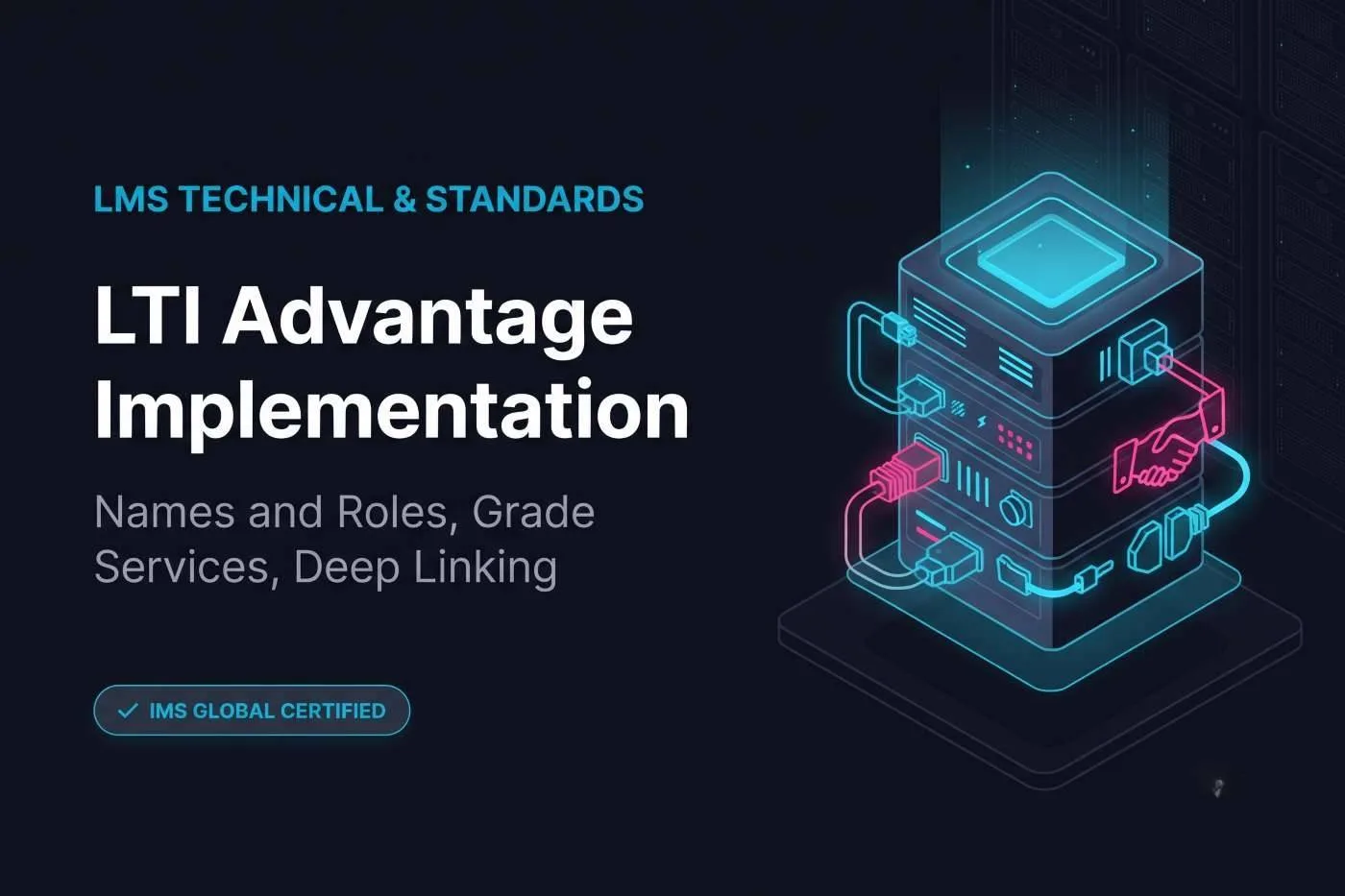
LTI Advantage Implementation: Names and Roles, Assignment and Grade Services, Deep Linking
Modern educational technology requires seamless interoperability between disparate learning systems. Historically, integrating external tools into a learning management platform demanded complex custom coding. Legacy protocols struggled to maintain security and consistent data synchronization across vendor boundaries. Fortunately, modern standards revolutionize how software applications communicate securely. Implementing LTI advantage transforms basic tool integration into a cohesive, secure ecosystem. Furthermore, enterprise buyers should evaluate core training management system features to ensure robust technical compatibility before procurement.
Technical architects must understand the underlying structural shifts governing modern educational standards. To explore broader platform comparisons, review our guide on LTI vs SCORM academic LMS architectures. Additionally, ensuring unalterable administrative logs protects institutions during compliance reviews, as detailed in our analysis of LMS for compliance training and audit evidence. Ultimately, mastering these protocols guarantees frictionless data exchange, supported by technical frameworks established by the 1EdTech Consortium.
Key Takeaways

Architectural Superiority: Modern integration frameworks replace insecure legacy protocols with robust OAuth 2.0 and JSON Web Token security.
Dynamic Roster Management: Names and Role Provisioning Services automate participant enrollment securely without manual administrative overhead.
Real-Time Grade Passback: Assignment and Grade Services eliminate manual gradebook entry by synchronizing performance metrics instantly.
Streamlined Content Curation: Deep linking enables educators to embed external digital resources intuitively within course syllabi.
Rigorous Cryptographic Defense: Asymmetric key pairs and timestamp validation prevent replay attacks and safeguard institutional data integrity.
The Evolution of Interoperability: Moving Beyond LTI 1.1
Architectural Limitations of Legacy Standards
Early interoperability standards provided basic launching capabilities for external educational applications. However, those older versions relied heavily on insecure cryptographic signing methods. Specifically, LTI 1.1 and 1.2 utilized OAuth 1.0a shared secret signatures. In this model, both the tool consumer and the tool provider had to store an identical shared secret in plaintext or reversible encryption. Consequently, if a single tool provider suffered a database breach, every connected consumer key became compromised.
Furthermore, legacy protocols lacked standardized mechanisms for bidirectional communication. While a tool could launch a user from an LMS, it could not easily query the LMS to verify who else was enrolled in the course. Instructors had to manually enroll external tool users or duplicate rosters across systems. Similarly, reporting student performance was restricted to a single raw decimal score sent back through a basic outcomes service. Complex multi-part assignments, interactive simulations, and adaptive laboratory exercises could not communicate nuanced competency data. Modern educational ecosystems demanded a complete architectural overhaul.
The Security Foundations of LTI 1.3 Core
To resolve these structural vulnerabilities, 1EdTech completely re-architected the standard under the LTI 1.3 core specification. Version 1.3 introduced a robust security framework built upon OAuth 2.0 and JSON Web Tokens. Security replaces basic shared secrets with asymmetric cryptographic key pairs. The learning management system signs authentication payloads using its private key, while the external tool validates the signature using the platform’s public key.
Consequently, malicious actors cannot easily spoof launch requests or manipulate grade transmissions. Establishing this secure handshake protects institutional data integrity entirely. To understand how modern token authorization models differ from legacy identity assertions, system architects should review our technical comparison of SAML 2.0 vs OAuth 2.0 explained. Educational technology leaders collaborated closely through the W3C standards body to harden web protocols, while adhering strictly to guidelines published by NIST security standards. Modern cloud learning platforms now operate with complete cryptographic defensibility.
Core Service 1: Names and Role Provisioning Services (NRPS)
Dynamic Roster Harvesting and Context Memberships
Names and Role Provisioning Services represent a foundational operational pillar within the LTI Advantage package. In traditional integrations, an external application remained completely unaware of a student until that specific student clicked an external course link. If an instructor wanted to organize students into collaborative project teams or assign peer reviews before a course began, the external tool could not support them.
NRPS solves this limitation by establishing a standardized RESTful API endpoint that external tools can query on demand. Specifically, the external application requests the current context membership list from the learning platform. The platform returns a structured JSON payload containing all enrolled users, their unique platform identifiers, and their assigned course roles. Instructors no longer manually configure user lists inside third-party simulation tools. Instead, the platform securely shares authorized roster data dynamically.
Furthermore, NRPS provides real-time visibility into enrollment changes throughout the academic term. When a student drops a course or switches recitation sections, the external application detects these changes during its next roster synchronization. Automated updates ensure that external gradebooks and collaborative groups remain synchronized with official enterprise records.
Privacy Controls, Data Minimization, and User Governance
While dynamic rostering delivers immense convenience, it introduces significant data privacy obligations. Educational institutions must protect student personal identifiable information in accordance with international privacy regulations. NRPS incorporates granular data minimization controls directly into its protocol design.
Platform administrators configure privacy thresholds at the tool registration level. The LMS can be configured to suppress email addresses, withhold full student names, or provide only pseudonymous pairwise identifiers. Consequently, external tools receive only the bare minimum data necessary to conduct the educational activity. Reviewing best practices for architecting clear LMS user roles and permissions ensures secure administrative scaling.
Additionally, evaluating how dynamic tool rostering contrasts with broader corporate directory synchronization models like just-in-time provisioning vs SCIM helps enterprise IT teams coordinate external application access effectively. Structured role governance guarantees that external service providers operate with strictly bounded privileges.
Core Service 2: Assignment and Grade Services (AGS 2.0)
Beyond Simple Passback: Line Items, Sub-Scores, and Progress States
Assignment and Grade Services revolutionize how external tools report student performance metrics back to the core host platform. Legacy integrations forced cumbersome CSV exports or relied on primitive outcomes services that could only write a single score between 0.0 and 1.0. If an external simulator contained multiple graded milestones, instructors had to calculate weighted averages manually outside the LMS.
AGS 2.0 expands grading capabilities by introducing dynamic line item management. An external application can create, read, update, and delete multiple gradebook columns inside the LMS via secure RESTful APIs. For instance, a complex coding sandbox can create separate line items for code compilation, test suite execution, and documentation quality. Instructors view student progress across every distinct evaluation criteria instantly without switching administrative screens.
Furthermore, AGS supports standardized activity progress and grading progress states. The external tool updates the LMS gradebook when a student starts an exam, submits an initial draft, or awaits manual instructor evaluation. Typical progress states include:
Initialized: The learner opened the external activity but has not yet submitted work.Started: The learner engaged with interactive exercises and has active work in progress.Submitted: The learner submitted their final assignment, signaling that grading can proceed.PendingManualReview: Automated tests are complete, but an instructor must evaluate qualitative responses.FullyGraded: The evaluation is complete, and the final calculated score is available in the LMS gradebook.
Audit Readiness and Automated Grade Synchronization
In high-stakes corporate compliance environments and accredited academic programs, grade modifications must remain verifiable. Manual grade entry introduces severe risks of human transcription errors, accidental overwrites, and unrecorded adjustments. AGS eliminates these risks through automated machine-to-machine synchronization.
Every score update transmitted via AGS includes an immutable timestamp, the tool’s verified client credentials, and optional instructor feedback comments. If a regulatory auditor reviews a certification course, the LMS gradebook provides complete forensic attribution for every single score transaction. Automated grade synchronization protects corporate enterprises from compliance penalties while providing learners with immediate, transparent performance feedback.
Validate AGS Endpoints Early
Test your Assignment and Grade Services endpoints using sandbox environments and automated assertion scripts before launching live student cohorts.
Core Service 3: Deep Linking 2.0 (Content Selection)
Dynamic Resource Selection Workflows
Deep Linking fundamentally transforms how educators incorporate external digital assets into course structures. Historically, instructors had to open a third-party vendor portal in a separate browser tab, copy a cryptic URL containing tracking tokens, and manually paste that link into an LMS text module. If the vendor altered their link formatting or updated their content catalog, existing course links severed immediately.
Deep Linking 2.0 eliminates manual link copying through an intuitive, embedded content selection workflow. When an instructor adds an external activity inside their course editor, the LMS initiates a specialized deep linking launch. The external vendor’s user interface opens seamlessly within a modal window inside the LMS. The instructor navigates the vendor’s catalog, previews simulations, selects interactive quizzes, and clicks confirm.
Upon confirmation, the external tool packages the selected items into a signed JSON Web Token and posts it back to the learning platform. The platform reads the token claims and generates clean, native course activities automatically. This dynamic workflow saves course designers hundreds of hours while eliminating broken hyperlink errors completely.
Context-Aware Delivery and Adaptive Learning Integration
Beyond basic link creation, Deep Linking 2.0 transmits rich metadata along with selected resources. The external tool can specify custom parameters, grading line item definitions, maximum score values, and display dimensions directly within the launch response. Consequently, the LMS configures assignment parameters automatically without requiring secondary instructor setup.
Furthermore, deep linking supports context-aware content delivery. Because external tools receive specific course context variables during launches, platforms can construct responsive adaptive learning paths tailored to student progress. For instance, an external mathematics engine can deliver remediation modules or advanced challenge sets based on prerequisite competencies.
Instructional designers structure these dynamic modules using established cognitive frameworks, such as Gagne’s nine events of instruction applied to ILT and eLearning, to stimulate recall and reinforce comprehension. Dynamic content integration bridges the gap between third-party educational software and centralized curriculum governance.
Security Architecture: OIDC Launch Flow and Cryptographic Verification
The Three-Step OIDC Handshake
The security model underpinning LTI 1.3 and LTI Advantage relies on OpenID Connect (OIDC) third-party initiated login flows. Rather than passing unencrypted user IDs across HTTP POST parameters, the standard enforces a multi-step cryptographic verification sequence:
- Login Initiation: The user clicks an activity link inside the LMS. The LMS sends an HTTP request to the tool provider’s initiation endpoint containing the platform’s issuer identifier, a client ID, and a target link URI.
- Authentication Request: The external tool validates the initiation parameters and redirects the user’s browser back to the platform’s OIDC authentication endpoint. This request includes a unique
statestring, a cryptographicnonce, and the requested response parameters. - Authentication Response and Launch: The LMS authenticates the user session, generates a signed JSON Web Token (the LTI message), and submits it back to the external tool’s launch URL via an automated HTTP POST form. The external tool verifies the JWT signature against the platform’s public key, validates the nonce to prevent replay attacks, and renders the learning application.
This sophisticated exchange guarantees that neither the user nor an intermediary network actor can forge authentication assertions or tamper with session data. To explore how enterprise systems govern token lifecycles and scopes, examine our analysis of OAuth scopes and tokens for LMS integrations. Technical developers should also review our LMS API documentation guide to structure API client registrations correctly.
JSON Web Key Sets (JWKS) and Automated Key Rotation
Asymmetric cryptography requires secure distribution of public keys. LTI 1.3 specifies that both learning platforms and external tools maintain public JSON Web Key Sets published at secure, publicly accessible HTTPS endpoints. A JWKS document contains one or more public keys formatted in standard JSON notation, identified by unique key identifiers (kid).
When an external application receives a signed launch JWT, it inspects the token header to locate the corresponding kid. The application fetches the platform’s public JWKS, matches the key identifier, and verifies the mathematical signature using standard RSA or ECDSA algorithms. Because public keys can be cached locally, this verification step introduces minimal network latency.
Furthermore, JWKS endpoints simplify cryptographic key rotation. Security administrators can deploy new signing keys without contacting third-party tool vendors to re-exchange certificates. The platform simply adds the new public key to its JWKS document and begins signing tokens with the new private key. Automated key management ensures continuous operational resilience while meeting strict cybersecurity compliance standards.
Enforce Strict Token Lifespans
Configure OAuth 2.0 token expiration windows to under sixty minutes and cache public JWKS endpoints locally to balance high performance with rigorous security.
Enterprise Implementation Challenges and Technical Troubleshooting
Multi-Tenancy, Client IDs, and Deployment Identifiers
Deploying advanced integrations across massive enterprise instances introduces administrative complexity. In multi-tenant cloud platforms, a single external software application might serve hundreds of distinct corporate clients or university campuses. LTI Advantage accommodates multi-tenancy by separating Client IDs from Deployment IDs.
The Client ID identifies the developer or software vendor within the platform. In contrast, the Deployment ID identifies the specific institutional instance or tenant account utilizing the tool. Misconfiguring deployment identifiers causes immediate authentication handshaking failures. Maintaining an organized integration registry prevents operational downtime.
Furthermore, corporate training providers delivering external education across client networks must isolate data strictly. Configuring dedicated corporate client portals for training providers ensures that LTI deployments remain compartmentalized between distinct enterprise clients.
Overcoming Third-Party Cookie Deprecation and Iframe Sandboxing
A significant technical hurdle facing modern educational integrations is the aggressive phaseout of third-party cookies across major web browsers. Traditionally, external tools launched inside an LMS iframe relied on third-party session cookies to maintain user state. However, modern security architectures in Google Chrome, Apple Safari, and Mozilla Firefox block third-party cookies by default to prevent unauthorized web tracking.
Consequently, external tools embedded in iframes frequently fail to establish authenticated sessions, leaving users stranded on blank screens or infinite login loops. To resolve this issue, software developers must adopt the Storage Access API or transition to popup launch mechanisms. Technical teams facing cross-origin embedding challenges should consult our troubleshooting guide on SCORM cross-domain and iframe problems for proven architectural workarounds.
Moreover, developers must configure iframe sandbox attributes carefully. If an LMS restricts iframe permissions excessively, external applications cannot open modal windows, process audio inputs, or execute client-side scripts. Collaborative testing between platform administrators and tool developers ensures embedded tools render smoothly without sacrificing browser security.
Evaluating LMS Platforms for Interoperability
Educational institutions and enterprise corporations must evaluate platform interoperability carefully before committing to long-term software contracts. Selecting software with verified LTI Advantage certification prevents expensive custom engineering down the road. Furthermore, comparing platform capabilities against established market standards, such as Absorb LMS certification tracking and SCORM support, helps organizations benchmark external tool connectivity against traditional SCORM delivery. Below, we compare leading learning management platforms based on their architectural strength.
| Platform / Solution | Primary Focus | Interoperability & Standards Strength |
|---|---|---|
| SimpliTrain | Versatile training operations and capacity scheduling. | Excels at secure external tool synchronization, automated grade passback, dynamic roster provisioning, and standards-compliant LTI Advantage integration. |
| Canvas LMS | Higher education and large enterprise academic deployment. | Delivers comprehensive native support for deep linking, roster services, and advanced cryptographic security frameworks with full 1EdTech certification. |
| Blackboard Learn | Global academic institutional learning and assessment delivery. | Provides robust enterprise administration tools and mature integration pipelines for external publisher content and specialized third-party courseware. |
Strategic Operational Benefits of LTI Advantage
Accelerating Time-to-Market for Digital Learning Content
Organizations that adopt LTI Advantage achieve dramatic reductions in course deployment timelines. Historically, integrating a new third-party interactive simulation or virtual laboratory required months of custom API programming and security vetting. With standardized LTI Advantage services, administrators connect new certified tools in minutes using standardized configuration forms.
Rapid deployment capabilities allow academic departments and corporate training divisions to respond dynamically to emerging educational needs. When a new compliance mandate or technical software update emerges, instructional designers incorporate specialized third-party courseware immediately. Operational agility transforms learning systems from static digital libraries into responsive educational ecosystems.
Furthermore, standardized interoperability future-proofs institutional software investments. If an organization decides to replace its core learning management system, external tools migrate to the new platform effortlessly. Because certified tools utilize identical launch and reporting protocols, switching the central host does not require rebuilding dozens of custom integrations.
Unifying Learner Analytics Across Distributed Tools
Modern workforce learning occurs across a diverse array of platforms, including virtual reality flight simulators, automated coding playgrounds, and branching scenario modules. Without standardized reporting protocols, learner data becomes hopelessly fragmented across disparate vendor servers. Training managers cannot obtain an accurate, holistic view of organizational competency.
LTI Advantage establishes the connective infrastructure required to unify distributed analytics. By pairing Assignment and Grade Services with real-time roster harvesting, the central LMS serves as the single source of truth for organizational learning metrics. Executives inspect consolidated dashboards reflecting performance milestones achieved across dozens of independent learning platforms.
Consolidated reporting empowers leadership to identify skill gaps early, optimize curriculum investments, and demonstrate verifiable compliance during regulatory inspections. Standardized data pipelines transform fragmented digital tools into an integrated, data-driven workforce development engine.
Conclusion
Adopting modern interoperability standards unlocks unprecedented flexibility across enterprise and academic ecosystems. Names and Role Provisioning Services, Assignment and Grade Services, and Deep Linking eliminate legacy administrative friction entirely. Organizations embracing these robust cryptographic frameworks ensure scalable, secure, and compliant digital learning operations. Technical mastery of modern LTI Advantage protocols guarantees long-term educational excellence and operational resilience.
FAQ
Q: What is the primary difference between legacy tools and modern interoperability standards?
A: Modern standards utilize asymmetric cryptography, OAuth 2.0, and JSON Web Tokens to establish secure authentication and granular data exchange.
Q: How do Names and Role Provisioning Services benefit instructors?
A: They automatically synchronize course rosters between the learning management platform and external tools, eliminating manual user management.
Q: What purpose does Deep Linking serve in course design?
A: Deep linking allows educators to browse and embed specific external learning assets directly into their course navigation menus seamlessly.
Q: How does Assignment and Grade Services handle complex grading structures?
A: AGS supports multiple line items and custom result formats, allowing external applications to pass back granular component scores automatically.
Q: Why is cryptographic key rotation important for system security?
A: Regular key rotation prevents unauthorized token manipulation and protects institutional learning environments from compromised credentials.