Operating a certificated repair station demands absolute precision, unyielding safety standards, and strict adherence to federal aviation regulations globally. The Federal Aviation Administration explicitly mandates that a certificated repair station must have and use an employee training program approved by the FAA that consists of initial and recurrent training. Without a highly robust part 145 training program, maintenance repair and overhaul organizations risk catastrophic operational failures and severe regulatory penalties. Modern aviation facilities absolutely cannot rely on outdated paper tracking methods to manage these highly complex competency matrices. To scale these critical educational frameworks effectively, organizations must deploy specialized aircraft maintenance training software immediately. Utilizing the correct digital infrastructure guarantees that your specialized mechanics remain perfectly compliant with constantly evolving federal safety mandates.
Managing these complex regulations requires transitioning from legacy paper filing cabinets to modern digital infrastructures completely. While the Federal Aviation Administration sets the baseline domestic standards, many global organizations must also satisfy international aviation authorities simultaneously. By adopting robust EASA compliance training software frameworks alongside your domestic programs, you can harmonize international regulations seamlessly. If your facility operates across international borders, you should read our comprehensive guide on the EASA ATQP methodology to understand European differences thoroughly. Furthermore, maintaining a highly secure physical facility is just as important as maintaining the aircraft itself. To ensure your external vendors follow strict protocols, review our detailed guide covering contractor orientation and site induction software today. Finally, ensure your overarching occupational safety logs are perfectly aligned by reviewing our OSHA training documentation compliance checklist carefully.
Key Takeaways

Establish Baseline Indoctrination:
Require every single new hire to complete comprehensive indoctrination modules covering facility policies before touching any aircraft component natively.
Ensure Capability Verification:
Guarantee that every employee assigned to perform maintenance or inspection functions remains fully capable of performing the assigned task safely.
Maintain Recurrent Cycles:
Deploy strict digital tracking architectures to automate technical alerts, ensuring your mechanics never operate with expired federal qualifications.
Retain Records Properly:
Store individual employee training records in a format acceptable to the federal regulator for a strict minimum of two calendar years securely.
Update the Manual:
Submit any proposed revisions to your approved educational curriculum directly to your responsible Flight Standards office prior to field implementation.
The Regulatory Foundation of a Part 145 Training Program
Title 14 of the Code of Federal Regulations explicitly governs how maintenance organizations operate within the United States. Specifically, section 145.163 outlines the exact educational obligations for certificated repair stations. An applicant for a repair station certificate must submit a training program for approval by the FAA as required by section 145.51(a)(7). This initial regulatory submission forms the absolute foundation of your corporate safety culture natively.
The federal regulator does not accept generic, off the shelf curriculums. The mandate strictly states that the training program must ensure each employee assigned to perform maintenance, preventive maintenance, or alterations, and inspection functions is capable of performing the assigned task. Consequently, your part 145 training program must directly reflect the specific aircraft frames, powerplants, and mechanical accessories listed on your official operations specifications. If you add a new aircraft fleet type to your capabilities list, you must update your curriculum to reflect that new technical requirement immediately.
Decoding the Repair Station Training Requirements
To assist aviation organizations in meeting these strict mandates, the FAA provides information on developing the repair station employee training program required under 14 CFR 145.163 through Advisory Circular 145-10. This critical advisory circular covers categories of training, training program components, and sample training programs. Understanding these exact repair station training requirements separates compliant organizations from those facing severe operational suspensions.
You must map every single job function within your facility to a specific educational module. A sheet metal fabricator requires a completely different technical curriculum than an avionics technician. Your overarching software architecture must possess the capability to group learners by their specific job roles automatically. This automation ensures that administrators assign the correct modules to the correct mechanics without manual data entry errors.
Core Categories of Required Aviation Training
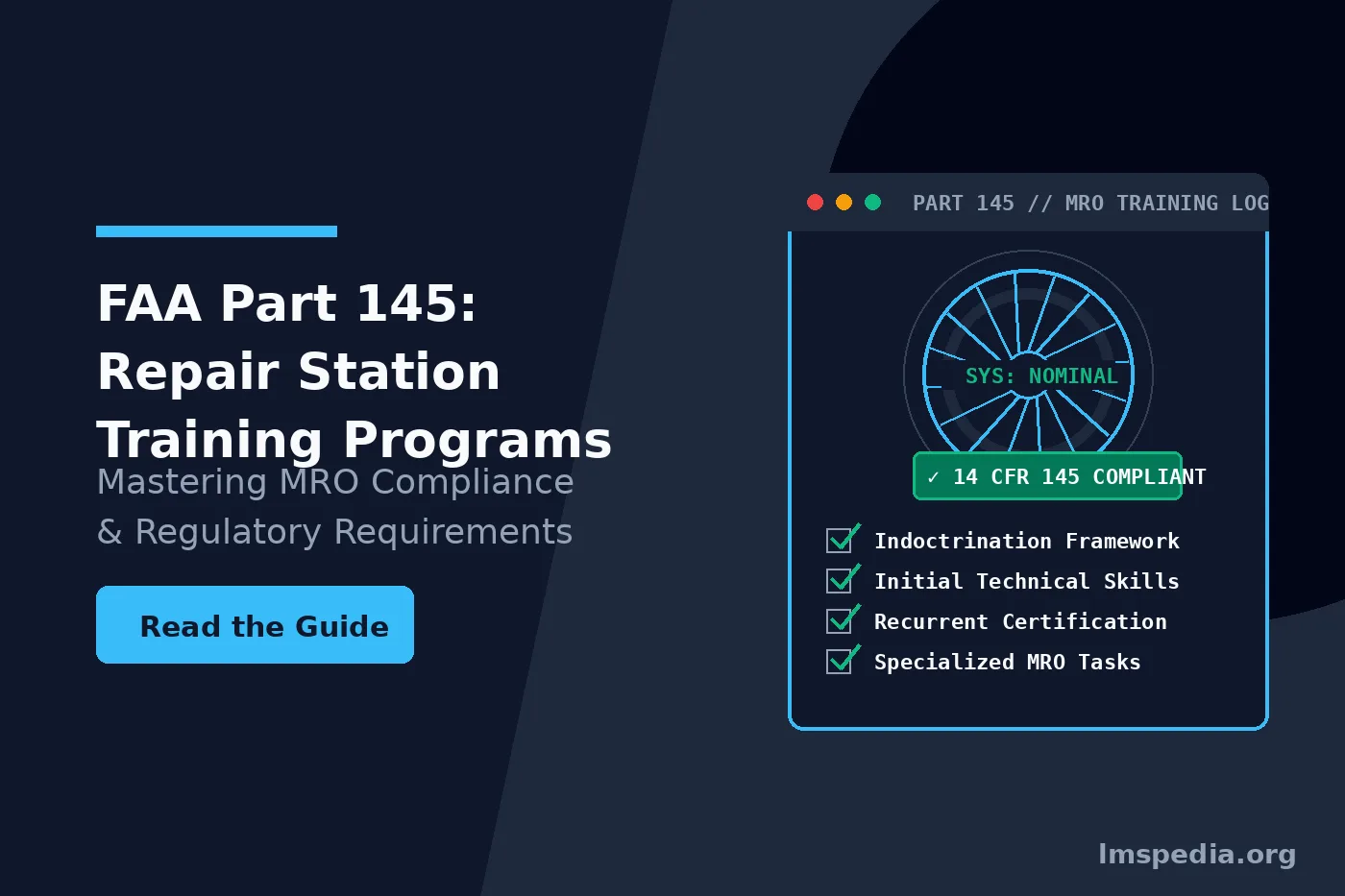
The federal guidance explicitly breaks down the educational journey into four distinct categories. You must incorporate all four categories into your overarching part 145 training program to achieve full compliance. Missing even one category creates a massive vulnerability during a federal audit.
Indoctrination and Initial Technical Requirements
The very first step for any new hire involves basic facility onboarding. Indoctrination training for new and existing employees covers the regulations and the repair station’s operations, policies, and procedures. This module ensures that every worker understands the fundamental safety culture of the specific facility, including proper forms, routing tags, and emergency protocols natively.
Following basic indoctrination, mechanics must prove their specific trade competencies. Initial technical requirements for new and existing employees taking on new tasks ensure appropriate technical skills training is provided. Even if an experienced mechanic joins your organization from a competing airline, you must still verify their initial technical skills according to your own internal quality control procedures completely.
Part 145 Recurrent Training and Specialized Tasks
Aviation technology evolves rapidly, making continuous education absolutely mandatory. Recurrent technical training for specific tasks or functions ensures currency in existing or added capabilities. This highly critical part 145 recurrent training phase forces mechanics to review critical service bulletins, updated maintenance manuals, and newly discovered failure trends regularly. It combats technical complacency perfectly.
Furthermore, certain highly dangerous tasks require completely distinct educational pathways. Specialized technical training or advanced training requirements for specific tasks or functions ensure all employees accomplishing maintenance remain capable of performing assigned tasks. Examples of specialized tasks include advanced non-destructive testing, complex composite structural repairs, and specialized hazardous material handling. Your learning management system must track these specialized expiration dates relentlessly.
Automate Recurrent Deadlines
Do not rely on manual calendar reminders to track recurrent expirations. Configure your learning management system to automatically email mechanics and their direct supervisors sixty days before a critical technical qualification expires. This proactive automation prevents catastrophic scheduling conflicts entirely.
Structuring the FAA Part 145 Training Manual
Your educational procedures cannot exist solely as an informal internal agreement. You must document your exact methodology thoroughly. The faa part 145 training manual serves as the legal blueprint for your entire educational operation. This comprehensive manual dictates exactly how your organization develops courseware, evaluates mechanic competency, and maintains accurate digital records permanently.
Managing Revisions and Federal Approvals
Because aviation regulations change frequently, your manual will require constant updates. A certificated repair station must submit revisions to its training program to its responsible Flight Standards office. You absolutely cannot implement a massive change to your syllabus without securing this formal approval first. Implementing unapproved curriculums invalidates the qualifications of every mechanic who takes the course natively.
When drafting these critical revisions, you must utilize highly structured instructional design principles. Using proper cognitive action verbs ensures your maintenance technicians actually comprehend the highly complex service bulletins. To build highly effective course curriculums, review our reference guide on utilizing Bloom’s taxonomy for corporate training verbs immediately. Clear, measurable objectives make securing federal approval significantly easier.
Achieving MRO Training Compliance FAA
Tracking mechanic progress across a massive maintenance facility generates massive amounts of data daily. Ensuring perfect mro training compliance faa standards requires flawless record keeping capabilities. A certificated repair station must document, in a format acceptable to the FAA, the individual employee training required.
Strict Record Retention Rules
Federal inspectors do not accept excuses for missing files. By law, these training records must be retained for a minimum of 2 years. However, industry best practice heavily dictates retaining these records for the entire duration of the mechanic’s employment plus an additional five years. If a critical component fails in flight, investigators will scrutinize the specific training records of the mechanic who signed the release certificate meticulously.
To eliminate missing records, you must deploy highly advanced digital tracking standards. A robust part 145 training program relies heavily on digital course packages to deliver indoctrination modules efficiently. If your digital platform fails to record these course completions correctly, you risk massive regulatory exposure. To resolve stubborn digital tracking errors, study our technical diagnostic checklist covering SCORM completion issues closely. Additionally, you must differentiate between simple attendance and actual quiz success perfectly by mastering the SCORM 2004 completion status variables natively.
| Operational Feature | Manual Paper Tracking Systems | Modern Digital Part 145 Training Program |
|---|---|---|
| Record Retention Security | Highly vulnerable to physical damage, loss, or unauthorized tampering. | Securely backed up in the cloud with strict cryptographic access logs. |
| Recurrent Expiration Alerts | Requires tedious manual audits of massive spreadsheet databases daily. | Triggers automated warning emails to supervisors months in advance. |
| Curriculum Version Control | Mechanics frequently study outdated paper manuals accidentally. | The system explicitly locks out outdated modules instantly upon revision. |
| Federal Audit Readiness | Requires days of stressful administrative preparation to gather files. | Generates comprehensive, timestamped compliance reports in mere seconds. |
| Competency Verification | Relies on easily forged physical signatures on fragile paper rosters. | Utilizes highly secure digital signatures and verifiable digital credentials. |
Implement Digital Credentials
Move away from static PDF certificates immediately. Modern aviation organizations utilize advanced digital credentialing to prove mechanic competencies on the shop floor securely. Explore how Open Badges 3.0 frameworks securely verify technical achievements permanently, completely eliminating the risk of internal certificate forgery.
Integrating Quality Assurance with Education
A highly successful part 145 training program does not operate in an isolated administrative silo. It must connect directly to your primary Quality Assurance department continuously. When your quality inspectors discover a rising trend of specific maintenance errors on the hangar floor, they must feed that data directly back into the educational curriculum.
Creating a Continuous Feedback Loop
If quality control notices that mechanics are consistently applying improper torque values to a specific landing gear assembly, the educational department must react instantly. They must develop a targeted remedial training module to address this exact technical deficiency natively. This proactive feedback loop transforms your training department from a passive compliance center into an active, highly dynamic safety engine.
To view official federal guidance directly, explore the authoritative regulatory text regarding 14 CFR 145.163 natively. Furthermore, you can review the specific programmatic structures suggested by the regulator by reading Advisory Circular AC 145-10 directly on the official agency website.
Conclusion
Mastering a highly compliant part 145 training program represents the absolute cornerstone of modern aviation safety. By meticulously adhering to the strict repair station training requirements established by federal regulators, maintenance facilities protect the flying public and shield their corporate executives from devastating liability. You must construct a highly detailed faa part 145 training manual that explicitly dictates how you deliver indoctrination, initial technical evaluations, and critical part 145 recurrent training natively. Furthermore, achieving total mro training compliance faa standards requires abandoning fragile paper records entirely. Embrace modern, highly automated digital learning platforms to secure your records, verify your mechanics, and optimize your overarching safety culture permanently.
FAQ
Q1. What is a Part 145 Training Program?
It is a mandatory, federally approved educational curriculum required for all certificated aircraft repair stations. The program dictates exactly how a maintenance organization trains its employees to ensure they are fully capable of performing their highly specific maintenance, alteration, or inspection duties safely.
Q2. What specific categories of training does the FAA require?
According to federal advisory circulars, a compliant program must include basic indoctrination training on company policies, initial technical training for new tasks, recurrent technical training to maintain currency, and specialized training for highly advanced or dangerous maintenance procedures.
Q3. How long must a repair station keep its training records?
Federal regulations explicitly require certificated repair stations to retain individual employee training records in an acceptable format for a minimum of two years. However, industry best practices strongly recommend keeping these records for the duration of the mechanic’s employment.
Q4. Can a repair station change its training program whenever it wants?
No. If a certificated repair station wishes to modify its educational curriculum, it must submit the proposed revisions directly to its responsible Flight Standards office for formal approval before implementing the changes on the hangar floor.