Modern corporate learning environments demand secure, verifiable proof of employee skills. Historically, companies relied on static paper files or basic PDF certificates to track training completions. However, these legacy formats fail in a modern digital workforce. Anyone can alter a PDF certificate using basic image software in minutes. Consequently, employers cannot trust unverified records during promotions, hiring, or compliance audits. Implementing open badges 3.0 solves this trust deficit completely. This framework creates an authentic, mathematically verifiable record of achievement. To see how digital credentials fit into a broader employee tracking strategy, read our guide on building a digital training passport employee credentials system.
Adopting verifiable credentials requires modernizing your learning technology stack. In addition, you must choose software platforms that support open data standards. If your enterprise is currently evaluating software architectures, review our comparison of enterprise lms vs hcm learning platforms. Furthermore, open source tools provide flexible credential management options. You can explore these solutions in our managed moodle comparison. To establish a strong foundation for your training programs, review our guide on modern lms certification protocols. Finally, ensure your training logs satisfy regulatory requirements by reviewing our checklist for osha training documentation.
Key Takeaways

Adopt the Standard:
Transition to open badges 3.0 to ensure your credentials remain globally recognized and cryptographically secure.
Implement Cryptographic Security:
Utilize the verifiable badge standard which uses built in digital signatures to prevent credential fraud.
Optimize Embedded Data:
Embed highly detailed badge metadata containing the exact skills and achievement criteria directly into the image file natively.
Automate Credential Delivery:
Modernize your digital badge issuing processes to deliver credentials directly into learner digital wallets automatically.
Deploy Stackable Achievements:
Use micro credential badges to recognize incremental learning milestones rather than waiting for massive long term program completions completely.
The Need for Open Badges 3.0
Digital badges have evolved significantly over the last decade. Early badge formats helped move credentials from physical filing cabinets into digital spaces. However, those early systems relied on centralized web servers to host verification records. As a result, the credentials suffered from severe long term reliability issues.
When an issuing platform shut down, the verification links broke immediately. Similarly, when an organization changed web domains, previously issued badges lost their proof of authenticity. Learners were left with unclickable graphic files that held no verifiable value. Therefore, the training industry needed a decentralized standard. This challenge led directly to the creation of open badges 3.0.
Understanding Open Badges 3.0 Architecture
The 1EdTech Consortium developed the open badges 3.0 specification to provide true digital permanence. Specifically, this standard aligns with the W3C Verifiable Credentials Data Model. This alignment transforms a standard badge image into a secure, self contained digital credential.
Consequently, credentials no longer depend on centralized web hosting. Each badge carries its own proof of authenticity wherever it travels. Because the data structure follows open web standards, learners can share their badges across different platforms, digital wallets, and social networks without losing verification.
Decentralized Identifiers in Open Badges 3.0
The standard introduces Decentralized Identifiers, commonly known as DIDs. In traditional systems, an email address served as the primary learner identifier. However, employees frequently change work email addresses when switching jobs. When an email account closes, the worker often loses access to their earned credentials.
In contrast, Decentralized Identifiers allow learners to own a unique digital identity independently. Learners can store their credentials in a personal digital wallet on their mobile device. As a result, the learner retains full ownership of their achievements throughout their entire career, regardless of employer changes.
Before launching a digital credential program, ensure your course tracking runs smoothly. If your LMS fails to record course completions, your automated badge triggers will fail as well. To fix tracking bugs in your courses, read our guide on resolving scorm completion issues. In addition, learn how to configure completion settings properly in our scorm 2004 completion status guide.
The Verifiable Badge Standard Explained
The modern verifiable badge standard incorporates several layers of security to protect corporate records. Understanding these technical components helps administrators build reliable, audit ready training programs that meet strict enterprise requirements.
Advanced Cryptographic Proofs in Open Badges 3.0
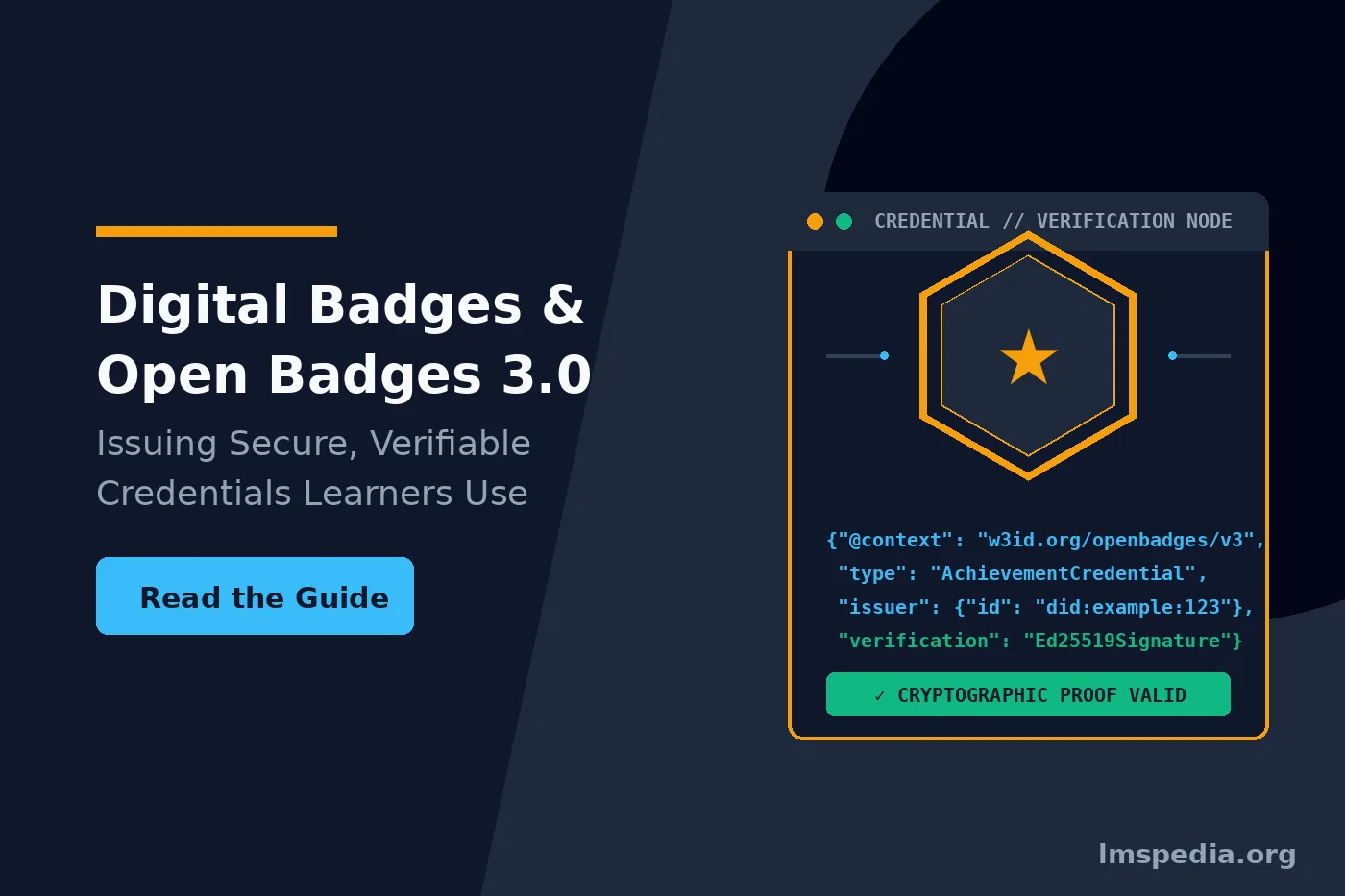
Security is the foundation of open badges 3.0. The framework uses public key cryptography to sign every issued credential digitally. When an LMS issues a badge, it applies a private cryptographic key to generate a unique digital signature. This signature embeds directly into the badge data.
If anyone attempts to alter the employee name, the issue date, or the skill level, the digital signature becomes invalid instantly. Any verifying software will immediately flag the modified file as fraudulent. Therefore, employers can verify achievements instantly without making manual confirmation phone calls.
Managing Credential Revocation Natively
Regulated industries require the ability to revoke credentials when safety rules are violated or certifications expire. Fortunately, the standard includes native revocation lists. These lists allow issuers to publish status updates securely.
When an auditor verifies a badge, the software automatically checks the issuer’s revocation registry. If a certification has expired, the verifier sees that status immediately. This feature is especially valuable for physical work environments. To learn more about tracking on-site worker safety, read our guide on contractor orientation and site induction software.
Check Platform Compatibility
Before selecting a badge vendor, verify that their software explicitly supports the W3C Verifiable Credentials format. Using outdated badge tools limits data portability and creates technical debt for your organization.
The Power of Embedded Badge Metadata
A digital badge is much more than an attractive image. In fact, the true business value lies within the embedded badge metadata. This structured data travels with the credential file permanently, providing complete context for every achievement.
Defining Strict Achievement Criteria
Compliant metadata includes detailed descriptions of the skills required to earn the credential. It lists the issuing organization, the exact date of completion, and the assessment standards used to measure success. Furthermore, it can include direct links to work samples, portfolios, or test scores.
To ensure your badge criteria are rigorous, design your training using clear cognitive goals. You can structure your learning goals effectively by reviewing our reference guide on blooms taxonomy training verbs. Clear objectives make your badges far more credible to external reviewers.
Mapping to Corporate Skills Taxonomies
Modern metadata allows you to connect credentials directly to industry skill frameworks. For example, you can map badges to standardized frameworks like O*NET or internal competency models. When an employee earns a badge, HR talent systems read the metadata automatically.
As a result, talent teams can quickly identify internal candidates for open positions based on verified badges. This automation reduces recruitment costs and supports targeted internal mobility programs across the enterprise.
Deploying Micro Credential Badges at Scale
Many organizations use micro credential badges to recognize incremental learning milestones. Traditionally, employees had to complete months of coursework before earning any formal recognition. This delayed feedback often reduced learner engagement over time.
In contrast, micro credentials break larger programs into bite-sized learning achievements. For example, a project management program can award separate badges for risk management, budget planning, and agile scheduling. Learners earn recognition as they progress through each unit.
Creating Stackable Learning Pathways
These smaller achievements naturally combine into larger credentials over time. When an employee collects all the required sub-badges, the system awards a comprehensive master credential automatically. This stackable structure keeps motivation high while providing granular skills visibility for managers.
Require Measurable Evidence
Do not award badges for simple course attendance. Require learners to pass a knowledge quiz, complete a simulation, or submit a project before issuing a verifiable credential.
Mastering Digital Badge Issuing Automation
Scalable corporate programs require automated digital badge issuing workflows. Manual badge generation is inefficient and introduces data entry mistakes. Connecting your LMS to a dedicated credentialing engine ensures fast, accurate delivery.
The Automated Delivery Workflow
First, an employee completes all required course activities in the LMS. Next, the LMS sends a completion webhook to the credentialing platform. Then, the credentialing platform builds the JSON data payload, signs it with a cryptographic key, and bakes the data into the badge image.
Finally, the platform delivers the verifiable badge to the learner via email or directly into their digital wallet. The entire process takes seconds and requires no manual administrative work. The table below highlights key differences between legacy certificates and modern verifiable badges.
| Feature Comparison | Static PDF Certificates | Open Badges 3.0 Standard |
|---|---|---|
| Verification Method | Manual checks via email or phone calls. | Instant cryptographic verification online. |
| Data Portability | Limited to static files or printouts. | Fully portable across digital wallets. |
| Embedded Metadata | Basic text printed visually on the page. | Machine readable JSON with skill mappings. |
| Tamper Resistance | Easily edited with graphic tools. | Tamper proof digital signatures. |
| Revocation Support | Difficult to track or cancel after delivery. | Real time status checks via revocation lists. |
Ensuring Audit Readiness with Open Badges 3.0
Organizations operating in regulated sectors must maintain meticulous compliance records. Traditional paper certificates often get misplaced during audit preparations, creating compliance vulnerabilities. Implementing open badges 3.0 simplifies regulatory compliance significantly.
Because every badge contains timestamped metadata and cryptographic verification, compliance teams can generate audit reports in seconds. Inspectors can verify employee qualifications instantly by scanning badge records. Consequently, organizations reduce audit prep time while maintaining complete confidence in their compliance standing.
Conclusion
The transition to open badges 3.0 marks a major advancement in how organizations recognize professional skills. By implementing this modern standard, learning leaders eliminate credential fraud, streamline verification, and empower employees with portable digital records. Rich metadata provides deep visibility into organizational capabilities, while automated workflows reduce administrative overhead. Transition away from unverified static certificates today. Embrace verifiable credentials to build a transparent, secure, and modern corporate learning culture.
FAQ
Q1. What is Open Badges 3.0?
It is the latest international standard for verifiable digital credentials, maintained by the 1EdTech Consortium. It aligns fully with the W3C Verifiable Credentials Data Model, allowing institutions to issue highly secure, tamper-proof digital records that learners can store directly in personal digital wallets.
Q2. How do verifiable credentials prevent forgery?
Modern digital badges use advanced cryptographic signatures embedded directly within the badge’s metadata. If any information within the badge is altered, the digital signature breaks, immediately proving to any verifying system that the credential is fraudulent.
Q3. What kind of metadata is stored inside a digital badge?
A compliant badge contains rich JSON data that explicitly details the issuer’s identity, the specific criteria required to earn the badge, the exact date of issuance, and direct links to any supporting evidence of the learner’s achievement natively.
Q4. Do learners need to rely on the issuing LMS forever?
No. Because the modern standard utilizes Decentralized Identifiers (DIDs) and embeds the cryptographic proof within the file itself, learners control their credentials entirely. They do not need to rely on the original platform to host their verification data publicly.
Q5. What are micro credentials in corporate training?
Micro credentials are stackable, granular achievements issued for mastering specific, targeted skills rather than completing massive, long-term programs. They provide immediate recognition for learners and offer employers highly detailed data regarding an employee’s exact capabilities.
Q6. What Is Open Badges 3.0?
This short video provides a quick, visual breakdown of how the modern credential standard functions to secure and standardize digital achievements globally.