Blooms Taxonomy Training: Action Verbs and Cognitive Levels
Corporate learning frequently fails today. Specifically, instructional designers misalign their educational goals with testing methods entirely. A business might want sales teams to negotiate enterprise contracts effectively. However, the training department builds a simple quiz to test this skill. Consequently, this massive disconnect wastes corporate resources completely. Therefore, learning professionals must utilize strict blooms taxonomy training principles. This psychological framework helps developers map how humans process information natively. Furthermore, applying it guarantees highly measurable workplace outcomes. Next, we will explore this exact framework deeply. Ultimately, mastering these tactical tiers transforms your digital curriculum forever.
Key Takeaways

Eliminate Vague Verbs:
Stop using unmeasurable words like understand or know in your corporate course designs immediately.
Target Appropriate Levels:
Match your educational goals to the correct cognitive tier perfectly to avoid overtraining or undertraining your staff.
Align Your Assessments:
Ensure your final quiz questions match the exact cognitive level specified in your initial learning objective.
Utilize Action Verbs:
Select highly specific action verbs to describe exactly what the learner will physically or cognitively perform on the job.
Structure Development Seamlessly:
Use this framework as the foundational blueprint for all your internal corporate curriculum development projects.
The Importance of Cognitive Frameworks in Business
Historically, corporate training relied entirely on rote memorization. Instructors forced employees to memorize massive product manuals blindly. However, modern corporate environments demand deep critical thinking. Consequently, educational psychologists updated the original framework significantly. Specifically, researchers at the American Psychological Association study these cognitive shifts extensively. Therefore, this update created a highly functional behavioral hierarchy. Furthermore, modern learning management systems can track these exact actions. Ultimately, writing cognitive levels learning objectives dictates your exact educational strategy.
Defining the exact cognitive level eliminates massive training waste instantly. First, a frontline retail cashier does not need to synthesize macroeconomic trends. Instead, they simply need to apply point-of-sale procedures flawlessly. Therefore, applying the correct tier prevents overcomplicating simple tasks. Additionally, it prevents undertraining senior executives who require complex analytical skills. Crucially, aligning the tier directly to the job role ensures total relevance. Furthermore, integrating this logic while designing a skills taxonomy maximizes your organizational impact.
Understanding the Six Levels of Mastery
Level 1: Remembering and Level 2: Understanding
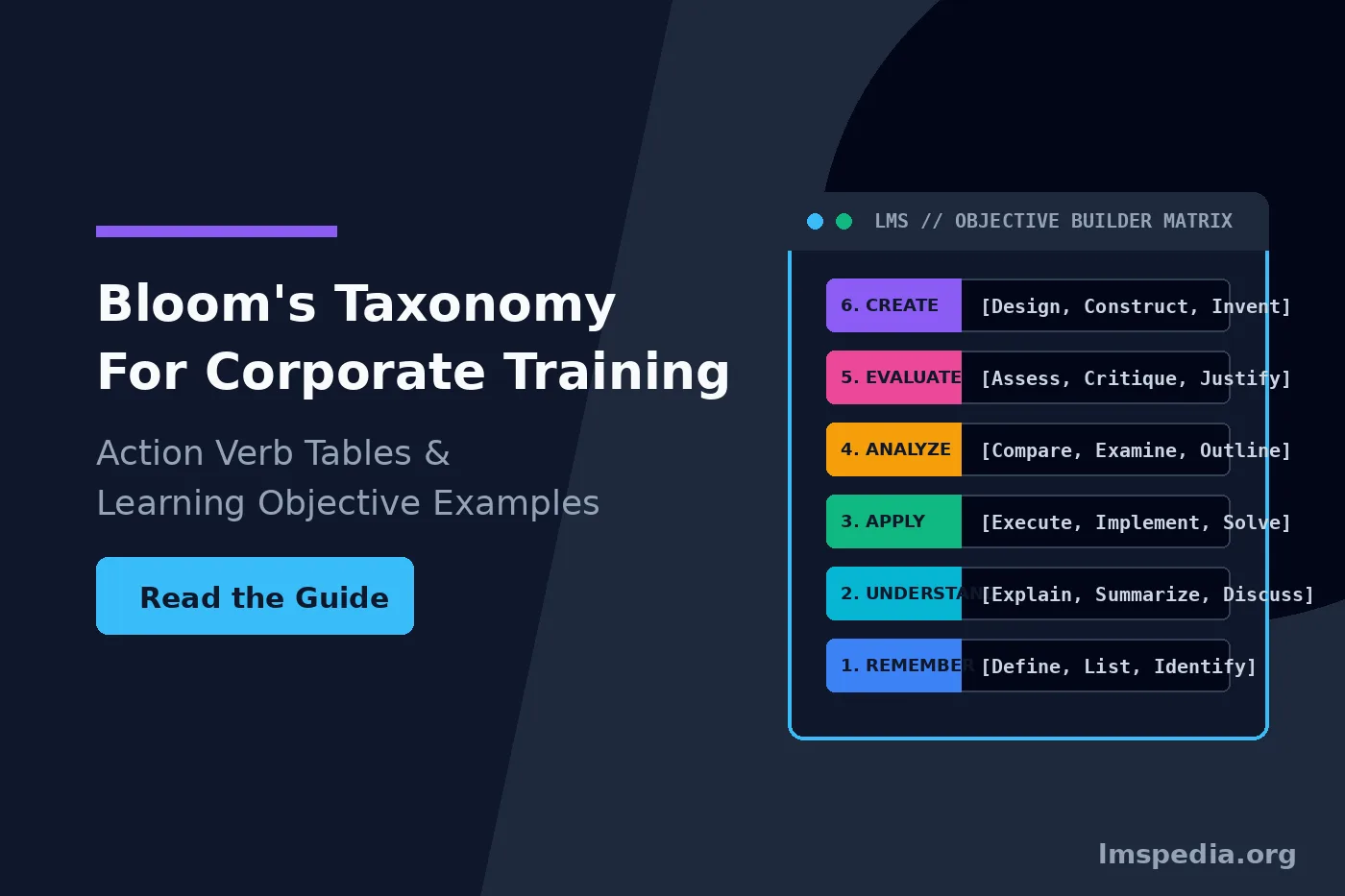
The modern framework organizes human learning into six distinct tiers. First, the remembering stage represents the absolute baseline. Learners simply retrieve factual knowledge directly from their long-term memory. Specifically, they state facts accurately without needing deeper context. Therefore, this tier applies heavily to compliance policies and acronyms. Next, the understanding level requires learners to explain concepts entirely. Consequently, they translate raw data into coherent, personal ideas. For instance, employees must understand why safety penalties exist natively. Ultimately, understanding bridges the gap between memory and physical action.
Level 3: Applying and Level 4: Analyzing
The applying tier represents the most critical workplace transition. Specifically, learners take theoretical knowledge and use it practically. Therefore, classroom theory finally meets actual job performance. If a software engineer understands coding but cannot fix a database, the training fails. Furthermore, analyzing requires learners to break complex information apart entirely. Next, they examine relationships to understand overarching organizational structures. Consequently, this tier proves vital for management and technical troubleshooting. Ultimately, analyzing reveals the precise root cause of systemic failures.
Level 5: Evaluating and Level 6: Creating
At the evaluating level, learners make highly complex judgments constantly. Specifically, they use strict criteria to defend strategic business decisions. Therefore, senior leaders operate almost entirely at this specific cognitive tier. Furthermore, creating represents the highest tier of the psychological taxonomy. Learners reorganize elements into completely new patterns or structures. Consequently, they generate brand-new solutions to unprecedented market problems. Ultimately, creating drives corporate innovation and captures emerging market segments natively.
Ban the Word Understand
You must officially ban the word understand from your corporate training vocabulary entirely. You cannot physically see a learner understand something. Therefore, force your instructional designers to use strict observable verbs natively.
The Revised Blooms Taxonomy Verbs Table
Writing highly effective objectives requires specific action words. Specifically, vague verbs destroy instructional design instantly. If you use the word learn, you cannot measure it objectively. Instead, you must use revised blooms taxonomy verbs exclusively. Furthermore, industry groups like the Association for Talent Development mandate measurable performance outcomes globally. Therefore, select verbs that indicate visible, verifiable human behaviors. Next, use the comprehensive table below to select your perfect verb. Consequently, mastering writing measurable learning objectives makes your training fully auditable.
| Cognitive Level | Highly Recommended Action Verbs | Forbidden Vague Verbs |
|---|---|---|
| Remembering | Define, List, State, Identify, Name, Recognize, Locate. | Know, Learn, Be aware of. |
| Understanding | Explain, Summarize, Paraphrase, Describe, Classify, Discuss. | Understand, Appreciate, Grasp. |
| Applying | Demonstrate, Calculate, Execute, Implement, Operate, Solve. | Familiarize, Explore, Experience. |
| Analyzing | Compare, Contrast, Differentiate, Investigate, Examine, Outline. | Think about, Look into, Review. |
| Evaluating | Assess, Critique, Defend, Judge, Justify, Recommend, Value. | Believe, Feel, Consider. |
| Creating | Design, Construct, Formulate, Propose, Invent, Author, Plan. | Make, Do, Try. |
Real World Blooms Taxonomy Examples Corporate
Theoretical tables only provide foundational value initially. Specifically, you must examine realistic blooms taxonomy examples corporate developers use daily. Therefore, we will break down a single cybersecurity topic completely. First, at the remembering level, employees define Personally Identifiable Information accurately. Next, at the understanding level, they summarize the financial risks of data breaches. Furthermore, applying requires them to execute two-factor authentication flawlessly. Consequently, the cognitive difficulty scales deliberately with every single instructional step.
Moving higher, analyzing requires employees to differentiate legitimate emails from phishing. Specifically, the evaluating level asks managers to assess firewall configurations rigorously. Finally, creating requires the Chief Information Security Officer to design new disaster recovery protocols. Therefore, you must target the precise level required for each job role. Crucially, testing a security officer on basic definitions wastes valuable corporate time. Furthermore, reaching the highest cognitive levels enables you to implement Kirkpatrick Level 3 and 4 evaluation practices effectively.
Selecting Action Verbs Learning Objectives
Selecting your specific action verbs learning objectives dictates your assessment format immediately. First, this concept is called instructional alignment universally. Specifically, academic bodies like Vanderbilt University emphasize this structural alignment heavily. If your objective states the learner will define a term, a simple quiz works perfectly. Therefore, mastering writing multiple choice questions supports lower-level cognitive testing well. However, if they must demonstrate a physical procedure, a quiz fails completely. Consequently, your verb choice restricts your testing options rigidly.
You absolutely cannot test a physical demonstration with a digital click. Specifically, you must build interactive simulations or require live video evaluations. Therefore, utilizing scenario-based assessment design becomes mandatory for higher cognitive tiers. Furthermore, mismatched assessments frustrate learners and invalidate your compliance data entirely. Next, evaluating your authoring software ensures you can build these complex interactions efficiently. Ultimately, structural alignment guarantees a massive return on your corporate training investments.
Authoring Tool Comparison for Cognitive Assessment
Developing varying assessment types requires flexible software platforms natively. First, basic systems handle rote memorization quizzes easily. However, evaluating complex analytical skills demands advanced branching simulation capabilities. Therefore, selecting the correct authoring tool impacts your instructional alignment directly. Next, we compare three platforms tailored for corporate curriculum development. Consequently, you can select the tool that supports your specific cognitive targets perfectly.
| Platform | Assessment Capabilities | Cognitive Level Focus | Primary Target Audience |
|---|---|---|---|
| SimpliTrain | Native scenario building and video evaluation | Applying through Creating (Levels 3 to 6) | Enterprise L&D scaling complex skills |
| Articulate 360 | Variable quiz types and branching logic | Understanding through Analyzing (Levels 2 to 4) | Traditional instructional design teams |
| Adobe Captivate | Heavy software simulation and VR | Applying and Evaluating (Levels 3 and 5) | Technical software training departments |
Write from the Learner's Perspective
Always write your learning objectives starting with the phrase: Upon successful completion of this module, the learner will be able to. Next, add your specific action verb natively. Finally, add the specific context completely.
Conclusion
Mastering strict blooms taxonomy training principles elevates your corporate curriculum significantly. Specifically, you transition from basic information delivery to advanced performance engineering. By selecting exact revised blooms taxonomy verbs, your educational goals remain completely measurable. Furthermore, utilizing cognitive levels learning objectives prevents you from overcomplicating simple tasks. Therefore, your digital training pathways align perfectly with daily operational reality. Consequently, you stop wasting payroll hours on ineffective memorization exercises natively.
You must apply these blooms taxonomy examples corporate formulas directly to your internal processes today. First, evaluate your existing modules for vague verbs and remove them instantly. Next, ensure your assessments match your action verbs learning objectives exactly. Furthermore, train your instructional designers to respect this psychological hierarchy strictly. Ultimately, aligning your teaching methods with human cognitive processing guarantees a smarter, highly capable workforce.
FAQ
What is Bloom’s Taxonomy in corporate training?
It is a highly structured psychological framework used to classify educational goals into specific levels of complexity. In corporate training, instructional designers use it to ensure that learning materials target the exact cognitive skills required for specific job roles, moving from basic memorization to advanced problem solving.
Why are action verbs so important for learning objectives?
Action verbs are critical because they dictate observable and measurable behaviors. Vague words like “understand” cannot be accurately tested. By using specific verbs like “calculate,” “define,” or “construct,” training managers can explicitly prove whether an employee has achieved the required level of mastery.
How many levels exist in the revised taxonomy?
The revised taxonomy features exactly six distinct cognitive levels. Ranked from lowest to highest complexity, they are: Remembering, Understanding, Applying, Analyzing, Evaluating, and Creating. Learners must generally master the lower levels before progressing to the higher, more complex tiers.
Can I test an ‘Applying’ objective with a multiple-choice quiz?
Generally, no. If your objective requires an employee to “apply” a skill or “demonstrate” a procedure, a simple multiple-choice quiz is inadequate. You must utilize practical evaluations, software simulations, or live observations to truly measure that specific level of cognitive mastery perfectly.