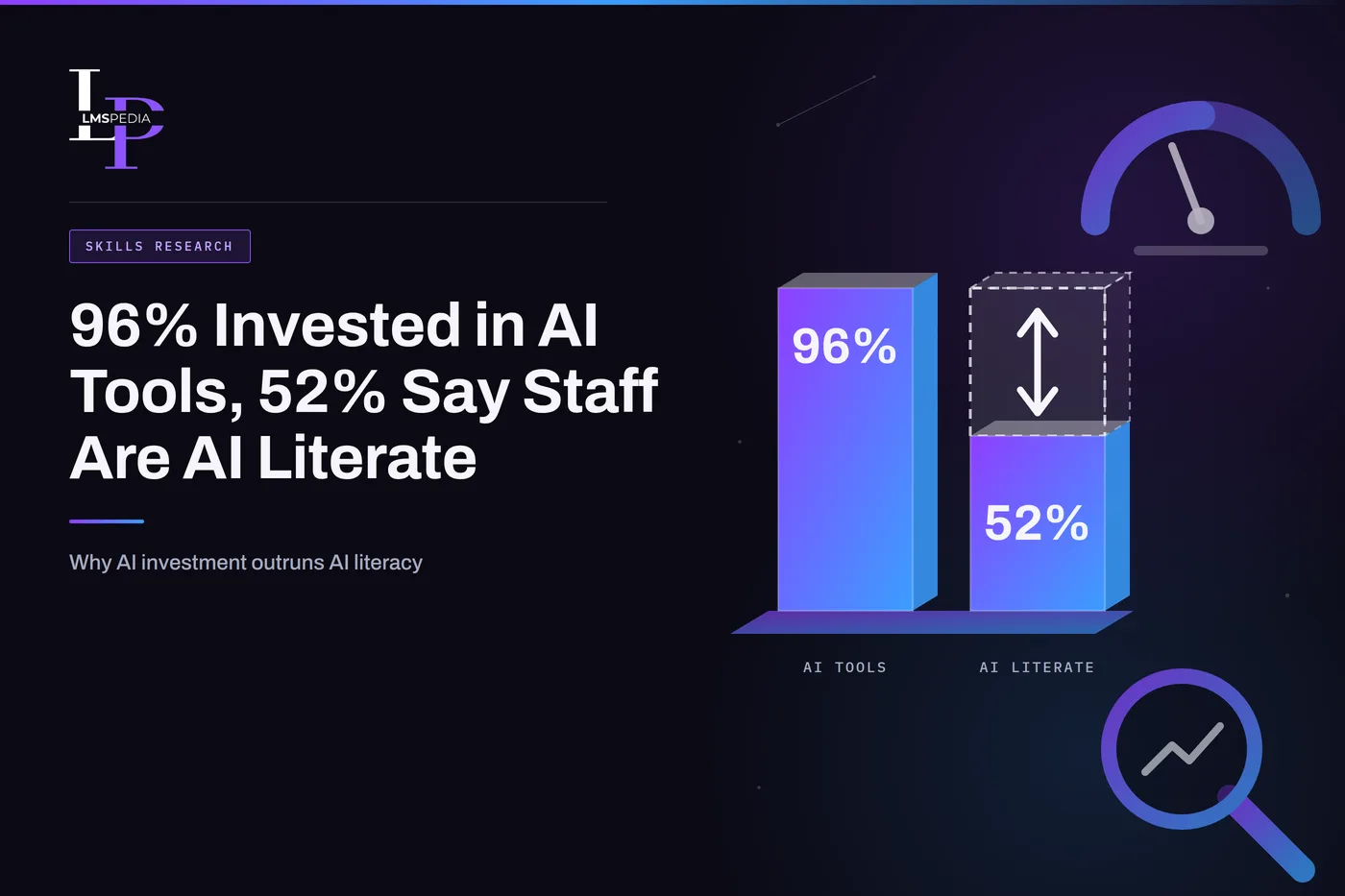
Pluralsight’s 2026 Tech Skills Report, announced on September 30, 2026, puts a price on the AI skills gap. According to Pluralsight’s press release, 61% of tech executives put the cost of skills gaps at $250,000 or more for their organization last year. It also says 96% of organizations have put money into AI tools, yet only 52% say most or all employees are AI literate.
These numbers are useful in a budget meeting, but they come from a vendor-run survey. Pluralsight sells tech skills training, and several headline figures are broader or softer than the summaries suggest.
This post separates what the data shows from what it does not. It then gives you a vendor-neutral way to measure AI literacy and a one-page memo structure for your finance team.
What did Pluralsight’s 2026 Tech Skills Report find?
Pluralsight reports near-universal AI tool investment (96%) but only 52% of organizations saying most or all staff are AI literate. It also reports that 69% dropped a project over missing tech skills, 84% saw skills-related budget overruns, and 77% of tech executives saw trained staff fail to apply their skills. All figures are as of October 2026.
The table below lists each headline figure with the group it covers, so you can quote it accurately.
| Figure (2026) | Who or what it covers | How to read it |
|---|---|---|
| 96% invested in AI tools | Organizations, for at least some employees | A low bar. A single pilot team counts. |
| 52% AI literate | Organizations saying most or all employees are literate | A perception. The report gives no definition of the term. |
| 69% abandoned a project | Organizations, last 12 months, due to missing tech skills | Any project, not only AI. The prior-year survey said 47%. |
| 61% lost $250,000 or more | Tech executives, last 12 months | An executive estimate. Average of $400,000 among those affected. |
| 84% budget overruns | Organizations | “At least some of the time,” so the frequency is unknown. |
| 77% trained but not applying | Tech executives | An observation by leaders, not a measured performance rate. |
| 29% tie ROI to outcomes | Organizations, for upskilling | The measurement gap that matters most for L&D. |
How was the Pluralsight survey run, and can you trust it?
Pluralsight published the research, and its report names Wakefield Research as the survey vendor. The sample was 1,500 tech executives, technologists and L&D leaders in the US, UK and Australia, surveyed from June 30 to July 20, 2026. Treat it as credible directional data from an interested party.
The margin of error is 4.0 percentage points for executives and practitioners and 5.7 for L&D leaders, according to Pluralsight’s Tech Skills Report 2026. The report is gated, and the public pages reviewed for this article did not show the sample size for each audience.
A company that sells skills training gains when skills gaps look expensive. That does not make the figures wrong. It does mean you should name Pluralsight as the source, check the wording behind each number, and pair it with your own data.
Does the 69% abandoned-project figure mean AI projects failed?
No. The figure covers projects dropped over the last 12 months due to missing tech skills, not AI projects specifically. Pluralsight says it rose from 47% in the prior-year survey. Its report adds that abandonment hits cloud, cybersecurity and AI/ML projects hardest.
Some summaries compress this into an AI project failure rate. Do not repeat that in a budget memo. A finance reader who checks the source will discount everything else you say.
The jump from 47% to 69% is also a comparison of two surveys. The public pages do not confirm that the questions and samples matched, so call it “higher than last year’s survey” rather than proof of a trend.
How much does the AI skills gap cost organizations?
Pluralsight reports that 61% of tech executives estimate skills gaps cost their organization at least $250,000 over the last year, averaging $400,000 among those affected. It also reports that 84% of organizations see skills-related budget overruns at least some of the time. These are executive estimates, not audited losses.
Sources word the average differently. The press release says $400,000 among affected organizations, while the report page says the global average cost exceeds $400,000. Trust the press release, because it states who the average covers.
The cost is also not AI-only. Use the figure as a prompt for your own audit, not as a forecast for your company. To build your own number, count these over the last 12 months:
- Projects abandoned or paused because staff lacked a needed skill.
- Projects that ran over budget for the same reason, and by how much.
- Launches delayed while you waited for people to learn a tool.
- Rework caused by output nobody on the team could evaluate.
Ask finance to price these. A cost that finance calculated carries more weight than any vendor average.
What does “52% AI literate” actually measure?
It measures what organizations believe. Pluralsight reports that 52% say most or all employees are AI literate, and the report does not define the term. In the same research, concern is high that skill measurement can be easily manipulated: 90% of executives, 84% of L&D leaders, 88% of practitioners.
Read that together: respondents rated their own workforce while doubting how skills are measured. The 52% is a perception, not a proficiency rate.
The report also lists how organizations measure skills today: training participation (57%), project and delivery outcomes (53%) and certifications (52%). Participation is the most common of the three and the weakest evidence of capability.
One more figure helps: 28% of organizations have invested more in AI tools than in AI literacy. That is a better spending signal than the 96%, which counts any organization with AI tools for even some employees.
Why do employees finish AI training and still fail to apply it?
Pluralsight reports that 77% of tech executives have watched employees finish training or gain certifications yet struggle to use the skills. That points to a measurement failure before a motivation problem. A completion record proves attendance. It does not show that a person can do the task at work.
The Kirkpatrick Model explains the gap. Level 2 checks whether people acquired the knowledge and skills. Level 3 checks whether they perform the critical behaviors at work and are supported and accountable for doing so. Completion data and quiz scores rarely get past Level 2.
The public Pluralsight material reports the gap but does not explain its causes. These are hypotheses you can test in your own data: no practice on real tasks, no manager follow-up, and tool access that arrives after the course.
Test The Task, Not The Course
Pick one real task, such as summarizing a customer call, and have five people who finished training do it live while their manager watches. The pass rate becomes your first honest baseline.
How should you measure AI literacy instead of completions?
Collect evidence at all four Kirkpatrick levels and require at least one artifact above completion. A scenario assessment shows learning, a manager-observed task shows behavior, and a workflow metric shows results. The table shows what to collect and what each level cannot prove.
| Level | Question to answer | AI literacy evidence | What it cannot show |
|---|---|---|---|
| 1. Reaction | Was it relevant to my job? | Short relevance rating, split by role | That anyone can do the task |
| 2. Learning | Can I do it in a realistic scenario? | Scenario assessment with a rubric for judging AI output | That I do it at work |
| 3. Behavior | Do I do it on the job? | Manager observation checklist, sampled work products, competency sign-off | That the business benefits |
| 4. Results | Did a target outcome move? | Cycle time, error rate or rework on chosen workflows | Why it moved, without a comparison group |
Scenario assessment has some research support. A 2025 study tested in a US Navy robotics training program found that scenario-based multiple-choice tasks that mimic real work beat conventional tests at measuring applied AI literacy. That is one program, so treat it as a direction, not a rule. Our guide to scenario-based assessment design covers how to build them.
Certifications fit at Level 2. Given the 77% figure, a credential such as the one in our AWS Certified AI Business Strategist guide should be followed by an observed task before you count someone as capable.
How do you turn the Pluralsight numbers into a one-page CFO memo?
Open with one decision and one ask, add three attributed external facts, then your own data and a measurement plan. Label Pluralsight’s figures as vendor survey results. A CFO should see on one page what you want, what it costs and how you will prove it worked.
Use this structure:
- The ask: the amount, the period and the workflows covered.
- External context: two or three Pluralsight figures, such as 61% reporting $250,000 or more in costs and 29% tying ROI to outcomes, with the date and sample.
- Your evidence: projects abandoned, delayed or reworked for skills reasons, priced by finance.
- The measurement plan: baseline, Level 2 and 3 evidence, one Level 4 metric and a review date.
- The stop rule: the result that would make you cut or change the program.
Calculate the return with our training ROI formula. To show whether your ask is typical, compare it with corporate training budget benchmarks for 2026.
What is the minimum viable way to tie AI upskilling to business outcomes?
Pick two or three workflows, measure them before training, and measure again after. Pluralsight reports that only 29% of organizations tie upskilling ROI to business outcomes, so even a small before-and-after comparison puts you ahead of most. Keep it to one metric per workflow.
Follow these steps:
- Choose workflows where AI use is expected and the output can be counted, such as handling time or review cycles.
- Record a four-week baseline before any training starts.
- Train with scenario assessment built in, and sign off competence after an observed task.
- Re-measure the same metric over the next four weeks.
- Compare against a team that has not been trained yet.
Pick metrics from this list of learning and development KPIs rather than inventing new ones. Metrics your finance team already tracks are easier to defend.
Stagger Your Rollout
Train one team a month before the next. The untrained team becomes your comparison group, which is the cheapest way to separate the effect of the training from the effect of the tool.
How does Pluralsight’s survey compare with other 2026 research?
Docebo’s report, released April 7, 2026, shows a similar pattern from a different angle: 85% of employees say the training they get is not helping them use AI in their jobs. Both come from learning vendors with different samples, so treat them as two signals, not one confirmed rate.
Docebo’s AI Readiness Gap release describes 2,000 respondents across the US, UK, Canada, France, Germany and Italy. Half were employees at VP level or below outside HR and L&D, and half were learning leaders. The research was run by Centiment.
The difference matters. Pluralsight asked tech executives, technologists and L&D leaders. Docebo asked employees as well, which is closer to the learner’s own experience. Neither is a test of measured proficiency, and both sell into the same buyers.
Does the Pluralsight data apply outside tech roles?
Only loosely. The survey sampled tech executives, technologists and L&D leaders in the US, UK and Australia, and most questions concern tech skills. The measurement lesson transfers to any role. The dollar figures do not, so use your own data for sales, operations or frontline teams.
If you run AI training for non-technical staff, define AI literacy per role before you measure it. Write three observable tasks for each role, such as drafting a customer reply and checking it for errors. Then assess those tasks, not general knowledge.
What should you do next?
This week, pull last year’s list of delayed, paused or abandoned projects and ask a finance partner to price the ones that involved a skills shortfall. That one list gives you a number you own, which is stronger than any vendor average.
Then book 45 minutes with five managers and agree what “AI literate” means for one role, written as three tasks you could watch someone do. Those tasks become your Level 2 scenarios and your Level 3 checklist.
If the list is short, say so in your memo. A small, well-measured gap is a better budget argument than a large one you cannot defend.
FAQ
Q1. Is Pluralsight's 2026 AI skills gap survey independent research?
No. Pluralsight published the Tech Skills Report, and the report names Wakefield Research as the survey vendor. Pluralsight sells tech skills training, so it has a commercial interest in the topic. The figures are still useful, but attribute them to Pluralsight and pair them with your own internal data before using them in a budget case.
Q2. How many people did Pluralsight survey for the 2026 Tech Skills Report?
Pluralsight surveyed 1,500 tech executives, technologists and L&D leaders in the US, UK and Australia between June 30 and July 20, 2026. The report lists a margin of error of 4.0 percentage points for executives and practitioners and 5.7 for L&D leaders. The report is gated, so check it for audience-level sample sizes.
Q3. Does the 69% abandoned-project figure mean AI projects fail?
No. Pluralsight reports that 69% of organizations dropped a project over the last year due to missing tech skills, up from 47% in its prior-year survey. The figure covers any project, not only AI. The report adds that cloud, cybersecurity and AI/ML projects suffer most, so avoid quoting it as an AI failure rate.
Q4. How much does the AI skills gap cost companies?
Pluralsight reports that 61% of tech executives estimate skills gaps cost their organization at least $250,000 over the last year, averaging $400,000 among those affected. These are executive estimates covering tech skills in general, not audited AI losses. To build a defensible number, have finance price your own abandoned, delayed and over-budget projects.
Q5. How do you measure AI literacy in employees?
Define AI literacy per role as a few observable tasks, then collect evidence at each Kirkpatrick level. Use a scenario assessment for learning, a manager-observed task or competency sign-off for behavior, and a workflow metric for results. Completion records and self-ratings alone show attendance and confidence, not whether someone can do the work.
Q6. Why do employees finish AI training but still not use the skills?
Pluralsight reports that 77% of tech executives have watched this happen, but its public material does not explain the causes. Plausible, testable reasons include no practice on real tasks, no manager follow-up and tools arriving after the course. Measuring behavior on the job, not completion, shows which of these applies in your organization.