Mastering the skill of writing learning objectives remains absolutely essential for any modern corporate training professional. Instructional designers frequently struggle to prove the actual return on investment for their digital courses. Typically, this struggle originates from poorly defined instructional goals. When a developer builds a course without a highly specific target, the resulting training becomes a random collection of disconnected facts.
Consequently, employees waste highly valuable production hours consuming irrelevant content. To prevent this massive operational waste, organizations must implement strict instructional frameworks natively. By mastering these foundational frameworks, you guarantee that your training programs actually change employee behavior on the job. To understand exactly where this skill fits into the broader curriculum development cycle, you must review our foundational guide. Explore the core instructional design steps for corporate training today.
The process of writing learning objectives requires methodical precision rather than creative guessing. First, you must transition from writing vague corporate aspirations to engineering highly precise, mathematically measurable performance targets. When your objectives lack precision, your learning management system cannot track employee mastery accurately. For instance, vague goals often lead to severe tracking failures natively.
To understand how poor design affects your technical reporting, read our diagnostic checklist regarding scorm completion issues immediately. Furthermore, selecting the exact correct verb represents the most critical step in this entire design process. Therefore, you must align your specific vocabulary with proven psychological models flawlessly. Review our comprehensive guide detailing blooms taxonomy training verbs to secure this foundational knowledge completely. Additionally, if you are upgrading your enterprise software to track these new objectives, analyze our managed moodle comparison to find the perfect compliance engine.
Key Takeaways

Define Observable Behaviors:
Ensure every single objective focuses on a physical or cognitive action that an instructor can actively observe and accurately measure.
Utilize the ABCD Model:
Structure your goals using the strict Audience, Behavior, Condition, and Degree framework to eliminate all instructional ambiguity completely.
Clarify Outcome Definitions:
Understand the exact difference between a learning outcome vs objective to align your overarching corporate goals with granular daily tasks perfectly.
Adopt Mager Objectives:
Leverage Robert Mager’s three-part performance formula to build highly specific criteria for corporate compliance and technical assessments.
Eliminate Vague Verbs:
Stop using unmeasurable verbs like understand, know, or appreciate to guarantee your final assessments align perfectly with your instructional materials.
Analyzing Learning Outcome vs Objective
Before exploring specific structural formulas, you must resolve a massive terminology conflict that plagues the corporate training industry. Novice designers frequently use the terms outcome and objective interchangeably. However, this represents a severe methodological error. Understanding the strict difference between a learning outcome vs objective ensures your curriculum architecture remains perfectly aligned from top to bottom.
Defining the Overarching Outcome
A learning outcome represents the broad, overarching destination of the entire training program. Specifically, it describes the massive shift in capability that the learner will possess after completely finishing a multi-week curriculum. For example, an outcome might state that the sales team will confidently negotiate complex enterprise software contracts. Outcomes focus heavily on the final, real-world application of the combined skills. Ultimately, they provide the strategic vision for the corporate stakeholders.
Defining the Granular Objective
Conversely, a learning objective represents the highly granular, step-by-step milestone required to reach that final outcome. Objectives focus entirely on isolated, specific behaviors observed within a single training module. For example, a supporting objective might state that the sales representative will accurately calculate a software discount margin within five minutes using the internal pricing calculator. Thus, you must master writing learning objectives to build the actual stepping stones that lead directly to your ultimate corporate outcome.
The Core of Mager Objectives
In the early 1960s, educational psychologist Robert Mager revolutionized how professionals design instructional content. He proposed that an objective must communicate intent so clearly that another competent instructor could read it and instantly build a perfect assessment. Consequently, mager objectives rely on a strict three-part formula. This specific formula eliminates all subjective interpretation entirely.
Component One: The Performance
The first component of mager objectives dictates that you must explicitly state what the learner will physically or cognitively do. You must use an observable action verb. Therefore, you absolutely cannot use the word “understand” when writing learning objectives. You cannot physically see a learner understand a concept. However, you can actively watch them list, define, assemble, or calculate something. This performance must remain entirely observable and completely measurable by an external auditor.
Component Two: The Condition
The second component establishes the exact environment or the specific tools provided to the learner during the final assessment. Will the learner have access to a reference manual? Must they perform the task from memory? Will they use a specific software program? By defining the condition perfectly, you ensure that the assessment environment perfectly mimics the actual job environment. Consequently, this strict alignment prevents false positive testing results natively.
Component Three: The Criterion
The final component defines the exact standard of acceptable performance. How well must the learner perform the specific task to pass? For instance, you might specify a time limit, a required degree of accuracy, or a specific quality standard. In highly dangerous industrial environments, the criterion is almost always one hundred percent accuracy. Without a strict criterion, the instructor possesses no mathematical baseline to evaluate the learner fairly.
Mager Formula in Action
A perfect Mager objective looks exactly like this: Given a standard schematic diagram (Condition), the technician will successfully solder the circuit board (Performance) with zero functional defects within fifteen minutes (Criterion). This formula guarantees absolute instructional clarity.
Structuring ABCD Model Objectives
While the Mager method provides an exceptional foundation, modern instructional designers frequently prefer a slightly expanded framework. The ABCD model builds directly upon Mager’s principles but adds a specific focus on the target learner. By using abcd model objectives, you ensure that your curriculum developers never lose sight of their primary audience.
Breaking Down the ABCD Acronym
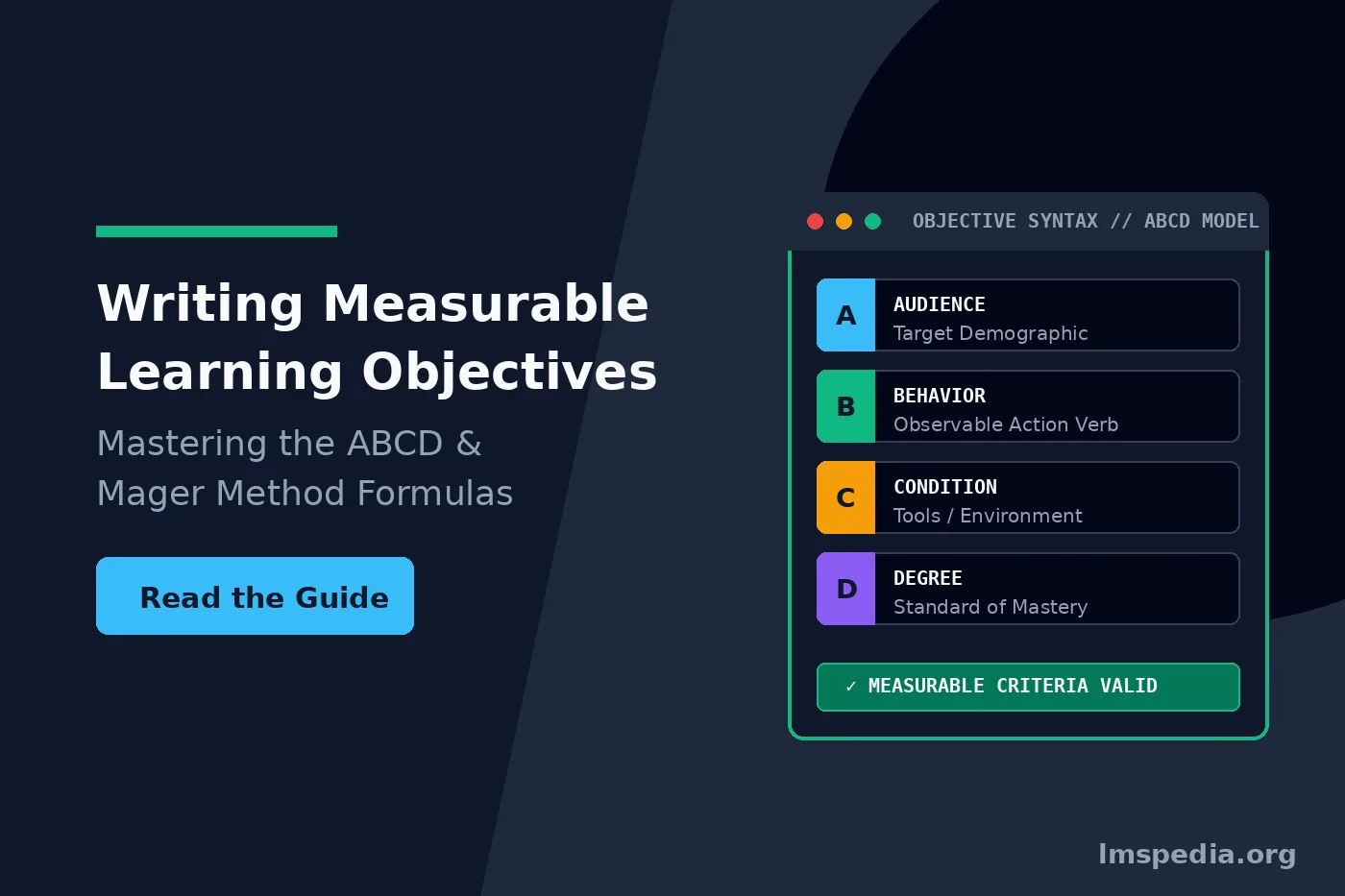
The ABCD methodology forces the instructional designer to answer four highly specific questions before drafting a single slide. Writing learning objectives utilizing this explicit framework creates an undeniable blueprint for your entire digital module.
- Audience: Exactly who is performing the specific behavior? First, you must identify the target demographic clearly.
- Behavior: What specific, observable action will the target audience perform? Second, you must use a measurable action verb natively.
- Condition: Under what specific constraints or circumstances will the audience perform this exact behavior?
- Degree: Finally, how well must the audience perform the specific behavior to achieve absolute mastery?
The Importance of the Audience Component
Many novice developers assume the audience is always just “the learner.” However, highly specialized corporate training requires much more specificity. Specifying that the audience is “newly hired warehouse supervisors” immediately changes how you design the content compared to “senior corporate executives.” As a result, this specific demographic focus prevents developers from building generic, highly ineffective training modules.
| Component | Definition | Corporate Example Phrase |
|---|---|---|
| Audience | The specific group of targeted learners. | “The newly hired customer service representative…” |
| Behavior | The observable, measurable action verb. | “…will accurately process a customer refund…” |
| Condition | The tools, environment, or resources provided. | “…using the internal point of sale software…” |
| Degree | The strict standard of acceptable performance. | “…within exactly two minutes with zero errors.” |
Measurable Learning Objectives Examples
Theoretical frameworks provide limited value without practical application. To truly master the art of writing learning objectives, you must study specific, highly structured corporate examples. Below, we provide completely robust measurable learning objectives examples across several distinct business departments.
Examples for Sales and Software Teams
Sales training frequently suffers from vague, unmeasurable goals. Therefore, you must transition from telling your sales team to “understand the product” to forcing them to demonstrate their specific skills actively.
- Example 1: Given the new Q4 pricing matrix (Condition), the enterprise account executive (Audience) will accurately calculate the maximum allowable client discount (Behavior) with one hundred percent mathematical accuracy (Degree).
- Example 2: Using the primary CRM software (Condition), the junior sales development representative (Audience) will successfully generate a weekly pipeline report (Behavior) within five minutes without requiring any managerial assistance (Degree).
Examples for Safety and Industrial Compliance
When lives are on the line, vague objectives create catastrophic legal liabilities. You must use abcd model objectives to guarantee absolute safety compliance natively. If you manage high risk environments, you must integrate these objectives directly into your entrance protocols. Review our comprehensive guide on implementing contractor orientation and site induction software to secure your physical perimeters.
- Example 3: During a simulated chemical spill (Condition), the certified warehouse floor supervisor (Audience) will correctly don their personal protective equipment (Behavior) in under exactly forty-five seconds (Degree).
- Example 4: Without referencing the operator manual (Condition), the heavy crane operator (Audience) will successfully execute the emergency engine shutdown sequence (Behavior) in the exact correct chronological order natively (Degree).
Test Your Objectives
Before finalizing your curriculum, perform a strict objective test. Hand your written objective to a colleague who knows nothing about the topic. Ask them how they would grade a student based solely on your sentence. If they cannot describe a specific assessment method instantly, your objective remains too vague. You must rewrite it immediately.
Common Mistakes in Writing Learning Objectives
Even highly experienced instructional designers occasionally fall into dangerous methodological traps. Recognizing these common failures allows you to audit your own corporate curriculums effectively. You must aggressively eliminate these specific errors when writing learning objectives for your enterprise.
The Trap of Vague Terminology
The single most destructive mistake involves using cognitive verbs that you cannot observe. Words like appreciate, internalize, familiarize, or know are completely useless in a corporate training environment. For instance, you cannot build a reliable multiple-choice quiz to test if someone “appreciates” a new human resources policy. Therefore, you must forcefully replace these vague words with specific verbs like list, state, defend, or assemble entirely.
Creating Double Barreled Objectives
Another frequent error involves cramming multiple distinct behaviors into a single sentence. A double-barreled objective asks the learner to perform two completely different tasks simultaneously. For example, stating that the learner will “assemble the engine and evaluate the warranty claim” ruins the assessment completely. What happens if the learner assembles the engine perfectly but fails the warranty evaluation entirely? Consequently, the instructor cannot grade the objective fairly. You must split double-barreled statements into two completely separate, highly focused objectives natively.
Integrating Objectives with Digital Platforms
Once you master the art of writing learning objectives, you must configure your learning management system to track them perfectly. Your highly precise measurable learning objectives examples mean absolutely nothing if your software fails to record the final assessment data securely.
Modern compliance platforms allow administrators to map specific course quizzes directly to overarching corporate competencies. Consequently, when a learner passes a quiz designed around a strict Mager objective, the system automatically awards the corresponding skill tag in the talent database. To ensure these granular achievements remain permanently verifiable and highly portable, you should issue secure digital credentials natively. Discover how deploying open badges 3.0 frameworks protects your corporate training records from internal forgery completely.
Conclusion
The entire foundation of highly successful corporate training relies entirely on the precise methodology of writing learning objectives perfectly. When you clearly understand the strict differences regarding a learning outcome vs objective, you ensure your tactical modules align directly with your strategic business goals.
By rigorously applying the principles found within mager objectives and highly structured abcd model objectives, you completely eliminate instructional ambiguity natively. Therefore, you must audit your current digital library today. Replace every vague aspiration with highly precise measurable learning objectives examples immediately. Doing so guarantees that your assessments remain mathematically valid, your training data remains absolutely accurate, and your employees actually acquire the critical skills necessary to drive massive enterprise growth.
FAQ
Q1. Why is writing learning objectives so important in corporate training?
Writing clear objectives is essential because it provides a highly specific, mathematically measurable target for both the instructor and the learner. Without a precise objective, instructional designers cannot build accurate assessments, and businesses cannot prove any actual return on their training investment.
Q2. What is the difference between a learning outcome vs objective?
A learning outcome is a broad, overarching statement describing the ultimate real-world capability a learner will achieve after completing an entire curriculum. An objective is a highly granular, specific, and measurable step-by-step milestone required to reach that ultimate final outcome.
Q3. What are the three components of Mager objectives?
Robert Mager’s framework dictates that a perfect objective must contain three strict elements: the Performance (the specific observable action the learner will take), the Condition (the tools or environment provided during the assessment), and the Criterion (the exact standard of acceptable performance required to pass).
Q4. How does the ABCD model differ from the Mager method?
The ABCD model builds directly upon Mager’s foundation but explicitly adds the “Audience” component. It requires the designer to define the Audience, Behavior, Condition, and Degree, ensuring the training is targeted at a highly specific demographic rather than a generic user base.
Q5. Why should I avoid using verbs like "understand" or "know"?
You must avoid these vague verbs because they refer to internal cognitive processes that an instructor cannot physically observe or mathematically measure. You cannot see someone “understand,” but you can watch them “list,” “define,” “calculate,” or “assemble,” making those specific action verbs highly measurable.