Dangerous Goods Training Requirements: IATA CBTA and Recurrency Guide
Every single day, thousands of commercial flights transport hazardous cargo globally. Specifically, shipments range from life-saving medical isotopes to consumer lithium batteries. Consequently, hazardous materials present severe operational hazards if ground staff handle them improperly. A single thermal runaway event inside a cargo hold causes catastrophic damage. Therefore, civil aviation regulators mandate strict dangerous goods training requirements for aerospace workers. Historically, international authorities categorized educational requirements using rigid, numbered categories. However, modern aviation has transitioned to a dynamic competency-based operational framework. In this comprehensive guide, we examine the modern regulatory landscape thoroughly. Furthermore, we clarify mandatory recurrent timelines and audit documentation standards. Ultimately, understanding these requirements safeguards ramp personnel, aircraft, and passengers worldwide.
Transporting dangerous materials safely requires a deep understanding of international aviation safety law. Furthermore, dangerous goods protocols fit directly into broader airline safety management systems. To understand these overarching compliance standards, review our guide on IATA dangerous goods training CBTA frameworks. Additionally, enterprise buyers should cross-reference vendor capabilities against a comprehensive benchmark of core training management system features to avoid functional compliance gaps. Next, we will explore the transition away from legacy category frameworks thoroughly. Additionally, we will explain how to establish defensible employee records. Therefore, operations leaders can maintain continuous regulatory audit readiness effortlessly. Ultimately, proactive compliance ensures uninterrupted flight operations across global networks.
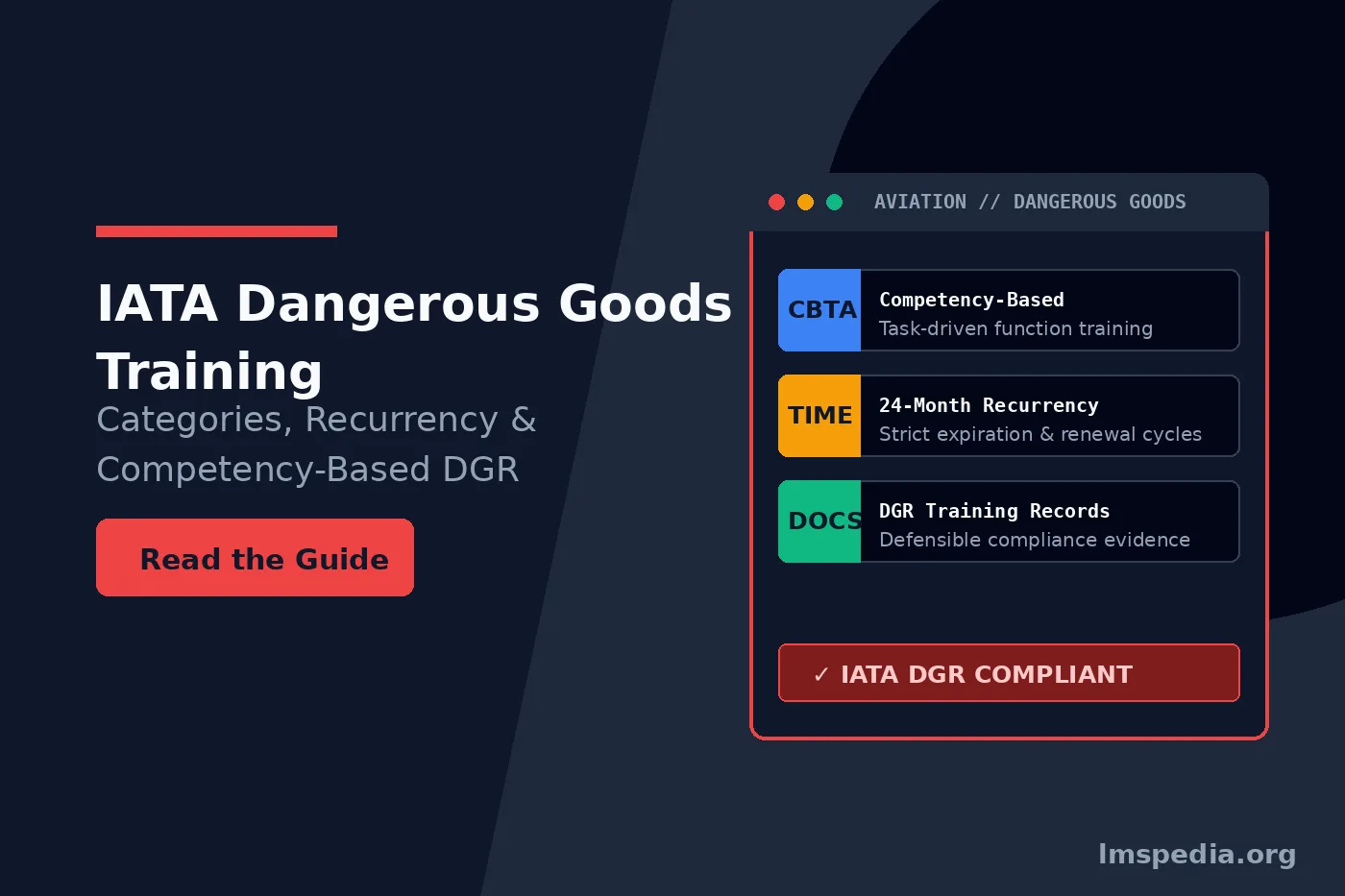
The Paradigm Shift to CBTA: IATA officially retired the legacy Categories 1-17 system on January 1, 2023. All dangerous goods instruction must now follow a Competency-Based Training and Assessment (CBTA) framework based on specific employee job functions rather than generic job titles. Assessments Drive the Curriculum: Under the CBTA model, organizations must define the required competency levels and design the final practical/theoretical assessment to-node=”3,1,0″ data-index-in-node=”167″>before designing the training materials. Strict 24-Month Recurrency: Dangerous goods qualifications expire every 24 months. If an employee misses their renewal date, they are immediately disqualified from handling hazardous materials until fully retrained. The 3-Month Grace Window: Employers should leverage the 3-month eligibility window, allowing employees to take their recurrent training up to 90 days before expiration while keeping their original anniversary renewal date intact. Comprehensive Recordkeeping is Mandatory: Modern DGR training records must include detailed proof of assessment, references to the specific IATA DGR manual edition used, and the verifiable credentials of the evaluator who signed off on the competency.
Key Takeaways

Evolution of IATA DGR Training Categories
The Legacy Numbered Category Limitations
For decades, commercial aviation managed dangerous goods curricula through numbered categories. Specifically, these categories ranged from Category 1 through Category 17. Training managers assigned specific syllabi based on an employee overarching job title. For example, rules directed freight shippers to complete Category 1 training. Meanwhile, ramp handlers completed Category 8 and flight attendants completed Category 11. However, this legacy architecture possessed severe structural flaws across diverse airline operations. First, organizational job titles vary wildly between airlines, cargo carriers, and ground handling agencies. Consequently, two workers with identical titles often performed completely different daily tasks. Therefore, rigid categorizations forced employees into irrelevant theoretical coursework continually. Ultimately, passing generic multiple-choice quizzes failed to guarantee safe handling on the airport ramp.
The Mandated Transition to CBTA
To resolve these dangerous operational gaps, international aviation authorities acted decisively. The International Air Transport Association officially mandated Competency-Based Training and Assessment. Consequently, this formal regulatory shift retired the legacy numbered category framework completely. Many veteran aviation trainers still reference legacy category numbers colloquially today. However, instructional designers must now build curricula around specific functions employees execute. Furthermore, the International Civil Aviation Organization establishes overarching global hazardous cargo standards. Therefore, national civil aviation authorities audit airlines against functional competency rather than seat time. Consequently, training departments must demonstrate that employees master practical tasks before handling hazardous cargo. Ultimately, this paradigm shift ensures that instructional investments directly enhance flight safety.
Understanding Competency-Based Training and Assessment
The core philosophy behind competency-based learning requires tailored, job-specific training design. Specifically, trainers must map educational content to the distinct operational duties an employee performs. Instead of evaluating generic job descriptions, the organization analyzes discrete functional tasks. For example, an employee might assemble unit load devices, inspect cargo documentation, or issue load notifications. Therefore, managers assign targeted educational modules that address those precise capabilities. Next, we examine the four critical phases required to implement this framework successfully.
Phase 1: Establishing the Training Needs Analysis
Employers must first execute a comprehensive training needs analysis across every operational role. Specifically, managers map corporate duties against recognized dangerous goods functional tasks. For example, tasks include classifying hazard classes, packaging dangerous goods, or verifying transport documents. Furthermore, operations teams evaluate how frontline personnel interact with dangerous shipments daily. Consequently, this rigorous discovery process identifies exact skill requirements for every job role. Therefore, training managers eliminate unnecessary generic modules from employee learning paths entirely. Ultimately, a precise needs analysis provides the foundational architecture for all subsequent curriculum design.
Phase 2: Defining Functional Task Proficiency Levels
Next, the organization establishes the mandatory proficiency benchmark for each functional task. Specifically, employers determine the depth of technical expertise an employee requires to operate safely. Does the frontline worker merely require general hazard recognition skills? Alternatively, does the specialist require expert technical knowledge to authorize complex cargo manifests? Furthermore, establishing clear proficiency benchmarks supports competency based assessment training across all operational departments. Consequently, trainers assess employees against standardized, objective operational rubrics. Therefore, workers acquire the exact depth of knowledge necessary to execute their duties safely. Ultimately, defined proficiency benchmarks eliminate guesswork from employee competency evaluations.
Phase 3: Designing Practical Competency Assessments
Competency-based frameworks prioritize practical evaluation methodology before developing courseware. Specifically, instructional designers determine how evaluators will verify practical competence before writing training materials. Traditional aviation courses relied almost exclusively on memorization and written multiple-choice examinations. Conversely, modern competency frameworks demand authentic practical evaluations in operational environments. Evaluators observe ramp workers securing cargo, inspecting damaged packaging, and validating shipping manifests. Furthermore, evaluators use digital checklists on mobile devices to document practical execution. Therefore, assessment outcomes reflect genuine operational capability rather than simple memorization. Ultimately, rigorous practical assessments verify that personnel perform safely under pressure.
Phase 4: Developing Targeted Instructional Content
Finally, instructional design teams develop targeted training materials to bridge identified capability gaps. Specifically, developers create materials only after finalizing task assessments and operational performance criteria. This deliberate sequence ensures that every instructional module supports a verified job function directly. Furthermore, integrating ramp safety training IATA AHM IGOM standards aligns ground operations with international criteria. Consequently, employees absorb relevant technical instructions without suffering from cognitive overload. Therefore, training delivery becomes faster, more focused, and significantly more cost-effective. Ultimately, targeted instructional design produces highly competent ground handling personnel.
Separate Instruction from Assessment
Under rigorous competency-based standards, the instructor delivering the training should never sign off as the final assessor. Utilizing independent quality evaluators eliminates confirmation bias and produces defensible audit records.
Software Comparison for Aviation Dangerous Goods Compliance
Managing specialized training matrices across thousands of aviation workers requires modern enterprise software. Specifically, training managers must automate recurrency tracking, schedule practical evaluations, and generate audit-ready documentation. Standard corporate learning platforms lack the specialized architecture required to monitor complex aviation certifications. Therefore, aviation organizations deploy specialized training management software to maintain continuous compliance. The comparative table below outlines three prominent platforms operating within the aviation compliance sector.
| Platform | Aviation Compliance Features | Practical Evaluation Tools | Primary Target Audience |
| SimpliTrain | Automated 24-month recurrency engines with native eligibility windows | Mobile practical assessment rubrics with offline operational logging | Airlines, airport ground handling organizations, and aviation cargo hubs |
| CAE Pelesys | Standard aircrew compliance tracking and generic regulatory courses | Basic electronic grading forms with desktop verification | Commercial passenger airlines and flight crew training centers |
| Aeroclass | Pre-packaged digital aviation courses with static completion tracking | Traditional multiple-choice knowledge checks | Regional flight schools, small operators, and individual aviation students |
The Strict 24-Month Recurrency Window
Enforcing Recurrent Training Deadlines
International regulatory authorities update dangerous goods manuals annually to address emerging safety risks. For example, regulators publish updated restrictions regarding high-density lithium battery shipments and infectious substances regularly. Consequently, an employee dangerous goods qualification never remains permanently valid. Global aviation regulations strictly enforce recurrent evaluations within a maximum 24-month validity interval. Specifically, an employee must complete recurrent training and competency assessment within 24 months of their prior qualification. If an employee misses this deadline by a single day, their operational qualification expires immediately. Consequently, aviation regulations prohibit that employee from performing any dangerous goods functions. The employee cannot resume operational duties until instructors retrain and reassess them. Therefore, training departments must track expiration deadlines with absolute mathematical precision.
Navigating the Three-Month Eligibility Window
Scheduling recurrent training for thousands of rotating ramp agents creates massive logistical friction. Fortunately, international regulations incorporate a flexible three-month eligibility window for recurrent certifications. Specifically, an employee may complete recurrent assessments within the final three months of their validity period. When completed within this window, the system locks the new expiration date to the original anniversary month. Furthermore, mastering building a recurrency matrix ensures your system applies this anniversary logic automatically. Therefore, training schedulers gain a wide window to book recurrent sessions without shortening qualification intervals. Consequently, airlines avoid paying for redundant training sessions caused by early course completions. Ultimately, utilizing the eligibility window maintains continuous qualification while protecting operational budgets.
Schedule at Day 60
Configure your training management system to assign recurrent training sixty days prior to qualification expiration. This automated window provides ample scheduling buffer while preserving the original anniversary month.
Generating Defensible Dangerous Goods Training Records
Mandatory Components of Audit-Ready Records
Civil aviation inspectors frequently execute unannounced audits on commercial airlines and cargo freight forwarders. During these inspections, auditors demand immediate access to employee qualification documentation. Under modern competency standards, maintaining simple spreadsheets with checkmarks constitutes a major compliance violation. Instead, organizations must produce comprehensive, verifiable evidence confirming individual operational competency. Specifically, audit-ready training documentation must contain the following core elements natively:
-
Full Employee Identification: The record must state the full legal name and specific job function of the assessed individual.
-
Assessment Dates and Validity: The record must clearly indicate the assessment completion date and the calculated 24-month expiration deadline.
-
Curriculum and Manual References: Documentation must identify the specific training materials, syllabus edition, and manual version utilized during instruction.
-
Qualified Assessor Credentials: The file must record the certified assessor name, credentials, and digital signature validating competency.
-
Verifiable Evaluation Evidence: The record must include practical observation checklists, simulator logs, and examination scores proving competency.
The Severe Dangers of Fragmented Spreadsheets
Relying on manual spreadsheets to manage dangerous goods records invites catastrophic regulatory liability. Specifically, human data entry errors inevitably lead to missed recurrent deadlines. If an uncertified employee accidentally loads dangerous goods onto a commercial aircraft, severe consequences follow. The Federal Aviation Administration imposes massive financial civil penalties for uncertified hazardous cargo handling. Furthermore, regulators can suspend air operator certificates following systemic compliance failures. Additionally, establishing compliant aviation training records retention protocols guarantees that records survive unannounced regulatory inspections. Furthermore, verifying compliance documentation through resources like our guide on LMS for compliance training and audit evidence ensures complete institutional readiness. Therefore, transitioning from manual spreadsheets to automated compliance platforms protects operating licenses. Ultimately, digital record automation guarantees defensible regulatory compliance across global operations.
Integrating CBTA with Safety Management Systems
Proactive Ramp Risk Mitigation
Transitioning to a competency-based training framework cannot occur within an isolated departmental silo. Instead, dangerous goods education must integrate directly into the organizational Safety Management System. Modern aviation standards treat continuous employee training as a frontline barrier against operational hazards. Specifically, when safety managers identify hazardous material reporting trends, training departments must react promptly. For example, if line personnel report recurring undeclared lithium battery incidents, trainers update coursework immediately. Consequently, the curriculum evolves dynamically to address authentic, documented hazards observed on the ramp. Therefore, training initiatives serve as proactive risk mitigation controls rather than static educational requirements. Ultimately, aligning training with safety systems actively prevents catastrophic aviation accidents.
Digital Observation Rubrics on the Hangar Floor
Achieving compliance requires continuous practical verification on the active warehouse and hangar floor. Traditional multiple-choice quizzes fail to prove whether an employee can identify leaking chemical containers. Therefore, safety evaluators must conduct structured on-the-job assessments using standardized grading rubrics. Modern operations utilize ruggedized mobile tablets to conduct real-time evaluations during active cargo loading operations. Evaluators verify that workers cross-reference transport documents, verify package integrity, and position tie-down straps correctly. Furthermore, mobile platforms sync completed evaluation rubrics directly to central compliance databases instantly. Consequently, safety managers verify workforce competence without managing physical paperwork. Ultimately, digital practical assessments connect theoretical instruction directly to operational execution.
Audit Active Field Records
Perform monthly spot audits on active ramp teams to verify that frontline workers hold valid digital qualifications. Detecting expired certifications internally prevents severe regulatory findings during formal civil aviation inspections.
Preparing for Civil Aviation Regulatory Audits
Surviving Unannounced Inspections
Civil aviation inspectors demand immediate proof of compliance during formal airworthiness audits. When an auditor requests dangerous goods records, administrators cannot spend hours locating paper files. If your team cannot produce verifiable training records promptly, auditors issue immediate non-conformance notices. Therefore, training departments must maintain cloud-based archives that generate comprehensive compliance reports within minutes. Furthermore, digital records must retain cryptographic audit trails proving that nobody altered completion timestamps retroactively. Consequently, quality assurance managers present clean, validated certification portfolios during surprise inspections effortlessly. Ultimately, automated audit readiness transforms high-stress inspections into routine operational validations.
Continuous Quality Control and Internal Audits
Maintaining continuous audit readiness requires proactive internal quality assurance oversight throughout the year. Quality teams must audit training syllabi, instructor qualifications, and assessment rubrics every six months. Specifically, internal auditors verify that training materials incorporate the latest Dangerous Goods Regulations revisions. Furthermore, quality managers evaluate assessor consistency to ensure objective, standardized grading across line stations. If internal audits reveal inconsistent evaluation scoring, instructors receive corrective coaching immediately. Consequently, the organization rectifies procedural deviations before external regulators inspect the facility. Therefore, internal quality control safeguards organizational airworthiness certifications permanently. Ultimately, rigorous internal governance ensures uncompromising dangerous goods compliance worldwide.
Conclusion
The safe transportation of hazardous materials by air demands a highly skilled and perpetually vigilant workforce. By mastering rigorous dangerous goods training requirements, aviation organizations actively protect personnel, airframes, and passengers worldwide. The global industry has rightfully replaced legacy numbered category systems with competency-based instructional frameworks. Consequently, every cargo agent, loadmaster, and ramp specialist acquires the exact practical capabilities required for their job. Frontline workers no longer memorize abstract regulations merely to pass multiple-choice tests. Instead, employees master concrete handling procedures that safeguard aircraft operations daily.
Maintaining regulatory compliance requires structured operational oversight and advanced digital recordkeeping systems. Training leaders must enforce the strict 24-month recurrent cycle through automated expiration tracking and eligibility windows. Furthermore, aviation providers must abandon vulnerable paper tracking sheets in favor of centralized digital compliance databases. Integrating competency frameworks with corporate safety management systems ensures that training targets authentic operational hazards proactively. Ultimately, treating dangerous goods training as an indispensable operational safeguard builds a resilient, highly capable aviation workforce.
FAQ
Q1. What are the primary dangerous goods training requirements for aviation?
Aviation dangerous goods training requirements mandate that any individual involved in the preparation, acceptance, handling, loading, or transport of cargo and passenger baggage must be trained and assessed to safely identify and manage hazardous materials in accordance with ICAO and IATA regulations.
Q2. Are IATA DGR training categories still used?
Officially, no. As of January 1, 2023, IATA completely transitioned from the legacy Category 1-17 system to a Competency-Based Training and Assessment (CBTA) framework. Training is now categorized by specific operational functions (e.g., “Personnel Accepting Dangerous Goods”) rather than generalized job titles.
Q3. What is competency based DG training (CBTA)?
Competency-based DG training is an educational framework that focuses on an employee’s ability to demonstrate specific skills and behaviors necessary for their daily tasks. Instead of just passing a multiple-choice knowledge test, the employee must prove they can actually perform their job functions safely under realistic operational conditions.
Q4. How often is DG recurrent training required?
The industry strictly enforces a DG recurrent training 24 months validity cycle. Employees must undergo recurrent training and pass a new competency assessment every 24 months to maintain their legal qualification to handle or process dangerous goods.
Q5. What must be included in official DGR training records for an audit?
Audit-ready DGR training records must include the employee’s full name, specific job function, the date of assessment, the expiration date, the specific IATA DGR edition/syllabus referenced, the name and credential of the assessor, and objective evidence of the competency evaluation (such as a signed practical observation rubric or exam scorecard).