
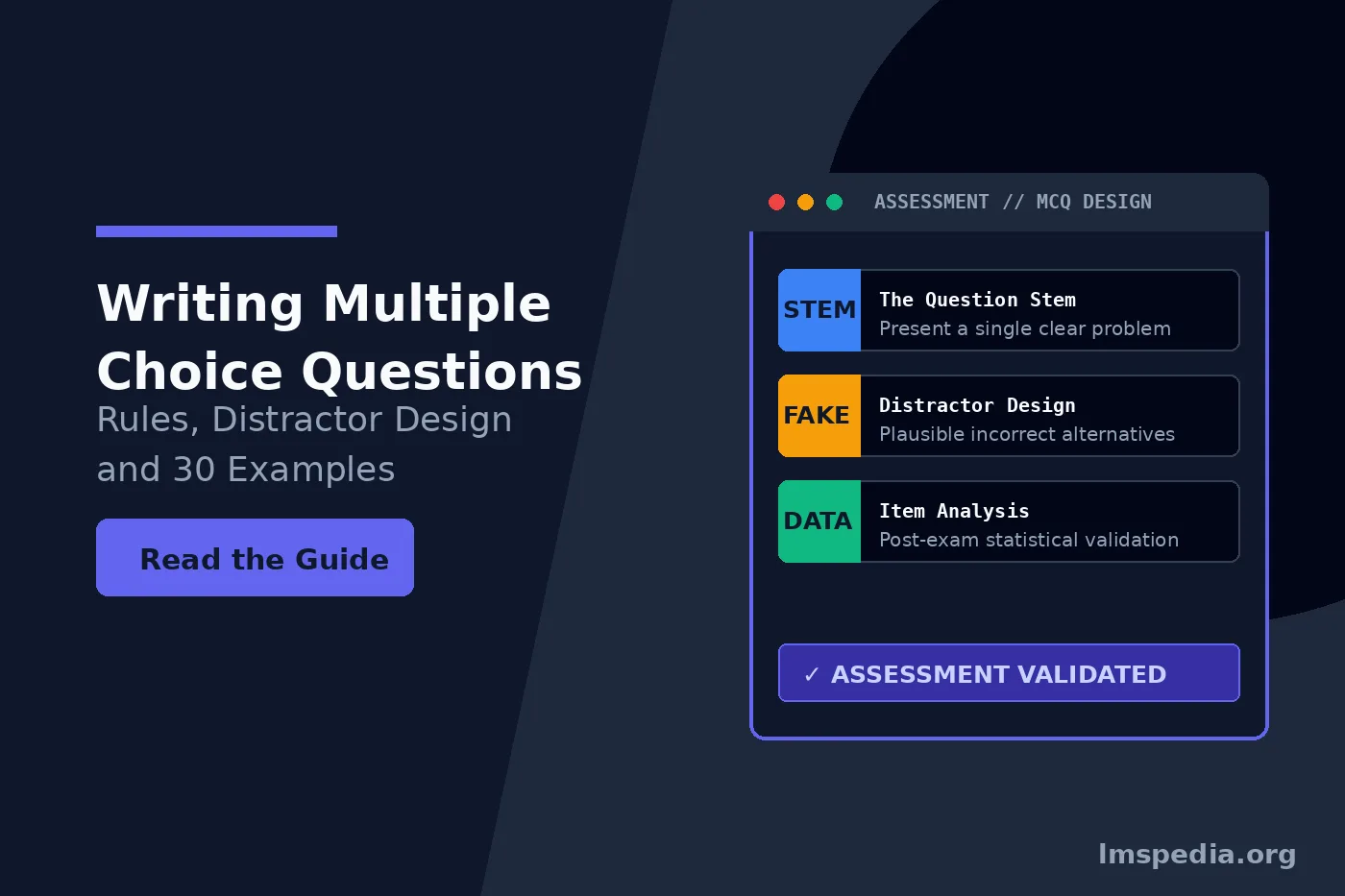
Writing Multiple Choice Question Examples: Rules and Distractor Design
For decades, instructional designers have relied heavily on multiple choice assessments. Specifically, their popularity remains completely understandable today. First, they are incredibly scalable globally. Furthermore, they allow rapid coverage of massive subject areas. Additionally, they eliminate subjective grading biases completely. However, writing effective multiple choice question examples represents a precise science. Consequently, poorly designed tests fail to measure actual knowledge transfer natively. Instead, they merely measure test-taking savvy or reading speed. When high-stakes corporate compliance relies on these tests, invalid assessments create massive organizational liability. Therefore, you must master specific multiple choice writing rules immediately. Fortunately, decades of rigorous psychometric research have established clear guidelines. Next, we will explore these foundational concepts thoroughly. Ultimately, robust testing protects your corporate operating license entirely.
Key Takeaways

The Cover-Up Rule: A well-written stem must present a complete, self-contained problem. Learners should know exactly what is being asked before they even look at the answer options.
Distractor Plausibility is Paramount: Incorrect options (distractors) must be highly plausible to uneducated learners. Use common operational mistakes or frequent misconceptions to build robust distractors.
Keep Options Symmetrical: Ensure all your answer choices are relatively the same length and share the same grammatical structure. Never make the correct answer significantly longer or more detailed than the distractors.
Ban “All of the Above”: Avoid using “All of the above” or “None of the above.” These options allow learners to guess correctly with only partial knowledge or turn the question into a simple True/False exercise.
Test Higher Cognitive Levels: Do not limit MCQs to basic rote memorization. Write scenario-based stems that force learners to analyze data, troubleshoot problems, and apply rules to real-world situations.
The Anatomy of a Multiple Choice Question
Before diving into complex rules, we must establish shared vocabulary. Specifically, a standard test item consists of three distinct components. First, understanding this anatomy prevents catastrophic design failures later. Therefore, review these structural elements closely.
The Stem
First, the stem represents the core premise or scenario. Specifically, it forms the direct question that the learner must solve. Furthermore, the stem must remain completely clear, focused, and incredibly concise.
The Key
Second, the key represents the single undeniably correct answer. Specifically, it must resolve the problem presented in the stem perfectly. Therefore, subject matter experts must verify its absolute accuracy beforehand.
The Distractors
Finally, distractors represent the carefully crafted incorrect options natively. Their primary job involves distracting learners who lack true mastery. Specifically, they offer highly plausible common operational misconceptions. Furthermore, mastering excellent distractor design separates novice writers from elite instructional designers completely.
Core Rules for Writing the Stem
Rule 1: The Cover Up Rule
The stem represents the absolute foundation of your assessment natively. Consequently, if the stem is flawed, the entire question collapses entirely. According to the Eberly Center at Carnegie Mellon University, stems must remain direct. The most important rule involves presenting a completely self-contained problem. Specifically, a learner should cover up all answer choices easily. Next, they should read the stem and know the exact question natively. For example, a stem stating “Regarding organizational leadership” fails completely. The learner has no idea what the question entails initially. Instead, you must rephrase it clearly. A better stem asks, “Which leadership style works best during sudden crises?”
Rule 2: Eliminate Window Dressing
Corporate trainers frequently fall into narrative-heavy writing traps. Specifically, they add massive fluff to make questions feel realistic. While realistic scenarios add value, you must ruthlessly edit irrelevant details natively. For instance, learners calculating profit margins do not need corporate histories. Ultimately, extraneous reading material discriminates against non-native speakers heavily. Furthermore, it tests reading speed rather than true subject matter expertise. Therefore, keep your scenarios tightly focused and incredibly brief always.
Rule 3: Avoid Negative Phrasing
Human brains struggle to process negative phrasing efficiently under stress natively. Consequently, stems asking for symptoms that are NOT present confuse learners heavily. These learners accidentally misread the question entirely. Next, they actively search for the correct symptom instead. Whenever possible, you should phrase your stems positively universally. However, sometimes you must test critical exclusionary knowledge directly. Therefore, you must draw massive visual attention to the negative word. Crucially, capitalize and bold words like NOT or EXCEPT always.
Rule 4: Centralize the Content
To reduce reading fatigue, you must centralize repeating words immediately. Specifically, move phrases that repeat across all options into the stem. For example, imagine all options begin with “The operator should”. Instead of repeating this phrase, remove it from the distractors completely. Next, attach it directly to the end of your stem natively. As a result, this creates significantly cleaner multiple choice question examples. Ultimately, centralized content accelerates cognitive processing for the learner.
The Art and Science of Distractor Design
Writing the stem and correct key remains relatively easy natively. However, true instructional design skill shines during distractor design. If your incorrect options look obviously wrong, you provide statistical advantages. Specifically, uneducated learners can simply guess the correct answer instantly. Therefore, utilizing advanced strategies for writing multiple choice questions prevents this vulnerability entirely.
Rule 5: Ensure Universal Plausibility
Every single distractor must seem completely plausible to uneducated learners natively. Specifically, the absolute best distractors utilize common operational mistakes constantly. Furthermore, they use frequent misunderstandings or truthful but irrelevant statements. Therefore, you should never use joke answers or throwaway options. This practice instantly turns a four-option question into a simpler format natively. Consequently, you artificially inflate your corporate assessment scores dangerously.
Rule 6: Maintain Consistent Length
Test takers remain incredibly observant during strict exam conditions. Consequently, they quickly learn specific visual formatting patterns natively. They know the longest, most detailed answer usually represents the key. Instructional designers often overwrite the correct key to ensure absolute accuracy. Meanwhile, they leave the incorrect distractors incredibly short and punchy natively. Therefore, you must ensure all options share roughly identical lengths. Furthermore, they must share the exact same grammatical complexity completely.
Rule 7: Avoid Overlapping Choices
Your options must remain entirely mutually exclusive completely. For instance, ensure numerical ranges never overlap during quantitative questions natively. If Option A spans one to five, Option B cannot start at five. A learner calculating exactly five will feel hopelessly confused instantly. Additionally, you must avoid logical overlaps entirely. If Option A states “The project fails”, Option B cannot expand on that failure redundantly.
Rule 8: Ban All of the Above
The Poorvu Center for Teaching and Learning at Yale University advises caution. Specifically, they strongly recommend banning the phrase “All of the above” globally. If a learner knows two options are correct, they guess the third automatically. As a result, they achieve a perfect score possessing only partial knowledge. Similarly, “None of the above” turns the item into a basic true-or-false format natively. Ultimately, these phrases destroy strict assessment validity completely.
Rule 9: Eliminate Absolute Terminology
Savvy test takers know the real world rarely operates in absolutes natively. Consequently, distractors containing words like always or never fail immediately. Learners eliminate these absolute statements as false options instantly. Conversely, words like usually or frequently signal the correct nuanced answer. Therefore, you must keep option language strictly neutral universally. Crucially, eliminating absolute terminology forces learners to evaluate actual concepts.
Authoring and Assessment Tools
Before deploying your exam, ensure your testing infrastructure supports advanced design completely. Specifically, deploying robust AI generated assessments requires highly capable software natively. You must support randomization, dynamic branching, and detailed item reporting perfectly. Next, we will compare three platforms tailored for complex corporate evaluations. Consequently, you can select the tool that supports your specific cognitive targets natively.
| Software Platform | Assessment Engine Features | Randomization & Security | Primary Target Audience |
|---|---|---|---|
| SimpliTrain | Advanced branching and native video evaluations | Bank randomization and strict time limits | Enterprise training and compliance teams |
| Articulate 360 | Standard multiple choice and drag-and-drop | Basic question bank drawing | Traditional instructional design departments |
| Adobe Captivate | Complex software simulation testing | Variable-driven question logic | Technical software training specialists |
Randomize Answer Order
Configure your assessment tool to automatically shuffle the order of the answer options for every single learner. This prevents employees from simply memorizing letter patterns during compliance exams.
Moving Beyond Rote Memorization
Elevating Cognitive Load
A common criticism states that multiple choice formats only test basic recall. However, this represents a flaw of the specific author natively. You can easily write highly complex scenario-based questions effectively. Therefore, utilizing scenario based assessment design tests true application natively. According to the Vanderbilt University Center for Teaching, you can elevate cognitive load significantly. First, you can present a highly detailed mini case study. Next, you provide a specific set of complex operational data. Furthermore, you ask the learner to identify the best troubleshooting step natively. Consequently, this format measures advanced analytical skills perfectly.
Post Exam Validation and Item Analysis
Measuring Difficulty and Discrimination
Writing the assessment represents only the first phase completely. Once learners finish, you must statistically evaluate question performance natively. This specific step ensures your exams remain fair and highly reliable. Specifically, deploying competency based assessment training metrics reveals exact knowledge gaps. First, calculate the difficulty index for every single item natively. If everyone answers correctly, the question provides zero evaluative value. Next, calculate the specific discrimination index thoroughly. If high performers miss the question while guessers pass, the item fails. Consequently, you must rewrite flawed questions immediately. Furthermore, applying Kirkpatrick Level 3 and 4 practice principles requires perfectly valid foundational tests. Ultimately, constant statistical validation protects your corporate testing integrity.
Run a Pilot Test
Always run a pilot test with a small group of subject matter experts before launching a high-stakes exam globally. Experts will quickly identify ambiguous stems or overlapping distractors that you missed entirely.
30 Multiple Choice Question Examples
To put these how to write mcq questions rules into perfect perspective, review this list natively. Below are thirty meticulously crafted mcq examples training professionals use daily. Furthermore, we grouped these into three distinct cognitive levels accurately. This structure clearly demonstrates distractor design that scales perfectly.
Level 1 Recall Questions Part 1
These questions measure the ability to remember facts directly natively. Specifically, learners do not need to apply them to scenarios.
1. What is the primary function of a Customer Relationship Management system?
A) To process internal payroll and human resources data.
B) To track, manage, and analyze interactions with potential clients.
C) To host the company public-facing marketing website.
D) To manage physical inventory in the distribution warehouse.
2. What is the maximum allowable noise exposure for an eight-hour shift?
A) 75 decibels
B) 85 decibels
C) 90 decibels
D) 100 decibels
3. Which global regulatory body publishes the primary Dangerous Goods Regulations manual?
A) The Federal Aviation Administration
B) The International Air Transport Association
C) The Occupational Safety and Health Administration
D) The World Health Organization
4. In the context of digital learning, what does SCORM signify?
A) Synchronous Course Object Reference Model
B) Sharable Content Object Reference Model
C) Standardized Curriculum Online Resource Manager
D) System Content Operational Response Module
5. Which fire extinguisher class specifically suppresses electrical fires?
A) Class A
B) Class B
C) Class C
D) Class K
Level 1 Recall Questions Part 2
Continuing with basic knowledge checks, these require straightforward memorization completely.
6. What is the first mandatory step in a Lockout Tagout procedure?
A) Apply the physical padlock to the energy source.
B) Notify all affected employees regarding the equipment shutdown.
C) Disconnect the primary electrical power supply entirely.
D) Release all stored kinetic or thermal energy.
7. Under ISO 9001 guidelines, how is a non-conformance officially defined?
A) A product defect causing injury to a consumer.
B) A failure to fulfill a specific requirement or standard.
C) A sudden delay in the manufacturing supply chain.
D) A customer complaint regarding poor customer service.
8. Which physical tool remains strictly prohibited when cutting live electrical wires?
A) Insulated wire strippers
B) Lineman pliers
C) Standard steel hacksaws
D) Heavy-duty cable cutters
9. In corporate accounting, what is the formula for calculating Gross Profit?
A) Total Revenue minus Operating Expenses
B) Total Revenue minus Cost of Goods Sold
C) Net Income divided by Total Assets
D) Operating Cash Flow minus Capital Expenditures
10. What is the expiration timeframe for a standard Class A industrial hard hat?
A) One year from the date of manufacture
B) Three years from the date of issue
C) Five years from the date of issue
D) Ten years from the date of initial purchase
Level 2 Application Questions Part 1
These questions force learners to apply known rules to practical scenarios natively.
11. A customer requests a refund on day thirty-five of a thirty-day policy. According to policy, how should the agent proceed?
A) Deny the return because it falls outside the designated window.
B) Issue a full refund immediately overriding the time limit.
C) Offer a replacement product or store credit exclusively.
D) Instruct the customer to contact the original manufacturer directly.
12. A chemical spill with a measured pH of 3 occurs. Which neutralizer should the technician deploy immediately?
A) A strong industrial acid
B) A weak industrial acid
C) A weak base chemical
D) Pure distilled water
13. A warehouse worker suffers a minor laceration that is bleeding steadily. What is the immediate correct first aid response?
A) Apply a tight tourniquet directly above the elbow.
B) Apply direct pressure using a clean sterile dressing.
C) Flush the wound with isopropyl alcohol immediately.
D) Elevate the arm and wait for emergency services.
14. During pre-flight checks, the primary hydraulic pressure warning illuminates. What is the mandatory first action for the pilot?
A) Abort the flight and order an immediate evacuation.
B) Check standby hydraulic reservoir levels in the management system.
C) Cycle the main power generators to reset the warning.
D) Ignore the warning if secondary systems show normal pressure.
15. A retail store purchases a product for forty dollars and sells it for one hundred. What is the gross profit margin percentage?
A) 40 percent
B) 60 percent
C) 150 percent
D) 250 percent
Level 2 Application Questions Part 2
These scenarios become slightly more complex natively. Consequently, they require strict application of company policies.
16. An employee attempts to access the intranet and receives an Error 404 message. Which troubleshooting step should the IT desk recommend first?
A) Reboot the local machine entirely immediately.
B) Verify the employee typed the correct URL in the address bar.
C) Reset the active directory password for the specific employee.
D) Ping the central server to check for total network outages.
17. An employee requests two weeks of paid time off but only has three days accrued. According to the handbook, how must the manager respond?
A) Approve the full request and allow the balance to go negative.
B) Deny the entire request due to insufficient accrued balances.
C) Approve three days paid and offer the remainder as unpaid leave.
D) Force the employee to borrow time from a willing coworker.
18. A ramp agent needs to manually lift a fifty-pound cargo box. Which lifting technique remains legally required?
A) Bend at the waist and lift the box rapidly.
B) Squat down and lift using the heavy leg muscles.
C) Keep the box extended away from the body to maintain balance.
D) Twist the torso while lifting to align with the conveyor belt.
19. An industrial boiler pressure gauge reads thirty PSI above the optimal threshold. Which adjustment must the operator make immediately?
A) Open the primary manual pressure relief valve entirely.
B) Increase the flow of cold water to the internal radiator.
C) Shut down the main power breaker to the entire facility.
D) Decrease the fuel injection rate to lower the core temperature.
20. A sales prospect states your software is twenty percent more expensive than competitors. Which rebuttal technique applies Value Framing correctly?
A) Offer a twenty-five percent discount to secure the signature today.
B) State the competitor software lacks critical security features natively.
C) Explain how automated reporting saves ten hours weekly, yielding higher ROI.
D) Promise to speak with management to price match the competitor exactly.
Level 3 Analysis Questions Part 1
These highly complex questions require learners to break down scenarios thoroughly. Specifically, they must identify root causes flawlessly.
21. In quarter three, distribution centers saw a fifteen percent operational cost spike while volume remained flat. What is the most likely root cause?
A) A sudden increase in national marketing expenditures natively.
B) An increase in fleet vehicle maintenance and fuel consumption costs.
C) An unrecorded increase in local minimum wage laws.
D) A decrease in overall customer demand for the physical product.
22. In a series circuit, component A functions normally but component C lacks power. If component B shorts to the ground, what physical consequence occurs?
A) Component A will draw excessive current and overheat rapidly.
B) The main circuit breaker will trip, protecting component A perfectly.
C) Component C will experience a sudden catastrophic power surge.
D) The voltage across the entire system will double safely.
23. A patient presents with sudden shortness of breath and chest pain after long-haul travel. Which medical diagnosis remains highly probable?
A) Acute myocardial infarction
B) Pulmonary embolism
C) Severe bronchial asthma attack
D) Gastroesophageal reflux disease
24. A fifty-person enterprise requires a cheap visual Kanban project management tool. Which software architecture fits this specific requirement best?
A) An on-premise open-source solution requiring dedicated internal servers.
B) Custom proprietary software designed by an external boutique agency.
C) A cloud-based multi-tenant SaaS platform with tiered user licensing.
D) A decentralized blockchain ledger application completely custom built.
25. During a destructive test, a newly welded joint failed at sixty percent capacity. Microscopic analysis revealed severe porosity. Why did this failure occur?
A) The welder utilized a travel speed that was incredibly slow.
B) The shielding gas flow rate was set incorrectly, allowing atmospheric contamination.
C) The base metal was far too thick for the selected amperage.
D) The filler metal rod was stored in a high-temperature oven.
Level 3 Analysis Questions Part 2
Finally, these advanced scenarios test critical thinking exclusively. Consequently, they force learners to predict exact consequences natively.
26. Task A takes three days and must finish before Task B begins. Task C runs concurrently with Task A. Task D requires both B and C to finish. Which sequence represents the critical path?
A) Task A then Task C then Task D
B) Task C then Task D exclusively
C) Task A then Task B then Task D
D) Task B then Task C then Task D
27. A customer feedback form states they had to call support three times for verification, delaying launch. What is the primary business risk indicated?
A) Neutral risk because support eventually answered the tickets.
B) High churn risk due to incredibly high customer effort scores.
C) Low risk because the customer appreciated the thorough security verification.
D) Moderate risk requiring more technical training on the platform.
28. An underground mine uses a primary shaft and a backup fan. If the primary shaft collapses and the fan fails, what happens immediately?
A) A rapid increase in ambient temperature causing sudden heat stroke.
B) A slow build-up of explosive methane gas over several hours.
C) The immediate accumulation of toxic carbon monoxide and oxygen depletion.
D) The total permanent loss of internal facility radio communications.
29. An aircraft banks steeply into a sixty-degree turn. The pilot pulls back aggressively, increasing the angle of attack. Why does an accelerated stall occur?
A) The engine loses access to atmospheric oxygen due to the steep bank.
B) Smooth airflow separates from the wing due to the high load factor.
C) The aircraft center of gravity shifts too far forward dynamically.
D) Pitot tubes freeze over, providing completely false airspeed readings.
30. A Python script contains a while loop checking if x is greater than 10. Inside, x initializes at 15 without any increment line. What happens upon execution?
A) The compiler throws a syntax error and refuses to run.
B) The loop executes exactly one time and terminates gracefully.
C) The script enters an infinite runtime loop, eventually crashing the application.
D) The variable automatically resets to zero, ending the loop perfectly.
Conclusion
Writing high-quality multiple choice questions remains a foundational skill for any modern educator natively. Specifically, corporate trainers must adhere strictly to established multiple choice writing rules globally. By doing so, you guarantee your assessments measure actual operational knowledge flawlessly. Furthermore, you eliminate variables like test-taking ability completely. This requires maintaining single problem stems and obsessing over plausible distractor design natively. Therefore, use the thirty mcq examples training scenarios provided above as a strategic blueprint. Next, elevate the cognitive load of your own corporate tests actively. Move far beyond simple factual recall universally. Challenge your learners with deep application and complex analysis questions natively. Ultimately, statistically valid assessments allow your organization to confidently prove true workforce capability globally.
FAQ
Q1. What are the basic rules for writing multiple-choice questions?
The core rules dictate that the stem (the question) must present a single, clear problem without irrelevant fluff. Distractors (the incorrect options) must be highly plausible, mutually exclusive, grammatically consistent, and similar in length to the correct answer. Negative phrasing (like “NOT”) should be avoided or heavily emphasized.
Q2. What is a distractor in multiple-choice design?
A distractor is an incorrect answer option in a multiple-choice question. Its primary purpose is to “distract” learners who have not truly mastered the material by offering a highly plausible, common misconception or operational error as a viable choice.
Q3. Why should you avoid "All of the above" in multiple-choice tests?
“All of the above” should be avoided because it compromises the validity of the assessment. If a learner knows that Option A and Option B are correct, they will select “All of the above” without needing to know if Option C is correct, allowing them to pass with only partial knowledge.
Q4. How can I make my multiple-choice questions harder without tricking the learner?
To increase difficulty fairly, elevate the cognitive level of the question from simple recall to application or analysis. Present a short, realistic scenario or a set of troubleshooting data, and ask the learner to apply a rule or identify the root cause, rather than just asking them to define a term.
Q5. What is item analysis in multiple-choice testing?
Item analysis is a statistical evaluation conducted after an exam is administered. It measures the Difficulty Index (how many learners got the question right) and the Discrimination Index (how well the question separates high-performing learners from low-performing learners) to ensure the question is valid and reliable.