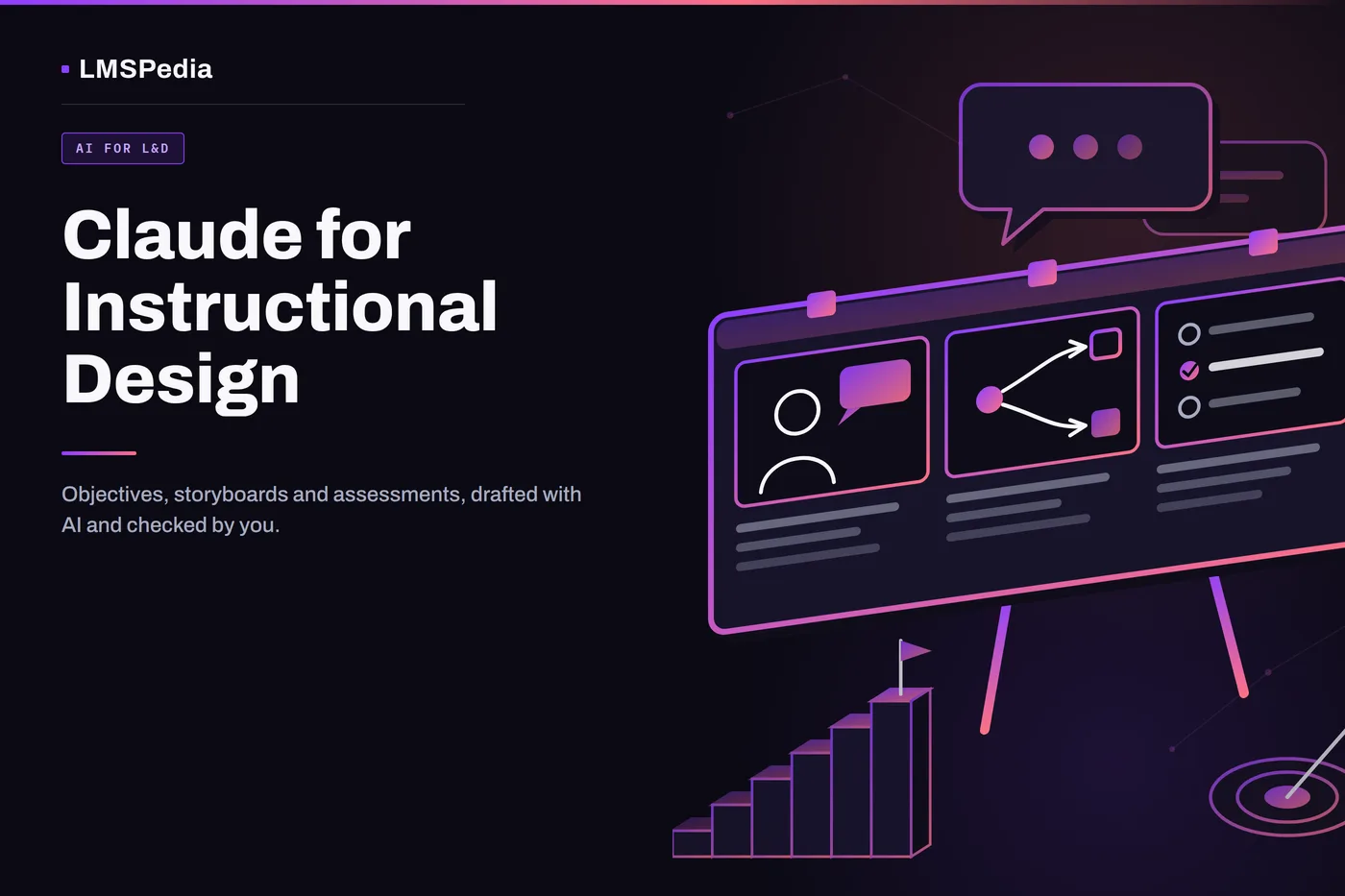
Using Claude for instructional design works best when you treat it as a drafting partner inside your existing ADDIE or SAM process: feed it SME notes and source documents, then ask it for needs analysis summaries, measurable objectives, storyboards, branching scenarios, assessment items and evaluation surveys. You still make the design decisions, and an SME still signs off the content.
Claude will not build, package or host a finished course for you. It produces text, documents, slides and HTML that you then move into an authoring tool or LMS. This guide maps Claude’s current features (as of September 2026) to each stage of the design workflow, gives you five copy-paste prompts, and is clear about where human review is non-negotiable.
Can Claude be used for course creation?
Yes, Claude can draft most of the written layer of a course: outlines, objectives, scripts, storyboards, scenarios, quiz items, job aids and facilitator guides. It cannot replace an authoring tool or LMS. Treat its output as a first draft that an instructional designer shapes and an SME verifies before anything reaches learners.
Claude earns its place in the slow, text-heavy middle of a project: turning 60 pages of policy into a module outline, rewriting SME jargon for new hires, or producing ten variations of a scenario.
The weak point is judgement. A 2024 evaluation by learning scientist Philippa Hardman found that general-purpose models, Claude included, showed shallow grasp of instructional design theory and struggled to adapt strategies to specific learners without expert steering. The lesson holds: Claude drafts, you design.
Which Claude features matter most for instructional designers?
Five features do most of the work for L&D teams: Projects (a workspace holding your source files and standing instructions), file creation (Word, PowerPoint, Excel and PDF output), Artifacts and Claude Design for visual and interactive drafts, web search, and a context window of up to 1M tokens on current top models.
Claude Projects are self-contained workspaces with their own chat history, a knowledge base of uploaded files, and custom instructions. Free accounts get up to five projects; paid plans get retrieval that expands project capacity, and Team and Enterprise users can share projects with colleagues.
Claude can also create and edit .docx, .pptx, .xlsx and PDF files on every plan, with a 30MB per-file limit. A storyboard can arrive as a Word table and an item bank as a spreadsheet. Claude Design, launched in April 2026 as a research preview on paid plans, turns prompts into prototypes, slides and one-pagers, and exports to PDF, PPTX, Canva or standalone HTML.
On 16 September 2026, Anthropic merged Claude chat and Cowork into one app, added Claude Docs and Slides in beta for paid plans, and brought Claude Design into conversations. The rollout starts with Pro and Max, so Team users may not see every feature yet.
For models, Sonnet 5 is the default for Free and Pro users and handles most ID drafting well. Opus 5.5, released on 22 September 2026, and Fable 5.1 (1 September 2026) are better for long, multi-document analysis. Plans run from Free to Pro at $17 a month billed annually ($20 monthly), then Max, Team and Enterprise; our Claude pricing breakdown covers the usage limits in detail.
How do instructional designers use Claude across ADDIE?
Instructional designers use Claude at every ADDIE stage: summarising SME input during analysis, writing objectives and storyboards during design, drafting scripts, scenarios and items during development, producing facilitator notes for implementation, and building Kirkpatrick surveys for evaluation. The same pattern fits SAM, where Claude speeds up each prototype iteration.
| ID task | Claude feature | Example output | What a human must still check |
|---|---|---|---|
| Training needs analysis | Projects with uploaded SME notes and incident data | Performance gap summary with training and non-training causes | Whether training is the right fix at all |
| Learning objectives | Chat with Bloom’s verb list in project instructions | Measurable objectives with condition and criterion | Alignment to the real job task and business metric |
| Storyboards and scripts | File creation (.docx table or .pptx) | Screen-by-screen storyboard with narration and visual notes | Technical accuracy, tone, cognitive load |
| Branching scenarios | Artifacts or Claude Design for a clickable HTML draft | Decision tree with consequences and feedback | Realism, fairness of choices, SME sign-off |
| Assessment items | File creation (.xlsx item bank) | Items tagged by objective and Bloom level with distractor rationale | Answer keys, ambiguity, bias, item statistics after pilot |
| Microlearning and job aids | Chat or Claude Docs | Five-minute lesson scripts, one-page checklists | That nothing safety-critical was cut |
| Localisation drafts | Chat with a glossary file in the project | First-pass translation with flagged idioms | Native-speaker and regulatory review |
| Evaluation | File creation (.docx or .xlsx) | Kirkpatrick Level 1 to 3 survey and follow-up plan | Survey validity and how data will be used |
How do you run a training needs analysis from SME notes with Claude?
Upload interview notes, incident logs or help-desk themes to a project and ask Claude to separate skill gaps from process, tooling or motivation problems. This is where Claude saves the most rework, because it will often surface issues that training cannot fix.
You are an instructional designer running a training needs analysis.
Source files: SME interview notes, last quarter's error log, current SOP.
1. List the observable performance problems, citing the source for each.
2. Classify each as: knowledge/skill gap, process gap, tool gap, or motivation/incentive gap.
3. For skill gaps only, state the target behaviour and who needs it.
4. List questions I should ask the SME before designing anything.
Do not invent data. If a source does not support a point, say "not in sources".
How do you write measurable learning objectives with Claude?
Give Claude the target behaviour and audience, then require an observable verb, a condition and a criterion for each objective, tagged with a Bloom’s level. Ban vague verbs like “understand” and “know” in your prompt, or they will creep back in. Our guide to writing measurable learning objectives covers the underlying method.
Audience: new branch cashiers, week 2 of onboarding.
Target behaviour: process a cash refund correctly under the new policy.
Write 4-6 learning objectives. Each must include:
- an observable action verb (no "understand", "know", "be aware of")
- the condition (tools, job aids or situation)
- a measurable criterion (accuracy, time, or standard)
Tag each with its Bloom's taxonomy level and suggest one assessment method that would prove it.
Output as a table: Objective | Bloom level | Evidence of mastery.
Put Your Standards In Project Instructions
Paste your house style, approved Bloom’s verb list, reading-level target and banned terms into the project instructions once, so every chat in that project inherits them and you stop correcting the same issues in each draft.
Can Claude write storyboards and scenario-based branching?
Yes. Claude writes screen-by-screen storyboards with narration, on-screen text and visual notes, and it handles branching logic well when you define the decision points and consequences. Ask for the storyboard as a Word table so it drops into your review cycle; see our storyboarding for eLearning guide for the format.
Create a branching scenario for customer-service agents handling a billing complaint.
Structure: 1 opening situation, 3 decision points, 3 choices each (1 best, 1 acceptable, 1 poor).
For every choice give: the customer's reaction, the consequence, and coaching feedback.
Keep it realistic for a UK telecoms contact centre. No choice should be obviously silly.
Return a .docx storyboard table: Screen ID | On-screen text | Narration | Visual notes | Branch to.
To test flow with stakeholders, ask Claude to build the same scenario as a clickable HTML artifact or in Claude Design. It is a prototype, not a production module.
How do you use Claude to write assessment items with distractor rationale?
Ask for items mapped to specific objectives, with each distractor based on a real misconception and a rationale explaining why it is wrong. Requiring rationale forces better distractors and gives SMEs something concrete to review. Treat every answer key as unverified until checked. Our overview of AI-generated assessments covers validation.
Using the attached policy and these objectives [paste objectives], write 8 multiple-choice items.
Rules:
- 2 items per objective, mixed Bloom levels (at least half at Apply or above)
- 4 options, one correct; distractors must reflect common misconceptions, not trick wording
- no "all of the above" or "none of the above"
- for each item give: correct answer, rationale for the correct answer, rationale for each distractor, and the policy section it tests
Output as an .xlsx item bank with one row per item.
Can Claude produce microlearning, job aids and localisation drafts?
Yes. Claude is quick at cutting a long module into five-minute microlearning scripts, turning a procedure into a one-page job aid, and producing first-pass translations. Each output needs a different check: microlearning for missing steps, job aids for field usability, and translations for native-speaker and legal review before release.
For localisation, upload a glossary of approved terms and ask Claude to flag idioms, culture-specific examples and units that need adapting rather than translating them literally.
How can Claude help with accessibility checks and Kirkpatrick evaluation?
Claude can review scripts and HTML for common accessibility problems (missing alt text, unclear link text, reading level, colour-only instructions) and draft Kirkpatrick Level 1 to 3 surveys with follow-up plans. It does not replace an automated WCAG checker or testing with assistive technology, so treat its review as a first pass.
Draft an evaluation plan for a 45-minute data privacy course.
Level 1: 6 reaction questions (mix of Likert and one open question), no leading wording.
Level 2: describe how the existing quiz measures learning and suggest one gap.
Level 3: a manager checklist to observe behaviour 60 days later, with 5 observable indicators.
Also list which business metrics could support a Level 4 discussion, and what data we would need.
How do you set up a Claude Project for a training program?
Create one project per course or program, load it with approved sources and a clear instruction block, and run every design conversation inside it. This keeps Claude grounded in your own materials and shows reviewers exactly which files each draft was based on.
Step 1: Gather approved sources only
Upload the current policy, SOPs, SME notes and your style guide. Remove outdated versions first, because Claude cannot tell which of two conflicting documents is the approved one.
Step 2: Write the project instructions
State the audience, reading level, tone, Bloom’s verb list, and a rule that Claude must cite the source file for factual claims and say “not in sources” when it cannot.
Step 3: Work through the design in order
Run needs analysis, then objectives, then storyboard, then items, approving each before moving on.
Step 4: Export to working files
Ask for storyboards as .docx and item banks as .xlsx so SMEs review in familiar tools. A shared prompt library for instructional designers keeps your team’s requests consistent.
Step 5: Log what changed in review
Record SME corrections. Repeated errors show which instructions to tighten.
Ask Claude To Argue Against Its Own Draft
After Claude drafts a storyboard or item set, start a fresh chat in the same project and ask it to review the draft as a sceptical SME, listing inaccuracies, weak distractors and objectives that are not actually assessed. A second pass catches more than asking the first chat to check itself.
Does Claude export SCORM?
No, Claude does not natively export a packaged SCORM course. Its file creation covers Word, PowerPoint, Excel and PDF. It can write HTML and JavaScript for a module and draft an imsmanifest.xml, but you must package, upload and test the result in an LMS or SCORM Cloud before learners see it.
There are three realistic workflows. The most common is to use Claude for the design documents and scripts, then build in an authoring tool such as Articulate, iSpring or Adobe Captivate, which handles SCORM, xAPI or cmi5 publishing for you. The second is to paste Claude’s content into your LMS’s native course builder, if it has one.
The third is for teams comfortable with code. Claude (especially Claude Code) can generate a self-contained HTML module, the SCORM JavaScript API calls and a manifest file. Community-built add-ons exist too, such as an open-source Claude Code skill that zips HTML modules as SCORM packages, but it is third-party, not an Anthropic product, and has little adoption so far. Whichever route you take, test completion, score and resume behaviour in SCORM Cloud’s free testing and then in your own LMS. Our SCORM package structure guide explains what the zip must contain.
Is Claude suitable for compliance training?
Claude is suitable for drafting compliance training, provided a qualified SME or legal reviewer checks every factual and regulatory statement before release. It can misstate rules or cite outdated requirements with confidence. Use a Team or Enterprise plan for sensitive policy content, and never treat Claude’s output as legal advice.
Three controls matter. First, ground Claude in the actual regulation or policy text and require source citations, so reviewers can check each claim. Second, keep a documented approval step, because auditors want to see who approved the content, not which tool drafted it.
Third, check data terms. Anthropic states that by default it does not use inputs or outputs from its commercial products to train models, which covers Team, Enterprise and the API. Consumer plans (Free, Pro, Max) follow separate terms with an opt-out, so do not paste employee records, incident details or confidential policies into a personal account.
What are the limits of Claude for L&D?
Claude’s main limits for L&D are accuracy, judgement and delivery. It can produce plausible but wrong content, it cannot decide whether training is the right intervention, and it does not host courses, track learners or produce packaged SCORM. It also cannot see your learners, so it relies entirely on what you tell it about them.
Other practical limits to plan for:
- Output quality depends heavily on source quality; thin SME notes produce generic courses.
- Some features (Claude Design, Docs and Slides) are in preview or still rolling out, and may change.
- Usage caps on Free and Pro can interrupt long drafting sessions on big programs.
- Assessment items have no psychometric data until you pilot them with real learners.
Conclusion
Claude is most useful to instructional designers as a fast, well-grounded drafting partner across analysis, design and development, not as a course builder. Give it approved sources, strict instructions and a clear design sequence, and keep SMEs and your own judgement in charge of what ships.
Start small: pick one upcoming module, create a Claude Project with its source files and your standards, and run the objectives and assessment prompts above. Compare the review time against your last similar module, then decide which stages of your process Claude should own as first drafter.
FAQ
Q1. Can Claude be used for course creation?
Yes, for the content layer. Claude can draft course outlines, learning objectives, scripts, storyboards, scenarios, quizzes and job aids from your source documents. It does not host courses, enrol learners or track completions, so you still need an authoring tool or LMS to build and deliver the finished course, plus an SME to verify accuracy.
Q2. Does Claude export SCORM packages?
Not natively. Claude creates Word, PowerPoint, Excel and PDF files, and it can write HTML, JavaScript and a draft imsmanifest.xml. Turning that into a working SCORM zip needs an authoring tool, your LMS course builder or a developer, and every package should be tested in SCORM Cloud and your own LMS before release.
Q3. Is Claude suitable for compliance training?
It is suitable for drafting, not for final sign-off. Claude can misstate regulations or rely on outdated rules, so a qualified SME or legal reviewer must approve every statement. Ground it in the actual policy text, require source citations, keep an approval record for auditors, and use a Team or Enterprise plan for confidential material.
Q4. How do instructional designers use Claude day to day?
Most use it inside a Claude Project per course, loaded with SME notes, policies and a style guide. Typical tasks include summarising interviews for needs analysis, writing objectives against Bloom’s taxonomy, drafting storyboards and branching scenarios, building item banks with distractor rationale, and producing Kirkpatrick evaluation surveys for later stages.
Q5. What are the limits of Claude for L&D teams?
Claude can produce confident but incorrect content, cannot judge whether training is the right fix for a performance problem, and has no view of your real learners. It does not deliver or track courses. Usage caps on lower plans can interrupt long sessions, and some features such as Claude Design are still in preview.
Q6. Which Claude model is best for instructional design?
As of September 2026, Sonnet 5 is the default for Free and Pro users and handles most drafting well. For analysing many long documents at once, such as a full policy set and interview transcripts, Opus 5.5 or Fable 5.1 on a paid plan give stronger reasoning, with context windows of up to 1M tokens.