
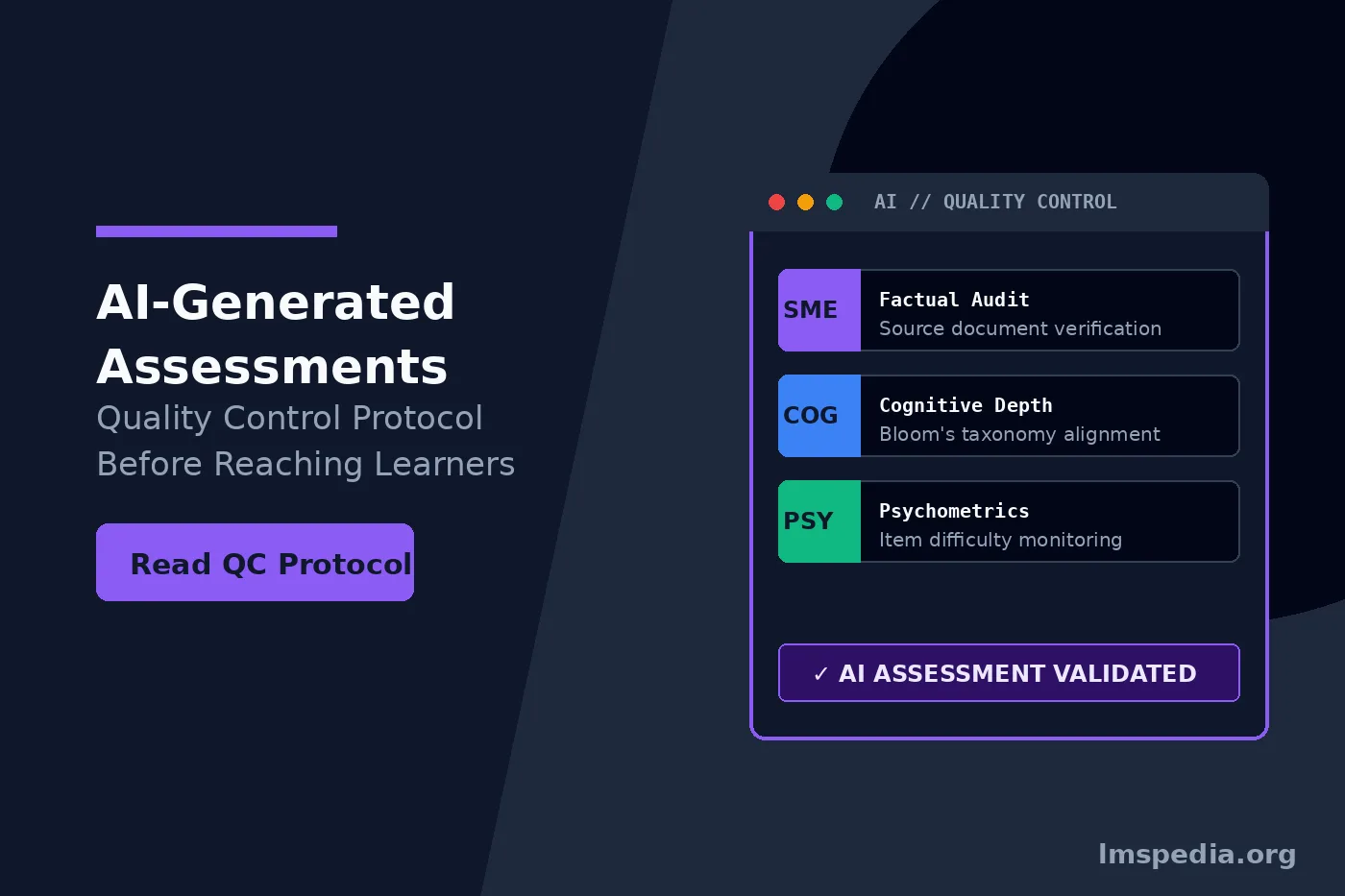
Artificial intelligence has fundamentally transformed instructional design by automating question creation at unprecedented speed. Consequently, learning and development teams can produce extensive question banks in seconds rather than weeks. However, deploying raw ai generated assessments directly to students introduces serious pedagogical hazards. Generative models frequently hallucinate facts, generate implausible distractors, and produce subtle grammatical clues that spoil correct answers. Without rigorous human oversight, automated testing tools compromise instructional integrity and skew learner evaluation metrics completely.
Implementing a systematic quality control protocol protects your testing programs from flawed test items. Rather than viewing ai quiz generation as an autonomous solution, organizations must treat artificial intelligence as a drafting assistant. Instructional designers and subject matter experts must audit every prompt output before publishing. In this comprehensive guide, we establish an enterprise quality control protocol for reviewing ai assessment items. Furthermore, we examine key benchmarks for ai question generator quality, explore automated item generation frameworks, and outline post-deployment psychometric tracking.
Key Takeaways

AI Requires Human Validation:
Generative AI tools draft questions quickly, but human subject matter experts must verify factual accuracy, distractor quality, and cognitive alignment before release.
Watch for Syntactical Clues:
Automated tools frequently make correct answers longer and more detailed than distractors, allowing learners to guess answers without mastering content.
Enforce Source Grounding:
Restrict AI prompts to verified technical manuals and standard operating procedures to eliminate hallucinations and ungrounded claims.
Apply Role-Based Access Control:
Authoring workflows must separate draft item generation from final exam publishing permissions to prevent unvetted questions from reaching students.
Monitor Post-Deployment Psychometrics:
Continually track Item Difficulty ($p$-value) and Item Discrimination ($D$) indices within your LMS to detect and fix flawed questions using real response data.
The Rise and Risks of Automated Item Generation
The transition toward automated item generation represents a major leap forward for educational technology. Traditionally, developing high-stakes examination questions required hundreds of hours of manual authoring. Instructional teams had to draft question stems, write plausible distractors, and balance cognitive levels manually. Large language models (LLMs) accelerate this process by ingesting source manuals and generating hundreds of multiple-choice questions instantly.
However, automated speed introduces distinct operational vulnerabilities. When instructional designers rely on artificial intelligence without structured review gates, several recurring defects enter production question pools:
- Factual Hallucinations: Generative models often invent plausible-sounding facts, technical terms, or regulatory citations that do not exist in reality.
- Cognitive Shallowing: AI tools default overwhelmingly to low-level recall questions. Consequently, they fail to assess higher-order application, evaluation, or troubleshooting skills.
- Flawed Distractor Construction: Automated tools frequently generate distractors that are either obviously incorrect or partially correct, creating confusion among high-performing students.
- Syntactical Clueing: Algorithms often make the correct option significantly longer or more detailed than incorrect options. As a result, test-savvy learners guess the right answer without mastering the subject.
To establish strong foundational learning objectives before generating test items, instructional designers should review proven strategies in enterprise learning design and compliance frameworks.
Core Dimensions of AI Question Generator Quality
Evaluating automated test items requires a structured evaluation framework. Instructional designers cannot simply ask if a question looks reasonable. Instead, they must evaluate four distinct psychometric dimensions to measure true ai question generator quality.
1. Target Alignment and Cognitive Depth
Every generated item must map directly to a verified learning objective. Evaluators must verify that the item assesses the intended cognitive level under Bloom’s Taxonomy. If a learning objective requires a student to diagnose a hardware fault, an AI question asking for the definition of a component fails to meet the standard.
2. Stem Clarity and Focus
The question stem must present a single, unambiguous problem. Students should understand what the question asks before reading the answer choices. Furthermore, the stem must contain all necessary context without introducing extraneous filler text that increases cognitive fatigue.
3. Distractor Plausibility and Discrimination
Effective distractors must represent common learner misconceptions. If an incorrect option is absurd, it fails to differentiate between competent and incompetent candidates. Distractors must remain mutually exclusive and share similar lengths, grammatical structures, and complexity.
4. Absence of Bias and Cultural Clues
AI training datasets often contain inherent linguistic and cultural biases. Question reviewers must ensure that idioms, regionally specific phrasing, and confusing colloquialisms do not disadvantage international learners.
| Quality Dimension | Common AI Failure Mode | Reviewer Verification Action |
|---|---|---|
| Factual Accuracy | Hallucinated regulations, incorrect mathematical values, or obsolete facts. | Cross-reference the question stem and answer key directly against approved source documentation. |
| Cognitive Alignment | Defaulting to simple rote memorization instead of real-world scenario analysis. | Verify that the assessment item matches the explicit cognitive level of the target learning objective. |
| Distractor Viability | Generating obviously absurd or completely implausible incorrect options. | Ensure all distractors represent authentic real-world misconceptions with equal plausibility. |
| Structural Clueing | Making the correct answer conspicuously longer, more detailed, or grammatically unique. | Standardize length and formatting across all options to prevent intuitive guessing. |
| Stem Precision | Using negative phrasing (e.g., “Which of the following is NOT…”) excessively. | Rewrite negative stems into clear, positive problem statements whenever possible. |
Before building extensive question banks, training departments must define their competency gaps accurately. Utilizing structured training needs assessment tools helps organizations identify critical knowledge domains that require rigorous testing.
The 5-Step Quality Control Protocol for AI Assessments
To eliminate errors systematically, organizations must institutionalize a repeatable review process. Applying this 5-step quality control protocol ensures that every assessment item meets rigorous psychometric and regulatory standards before reaching active learners.
Step 1: Source Document and Learning Objective Grounding
First, restrict the AI model to approved source content. Never prompt a public model to generate generic questions without context. Instead, feed the model specific standard operating procedures, technical manuals, or curriculum guides. Require the algorithm to output the exact page number or section citation for each generated item.
Step 2: Technical and Factual Verification
Second, a subject matter expert (SME) must inspect the draft items. The SME verifies that the correct answer is indisputably true and that none of the distractors are accidentally valid. Furthermore, the SME confirms that the technical terminology reflects current operational standards.
Step 3: Pedagogical and Distractor Screening
Third, an instructional designer reviews the question architecture. The reviewer eliminates common item-writing flaws such as “all of the above” or “none of the above.” Additionally, the reviewer balances option lengths and ensures that grammatical articles (like “a” or “an”) at the end of stems do not give away the correct choice.
Step 4: Bias, Accessibility, and Cognitive Load Audit
Fourth, review the items for readability and accessibility compliance. Ensure that the language remains direct and free of unnecessary jargon. Furthermore, verify that the reading grade level matches the target audience profile to prevent reading comprehension from interfering with technical assessment.
Step 5: Question Bank Ingestion and Metadata Tagging
Finally, upload the validated items into the central Learning Management System. Tag each item with relevant metadata, including difficulty level, objective ID, author, and review date. Consequently, the LMS can generate randomized, balanced exams that distribute cognitive load evenly across cohorts.
Human-in-the-Loop Governance and Review Workflows
Achieving consistent quality requires clear administrative governance. Artificial intelligence accelerates drafting, but human professionals remain legally and pedagogically accountable for test validity. Organizations must establish clear role separation between AI prompters, SME reviewers, and LMS administrators.
When multiple team members collaborate on question authoring, administrative confusion can lead to unvetted drafts leaking into live exams. Therefore, training teams must implement role-based access controls within their authoring platforms. To organize authoring permissions securely across departments, administrators should explore best practices on architecting clear LMS user roles and permissions.
Furthermore, human reviewers often experience cognitive fatigue when reviewing hundreds of questions consecutively. Fatigued reviewers easily miss subtle factual errors or duplicate distractors. To prevent administrative oversight errors caused by fatigue, compliance managers should integrate operational insights from the Dirty Dozen framework of human factors directly into their review workflows.
Managing AI Question Repositories in Enterprise LMS Architectures
Once you validate your assessment items, you must manage them within a scalable enterprise infrastructure. Large organizations often maintain tens of thousands of test items across global business units. Managing these massive repositories requires robust platform capabilities.
Different LMS platforms handle complex question banks, item pools, and algorithmic quiz randomization differently. Comparing enterprise platforms helps organizations choose systems that support sophisticated testing architectures. Review our detailed comparison of Open LMS vs Totara Learn to understand how different engines manage enterprise assessment workflows.
Additionally, high-stakes assessments demand uncompromised identity security. Ensuring that only authorized personnel can access, edit, or publish items into production repositories is critical. Implementing automated identity management protocols guarantees that permissions update instantly across enterprise platforms. To secure your administrative architecture, review this technical overview explaining what SCIM is and how it powers identity security.
Post-Deployment Psychometric Monitoring
Quality control does not end when you publish an exam. In fact, post-deployment psychometric analysis provides the ultimate validation of ai question generator quality. By analyzing real student response data, instructional designers can identify problematic questions that passed initial human screening.
Read more: Matching and Drag-and-Drop Question Design for Digital Assessments
Training teams should monitor three vital psychometric metrics continuously:
- Item Difficulty Index ($p$-value): This metric measures the proportion of examinees who answer an item correctly. A $p$-value between 0.30 and 0.80 generally indicates an effective item. Items with a $p$-value above 0.90 are too easy, while items below 0.20 may contain confusing wording or inaccurate answer keys.
- Item Discrimination Index ($D$): This calculation compares the performance of top-performing students against lower-performing students on a specific item. A high positive discrimination value ($D \ge 0.30$) indicates that high scorers answer correctly far more often than low scorers. A negative value signals a broken question where top students consistently pick a misleading distractor.
- Distractor Selection Frequency: Evaluators analyze whether students select every distractor. If a distractor receives zero selections across hundreds of test attempts, it is non-functional and requires revision.
Tracking these statistical metrics establishes a continuous improvement loop. When statistical anomalies emerge, instructional designers can pull the flagged items, refine the prompts, and update the question pool instantly.
Conclusion
Artificial intelligence offers immense productivity gains for instructional design teams, but automated speed must never supersede assessment quality. Relying on unverified ai generated assessments introduces factual inaccuracies, flawed distractors, and compromised evaluation standards. By enforcing a rigorous 5-step quality control protocol, organizations capture the rapid drafting power of AI while safeguarding pedagogical rigor.
Combining automated drafting with subject matter expert reviews, strict access governance, and continuous psychometric monitoring builds an unshakeable assessment infrastructure. Ultimately, maintaining high standards for reviewing ai assessment items ensures that your tests measure authentic student competence, protect organizational compliance, and uphold institutional credibility over time.
FAQ
Q1. What are AI-generated assessments?
They are quizzes, exams, and knowledge checks created using artificial intelligence algorithms or large language models that ingest instructional content to produce question stems, answer keys, and distractors automatically.
Q2. What is the biggest risk of using AI for quiz generation?
The primary risk is factual hallucination and flawed distractor construction. AI models often generate plausible-sounding but incorrect information or create distractors with subtle grammatical clues that give away the answer.
Q3. How do you review AI-generated multiple-choice questions effectively?
Follow a structured protocol: verify factual accuracy against approved sources, confirm alignment with target learning objectives, balance distractor lengths, eliminate biased phrasing, and remove clues like “all of the above.”
Q4. What is the ideal Item Difficulty index for assessment questions?
An optimal Item Difficulty index ($p$-value) sits between 0.30 and 0.80. A score above 0.90 indicates the question is too easy, while a score below 0.20 indicates confusing wording or a flawed answer key.
Q5. How does an LMS help maintain AI assessment quality?
An LMS provides centralized question banking, randomized quiz generation, role-based publishing workflows, and psychometric analytics to track real-world question performance continuously.