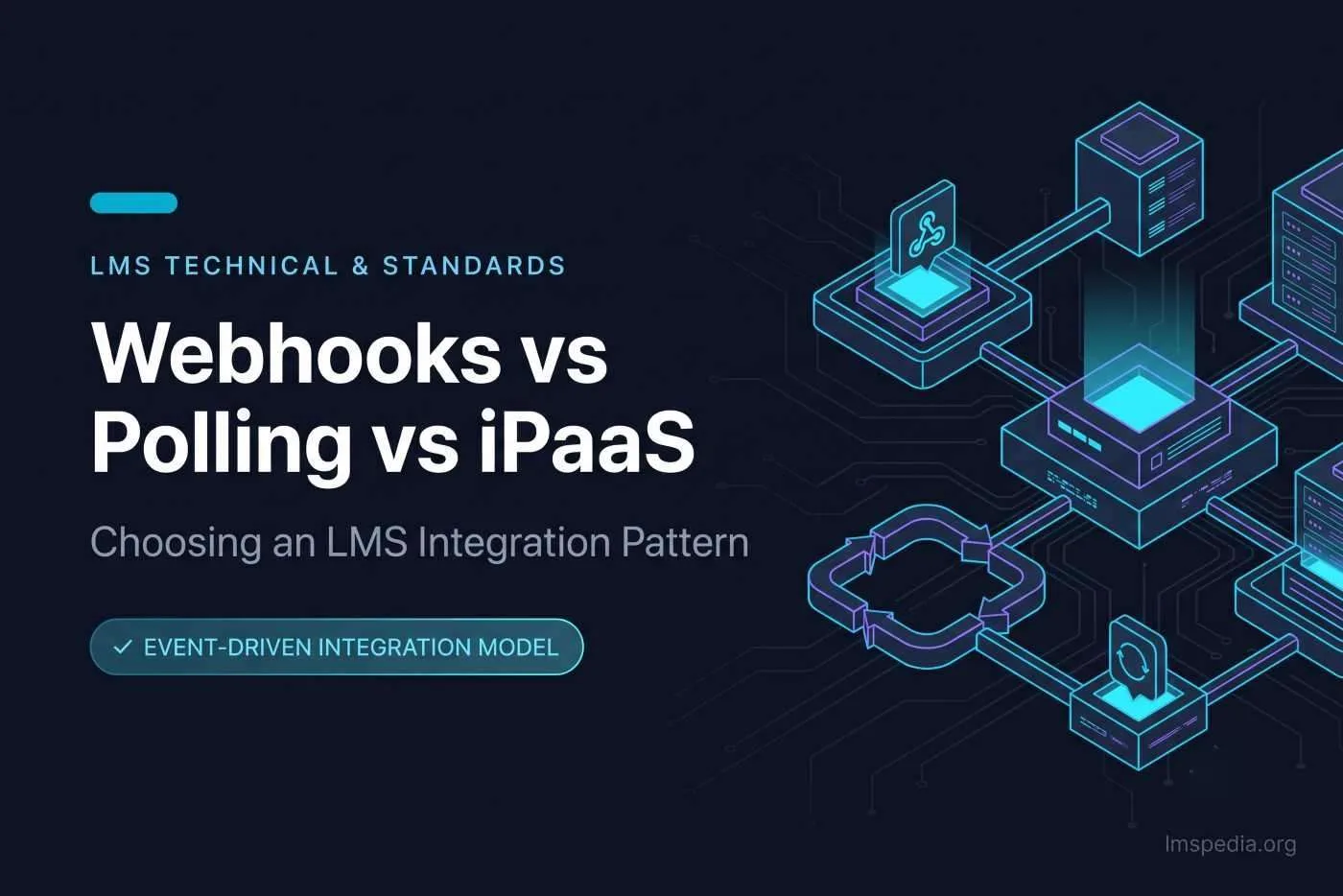
Webhooks vs Polling vs iPaaS: Choosing an LMS Integration Pattern
Enterprise technology ecosystems cannot tolerate operational isolation. Modern human resources information systems, customer relationship management platforms, and enterprise resource planning databases must exchange data continuously. When an enterprise deploys learning technology, administrators must synchronize user rosters, track course completions, and provision licenses automatically. However, selecting improper lms integration patterns creates fragile architectures, delayed synchronizations, and severe server strain. Technical software architects must evaluate whether webhooks, API polling, or iPaaS middleware best supports their operational requirements.
Historically, organizations relied on manual spreadsheet uploads or scheduled batch file transfers. These outdated methods introduce administrative friction and data discrepancies across corporate directories. Consequently, progressive engineering teams now implement automated, event-driven data pipelines. To review foundational architectural blueprints, explore our technical LMS webhook integration guide. Furthermore, system administrators should consult our comprehensive LMS integrations HRIS CRM API guide to understand cross-platform data mapping. Selecting an appropriate integration pattern ensures real-time accuracy and long-term infrastructure stability.
Ultimately, software architecture choices dictate system reliability during peak usage spikes. Permitting thousands of uncoordinated API calls degrades server performance rapidly. Therefore, enterprise IT leaders must evaluate data freshness, developer maintenance, and infrastructure costs before building integrations. A disciplined technical evaluation prevents multi-million-dollar software re-engineering initiatives later. Modern digital learning ecosystems require robust, predictable data pipelines to support enterprise scalability.
Key Takeaways

Architectural Latency Differences: Scheduled API polling introduces unavoidable data synchronization delays, whereas event-driven webhooks push critical learning updates to downstream systems in milliseconds.
Resource Optimization via Webhooks: Webhooks eliminate the massive computational waste of empty polling requests, preserving server CPU cycles and preventing API rate-limit throttling.
Idempotency and Security Mandates: Implementing webhooks requires robust engineering safeguards, including cryptographic signature verification, retry handlers, and idempotent payload consumers.
Centralized Middleware Orchestration: Enterprise iPaaS solutions solve data schema divergence and provide visual error management, making them ideal for complex, multi-application business workflows.
Least-Privilege Token Governance: Securing modern learning integrations demands fine-grained OAuth token scopes and automated SCIM identity synchronization to protect sensitive workforce records.
The Evolution of Integration Architecture in Learning Systems
Enterprise software stacks have transitioned from isolated monoliths toward decoupled, best-of-breed cloud applications. In the past, single software vendors attempted to handle every operational requirement natively. Today, organizations connect specialized tools using standardized communication protocols. Understanding this architectural shift helps engineering teams design resilient data conduits.
From Monolithic Suites to Distributed Ecosystems
Modern learning platforms do not operate in a vacuum. Instead, they interact with corporate identity providers, payroll software, enterprise data warehouses, and custom mobile applications. For example, when a new employee joins an organization, their identity profile originates inside an HRIS database. That record must propagate downstream into the learning platform within minutes. Similarly, when a technician completes a mandatory electrical safety certification, compliance records must update corporate directories instantly.
Consequently, integration architecture directly impacts workforce productivity and regulatory compliance. If synchronization jobs fail, employees cannot access required onboarding materials. Furthermore, safety managers cannot verify field technician qualifications during state audits. Technical guidelines defined by the Internet Engineering Task Force govern the underlying HTTP standards that power these modern data exchanges. Building clean, standardized connections eliminates operational blind spots across the enterprise.
The Real Cost of Inefficient Data Pipelines
Inefficient data integrations consume valuable engineering resources and inflate cloud hosting expenditures. When developers build brittle, point-to-point connections, routine system upgrades break downstream integrations unexpectedly. Technical teams then spend hours diagnosing database schema mismatches and re-running failed batch jobs manually. Therefore, selecting an inappropriate integration pattern generates ongoing technical debt.
Moreover, unoptimized data transfers introduce severe network latency. Processing massive data payloads during business hours slows down user interfaces for active learners. Frustrated employees submit support tickets, overwhelming internal IT helpdesks. Establishing structured, reliable integration patterns eliminates these costly bottlenecks permanently.
Pattern 1: Scheduled API Polling (Request-Response Architecture)
API polling represents the traditional request-response integration model. Under this pattern, a client system queries an external API endpoint repeatedly at set intervals. Let us analyze the mechanics, advantages, and operational drawbacks of scheduled API polling.
Architectural Mechanics of Polling
Under a polling architecture, the client system initiates every transaction. Specifically, an automated background scheduler executes an HTTP GET request to the LMS API every few minutes. The client asks the server if new events or updated records exist. If records have changed since the last request timestamp, the LMS server returns the modified dataset. If no changes occurred, the server returns an empty response payload.
Developers often select polling because it is straightforward to conceptualize and deploy. Most developers understand basic HTTP GET requests and cron schedulers instinctively. Furthermore, polling operates cleanly behind corporate firewalls because the client system initiates all outbound requests. Inbound firewall ports do not need to be opened to external internet traffic. Therefore, basic polling requires minimal initial network security configuration.
Rate Limits, Server Overhead, and Resource Waste
Despite its simplicity, polling introduces immense computational waste. In typical enterprise environments, over ninety percent of routine polling requests return zero new data. Yet, each request consumes server CPU cycles, database connection pools, and network bandwidth. When multiple downstream systems poll the same LMS simultaneously, server resources degrade rapidly.
Consequently, SaaS learning platforms enforce strict API rate limits to protect server health. If your background synchronization scripts exceed these rate limits, the LMS returns HTTP 429 Too Many Requests errors. Downstream data synchronization halts until the rate-limiting window resets. Furthermore, polling introduces unavoidable data latency. If your scheduler polls every thirty minutes, critical completion records remain synchronized up to twenty-nine minutes late. Tightening the interval to thirty seconds reduces latency but multiplies infrastructure costs exponentially.
Avoid Tight Polling Loops
Never configure sub-minute API polling schedules on high-volume endpoints; aggressive request loops trigger automated rate-limit throttling and degrade database performance.
Pattern 2: Event-Driven Webhooks (Push Architecture)
Event-driven architecture replaces repetitive requests with real-time notifications. Rather than asking for updates constantly, downstream systems wait to be notified. Webhooks provide the foundation for modern real-time learning management operations.
Event Driven LMS Integration Mechanics
Webhooks utilize an inverted client-server relationship, often described as a reverse API. Instead of the client polling the LMS, the LMS initiates an HTTP POST request to a designated listener URL. This event fires immediately when a specific business event occurs within the learning platform. For instance, when a learner finishes a course, the LMS generates an event payload instantly.
The webhook payload typically contains structured JSON detailing the event type, timestamp, user identifiers, and completion statuses. The receiving system receives this payload, parses the JSON data, and updates its local databases in real time. Because transactions occur only when actual events happen, computational waste drops to absolute zero. Webhooks eliminate empty requests, preserving server resources and delivering sub-second data synchronization.
Payload Delivery, Failures, and Idempotency
While webhooks provide superior efficiency, they introduce distinct engineering challenges regarding network reliability. Because the internet is inherently unreliable, webhook deliveries can fail due to network timeouts or server restarts. Robust webhook producers must implement automated retry mechanisms with exponential backoff algorithms. If the receiving listener endpoint fails to return an HTTP 200 OK status, the producer retries delivery over several hours.
However, automated retries introduce the risk of duplicate message deliveries. Therefore, receiving endpoints must implement strict idempotency controls. An idempotent consumer inspects unique event IDs inside inbound headers before processing records. If the system has already processed that specific event ID, it acknowledges receipt but discards the duplicate payload safely. Furthermore, securing public-facing webhook listeners requires rigorous signature verification. Developers should review standards published by the National Institute of Standards and Technology to ensure cryptographic integrity across all open web endpoints.
Enforce Webhook Idempotency
Always track unique event IDs in a fast cache like Redis; verify incoming webhook signatures and drop duplicate message deliveries automatically.
Pattern 3: Enterprise iPaaS (Middleware Orchestration)
As enterprise software portfolios expand, point-to-point connections become unmanageable. Connecting dozens of applications directly creates an entangled web of custom code. Integration Platform as a Service (iPaaS) solutions introduce a centralized middleware orchestration layer.
iPaaS Learning Systems Architecture
An iPaaS acts as an intelligent communication broker between your LMS and corporate systems. Leading middleware platforms decouple individual software tools entirely. Instead of coding direct API links between your LMS and HRIS, both systems connect directly to the iPaaS middleware. The iPaaS manages message queues, visual workflows, and scheduled triggers centrally.
Furthermore, middleware platforms provide visual, low-code interface builders. Non-engineering technical specialists can configure multi-step data routing without writing complex custom software. For example, an iPaaS can listen for an LMS completion event, transform the date format, query a CRM database, and post an alert to Slack. Centralized orchestration simplifies complex multi-system business workflows significantly.
Transformation, Routing, and Error Governance
Data schema divergence represents a major hurdle in enterprise integrations. Your LMS might format employee names as two separate fields, while your payroll database expects a single string. Enterprise middleware handles complex data transformations dynamically in memory. The iPaaS translates field names, standardizes date formats, and filters payloads before routing records to target destinations.
Additionally, modern iPaaS solutions deliver centralized error logging and visual troubleshooting dashboards. When a destination system goes offline, the middleware queues failed transactions in persistent dead-letter buffers. Once the target database recovers, the iPaaS replays the queued messages in chronological order. Centralized error handling prevents catastrophic data loss and relieves software developers from building custom queuing infrastructure manually.
Deploy Asynchronous Dead-Letter Queues
Configure persistent dead-letter queues inside your middleware to store failed LMS transactions securely until destination services restore normal operations.
Technical Comparison: Webhook vs Polling vs iPaaS
Evaluating these three integration patterns requires balancing latency, development complexity, maintenance overhead, and operational cost. No single pattern solves every enterprise challenge universally. The optimal choice depends entirely on your organizational scale and data velocity requirements.
| Integration Dimension | Scheduled API Polling | Event-Driven Webhooks | Enterprise iPaaS Middleware |
|---|---|---|---|
| Data Freshness & Latency | High latency; updates depend strictly on polling schedule intervals. | Near-instantaneous; events push milliseconds after occurring. | Near-instantaneous; real-time event streaming and queued routing. |
| Server Resource Efficiency | Low; high percentage of empty calls wastes bandwidth and CPU. | Optimal; network calls occur only when real business events happen. | High; middleware absorbs connection overhead and buffers traffic. |
| Initial Engineering Effort | Low; simple HTTP GET scripts are easy to write initially. | Moderate; requires public endpoints, SSL, and retry handlers. | Low to Moderate; leverages visual connectors and pre-built templates. |
| Maintenance & Scalability | Poor; complex rate-limiting rules and cron maintenance over time. | Moderate; individual webhook listeners require ongoing monitoring. | Excellent; centralized governance, visual logs, and managed infrastructure. |
| Total Cost of Ownership | Low initial cost; hidden infrastructure expenses escalate at scale. | Low software cost; ongoing developer maintenance for custom listeners. | High subscription cost; offset by reduced custom developer overhead. |
When selecting a pattern, technical architects must examine operational trade-offs closely. For simple batch updates where data freshness is irrelevant, polling remains functional. However, for real-time compliance tracking or automated onboarding, event-driven webhooks provide unmatched operational efficiency. Conversely, if your IT department manages hundreds of interconnected enterprise applications, the governance benefits of an iPaaS justify its premium software licensing cost.
Securing Data Pipelines Across Learning Ecosystems
Data pipelines connecting enterprise learning systems handle sensitive employee and customer information. Consequently, security governance must remain an uncompromised priority across every integration layer. System architects must enforce strict authentication, access controls, and data protection protocols universally.
Token Governance and Scoped Permissions
Modern integrations must abandon static administrative API keys entirely. Sharing master administrative keys across multiple integration scripts creates catastrophic security vulnerabilities. If an attacker compromises a single script, they gain unchecked access to the entire learning database. Therefore, enterprise platforms must implement modern OAuth 2.0 token governance.
Developers should configure granular, least-privilege permission scopes for every integration client. To structure secure authorization parameters, review our technical guide on OAuth scopes and tokens for LMS integrations. An integration that synchronizes completion records requires read-only access to course data and write access to completions. That same integration must never possess privileges to delete user accounts or alter billing configurations. Restricting token scopes limits damage if credentials leak.
Automated Identity Provisioning and User Lifecycles
User lifecycle governance requires dedicated synchronization protocols. Relying on basic API scripts to manage employee onboarding and offboarding introduces severe compliance risks. When an employee leaves an organization, their access to corporate learning assets and internal intellectual property must terminate immediately. Delayed offboarding creates severe insider threat exposures.
Enterprise organizations solve this challenge by implementing standardized identity provisioning. Reviewing our architectural analysis of SCIM provisioning for LMS demonstrates how automated identity standards streamline user lifecycles. System for Cross-domain Identity Management (SCIM) utilizes RESTful APIs to push user creations, attribute updates, and account deactivations automatically. Synchronizing identity governance ensures that training access reflects real-time corporate employment statuses.
Contract Integrity and Standardized Documentation
Integrations remain maintainable only when software contracts are documented meticulously. When internal software teams change without clear documentation, custom integration code becomes unmaintainable legacy software. New developers hesitate to modify scripts, fearing they might break undocumented dependencies. Rigorous documentation preserves institutional knowledge permanently.
Engineering teams must maintain standardized API definitions using modern OpenAPI specifications. To evaluate documentation standards, consult our operational LMS API documentation guide. Clear documentation details request headers, query parameters, sample JSON payloads, and HTTP error responses. International data management standards maintained by the International Organization for Standardization guide clean corporate technical documentation. Structured documentation enables developers to build, test, and troubleshoot integration pipelines with complete confidence.
Benchmarking Integration Platforms and Tools
Selecting software to manage learning data pipelines requires objective technical benchmarking. Organizations must evaluate whether their core platforms offer native scheduling, flexible webhook engines, and enterprise connector ecosystems. Below, we compare leading software solutions engineered for training operations and enterprise automation.
| Platform / Solution | Primary Architectural Focus | Integration & Automation Strength |
|---|---|---|
| SimpliTrain | End-to-end commercial training operations, resource logistics, and automated scheduling. | Excels at native bidirectional webhooks, robust REST APIs, automated event triggers, and seamless HRIS/CRM data synchronization with zero manual middleware requirements. |
| Workato | Enterprise integration platform as a service (iPaaS) and workflow automation. | Delivers complex multi-system enterprise orchestration, pre-built application connectors, and advanced data transformation pipelines for large IT ecosystems. |
| Zapier Central | Lightweight cloud automation and task trigger management. | Provides rapid low-code connections for standard business apps, but features execution limits and latency constraints for complex enterprise learning matrices. |
Decision Matrix: Selecting Your Integration Pattern
Navigating technical integration choices requires a clear operational decision framework. Engineering leaders must evaluate organizational maturity, developer availability, and business latency requirements. Follow this strategic guidance to select the optimal integration pattern for your enterprise.
When to Implement Event-Driven Webhooks
Choose event-driven webhooks when business processes demand real-time execution. For example, if safety certifications must unlock physical facility access gates immediately, polling latency is unacceptable. Webhooks fire the millisecond an assessment finishes, updating access control databases instantly. Furthermore, webhooks represent the ideal choice when your development team possesses the technical expertise to build and maintain secure listener endpoints.
Additionally, webhooks are optimal when managing high-volume transactional platforms. If your LMS processes thousands of course completions daily, polling those endpoints wastes immense computational bandwidth. Webhooks push data only when events occur, preserving server stability and minimizing hosting costs. If you need low latency and high efficiency, webhooks represent the gold standard.
When Scheduled API Polling Remains Justified
Scheduled polling remains acceptable for asynchronous reporting and data warehousing. If your corporate analytics team extracts historical completion data once every twenty-four hours to update executive dashboards, real-time webhooks provide zero practical benefit. Executing a scheduled nightly batch query is simple, reliable, and perfectly adequate for aggregate reporting.
Moreover, polling is justifiable when connecting to legacy internal databases that sit behind strict corporate firewalls. If network security policies prohibit exposing public-facing webhook listeners to the internet, polling allows internal scripts to initiate outbound queries safely. When latency is irrelevant and network environments are heavily restricted, scheduled polling serves as a practical, low-risk fallback.
When Enterprise iPaaS is Non-Negotiable
Deploying an iPaaS middleware platform becomes mandatory when learning data must synchronize across complex, multi-application business workflows. If completing a training program requires updating an HRIS record, generating a state regulatory filing, creating a sales commission tier in Salesforce, and notifying a regional manager, point-to-point webhooks become unmanageable. Custom-coding these multi-step interactions creates severe technical debt.
Furthermore, an iPaaS is essential for enterprise organizations that lack dedicated software engineering teams to maintain custom code. Business analysts and IT specialists can manage pre-built connectors and visual mappings through low-code interfaces. If your organization prioritizes centralized governance, visual error monitoring, and rapid deployment across dozens of enterprise systems, investing in an iPaaS represents the most sustainable long-term decision.
Conclusion
Architecting resilient learning technology integrations requires moving beyond reactive, ad-hoc connectivity. As corporate software ecosystems expand, the technical mechanisms used to exchange workforce training data dictate operational velocity and system reliability. Disorganized data pipelines create administrative friction, corrupt corporate directories, and expose organizations to severe regulatory audit failures. Selecting the correct integration pattern establishes a stable foundation for long-term digital growth.
By conducting a rigorous technical evaluation of event-driven webhooks, scheduled API polling, and enterprise iPaaS middleware, technology leaders align system performance with true business requirements. Webhooks deliver unmatched real-time efficiency for critical compliance events. Scheduled polling provides dependable utility for asynchronous reporting and heavily restricted network environments. Centralized iPaaS orchestration empowers large enterprises to govern multi-system workflows without accumulating brittle custom code. Establishing disciplined, secure, and well-documented data pipelines ensures that your enterprise learning ecosystem remains agile, audit-ready, and scalable for years to come.
FAQ
What is the primary difference between API polling and webhooks in an LMS?
API polling relies on a client repeatedly sending HTTP GET requests to the LMS on a fixed schedule to check for new data. Webhooks use an event-driven push model where the LMS automatically sends an HTTP POST request containing event data to a listener URL the moment an event occurs.
When should an enterprise choose an iPaaS over custom webhook integrations?
An enterprise should choose an iPaaS when training completion data must trigger multi-step workflows across three or more disconnected systems, or when the organization lacks dedicated software engineers to maintain custom API code. Middleware provides pre-built connectors, visual mapping tools, and centralized error handling.
How do webhooks handle network delivery failures and downtime?
Reliable webhook producers implement retry mechanisms with exponential backoff algorithms, attempting redelivery over several hours if the listener returns an error. Destination systems should also implement dead-letter queues to catch and store failed messages for subsequent reprocessing.
Why is idempotency critical when building webhook listener endpoints?
Because network retries can cause the same webhook event payload to be delivered multiple times, receiving endpoints must be idempotent. Inspecting a unique event ID before executing database updates ensures duplicate messages are acknowledged and discarded without corrupting data.
Can an organization use both webhooks and polling within the same LMS architecture?
Yes, hybrid architectures are common and highly effective. Organizations frequently use real-time webhooks for time-critical actions (such as revoking facility access or provisioning licenses) while running scheduled nightly polling scripts for asynchronous data warehousing and aggregate business intelligence reporting.