Salesforce and LMS Integration for Customer Training and Partner Enablement
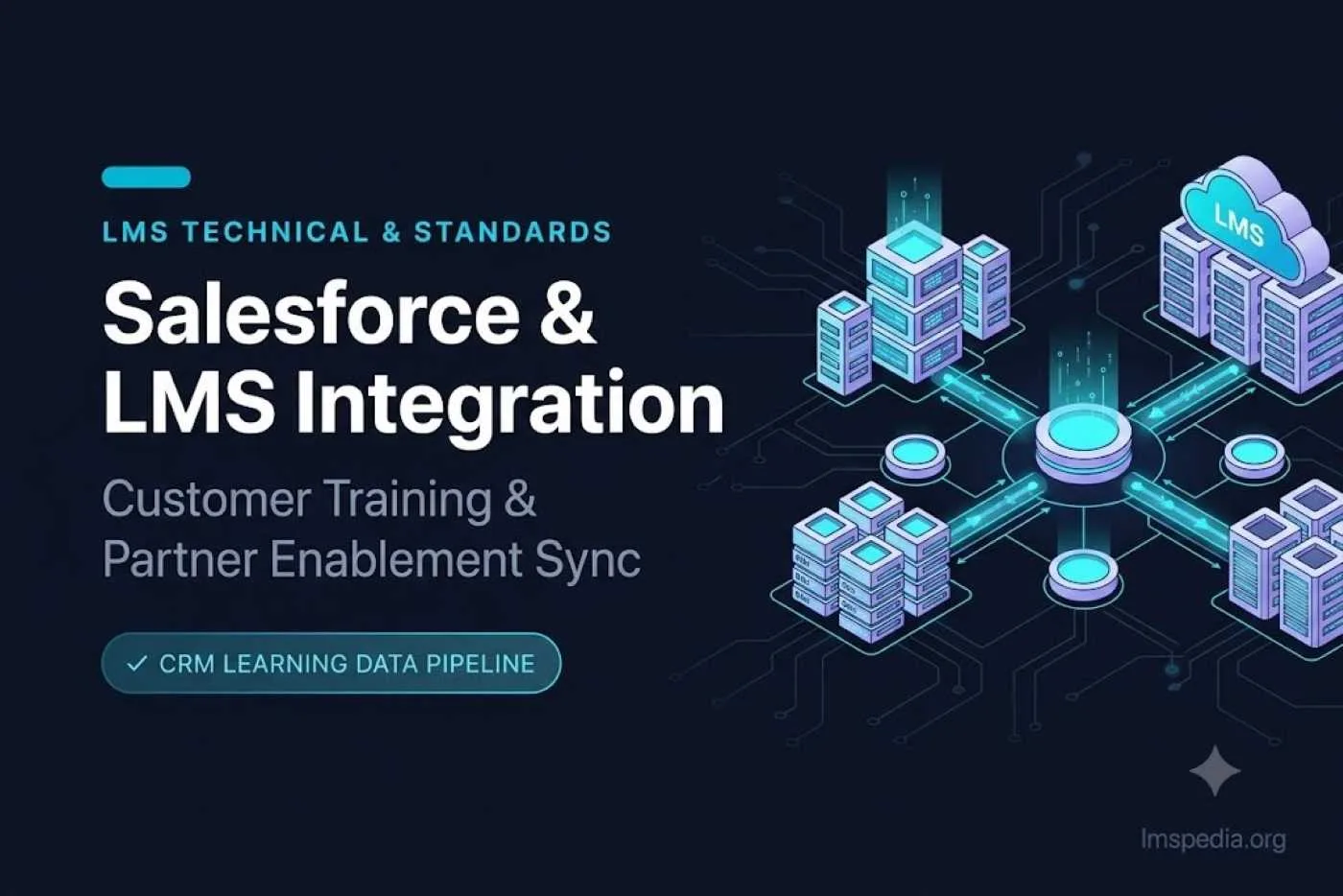
Enterprise growth strategies increasingly depend on educating external stakeholders alongside internal teams. Specifically, implementing an automated salesforce lms integration connects customer education directly to core commercial revenue workflows. Organizations often isolate learning platforms from daily sales and customer success operations. Consequently, client onboarding data remains trapped inside isolated learning databases where account teams cannot see it. Account executives struggle to identify which prospective buyers complete technical evaluations. Similarly, customer success managers lack visibility into customer training milestones before renewal discussions occur. Operating disconnected platforms introduces severe administrative overhead, delayed certifications, and lost revenue opportunities. Therefore, enterprise software architects must engineer dependable data pipelines between customer relationship management systems and modern learning platforms.
Connecting learning systems with customer relationship databases transforms educational programs into measurable business drivers. Indeed, corporate educators must implement proven customer education best practices to accelerate software adoption and minimize churn. Partner networks also require verified certification tracking to maintain authorized reseller tiers. Furthermore, technical leaders must evaluate comprehensive training software integrations across HR, CRM, and collaboration tools to unify operations. Eliminating data silos enables organizations to trigger targeted training enrollments based on real CRM milestones. This technical guide explores architectural paradigms, bidirectional entity synchronization, partner portal enablement, and resilient error governance.
Key Takeaways

Strategic CRM-LMS Alignment: Integrating an LMS directly with Salesforce breaks down customer data silos, transforming educational initiatives from an administrative overhead into an active driver of customer retention and revenue growth.
Event-Driven Architecture vs. Polling: Utilizing Salesforce Platform Events and real-time webhooks preserves daily API governor limits and delivers near real-time enrollment synchronization compared to traditional batch polling.
Actionable Customer Health Scoring: Populating custom learning objects (such as Course Enrollments and Certifications) inside Salesforce provides Customer Success Managers with real-time customer health telemetry to proactively mitigate churn risks.
Commercial Governance for Partner Portals: Embedding training inside Salesforce Experience Cloud enables automated deal registration gating, requiring channel partners to hold active technical certifications before accessing protected commercial margins.
Resilient Enterprise System Design: High-volume customer training integrations must employ the Salesforce Bulk API 2.0, exponential backoff error handling, and immutable Contact ID anchoring to prevent user duplication and API rate-limit exhaustion.
Architectural Paradigms: Unifying CRM Operations and Learning Delivery
Bridging a customer relationship management platform with an external learning system requires careful architectural planning. Modern cloud architectures demand secure identity federation, low-latency event synchronization, and structured entity mappings. System architects must select protocols that respect platform constraints while maintaining real-time data integrity.
Connected Apps, OAuth 2.0, and Identity Federation
Modern CRM integrations depend on secure token delegation rather than basic administrative credentials. Specifically, technical teams configure a dedicated Salesforce Connected App to manage external API access. The Internet Engineering Task Force formalizes modern authorization flows under the RFC 6749 OAuth 2.0 specification. Integration clients execute the OAuth 2.0 Web Server Flow or JSON Web Token Bearer Flow to obtain scoped access tokens. Furthermore, administrators must understand how to manage OAuth scopes and tokens for LMS integrations to protect endpoints against expired credentials. Configuring restricted access scopes ensures that the learning platform reads only specified customer contacts and accounts. Additionally, security officers can implement single sign-on across platforms using Security Assertion Markup Language. Single sign-on allows external customers and partners to transition into training courses without managing secondary passwords.
Event-Driven Webhooks vs. Scheduled API Polling
Integration architects must determine how data travels between the customer relationship system and the learning engine. Historically, engineers scheduled nightly batch scripts to synchronize contact records across servers. However, batch synchronization creates unacceptable operational latency for active customer onboarding. Technical teams evaluate these patterns by analyzing webhooks versus polling versus iPaaS architectures during system design. Event-driven architectures dispatch automated webhooks whenever an account manager updates an opportunity or contact. In Salesforce, developers configure Apex triggers or Platform Events to publish outbound messages immediately. Consequently, the downstream learning engine provisions student accounts within seconds. Replacing scheduled polling routines with event-driven webhooks conserves API quotas and keeps customer rosters synchronized in near real time.
Bidirectional Entity Mapping: Contacts, Accounts, and Learning Objects
Maintaining data harmony across disparate cloud databases requires explicit schema alignment. Specifically, the integration must map core CRM entities directly to downstream student records. The Salesforce Contact object typically anchors individual learner identities, while the Account object maps to corporate customer organizations. Furthermore, learning platforms return completion events back to the CRM by populating custom objects. For example, architects deploy custom objects such as Course Enrollment, Certification Record, and Skill Badge. Updating these custom records provides account teams with immediate visibility into learner progression. To understand how contemporary cloud architectures compare against corporate directories, engineers often benchmark these pipelines against BambooHR and ADP LMS connectors during technical reviews. Establishing clear relational data models guarantees that course progress reflects accurately across client accounts.
Advanced Technical Strategy: Platform Events
Utilize Salesforce Platform Events instead of high-frequency REST polling. Subscribing to event channels preserves your daily API governor limits while delivering sub-second enrollment synchronization.
Customer Training in Salesforce: Accelerating Product Adoption and Retention
Educating customers effectively drives measurable improvements across product utilization, customer satisfaction, and contract renewals. However, customer success teams cannot intervene effectively if learning analytics remain isolated inside training repositories. Embedding educational milestones into CRM dashboards empowers frontline customer teams to take proactive action.
Automating Customer Onboarding and Salesforce Course Enrolment
Automated customer education begins the moment a commercial sales deal closes. Specifically, administrators configure workflow rules that trigger when an opportunity transitions to Closed-Won status. The CRM engine identifies key customer contacts and initiates automated salesforce course enrolment workflows. Next, the learning platform ingests these contacts and assigns relevant onboarding curricula automatically. Customers receive personalized welcome emails containing direct access links to their product modules. Automated onboarding eliminates manual account creation delays, allowing clients to commence training on day one. Additionally, organizations with public academies can utilize SEO for training providers to attract prospective buyers through un-gated instructional content. Streamlining initial course enrollment accelerates time-to-value for new enterprise customers.
Surfacing Learning Milestones to Customer Success Teams
Customer success managers require real-time visibility into client learning milestones to diagnose account health accurately. By executing a continuous crm learning data sync, the learning platform updates Salesforce contact records automatically. Account dashboards display real-time course completions, assessment scores, and certification statuses directly beside customer support tickets. For example, if a client submits multiple support cases regarding basic software configuration, the customer success manager checks their training history. Discovering that the client skipped foundational onboarding modules allows the manager to recommend targeted refresher courses. Furthermore, tracking learner satisfaction via a standardized training NPS survey helps customer teams spot dissatisfied clients early. Surfacing educational metrics inside familiar CRM interfaces enables customer teams to deliver data-driven account guidance.
Correlating Customer Certification with Product Usage and Churn Reduction
Modern enterprise leaders demand empirical proof that customer education investments reduce customer churn. Specifically, organizations must correlate client training completion rates directly with software renewal likelihood. Data analysts extract course completion metrics and compare them against annual product usage telemetry. Studies consistently reveal that certified customer accounts demonstrate significantly higher product utilization and lower customer support ticket volumes. Furthermore, learning leaders adapt the Phillips ROI methodology applied to monetize the operational benefits of customer training. Demonstrating that trained accounts generate higher customer lifetime value secures executive buy-in for ongoing educational initiatives. Connecting educational data to core customer relationship records establishes customer training as an indispensable corporate revenue driver.
Operational Best Practice: Health Score Weighting
Incorporate customer training completion percentages directly into your Salesforce Customer Health Score algorithms. Weighting certification status by fifteen percent helps account managers identify churn risks before renewal dates.
Partner Portal Training Integration: Empowering Channel Ecosystems
Channel partner ecosystems represent vital distribution channels for enterprise hardware, software, and industrial manufacturers. However, managing indirect sales teams requires strict qualification controls and consistent certification tracking. Integrating training into partner relationship portals ensures that external distributors maintain verified technical competence.
Embedding Learning Inside Salesforce Experience Cloud via Single Sign-On
Channel partners demand friction-free access to technical certification tracks and sales collateral. Consequently, organizations build unified partner portal training integration architectures using Salesforce Experience Cloud. Rather than forcing distributors to navigate multiple external websites, architects embed training modules directly into the partner community. Specifically, developers utilize Lightning Web Components or Canvas iframes to surface course catalogs seamlessly. The World Wide Web Consortium establishes technical standards for responsive web embedding and cross-origin security. Furthermore, single sign-on federation authenticates partner users automatically, removing secondary login friction. Presenting training within an established partner community elevates participation rates and reinforces brand loyalty across channel networks.
Tiered Partner Certifications and Channel Compliance
Indirect distribution agreements often require channel partners to maintain specific technical staffing levels. For example, achieving Gold Partner status may mandate that a reseller employ at least four certified system engineers. Managing these partner tiers requires continuous tracking of external worker credentials. Learning platforms synchronize completed partner certifications directly into Salesforce Account objects. Next, automated CRM workflows evaluate active certification counts against contractual partnership tier thresholds. Many technology companies deploy dedicated corporate client portals for training providers to segregate partner cohorts securely. Differentiating between formal professional certifications and basic course completions requires understanding credentialing versus training frameworks across technical domains. Automated tracking guarantees that only fully qualified partner organizations represent enterprise products in the field.
Tier-Gating Deal Registration Based on Active Training Credentials
Enforcing partner training compliance requires establishing tangible commercial incentives. Forward-thinking companies link partner deal registration permissions directly to active educational certifications. Specifically, if a partner sales representative lacks current product accreditations, Salesforce restricts their deal registration controls. The portal informs the representative that unlocking protected margins requires passing the latest product certification exam. Furthermore, organizations can apply psychometric rules from true/false question design to ensure partner exams test real product competence. Restricting deal registrations motivates external channel partners to prioritize corporate certification tracks over competing vendor solutions. Linking educational compliance to revenue margins establishes unassailable channel standards.
Commercial Strategy: Gated Deal Registration
Automate deal registration locks in Salesforce Experience Cloud for partners whose technical certifications have lapsed. Gating pipeline incentives drives immediate partner compliance without requiring manual administrative policing.
Overcoming Common Technical Failure Modes in CRM-LMS Syncs
Engineering robust enterprise integrations demands proactive mitigation of software bottlenecks and operational edge cases. High data volumes, restrictive API governors, and schema drifts can quickly derail customer synchronization pipelines. Technical teams must deploy defensive engineering safeguards to preserve continuous operational uptime.
Managing API Rate Limiting, Concurrency Limits, and Bulk Sync Bottlenecks
Cloud CRM platforms protect shared multi-tenant infrastructure by enforcing strict API rate limits. Specifically, Salesforce limits the number of REST API requests an organization can execute within a rolling twenty-four-hour window. When a learning platform syncs hundreds of historical customer training records simultaneously, it can exhaust available API allocations rapidly. Consequently, the CRM gateway returns an API limit exceeded fault and terminates external connectivity. To prevent API exhaustion, developers must utilize the Salesforce Bulk API 2.0 for high-volume data operations. The Bulk API processes thousands of student records asynchronously within compressed batch payloads. Furthermore, integration clients must incorporate exponential backoff algorithms to handle intermittent connection throttling gracefully. Defensive request throttling ensures that learning integrations never disrupt mission-critical sales and service operations.
Resolving Schema Drift, User Collisions, and Identity Federation Failures
Enterprise customer directories experience continuous data churn as contacts update email domains and transfer companies. If a customer contact changes their email address in Salesforce, downstream learning platforms can create accidental duplicate user profiles. Consequently, historical certification records detach from the active user account, creating compliance reporting errors. Technical teams avoid user collisions by anchoring customer training profiles to immutable Salesforce Contact IDs rather than email strings. System architects frequently benchmark these identity patterns against SAP SuccessFactors to LMS integration models to resolve complex directory conflicts. Furthermore, developers must implement automated validation layers that sanitize incoming data payloads. Isolating malformed records into dead-letter queues prevents isolated data errors from halting broader enterprise synchronization jobs.
Protecting Sensitive Customer and Partner Training Data
Customer and partner training records often contain confidential business information, proprietary technical roadmaps, and personal contact details. Therefore, system architects must enforce rigorous data security standards across the integration layer. The National Institute of Standards and Technology establishes foundational cybersecurity frameworks under SP 800-53. Specifically, all data in transit between the CRM and learning platform must utilize Transport Layer Security encryption. Furthermore, sensitive customer attributes must remain encrypted at rest within the learning platform database. Implementing fine-grained role-based permissions ensures that external partner administrators view only their own team records. Compliance teams also review LMS pricing by monthly active users to predict licensing expenses across large external customer audiences. Maintaining strict data privacy safeguards protects enterprise relationships and ensures international regulatory compliance.
Implementation Blueprint: Five-Stage Salesforce LMS Deployment
Deploying an enterprise CRM-to-LMS integration requires methodical engineering, cross-functional alignment, and disciplined testing protocols. Technical teams should treat the integration project as a structured software engineering initiative. Following a phased implementation blueprint eliminates data loss and ensures seamless stakeholder adoption.
Phase 1: Requirements Discovery and Security Scoping
The implementation lifecycle commences with comprehensive requirements mapping across commercial departments. First, integration leads interview sales, customer success, and partner operations managers to define necessary data flows. Determine the specific triggers that initiate course enrollments, such as deal closures or partner onboarding milestones. Next, security administrators configure a dedicated Salesforce Connected App within a non-production sandbox environment. Assign minimal required API permissions to the integration service account, adhering strictly to the principle of least privilege. Furthermore, security officers must generate and store OAuth private keys securely within enterprise key management vaults. Establishing clear functional requirements and robust security boundaries eliminates project delays during technical execution.
Phase 2: Custom Schema Design and Field Mapping
The second phase establishes the relational data structures required to house training records inside Salesforce. System administrators create necessary custom objects, including Course Enrollment, Certification Record, and Skill Badge. Next, engineers establish lookup relationships linking these custom objects directly to standard Contact and Account records. Configure explicit custom fields to capture completion percentages, final assessment grades, and certificate expiration dates. Furthermore, developers must map data schemas meticulously between the external learning engine and Salesforce fields. Sourcing standardized demographic definitions prevents data truncation and preserves informational fidelity across systems. Validating schema structures ensures that downstream reporting dashboards extract accurate analytical metrics.
Phase 3: Sandbox Verification and Event Simulation
Rigorous sandbox testing represents a mandatory milestone before activating production data pipelines. Engineers connect the development learning platform directly to a full-copy Salesforce sandbox environment. First, technical teams execute synthetic integration tests simulating common customer lifecycle milestones. Simulate opportunity stage progressions, contact updates, and partner portal self-registrations. Verify that Apex triggers and Platform Events dispatch outbound webhook payloads reliably. Next, stress-test the integration by importing several thousand simulated student records simultaneously. Verify that batch pagination and Bulk API routines handle high data volumes without exceeding API governor limits. Resolving communication bottlenecks in sandbox environments safeguards production CRM systems against unexpected operational disruptions.
Phase 4: Experience Cloud Portal Integration and Single Sign-On
Once backend data synchronization functions reliably, technical teams configure the frontend user experience. Administrators embed learning catalog components directly into Salesforce Experience Cloud partner and customer portals. Configure SAML single sign-on federation to ensure that authenticated portal users transition into training modules without re-entering passwords. Next, design responsive layouts that adapt dynamically to desktop workstations, tablets, and mobile devices. Conduct rigorous user acceptance testing with a representative cohort of external partners and customer champions. Gather qualitative feedback regarding interface navigation, video playback stability, and course accessibility. Refining the frontend portal experience ensures high participation and positive initial adoption across external learning audiences.
Phase 5: Production Cutover, Dashboard Deployment, and Ongoing Governance
The final implementation phase transitions the synchronized learning ecosystem into live operational service. First, execute an initial baseline data migration during off-peak weekend hours to populate active customer records. Next, enable production webhook listeners and verify that real-time event synchronization flows uninterrupted. Business intelligence analysts configure standardized Salesforce dashboards for customer success and partner management teams. These dashboards track active enrollments, certification completion velocities, and partner compliance tiers in real time. Finally, establish ongoing technical governance protocols, including automated dead-letter queue monitoring and weekly API quota audits. Maintaining active operational oversight ensures that the integrated learning ecosystem delivers sustained business value.
Conclusion: Constructing a Revenue-Driving Learning Ecosystem
Executing an automated salesforce lms integration represents a transformative operational milestone for modern enterprise organizations. Isolating customer education and partner enablement inside standalone learning platforms limits corporate growth and creates administrative friction. Connecting the learning engine directly to central CRM databases turns training into an active revenue driver. Customer success teams gain immediate visibility into learner progression, allowing them to proactively resolve adoption hurdles and prevent client churn.
Furthermore, integrating training into partner relationship portals ensures that external channel distributors maintain verified technical competence. Enforcing tier-gated deal registrations and automating credential tracking elevates channel standards while protecting corporate reputation. Overcoming technical failure modes through event-driven messaging, robust bulk APIs, and defensive error logging guarantees long-term system stability. By establishing resilient integration architectures, enterprise organizations empower their customers, activate channel partners, and drive sustainable commercial success.
FAQ
What is the best way to handle Salesforce API rate limits during large LMS synchronizations?
To avoid exceeding Salesforce API governor limits, enterprise integrations should utilize the Salesforce Bulk API 2.0 for high-volume historical syncs, implement exponential backoff retry algorithms, and replace frequent REST API polling with real-time event-driven webhooks or Salesforce Platform Events.
Can customers access LMS courses directly within Salesforce Experience Cloud?
Yes. Organizations can embed LMS course catalogs and video players directly inside Salesforce Experience Cloud using Lightning Web Components (LWC) or secure Canvas iframes, combined with SAML single sign-on to provide external users with a seamless, password-free learning experience.
How does syncing LMS data to Salesforce help Customer Success Managers prevent churn?
Syncing training data creates custom objects in Salesforce that track course progression, exam scores, and certifications. Customer Success Managers can view these metrics directly on the Account page, allowing them to correlate low product adoption with incomplete training and intervene with targeted onboarding assistance before contract renewal.
What happens if an external customer changes their email address in Salesforce?
If user accounts are anchored solely to email strings, changing an email creates duplicate user profiles in the LMS. To prevent this, the integration must anchor all downstream LMS student records to the immutable Salesforce Contact ID, updating the email attribute without breaking historical course records.
Can an organization gate Salesforce deal registration based on partner training completion?
Yes. By writing validation rules in Salesforce that cross-reference the partner contact’s active certification custom object, the CRM can restrict the deal registration form, preventing channel partners from submitting deals until they complete mandatory technical training certifications.