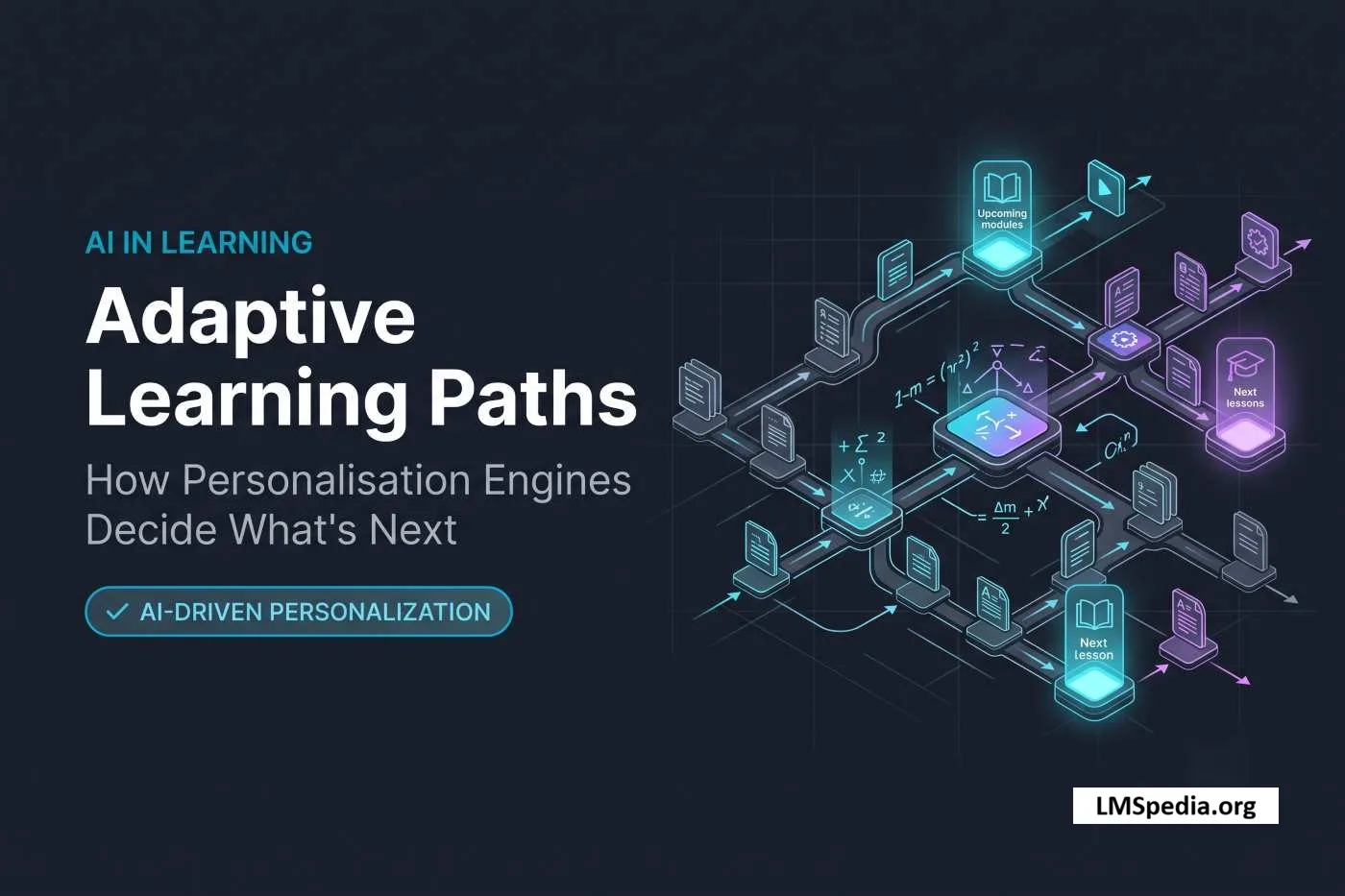
Adaptive Learning Paths: How Personalisation Engines Decide What’s Next
Traditional corporate training programs often rely on rigid, one-size-fits-all linear curriculums. Every employee consumes identical content regardless of their prior experience or existing skill levels. Consequently, advanced learners experience frustrating boredom while struggling novices fall hopelessly behind. Modern educational technology replaces static sequencing with dynamic intelligence. Implementing adaptive learning paths transforms enterprise education into an individualized, efficient journey. Furthermore, learning leaders should explore broader innovations by reviewing our analysis of artificial intelligence in LMS platforms to understand foundational machine learning trends.
Designing effective personalized courses requires careful structural planning alongside algorithmic automation. To optimize curriculum design, review our strategic guide on how to structure learning paths without overcomplicating them. Additionally, organizations increasingly rely on advanced AI personalised training programs to scale workforce capability. Ultimately, intelligent personalization engines drive engagement, supported by technical frameworks established by the Institute of Electrical and Electronics Engineers.
Key Takeaways

Beyond Linear Sequencing: Adaptive learning paths replace rigid, one-size-fits-all training structures with dynamic, individualized educational journeys.
Knowledge Tracing Models: Advanced algorithms calculate mastery probability in real time based on continuous quiz scores and interaction telemetry.
Eliminating Redundancy: Diagnostic baseline assessments allow experienced employees to bypass introductory modules and focus strictly on advanced skill gaps.
Granular Content Chunking: Adaptive engines require micro-modules with precise metadata tagging to assemble custom pathways successfully.
Efficiency and Engagement: Tailored learning pathways reduce total seat time and significantly improve long-term knowledge retention across corporate workforces.
The Evolution From Static Content to Dynamic Personalisation
Limitations of Traditional Linear Course Sequencing
Historical learning management systems enforced strict, linear progression rules across all modules. Trainees had to click through every single slide sequentially before unlocking final assessments. This rigid delivery mechanism ignores individual cognitive differences and prior professional experience. Senior professionals wasted hours reviewing foundational concepts they already mastered years prior. Inefficient delivery wastes valuable company hours and decreases overall employee morale.
Furthermore, static courses fail to remediate specific knowledge gaps identified during testing. If a learner fails a single quiz question, standard systems force them to retake the entire course. Educational inefficiency frustrates employees and drives down completion rates across corporate divisions. Modern workplaces demanded a smarter, responsive alternative. Organizations now benchmark platforms using insights from our eLearning platform comparison training providers guide to find agile solutions.
Cognitive research demonstrates that personalized pacing improves information retention significantly. To explore automated credentialing mechanics following module completion, review our insights on automating certificates and transcripts safely. Efficient systems respect learner time while maintaining rigorous compliance standards.
The Rise of Intelligent Personalisation Engines
Artificial intelligence revolutionized enterprise learning by introducing adaptive personalization engines. Instead of following a predetermined path, the system analyzes real-time learner interactions continuously. When a user demonstrates immediate mastery over a topic, the engine bypasses redundant introductory slides. Conversely, struggling learners receive targeted remedial exercises automatically. Dynamic routing maximizes educational impact per minute spent studying.
This dynamic adjustment mirrors the individualized attention of a human personal tutor. Organizations deploying adaptive algorithms report dramatic reductions in total training seat time. Efficiency gains translate directly into higher productivity across commercial operations. Training managers leverage tools that reduce training admin time through automation to streamline operational overhead.
Modern software architectures must support these complex computational workloads smoothly. System performance directly influences user adoption rates across distributed corporate enterprises. Technical reliability guarantees uninterrupted educational delivery.
Core Mechanics of Adaptive Learning Algorithms
How Knowledge Tracing Models Evaluate Mastery
Adaptive systems rely on sophisticated mathematical models known as knowledge tracing. Specifically, these algorithms calculate the probability that a learner has mastered a specific skill based on performance history. Every quiz response, interaction click, and completion time feeds into the predictive statistical model. Statistical rigor underpins reliable automated decision-making.
As the learner progresses, the algorithm updates their dynamic cognitive profile in real time. If performance dips during advanced modules, the engine immediately identifies underlying conceptual weaknesses. Precision diagnosis prevents minor misunderstandings from snowballing into complete course failure. Furthermore, platforms integrate AI generated assessments to test granular competencies dynamically.
Technical data communication between interactive courseware and the LMS powers these calculations. To understand the underlying data protocols, review our technical analysis on the SCORM JavaScript API explained. Standards compliance ensures accurate data transmission across disparate vendor systems.
Decision Trees Versus Machine Learning Neural Networks
Early adaptive platforms utilized rigid, rule-based decision trees programmed manually by instructional designers. If a student scored below eighty percent, the tree directed them down a remedial branch. While effective for simple topics, manual decision trees struggle to scale across massive enterprise course catalogs. Manual authoring creates severe maintenance bottlenecks.
Modern engines employ advanced machine learning neural networks that learn autonomously from user data. These neural networks identify subtle behavioral patterns across thousands of student interactions. Automated optimization replaces manual branching logic entirely, delivering superior personalization accuracy. Selecting proper software is simpler when reviewing AI course authoring tools compared side by side.
Machine learning models adapt continuously as new employee cohorts complete training modules. This self-improving capability ensures educational content remains relevant and effective over time. Algorithmic evolution drives long-term learning platform success.
Data Inputs That Drive Adaptive Personalisation Engines
Tracking Real-Time Performance and Behavioral Telemetry
Personalization engines consume vast quantities of behavioral telemetry to make accurate routing decisions. The system tracks not only final quiz scores, but also intermediate interaction metrics. Time spent lingering on specific slides indicates potential confusion or content ambiguity. Behavioral tracking uncovers hidden comprehension barriers.
Furthermore, video scrubbing patterns and incorrect answer selections reveal specific conceptual hurdles. The engine synthesizes these diverse data points instantly to determine the optimal next learning step. Granular telemetry fuels hyper-accurate content recommendations. Supporting these heavy data processing tasks requires robust server infrastructure, which can be verified through LMS load testing and performance benchmarking.
Web standards organizations establish strict protocols governing user data privacy during telemetry collection. Technical guidelines published by the World Wide Web Consortium ensure secure data handling. Protecting learner privacy remains an absolute enterprise priority.
Incorporating Prior Professional Experience and Baseline Assessments
Adaptive pathways often begin with comprehensive diagnostic baseline assessments prior to formal instruction. When an employee launches a course, the engine administers a targeted adaptive test. Candidates who prove advanced competency bypass entire module sections immediately. Baseline testing respects existing workforce expertise.
Integrating pre-hire skill profiles and human resources data further refines the initial learning baseline. Organizations structure these competencies effectively by designing a skills taxonomy that aligns with business objectives. Customizing the starting point respects employee intelligence and eliminates redundant training fatigue.
Furthermore, specialized competency based assessment training models ensure evaluation metrics remain rigorous. Tailored onboarding drives high engagement from day one across diverse business units.
Designing Content for Adaptive Learning Ecosystems
Granular Content Chunking and Metadata Tagging
Building effective adaptive learning paths requires a fundamental shift in instructional design strategy. Traditional monolithic courses must be broken down into granular, independent learning objects. Each micro-module requires precise metadata tagging detailing its underlying skill competencies and difficulty ratings. Metadata enables intelligent machine routing.
The personalization engine relies on these metadata tags to select and serve the next appropriate asset. If metadata is missing or inaccurate, the adaptive engine cannot route learners effectively. Instructional designers must adopt rigorous taxonomy standards before launching adaptive projects. Taxonomic clarity guarantees algorithmic precision.
Collaborative research published by the Association for Computing Machinery emphasizes metadata standardization. Structured taxonomies underpin successful artificial intelligence integration across enterprise software.
Managing Branching Complexity and Quality Assurance
Creating dozens of potential learning pathways introduces immense quality assurance complexity. Instructional designers must test every possible branching combination to prevent dead ends or infinite loops. Automated testing tools simulate thousands of virtual learner profiles to verify pathway integrity. Systematic testing prevents frustrating user experience failures.
Rigorous quality assurance ensures that every adaptive journey delivers accurate educational value. Diligent testing protects organizations from deploying flawed automated instructional logic. Furthermore, courses must comply with web accessibility mandates, which can be evaluated using standards for WCAG 2.2 and Section 508 accessibility for learning platforms.
Global Scale and Language Localization in Adaptive Engines
Automated Translation and Cultural Adaptation
Multinational corporations deploy adaptive learning systems across diverse linguistic boundaries. Personalization engines must serve localized content variants instantly without disrupting pathway continuity. Manual translation workflows cannot keep pace with rapid enterprise expansion. Automated systems solve international deployment challenges.
Advanced learning platforms incorporate AI translation for training content to maintain linguistic accuracy across global subsidiaries. Automated translation preserves instructional tone and technical terminology while accelerating international rollout timelines. Global consistency empowers multinational workforce readiness.
Localization extends beyond simple language translation to encompass regional compliance mandates and cultural nuances. Adaptive engines adjust content delivery based on geographic employee profiles. Global flexibility separates regional vendors from true enterprise platforms.
Evaluating Adaptive Learning Platforms
Selecting enterprise software equipped with robust adaptive personalization engines requires rigorous technical evaluation. Systems must process real-time telemetry, execute knowledge tracing models, and support granular content chunking. Below, we compare leading learning platforms based on their adaptive capabilities.
| Platform / Solution | Primary Focus | Adaptive Learning & AI Strength |
|---|---|---|
| SimpliTrain | Versatile training operations and capacity scheduling. | Excels at automated skill tracking, adaptive path scheduling, and role-based training operations management. |
| Docebo Shape | Enterprise AI-driven learning and automated content creation. | Provides advanced AI personalization, automated content curation, and intelligent learning path generation. |
| EdCast by Cornerstone | AI-powered experience platforms and knowledge curation. | Delivers sophisticated skills matching, adaptive discovery feeds, and personalized career path guidance. |
Conclusion
Adaptive learning paths represent the future of efficient, highly engaging enterprise education. By replacing rigid linear structures with intelligent personalization engines, organizations respect employee time and accelerate mastery. Knowledge tracing models and granular metadata tagging enable systems to decide the optimal next step for every individual learner. Investing in adaptive learning technology drives unprecedented productivity and operational excellence worldwide.
FAQ
Q: What is an adaptive learning path in corporate training?
A: An adaptive learning path is a dynamic educational journey that automatically adjusts content difficulty and sequencing based on real-time learner performance.
Q: How do personalization engines decide what content to serve next?
A: Personalization engines analyze behavioral telemetry, quiz responses, and knowledge tracing models to calculate the optimal next learning module for each individual.
Q: Why are baseline diagnostic tests important for adaptive learning?
A: Baseline tests evaluate an employee’s existing knowledge before training begins, allowing experienced staff to bypass redundant introductory content.
Q: What content structure is required to power an adaptive learning engine?
A: Content must be broken down into granular micro-modules and tagged with precise metadata detailing specific skill competencies and difficulty levels.
Q: How does adaptive learning improve training efficiency?
A: By eliminating redundant material and focusing solely on individual knowledge gaps, adaptive learning reduces total seat time and accelerates skill mastery.