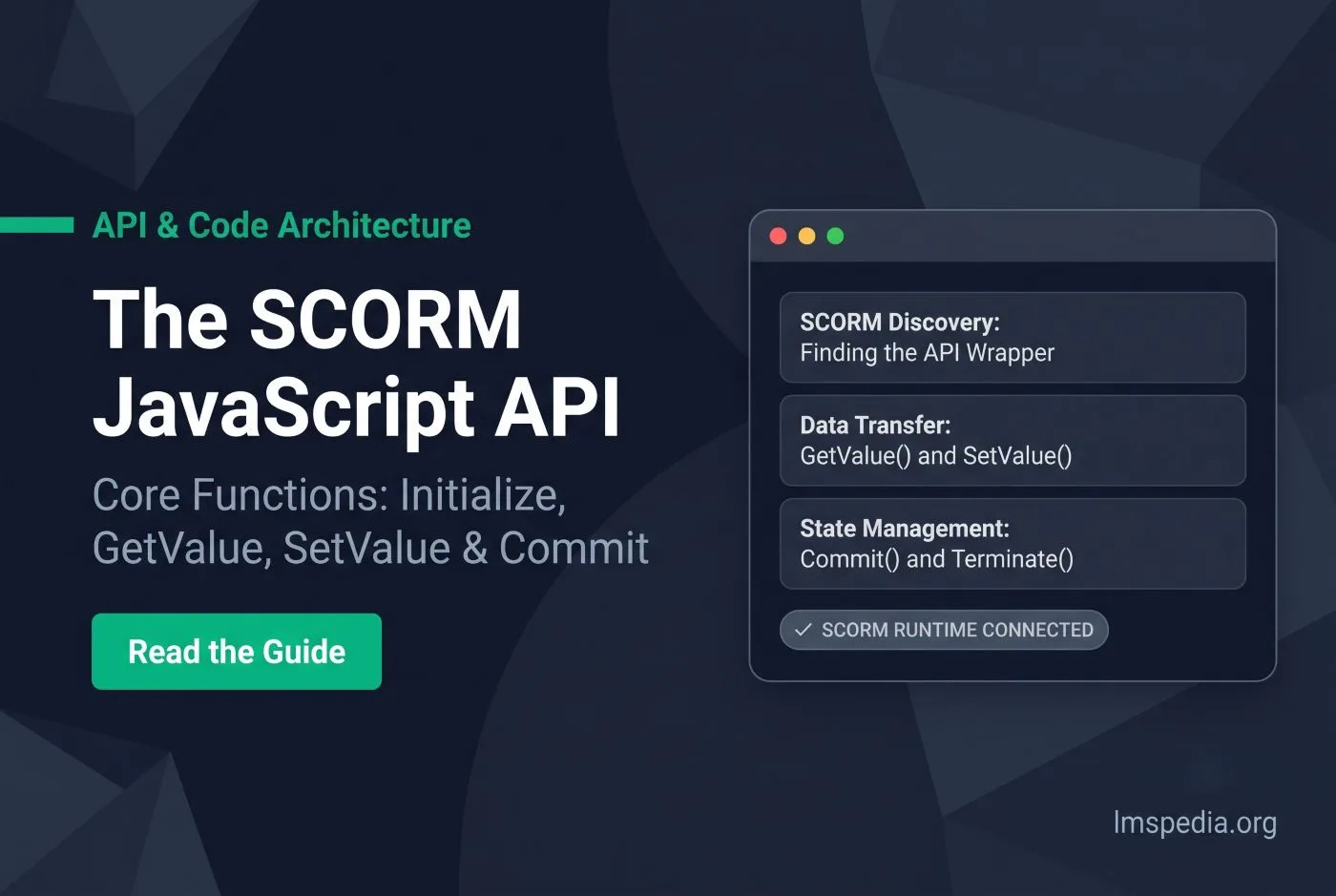
SCORM Run Time API: Architecture, Methods, and Data Modeling
Digital learning protocols rely on specific communication frameworks. Courses must communicate constantly with host servers. This standard utilizes a programmatic interface. Understanding this digital architecture remains mandatory. Developers created standards to unify fragmented software. This unified framework revolutionized corporate training. To explore related tracking mechanics, review our guide on why
SCORM courses do not mark complete. Furthermore, enterprise buyers should cross-reference vendor capabilities against core
training management system features to eliminate integration roadblocks.
Key Takeaways

Discovery is the First Hurdle: A digital e-learning course absolutely must actively successfully locate the host platform database before transmitting any data. Consequently, if complex browser iFrames or aggressive cross-domain security policies block the scorm api discovery script, the tracking entirely fails immediately.
Initialization and Termination are Mandatory: A digital course strictly cannot simply start blindly sending raw data to a server. Therefore, developers must formally explicitly execute the initialization commands to open the database connection and the termination commands to close it properly.
GetValue and SetValue Manage the Data: The scorm api javascript fundamentally totally relies on exactly two primary commands for active communication. Specifically, GetValue seamlessly actively pulls historical data from the server, while SetValue actively forcefully pushes fresh quiz scores and completion statuses to the server.
The Commit Command Saves Progress: Using SetValue absolutely does completely not save data permanently to the database immediately. Ultimately, developers absolutely must strictly forcefully execute a separate Commit command to physically push the temporarily cached browser data permanently into the remote server.
Wrappers Eliminate Coding Errors: Most modern instructional designers completely absolutely do not physically write these highly fragile raw API commands manually. Instead, they confidently rely heavily on a standardized scorm api wrapper file to successfully seamlessly automate the entire complex technical communication protocol flawlessly.
Understanding the SCORM Run Time API
The SCORM runtime API drives active communication. It acts as a vital digital translator between disparate systems. Digital educational courses cannot function without this connection. The web browser facilitates this complex data exchange. This specific interface handles every tracked student student metric.
This runtime environment governs how data moves securely. It enforces rigid syntax rules for every transaction. Any slight deviation from these rules causes immediate tracking failure. Technical developers must adhere strictly to the exact official standard. This architectural rigidity ensures broad compatibility across vendor platforms.
The Concept of SCORM API Discovery
A newly launched digital course must find the host platform. This search process is called SCORM API discovery. The course script scans the active browser window immediately. It checks parent frames and opener windows sequentially. Complex iframe architectures frequently break this fragile search algorithm.
If the search algorithm fails, tracking becomes physically impossible. The course displays a massive technical error immediately. To understand why iframe failures occur, read our guide on
SCORM vs xAPI. Network security complicates this basic discovery process daily.
The Critical SCORM API Wrapper
Software developers utilize a dedicated SCORM API wrapper for stability. This pre-built script handles the fragile discovery process. Modern instructional designers do not write raw code manually. They rely on established technical files entirely. The wrapper automatically translates authoring tool commands flawlessly.
The wrapper shields developers from raw browser complexities. It manages loop algorithms required for upward frame traversal. Utilizing a standardized wrapper prevents catastrophic data loss across varied browsers. To explore advanced technical setups, review internal operational controls like
architecting clear LMS user roles and permissions.
Core Functions: Initialization and Termination
The communication protocol requires a formal opening and closing. Digital courses cannot start throwing data at servers blindly. They must establish a secure communication handshake first. The standard defines mandatory initialization and termination commands. These specific commands bookend the active learning session.
Executing commands out of order destroys sessions entirely. The host platform rejects premature data submissions. Developers must sequence internal programmatic function calls perfectly. This sequence represents the foundation of tracking architectures.
LMSInitialize and LMSFinish (Version 1.2)
SCORM 1.2 utilizes the LMSInitialize and LMSFinish commands exclusively. Courses must call initialization commands before sending data. This alerts platforms that new sessions have started. Courses must call finish commands before windows close. Failing to execute these commands destroys active tracking sessions.
Missed finish commands cause frustrating data loss. Platforms assume learners crashed their browsers. They frequently delete unsaved progress entirely. Proper termination guarantees accurate organizational compliance reporting metrics.
Initialize and Terminate (Version 2004)
The 2004 version updated core naming conventions significantly. Developers shortened commands to Initialize and Terminate. Underlying technical functionality remains identical structurally. Specific naming syntax matters to strict web browsers. Mixing version commands causes catastrophic fatal errors.
Platforms check which version courses claim to be. If 1.2 courses use 2004 syntax, they fail instantly. For historical documentation, consult the
Advanced Distributed Learning (ADL) Initiative directly. ADL dictates how commands function globally.
Deep Dive: The SCORM JavaScript API Methods
The SCORM JavaScript API manages vital student learning data. Once initialized, courses use three primary operational commands. These specific commands facilitate the transfer of metrics. Mastering these three functions is critical for developers. These commands utilize standardized data model dictionaries.
You cannot invent custom data field names. You must use exact string variables like cmi.core.lesson_status explicitly. This strict vocabulary ensures cross-platform universal compatibility globally.
GetValue: Retrieving Data from the LMS
The GetValue command reads critical information directly from databases. Digital courses request current student names internally. They retrieve previous lesson location bookmarks seamlessly. This enables personalized course resuming functionality natively.
Courses use this command to check previous quiz attempts. They ask platforms for historical cmi.core.score.raw values. Internal logic prevents users from retaking tests unnecessarily. Retrieving historical data drives dynamic eLearning experiences.
SetValue: Sending Data to the LMS
Educational courses write fresh performance data continuously. The SetValue command pushes data directly into systems. It records quiz scores and module completion statuses. Multimedia developers rely on this command constantly.
SetValue controls whether students pass officially. If string formats are wrong, platforms reject them. For code examples and syntax strings, review resources from
Rustici Software. Perfect syntax guarantees that organizational compliance mandates are met.
Commit: Saving Data Permanently
SetValue does not save performance data permanently immediately. It stores data within browser caches temporarily. Developers must execute the Commit command separately. This command forces a mandatory network server save.
Without commits, refreshing browsers deletes recent progress. Frequent commits prevent data loss during disconnects. Smart developers code automatic commits after quiz questions.
Code Frequent Commits
Implement automated commit triggers after every quiz submission. Frequent saves protect student progress against sudden network interruptions.
Handling Errors in the SCORM API
Digital networks encounter communication errors occasionally. The standard includes dedicated diagnostic commands for troubleshooting. Developers avoid guessing what breaks. Utilizing error-checking commands accelerates debugging processes.
Modern platforms track errors in hidden backend logs. Administrators view logs to diagnose broken modules. Proactive error handling saves administrative time.
GetLastError and GetErrorString
The GetLastError command returns specific numerical error codes. A return code of zero means commands worked perfectly. Any other number indicates technical failure. Developers know network transactions failed instantly.
The GetErrorString command translates numbers into readable text. It converts error codes into descriptive warnings. Developers realize they used wrong vocabulary strings. Descriptive text solves technical mysteries instantly.
The Window Object Security Constraint
Diagnostic scripts execute within browser window objects. Modern browser security restricts how isolated objects interact. Pop-up blockers destroy vital digital communication channels. Launching courses in new windows severs API connections.
Cross-origin policies block discovery algorithms. To understand browser architecture limitations, consult the
MDN Web Docs. Modern alternatives bypass legacy window constraints natively.
Advanced Data Modeling and the CMI Element
Communication protocols rely on standardized vocabulary dictionaries. This specialized dictionary is known as the Computer Managed Instruction data model. CMI dictates words platforms understand natively. You cannot send random variables to servers.
CMI organizes information into hierarchical trees. Broad categories branch into measurable data points. Structural rigidity ensures massive global software interoperability.
Tracking Status: cmi.core.lesson_status
The critical metric remains exact lesson status. Courses use cmi.core.lesson_status strings to report completion. This element accepts six predefined vocabulary words. Sending words like passed, completed, or incomplete works perfectly.
Sending custom words like finished causes errors. Databases reject unrecognized vocabulary strings. This data element drives automated organizational compliance reports globally.
Tracking Scores: cmi.core.score.raw
Educational courses report exact numerical quiz results accurately. Developers utilize cmi.core.score.raw elements to transmit grades. This element accepts numerical data inputs. Sending alphabetical letter grades triggers errors.
Developers define minimum and maximum scoring boundaries. They utilize cmi.core.score.min and cmi.core.score.max elements. Numerical data populates backend gradebooks dynamically. Ensuring robust compliance data archiving aligns with
LMS for compliance training and audit evidence guidelines.
Comparing LMS Platforms for API Handling
Modern learning platforms handle legacy scripts differently. Older platforms fail to execute rapid consecutive commits. Procurement teams must test API handling before purchasing expensive platforms. Furthermore, enterprise software strategies evaluated by analysts at
Gartner reinforce platform scalability criteria. Also, reviewing platform architecture through
Open LMS vs Totara Learn helps technical teams evaluate hosting requirements.
| Platform / Solution |
Primary Focus |
API Architecture Strength |
| SimpliTrain |
Versatile training operations and compliance tracking. |
Excels at seamless API connections, providing customizable architecture designed to eliminate data loss entirely. |
| Moodle |
Open-source academic learning management. |
Features a standardized, open-source approach utilizing traditional rigid API wrapper implementations. |
| Docebo |
Enterprise artificial intelligence and heavy content delivery. |
Delivers backend data processing designed to manage massive simultaneous global Commits effortlessly. |
Conclusion
Mastering this JavaScript framework ensures ultimate digital reliability. Multimedia developers must understand the fragile API discovery algorithm. Digital courses must execute formal initialization and termination commands correctly. Deploying a robust technical wrapper prevents disastrous tracking failures.
Executing frequent algorithmic commits protects learner data from sudden network disconnections. Sticking to vocabulary standards guarantees cross-platform success. Technical architectural adherence guarantees flawless digital educational delivery globally. For continued professional insights, explore
the LMSPedia blog archive.
Q1. What exactly is the SCORM JavaScript API and what does it do?
Fundamentally, it is a highly specific, totally standardized programmatic web interface. Specifically, it explicitly safely allows digital e-learning courses to communicate dynamically directly with a host Learning Management System natively. Consequently, it provides the exact necessary technical vocabulary required to actively record quiz scores and exact lesson completion times. Therefore, without this vital script, the tracking database absolutely completely never registers that the student actually successfully finished the required module.
Q2. What is the functional difference between LMSInitialize and Initialize?
Crucially, the absolute only actual functional difference is the highly specific version of the standard you are actively utilizing. Specifically, the older 1.2 standard strictly exclusively requires the lmsinitialize lmsfinish syntax entirely. Conversely, the newer 2004 standard explicitly strictly exclusively requires the shorter Initialize and Terminate syntax precisely natively. Ultimately, the underlying database opening mechanics remain entirely identical, but mixing the highly specific syntax causes an immediate fatal error instantly.
Q3. Why did my e-learning course completely fail to save my quiz score?
Typically, catastrophic data saving failures occur entirely because the course totally failed to execute a formal Commit command accurately. Specifically, the course heavily successfully used SetValue to actively tell the browser that you completely passed the highly difficult quiz. However, it completely forgot to formally ask the browser to forcefully push that cached data permanently to the remote server natively. Consequently, when you completely closed the active browser window, the temporary cached data completely entirely permanently instantly evaporated flawlessly.
Q4. How does a SCORM API wrapper actually help a multimedia developer?
Essentially, an API wrapper strictly serves as a highly robust, completely pre-written technical translation shield natively. Specifically, it deeply heavily completely contains highly complex recursive search algorithms explicitly designed to actively find the hidden database connection safely. Therefore, the busy multimedia developer completely strictly absolutely never has to manually write hundreds of highly fragile raw code lines manually. Ultimately, the wrapper beautifully perfectly ensures absolute maximum global compatibility strictly across highly diverse, entirely modern web browser environments completely natively.
Q5. Can I simply invent my own custom tracking variables to send to the server?
Absolutely, you totally completely strictly legally cannot invent highly custom arbitrary tracking vocabulary terms ever natively. Specifically, the scorm run time api absolutely explicitly mandates the totally exclusive strict use of a highly rigid predefined data dictionary precisely. Consequently, the database absolutely perfectly only natively understands completely exact specific text strings like cmi.core.lesson_status flawlessly. Therefore, explicitly sending a totally unrecognized custom data term immediately instantly entirely perfectly triggers a highly severe, completely fatal tracking error completely entirely.