LearnUpon vs Skilljar: Extended Enterprise and Customer Training Comparison
Evaluating LearnUpon vs Skilljar requires auditing your primary training audience and software ecosystem carefully. Specifically, customer education teams demand tools that integrate directly with their customer success workflows. Software companies often select Skilljar to drive product adoption and combat account churn natively. Skilljar connects directly to CRM systems to measure customer engagement accurately. Consequently, customer success leaders track certification progress alongside product metrics seamlessly. Conversely, organizations choose LearnUpon to manage complex extended enterprise networks alongside internal employee learners. LearnUpon delivers a versatile multi-portal framework that segments partners, clients, and employees securely. Therefore, picking the wrong platform limits your long-term customer education and partner enablement initiatives. In this detailed guide, we evaluate both platforms across critical enterprise dimensions. Ultimately, choosing the right platform accelerates revenue and stabilizes customer retention globally.
Training external partners and clients requires fundamentally different software capabilities than standard internal training. First, internal employees represent a captive audience mandated to complete compliance modules. Human resource systems automatically provision internal users through standard corporate directories. In contrast, external learners access training voluntarily through public catalogs or customer academies. If the registration workflow creates friction, customers abandon the academy immediately. Therefore, extended enterprise platforms require self-registration, e-commerce gateways, and tailored client branding. Furthermore, modern customer training engines must pass data bidirectionally into customer relationship management software. Reviewing our analysis on Skilljar vs Thought Industries highlights additional nuances in external training architecture. Next, we explore the core architectural differences between LearnUpon and Skilljar thoroughly. Ultimately, selecting the proper foundation secures your long-term customer success strategy completely.
Key Takeaways

Architectural Differences in Multi-Tenancy:
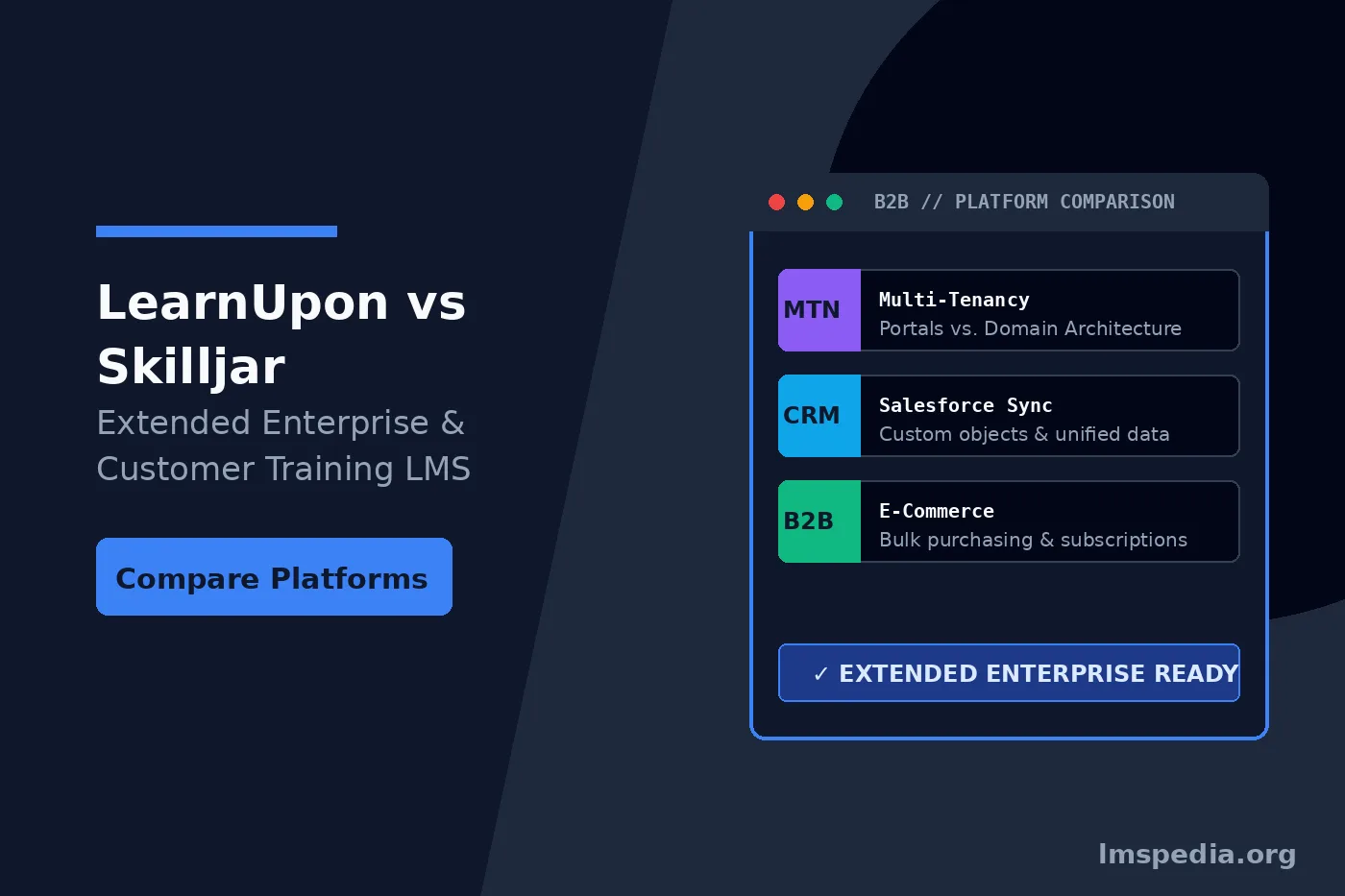
LearnUpon uses a hierarchical “Portal” system that isolates databases (ideal for strict franchise or reseller separation). Skilljar uses a “Domain” system that maintains a unified backend database (ideal for tracking a single customer’s journey across multiple branded touchpoints).
CRM and Customer Success Focus:
Skilljar dominates the SaaS customer education space through a highly advanced, native Salesforce managed package that writes custom objects directly to Account records, allowing organizations to tie training data to churn and Net Revenue Retention (NRR).
Versatility vs. Specialization:
LearnUpon is a versatile, hybrid engine capable of handling complex external partner training while simultaneously managing internal HR compliance. Skilljar is a specialized, hyper-focused tool built specifically for external customer onboarding and product adoption.
E-Commerce Execution:
For robust B2B bulk purchasing and complex tax/currency localization, LearnUpon leverages a deep Shopify integration. For B2C-style subscription models, premium training passes, and granular marketing promo codes, Skilljar provides a seamless native checkout experience.
Implementation and TCO:
LearnUpon generally offers a faster time-to-value with predictable scaling based on Monthly Active Users (MAUs). Skilljar requires a more technically intensive implementation to map its advanced data pipelines into your existing Customer Success stack.
Defining Extended Enterprise Architecture
Traditional corporate learning systems prioritize internal regulatory compliance, risk mitigation, and employee onboarding. Specifically, administrators configure automated provisioning workflows using enterprise identity tools. Reviewing modern SCIM provisioning for LMS environments demonstrates how internal systems automate user lifecycles. However, extended enterprise operations encounter entirely different operational realities daily. External learners do not exist within your internal corporate identity directory. Consequently, these learners require public registration pages, social login options, and flexible payment workflows. Furthermore, customer education platforms must deliver consumer-grade user interfaces to sustain engagement. If the platform feels clunky, external partners will refuse to complete certifications. Therefore, customer academies function more like marketing websites than traditional corporate compliance hubs. Ultimately, customer education platforms must generate revenue and protect client retention actively.
Audience Segmentation and Data Isolation
Extended enterprise networks require strict audience segmentation across competing customer cohorts. For example, a software vendor selling to rival financial firms cannot combine their learners. Specifically, employees from competing institutions must never see each other inside discussion boards or directories. Therefore, enterprise organizations require isolated learning environments featuring unique branding and distinct administrative controls. Furthermore, external customer training directly influences product adoption and customer renewal rates. When customers understand how to use your software, support ticket volume drops dramatically. Consequently, your customer education platform becomes a frontline revenue driver and brand ambassador. Both LearnUpon and Skilljar excel at external audience delivery. However, each system implements multi-tenancy through distinct technical philosophies natively. Next, we examine how each platform handles multi-tenant client environments.
Multi-Tenancy: Portals vs Domains
LearnUpon Hierarchical Multi-Portal Structure
LearnUpon approaches multi-tenancy through a top-down hierarchical portal architecture natively. First, administrators manage content within a central parent portal. Instructional designers upload SCORM packages, author assessments, and structure learning paths in this primary hub. Next, administrators spin up independent child portals from the parent environment. Each child portal operates as an isolated LMS instance with unique URLs, custom branding, and distinct user databases. Furthermore, content syndication represents the primary technical advantage of this structure. When administrators update a training video in the parent hub, changes push to child portals instantly. However, strict data isolation requires disciplined administrative governance across all child environments. LearnUpon suits franchise models and channel partner networks where legal separation remains mandatory. Consequently, multi-portal architectures guarantee complete privacy across external client organizations.
Skilljar Unified Domain Architecture
Skilljar manages multi-tenancy through customizable front-end domains tied to a unified backend database. Instead of spawning separate LMS instances, administrators launch multiple branded domains. For example, you can deploy distinct domains for enterprise clients, small businesses, and certification partners. Furthermore, all front-end domains share a centralized administrative console and reporting engine. Consequently, Skilljar provides a continuous, unified profile for every individual learner. If a prospect explores free public content before becoming a paying customer, their record persists unbroken. Customer Success Managers track learner progression across the entire customer lifecycle effortlessly. Therefore, SaaS companies prefer this unified database when monitoring product onboarding velocities. Ultimately, Skilljar eliminates data fragmentation across different stages of customer development completely.
Plan Your Tenant Architecture
Audit your client reporting requirements before choosing between sub-portals and domains. If clients require dedicated sub-administrators and isolated user directories, a hierarchical multi-portal architecture provides superior data isolation.
CRM Integrations and Customer Success Ecosystems
Skilljar Native Salesforce Integration
Customer training metrics provide little strategic value when isolated inside learning management systems. Therefore, customer education teams require bidirectional integrations with modern customer relationship management software. Skilljar demonstrates exceptional engineering strength within the Salesforce ecosystem. Rather than pushing flat data files via scheduled webhooks, Skilljar utilizes a sophisticated managed package. Specifically, organizations install this verified package directly from the Salesforce AppExchange directory easily. The integration writes custom training objects directly into native Salesforce database schemas. Consequently, training progress appears immediately on standard Account and Contact records. Furthermore, administrators trigger automated workflows based on real-time learner engagement data.
For example, if an enterprise client fails to begin onboarding within fourteen days, systems react automatically. Skilljar flags the inaction and creates automated alerts inside platforms like Gainsight instantly. Customer Success Managers intervene promptly before onboarding delays threaten long-term client health. Therefore, Skilljar treats customer training as a leading indicator of overall account retention. Furthermore, customer education leaders deploy strategies for client retention for training companies to maximize customer lifetime value. Connecting customer education metrics to renewal outcomes proves the financial value of the academy definitively. Consequently, software executives view Skilljar as an indispensable customer health engine. Ultimately, deep CRM connectivity aligns training initiatives directly with net revenue retention goals.
LearnUpon Two-Way CRM Synchronization
LearnUpon also provides a robust, bidirectional Salesforce integration alongside native connectors for HubSpot. Specifically, the integration automates user account creation based on CRM milestone triggers. For instance, when a sales representative marks an Opportunity as Closed Won, LearnUpon responds immediately. The system generates an account for the primary client contact automatically. Next, it enrolls the client into their designated onboarding learning path without manual intervention. While LearnUpon connects reliably to Salesforce, its architecture accommodates broader corporate use cases. Specifically, it synchronizes external CRM records alongside internal employee data from corporate human resource platforms. Therefore, LearnUpon serves organizations managing hybrid audiences exceptionally well. Ultimately, LearnUpon delivers dependable CRM data synchronization across diverse corporate operational models.
Tool Comparison: Extended Enterprise Platforms
Selecting an extended enterprise learning platform requires balancing architectural capabilities with commercial delivery goals. Organizations must evaluate how each system handles external multi-tenancy, commercial e-commerce, and back-office logistics. Furthermore, high-volume operations demand scalable software that accommodates fluctuating learner volumes smoothly. The comparative table below outlines three prominent platforms operating within the extended enterprise sector.
| Platform | Multi-Tenancy Framework | Core Commercial Focus | Ideal Operational Profile |
|---|---|---|---|
| SimpliTrain | Unified multi-tenant scheduling with automated client portals | Automated course operations, resource scheduling, and commercial checkout | Commercial training companies and enterprise providers managing complex customer operations |
| Skilljar | Branded front-end domains connected to a unified database | Customer education, SaaS product adoption, and customer retention metrics | High-growth SaaS organizations scaling customer academies via Salesforce |
| LearnUpon | Hierarchical parent-child sub-portals with strict database isolation | Hybrid delivery for employee compliance, channel partners, and customers | Mid-market to enterprise companies managing both internal staff and external reseller networks |
Monetization and B2B E-Commerce Capabilities
B2B Bulk Purchasing in LearnUpon
Commercial training monetization requires flexible payment processing for both consumers and enterprise buyers. LearnUpon processes individual course transactions through native Stripe and PayPal integrations securely. However, LearnUpon expands its retail reach through a deep integration with Shopify storefronts. By connecting to Shopify, organizations offload localized tax calculations, abandoned cart workflows, and currency conversions to dedicated retail engines. Furthermore, LearnUpon excels at B2B bulk seat licensing for corporate clients. Corporate buyers purchase course bundles and receive unique batch registration codes instantly. The client manager distributes these enrollment keys to their staff members independently. Consequently, this workflow removes manual administrative enrollment burdens from your internal team entirely. Ultimately, LearnUpon streamlines large-scale corporate seat sales effortlessly.
Subscription Models and Promotions in Skilljar
Skilljar delivers a streamlined checkout workflow optimized specifically for digital learning academies. First, the platform supports standard payment gateways for single-course credit card purchases. Additionally, Skilljar excels at managing recurring subscription training programs natively. Organizations can launch tiered training memberships that grant unlimited access to course catalogs for monthly fees. If a customer subscription payment fails, Skilljar revokes platform access automatically. Furthermore, the platform features a flexible promotional discount engine for customer marketers. Teams create unique coupon codes for marketing campaigns and track which promotions generate the highest registrations. Therefore, marketing leaders evaluate the acquisition cost of trained users accurately. Ultimately, Skilljar provides exceptional flexibility for digital course subscriptions and promotional marketing campaigns.
Leverage Bulk Seat Licensing
When selling training to corporate enterprise clients, mandate bulk seat licensing with self-service enrollment keys. This practice eliminates manual administrative overhead for your operations team completely.
Learner Experience and Interface Customization
Skilljar Consumer-Grade Academy Interface
External learners demand modern, intuitive interfaces comparable to consumer streaming platforms. Clunky compliance portals discourage voluntary customer engagement quickly. Skilljar designs its learner experience specifically to mirror consumer digital academies. The course catalog utilizes visual, tile-based navigation that showcases learning paths cleanly. Furthermore, administrators apply custom CSS and HTML to achieve precise brand alignment. Certification landing pages look identical to the company primary marketing website. Additionally, Skilljar optimizes its web interface for mobile browser responsiveness across all devices. Consequently, learners navigate courses on desktop monitors, tablets, or smartphones without encountering visual errors. Ultimately, Skilljar delivers an engaging learning environment that enhances brand equity consistently.
LearnUpon Structured Navigation and Native Mobile Apps
LearnUpon emphasizes structured, clean, and accessible interface navigation across all portals. The user interface remains highly intuitive and exceptionally stable for diverse audiences. However, LearnUpon maintains a more traditional corporate learning management system layout. The platform enforces structured design templates, preventing novice administrators from accidentally breaking page layouts. While it offers slightly less front-end code customization than Skilljar, LearnUpon ensures universal accessibility across all portals. Furthermore, LearnUpon provides dedicated native mobile applications for iOS and Android devices. External partners and field technicians download course content to study materials offline easily. Consequently, native mobile applications support mobile workforces who lack continuous internet connectivity. Ultimately, LearnUpon balances clean navigation with dependable offline mobile access.
Analytics, Reporting, and Financial ROI
Connecting Learning Metrics to Executive Business Outcomes
Executive leadership rarely evaluates external training success using simple course completion metrics alone. Instead, executives demand proof that trained customers renew contracts and purchase product expansions. Furthermore, leaders want evidence that customer academies reduce tier-one customer support inquiries. Reviewing frameworks for demonstrating training ROI to CFO stakeholders helps quantify the financial impact of learning initiatives. Skilljar excels at generating these executive-level correlative insights natively. By combining learning records with Zendesk and Salesforce data, analysts generate multi-variable reports easily. Teams prove mathematically that certified customers generate higher lifetime value and submit fewer support tickets. Consequently, these metrics transform customer education from an operational cost center into a documented revenue engine.
Operational Governance Across Decentralized Portals
LearnUpon provides a powerful operational reporting suite tailored for decentralized multi-portal management. Administrators generate global reports summarizing completion rates and e-commerce revenue across dozens of client portals. Dynamic user groups update automatically based on learner profile attributes, triggering scheduled automated reports. Furthermore, managers track certification expirations across regional partner organizations effortlessly. System administrators schedule automated executive summaries to arrive in stakeholder email inboxes weekly. Consequently, regional leadership monitors compliance adherence without logging into the administrative console manually. Therefore, LearnUpon makes managing massive, multi-tenant partner training operations remarkably efficient. Ultimately, robust operational governance guarantees total visibility across complex extended enterprise networks.
Deployment Timelines and Platform Performance
Implementation Scopes and Technical Workflows
Implementation timelines vary significantly between these two platforms based on their technical architectures. LearnUpon features a structured, out-of-the-box configuration that enables rapid deployment. Organizations frequently configure their parent portal, establish child environments, and launch courses within several weeks. Furthermore, LearnUpon provides structured onboarding packages and responsive customer support across all enterprise tiers. Conversely, Skilljar requires a more deliberate, technically intensive implementation process. Because Skilljar integrates deeply with Salesforce and customer success platforms, deployment demands cross-departmental coordination. System architects, CRM administrators, and marketing operations specialists must collaborate during the integration phase. However, once established, Skilljar automated workflows operate seamlessly with minimal daily administrative intervention.
Performance Benchmarking Under Peak Traffic
External customer training portals experience sudden traffic surges during product launches and global software updates. If thousands of external users access the platform simultaneously, server infrastructure must perform reliably. Conducting rigorous LMS load testing and performance benchmarking verifies platform stability before launching high-stakes customer certification campaigns. System latency or server downtime during a major client certification launch damages your professional brand reputation. Therefore, enterprise buyers must review vendor uptime service level agreements and peak concurrency benchmarks thoroughly. Both LearnUpon and Skilljar maintain robust cloud infrastructures designed to handle significant traffic spikes. Consequently, both platforms deliver dependable performance during demanding enterprise training events worldwide.
Benchmark Concurrency Early
Demand verified concurrency load testing metrics from your LMS vendor prior to contract execution. Ensure the platform supports simultaneous logins during global certification deadlines without performance degradation.
Conclusion
Choosing between LearnUpon and Skilljar requires auditing your primary audience and technical infrastructure carefully. If you operate a high-growth software company prioritizing customer onboarding, product adoption, and churn reduction, Skilljar provides the definitive technical solution. Its managed Salesforce package and customer success integrations transform training data into actionable business intelligence. Consequently, customer success teams identify at-risk accounts early and prove the financial value of customer education definitively. Skilljar delivers a modern, consumer-grade academy experience that engages voluntary external learners effectively.
Conversely, if your organization manages complex extended enterprise networks alongside internal employee learners, LearnUpon represents the superior architectural choice. Its hierarchical multi-portal architecture provides strict database isolation, making it ideal for franchise systems and global reseller networks. Furthermore, centralized content syndication allows administrators to push curriculum updates across hundreds of client portals instantly. LearnUpon balances external B2B commerce with robust internal compliance tracking through a dependable administrative console. By selecting the platform that aligns with your operational model, you build an efficient learning ecosystem that scales external revenue and strengthens client retention permanently.
FAQ
Q1. What is an extended enterprise LMS?
An extended enterprise Learning Management System is designed to train non-employees, such as customers, channel partners, resellers, and franchisees. Unlike internal HR platforms, these systems prioritize e-commerce gateways, public-facing course catalogs, self-registration workflows, and deep CRM integrations.
Q2. How does LearnUpon manage different partner brands?
LearnUpon utilizes a parent-child “Portal” architecture. An administrator can create a central parent environment and spin up multiple isolated child portals for different corporate clients. Content can be syndicated downward, but user data remains strictly segregated between portals.
Q3. Why is Skilljar preferred by SaaS customer education teams?
Skilljar is purpose-built to prove the ROI of customer training. Its deep integrations with Salesforce, Zendesk, and platforms like Gainsight allow organizations to mathematically prove that trained customers submit fewer support tickets and renew their software contracts at higher rates.
Q4. Can I sell bulk training courses to corporate clients on these platforms?
Yes. LearnUpon excels in B2B bulk purchasing, allowing clients to buy blocks of seats (e.g., 100 licenses) and distribute unique enrollment keys to their employees. Skilljar also supports B2B sales but has distinct native strengths in B2C subscription billing and promotional discount codes.
Q5. Can I use Skilljar for internal employee HR compliance?
While possible, it is not recommended. Skilljar is engineered specifically for external customer and partner education. If your organization requires a single platform to manage both mandatory internal employee compliance (via HRIS integrations) and external partner training, LearnUpon is the structurally superior hybrid choice.