LMS Validation: CSV vs CSA in Life Sciences
When highly regulated industries deploy new software, they cannot simply install an application and hope it works perfectly. In sectors like pharmaceuticals, biotechnology, and medical device manufacturing, software failures can directly compromise product quality and severely endanger human life. Consequently, global regulatory bodies like the United States Food and Drug Administration (FDA) and the European Medicines Agency (EMA) mandate strict quality assurance protocols. Before a life sciences company can legally train its manufacturing staff using a digital platform, they must execute rigorous lms validation. Furthermore, enterprise buyers should cross-reference vendor capabilities against a comprehensive benchmark of core training management system features to avoid functional compliance gaps.
Historically, organizations achieved this compliance through a heavily documented, manual testing process known as Computer System Validation (CSV). However, modern cloud architecture and agile software development forced regulators to rethink these archaic processes. The industry is currently transitioning toward a more dynamic, critical thinking approach known as Computer Software Assurance (CSA). Understanding the nuances of this transition is absolutely critical for compliance teams. In this comprehensive technical guide, we will break down the differences between traditional csv lms validation and modern CSA. We will also detail the exact mandatory documents you must generate to survive your next regulatory inspection. To understand how these compliance frameworks integrate with identity management, review our guide on SCIM provisioning for LMS architectures.
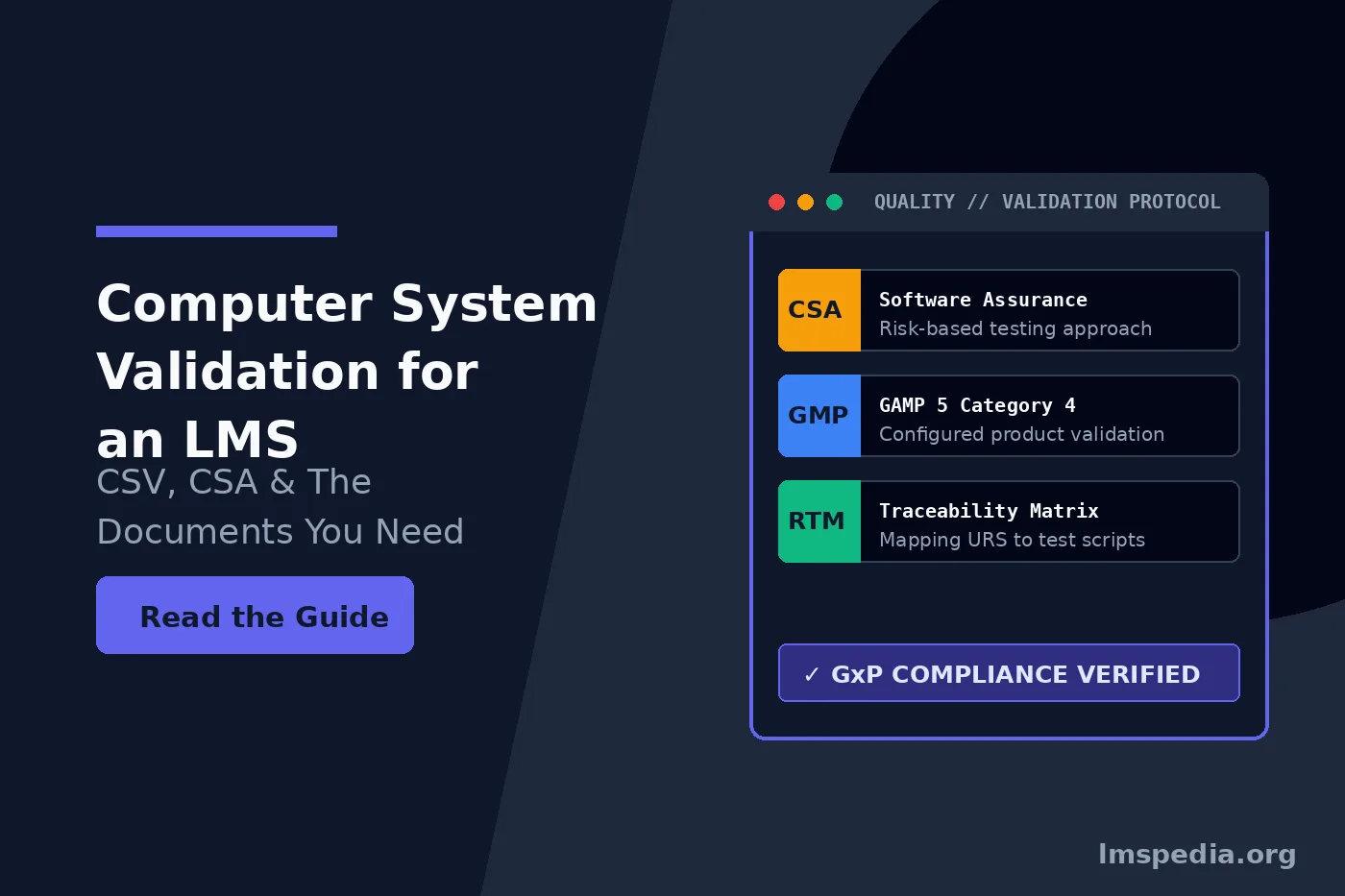
Validation is Legally Mandated: Because training systems dictate who is qualified to manufacture drugs or medical devices, the FDA classifies them as GxP-critical. You must formally validate the software before utilizing it in a live production environment. Transition from CSV to CSA: The industry is abandoning exhaustive, screenshot-heavy Computer System Validation (CSV) in favor of Computer Software Assurance (CSA), which focuses testing efforts strictly on high-risk features that directly impact patient safety.
GAMP 5 Dictates Effort: Most modern cloud-based LMS platforms fall under GAMP 5 Category 4 (Configured Products). You must validate your specific custom configurations rather than re-testing the vendor’s core source code The Golden Thread of Traceability: You must maintain a Requirements Traceability Matrix (RTM). This document provides undeniable proof to auditors that every single business requirement (URS) was successfully tested and verified. Validation is Continuous: Securing your initial Validation Summary Report is only the beginning. You must utilize strict formal Change Control procedures to evaluate and re-test the software every time the vendor releases a new patch or system update.
Key Takeaways

Why LMS Validation is a Legal Requirement
You might wonder why a training platform requires the exact same level of regulatory scrutiny as the heavy machinery mixing chemical compounds on the factory floor. The answer lies in the concept of predicate rules. In a Good Manufacturing Practice (GMP) environment, organizations must prove that their employees are fully qualified to perform their assigned tasks. If an uncertified employee operates a bioreactor, the entire batch of medicine must be destroyed. You can learn more about how to structure these specific role requirements in our guide on building a GxP training matrix by role.
Therefore, the Learning Management System is not merely a human resources tool; it is a critical operational safeguard. The LMS dictates exactly who receives digital access to the manufacturing floor. If the LMS suffers a software glitch and accidentally marks a failed exam as passed, it allows an unqualified employee to manufacture drugs. Because the software directly impacts product quality and patient safety, the FDA officially classifies it as a GxP critical system. This classification legally triggers the mandatory requirement for formal lms validation under 21 CFR Part 11 guidelines. Additionally, understanding foundational methodologies like computer system validation for an LMS ensures long-term audit readiness.
Understanding Traditional Computer System Validation (CSV)
For decades, the life sciences industry relied entirely on traditional Computer System Validation. The core philosophy of CSV is absolute, irrefutable documentation. The traditional approach mandates that every single function of the software must be tested, regardless of its actual impact on patient safety.
In a traditional csv lms validation project, quality assurance testers write massive, step-by-step test scripts for every feature. For example, they will write a ten page script to test if the forgot password button works. They will take a physical screenshot before clicking the button, another screenshot while clicking the button, and a final screenshot after clicking the button. This level of exhaustive, screenshot-heavy testing is incredibly expensive and notoriously slow. A standard CSV project for an enterprise LMS can easily take six to nine months to complete before the software can even go live.
Adopt Risk-Based Testing
First, transition away from exhaustive screenshot documentation on low-risk features. Focus rigorous script testing exclusively on audit trails and electronic signatures.
The Shift to Computer Software Assurance (CSA)
Recognizing that traditional CSV was stifling technological innovation and forcing companies to waste millions of dollars on meaningless paperwork, the FDA introduced Computer Software Assurance (CSA). CSA represents a massive paradigm shift in regulatory compliance. It moves the industry away from a compliance by documentation mindset and toward a compliance by critical thinking mindset. The FDA frequently issues updated guidance documents to help organizations navigate this transition.
The core principle of computer software assurance lms validation is risk-based testing. Instead of testing every single button equally, organizations must conduct an initial risk assessment. You analyze the LMS and determine which specific features directly impact patient safety or product quality, such as electronic signatures, audit trails, and automatic retraining triggers. You dedicate your rigorous, scripted testing entirely to those high-risk features.
Conversely, you use unscripted, ad-hoc testing for low-risk features like changing a user profile picture or updating dashboard colors. By adopting CSA, organizations can drastically reduce validation timelines, eliminate thousands of unnecessary screenshots, and focus quality assurance resources exactly where they matter most.
Determining the GAMP 5 LMS Category
Before you write a single test script, you must determine how much validation your specific software actually requires. The industry standard framework for making this determination is the Good Automated Manufacturing Practice guide, published by the International Society for Pharmaceutical Engineering.
The gamp 5 lms category directly dictates your testing burden:
-
Category 3 (Non-Configured Products): These are standard, off-the-shelf software applications that you use exactly as they arrive out of the box, with absolutely no modifications. They require the least amount of validation.
-
Category 4 (Configured Products): This is the standard gamp 5 lms category for modern enterprise platforms. The software is off-the-shelf, but the vendor allows you to configure specific workflows, turn modules on or off, and establish custom user roles without altering the core source code. Category 4 requires moderate to heavy validation focusing strictly on your specific configurations.
-
Category 5 (Custom Applications): This applies if you hire a development agency to build a proprietary LMS from scratch or if you drastically alter the source code of an open-source platform. Category 5 requires the absolute highest level of rigorous, end-to-end validation.
The Core Validation Documents You Must Generate
Whether you lean toward traditional CSV or modern CSA, regulators require a specific hierarchy of documentation to prove that your system is under absolute control. You must assemble these documents into a final Validation Master File. If an FDA auditor arrives at your facility, you must present these exact documents.
| Document Name | Primary Purpose | Regulatory Importance |
| SimpliTrain | Automated validation artifact tracking and audit readiness. | Ensures GxP compliance and traceable testing logs. |
| Validation Plan (VP) | Outlines the entire project strategy, defining the scope, responsibilities, and timeline. | Proves to the auditor that you followed a structured, pre-approved methodology. |
| User Requirements Specification (URS) | Details exactly what the business needs the software to do. | Acts as the absolute baseline; every test script must trace back to a specific URS requirement. |
| Functional Specification (FS) | Details exactly how the software fulfills the URS technically. | Ensures the IT architecture aligns with business compliance needs. |
| Validation Summary Report (VSR) | The final executive summary confirming testing is complete, listing deviations, and declaring the system fit for use. | The final legal sign-off required before migrating software to a live production environment. |
Executing the IQ, OQ, and PQ Testing Phases
The actual testing of the software occurs in three distinct phases. Quality assurance professionals commonly refer to these phases as the iq oq pq lms testing cycle.
1. Installation Qualification (IQ)
The IQ phase verifies that the software was installed correctly according to the vendor exact specifications. In modern cloud-based SaaS environments, the vendor usually handles the actual installation on their servers. Therefore, the vendor frequently executes the IQ and provides a summary report to the client. The client IT team simply verifies that they can access the correct URL and that the server environments are properly segregated.
2. Operational Qualification (OQ)
The OQ phase is the most intensive part of the iq oq pq lms cycle. This phase tests the software against Functional Specifications. During OQ, your validation engineers attempt to break the system. They intentionally enter incorrect passwords, try to bypass electronic signature prompts, and attempt to access administrative settings using basic learner accounts. OQ proves that system security features, audit trails, and automated workflows operate perfectly under extreme stress and edge-case scenarios. To understand specific electronic signature parameters you must test during this phase, review the official FDA Part 11 Guidance for Industry. For broader context on structuring records, consult our deep dive on 21 CFR Part 11 audit trails for training systems. Furthermore, verifying compliance documentation through resources like our guide on LMS for compliance training and audit evidence ensures complete institutional readiness.
3. Performance Qualification (PQ)
While OQ tests the technical boundaries of software, PQ tests software in the real world. During PQ, actual business users log into staging environments. They execute daily tasks according to approved company Standard Operating Procedures. PQ proves that software not only works technically but also seamlessly supports actual operational workflows of the business without causing friction or confusion.
Maintaining the Validated State
Validation is not a one-time project. It is a continuous lifecycle. Once your Validation Summary Report is signed and your LMS goes live, you must maintain its validated state indefinitely. Cloud software vendors push updates, security patches, and new features constantly. Every time the vendor updates the platform, you must execute formal Change Control procedures.
You must assess the vendor release notes to determine if updates impact critical GxP functionality. If updates alter electronic signature workflows or change how audit trails are generated, you must execute regression testing to prove systems remain compliant. If you fail to manage software updates formally, your system immediately falls out of compliance, completely invalidating your initial investment in lms validation. The European Medicines Agency provides excellent supplemental resources regarding Good Manufacturing Practice compliance that further detail continuous change control requirements.
Automate Regression Testing
Establish automated regression test scripts for core GxP functions. Running automated checks after every cloud vendor update minimizes manual validation overhead.
Conclusion
Deploying a Learning Management System in a highly regulated environment is a complex, high-stakes endeavor. You cannot simply trust that software will function correctly; you must prove it definitively to federal regulators. By understanding core principles of lms validation, you protect your organization from catastrophic audit findings and ensure absolute safety of manufactured products.
Embrace risk-based critical thinking of computer software assurance lms methodologies to reduce unnecessary paperwork. Accurately determine your gamp 5 lms category to scale testing efforts appropriately. Meticulously draft User Requirements Specifications and ruthlessly execute your iq oq pq lms testing cycles. When you treat validation as a strategic quality framework rather than a tedious administrative chore, you guarantee that your training technology serves as an unbreakable pillar of organizational compliance.
FAQ
Q1. What is LMS validation?
LMS validation is a formal, documented quality assurance process mandated by regulatory bodies like the FDA. It provides undeniable proof that a Learning Management System operates exactly as intended, securely tracks compliance training, and maintains accurate audit trails without technical errors.
Q2. What is the difference between CSV and CSA?
Computer System Validation (CSV) relies heavily on exhaustive documentation, requiring testers to write massive scripts and capture screenshots for every software feature regardless of risk. Computer Software Assurance (CSA) is a modern, risk-based approach that focuses rigorous testing only on features that directly impact patient safety or product quality, drastically reducing unnecessary paperwork.
Q3. What does IQ OQ PQ stand for in LMS validation?
It stands for Installation Qualification (proving the software was installed correctly), Operational Qualification (stress-testing the software’s functional limits and security features), and Performance Qualification (proving the software supports actual real-world business workflows).
Q4. Why do I need a Requirements Traceability Matrix (RTM)?
The RTM is the most critical document during a regulatory audit. It is a grid that connects every single business requirement to its corresponding test script, proving to the inspector that no critical software feature was skipped during the validation testing phase.
Q5. What happens if the software vendor updates the LMS after it is validated?
If the vendor releases an update, you must execute formal Change Control. Your quality team must review the release notes to determine if the update impacts critical GxP features. If it does, you must perform regression testing to re-verify compliance before accepting the update.