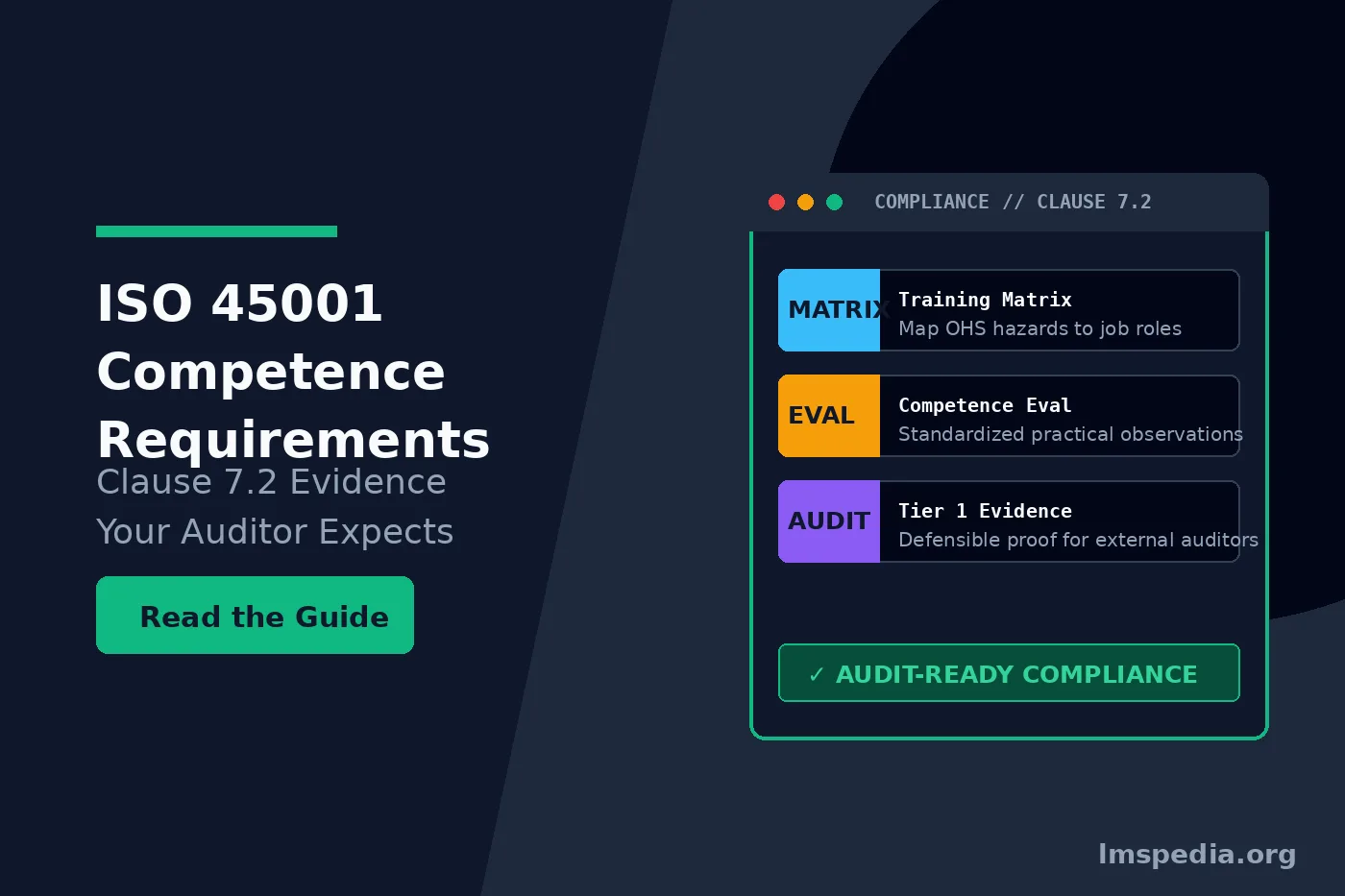
Many safety managers dread the annual ISO 45001 certification audit. When the external auditor reaches the section on worker capability, sliding a thick stack of paper attendance sheets across the conference table is an immediate recipe for a major non-conformance finding. ISO 45001 does not merely ask if your employees attended a safety presentation. The standard strictly demands undeniable proof that your workers are actually capable of performing their high risk tasks safely.
Understanding the strict nuances of iso 45001 training requirements separates world class safety cultures from organizations that merely chase paper compliance. To achieve true certification, safety professionals must transition from tracking basic attendance to measuring actual operational ability. In this comprehensive reference guide, we will break down the exact expectations of iso 45001 clause 7.2 competence. We will show you how to build a compliant iso 45001 training matrix, detail the exact types of ohs competence evidence auditors look for, and explain how to structure your overarching safety management system training natively.
Before diving into the complex international standards, it is highly beneficial to ensure your baseline domestic compliance records are in perfect order. Review our comprehensive checklist on OSHA recordkeeping and training documentation to secure your foundation. Furthermore, generating valid evidence requires highly specific assessment design. To ensure your exams actually measure operational capability accurately, explore our guide on writing measurable learning objectives thoroughly.
Key Takeaways

Shift from Attendance to Capability:
ISO 45001 Clause 7.2 demands that organizations stop relying on attendance sheets and start proving actual operational competence for high risk tasks.
Risk Based Requirements:
You cannot use generic training lists. Your specific ISO 45001 training requirements must map directly to the unique hazards identified in your facility’s risk assessments.
Structure Your Matrix Logically:
A compliant ISO 45001 training matrix clearly cross references job roles with required competencies, associated risks, evaluation methods, and strict refresher frequencies.
Generate Defensible Evidence:
Auditors prioritize high tier OHS competence evidence, such as supervisor signed practical observation records and simulation scores, over simple written quizzes or self declarations.
Automate Your Expirations:
Managing competence via spreadsheets leads to expired certifications and audit failures. Deploying a modern training management system automates compliance tracking and refresher notifications perfectly.
Decoding ISO 45001 Clause 7.2 Competence
To survive an audit smoothly, you must first understand the specific language used by the International Organization for Standardization. Clause 7.2 focuses exclusively on competence. The standard defines competence as the ability to apply knowledge and skills to achieve intended results. This definition represents a massive paradigm shift for traditional human resources departments.
An employee might possess thirty years of industry experience and hold a master’s degree in engineering. However, if they cannot physically demonstrate the safe operation of a newly installed hydraulic press on your factory floor, they are not competent under the eyes of the standard. ISO 45001 clause 7.2 competence requires organizations to systematically identify the skills required to navigate site specific hazards and then verify that workers actually possess those exact skills.
The Four Mandates of Clause 7.2
The standard explicitly requires your organization to take four distinct actions regarding your workforce. If you fail to document any of these four steps, you risk an immediate audit failure.
- Determine necessary competence: You must identify the exact skills required for workers who can impact your Occupational Health and Safety (OHS) performance.
- Ensure competence: You must guarantee that workers are competent based on their appropriate education, training, or practical experience.
- Take action: Where applicable, you must take immediate action to acquire and maintain the necessary competence. This usually translates to delivering targeted training programs.
- Retain documented information: You must maintain highly secure, verifiable records as evidence of this competence permanently.
Establishing ISO 45001 Training Requirements
You cannot buy a generic list of iso 45001 training requirements off the internet and apply it to your facility blindly. The standard is fundamentally risk based. Therefore, your educational requirements must be directly tied to the specific hazards present in your unique operational environment. A chemical processing plant will have completely different requirements than a commercial logistics hub.
Connecting Hazards to Education
The first step in defining your requirements involves a deep review of your existing hazard identification and risk assessment logs. For every high risk hazard identified in your facility, you must define a specific control measure. If that control measure relies on human behavior, you must establish a strict training requirement to support it.
For example, if your risk assessment identifies confined space entry as a critical hazard, your control measure likely involves a strict permitting process and continuous atmospheric monitoring. Consequently, your safety management system training must explicitly teach workers how to calibrate the gas monitors, how to fill out the entry permits accurately, and how to execute an emergency extraction safely.
Do Not Forget External Workers
ISO 45001 strictly applies to anyone working under the control of your organization. This absolutely includes temporary staff, sub-tier contractors, and visiting vendors. To ensure you verify the competence of external personnel before they enter your site, explore implementing dedicated contractor orientation and site induction software.
Building a Compliant ISO 45001 Training Matrix
Once you identify the required competencies for your specific hazards, you must organize this massive amount of data logically. The most effective tool for this task is the iso 45001 training matrix. This document serves as the absolute backbone of your audit preparation. When an auditor asks how you track requirements across different departments, you will present this exact matrix immediately.
A highly compliant matrix does not just list employee names and course titles. It must clearly cross reference specific job roles with the required competencies, the frequency of required refresher training, and the acceptable methods of evaluation. It must provide total clarity regarding who needs what and when they need it.
Example of a High Compliance Matrix Structure
Below is an example of how world class safety departments structure their organizational matrices to satisfy strict international auditors seamlessly.
| Job Role / Function | Required Competency | Associated OHS Risk | Delivery Method | Evaluation Method | Refresher Frequency |
|---|---|---|---|---|---|
| Maintenance Technician | Hazardous Energy Control | Electrocution, Amputation | Instructor Led Classroom | Written Exam & Practical Observation | Annually |
| Warehouse Operator | Safe Forklift Operation | Pedestrian Collision, Crushing | Blended Learning | Supervisor Floor Assessment | Every 3 Years |
| Laboratory Chemist | Chemical Spill Response | Toxic Inhalation, Burns | Virtual Simulation | Simulation Scorecard | Bi-Annually |
| Site Supervisor | Incident Investigation | Systemic Risk Failure | External Certification | Third Party Credential Verification | Every 5 Years |
Generating Defensible OHS Competence Evidence
The most challenging aspect of an ISO audit is the evidence review phase. Many organizations mistakenly believe that a signed attendance roster is sufficient proof of competence. It is not. An attendance sheet only proves that a worker occupied a chair in a specific room for two hours. It does not prove that they absorbed the information or can apply it safely on the factory floor.
To satisfy the auditor completely, you must generate highly defensible ohs competence evidence. This evidence must clearly link the educational intervention to a verified, measurable operational outcome.
The Hierarchy of Acceptable Evidence
Auditors weigh different types of evidence differently based on their reliability. You should always strive to collect evidence from the top tier of this hierarchy for your highest risk activities.
- Tier 1 (Highest Reliability): Practical Observation Records. A documented evaluation where a qualified supervisor physically watches the employee perform the high risk task using a standardized grading rubric. Both the supervisor and the employee sign the final rubric digitally.
- Tier 2 (High Reliability): Interactive Simulation Scores. Data generated by a digital simulation or virtual reality module that forces the user to make real time safety decisions in a controlled digital environment.
- Tier 3 (Moderate Reliability): Written or Digital Examinations. A randomized, multiple choice quiz that tests theoretical knowledge. This is acceptable for basic policy awareness but is generally insufficient for complex physical tasks like crane operation.
- Tier 4 (Lowest Reliability): Self Declarations. A form where the employee simply checks a box stating they understand the procedure. Auditors generally reject this as proof of competence for anything involving physical risk.
Separate Training from Evaluation
To strengthen your evidence massively, separate the person providing the training from the person evaluating the competence. If the site safety manager delivers the forklift classroom session, require the warehouse shift supervisor to perform the final practical driving evaluation. This separation of duties proves to the auditor that your evaluation process is totally objective.
The Role of Digital Systems in Audit Readiness
Managing a complex iso 45001 training matrix for an organization with hundreds or thousands of employees using manual spreadsheets is an operational nightmare. Spreadsheets break, formulas fail, and physical observation rubrics get lost in filing cabinets constantly. When an auditor asks to see the complete competence profile for a specific maintenance worker, spending forty five minutes digging through boxes is unacceptable.
Modern regulated organizations solve this massive administrative burden by deploying dedicated software infrastructure natively. By utilizing the best training management software, safety departments can automate the entire competence lifecycle completely. These systems allow safety managers to build dynamic matrices that automatically assign required digital modules to workers based on their specific HR job titles.
Automating Expirations and Refresher Cycles
One of the most common reasons companies fail their ISO 45001 audits is expired training. A worker might have been fully competent in 2021, but if their hazardous materials certification expired three months before the audit, the organization is out of compliance.
Digital learning management systems track expiration dates relentlessly. When a critical certification is sixty days away from expiring, the system automatically emails the worker and their direct supervisor. It forces the worker to complete the refresher module before their status turns red in the compliance dashboard. For highly complex industrial environments, choosing specialized software is critical. Explore our specific recommendations for the best LMS for construction industry deployments to handle these rigorous demands effectively.
Evaluating Safety Management System Training Effectiveness
Clause 7.2 explicitly requires organizations to evaluate the effectiveness of the actions taken to acquire competence. This means you must prove that your safety management system training actually works. You cannot simply deliver the training and assume it was successful.
Auditors look for a continuous feedback loop between your training department and your incident reporting metrics. If you recently delivered a massive organizational workshop on slip, trip, and fall prevention, the auditor will ask to see your incident rates for the six months following that workshop. If the incident rates remained identical or actually increased, the auditor will conclude that your training was ineffective. You must then show documented proof that you recognized this failure, redesigned the curriculum, and delivered a new, more effective intervention.
Conducting Auditor Interviews
Do not be surprised when the ISO auditor leaves the conference room and walks directly onto your production floor. They will randomly select employees and ask them specific questions about their operational tasks. This is the ultimate test of your ohs competence evidence.
The auditor might approach a machine operator and ask them to explain the emergency stop procedure for their specific lathe. If the operator stumbles, looks confused, or points to a manual they have never read, your digital certificates and perfect spreadsheets become completely irrelevant instantly. The organization has failed to ensure actual operational competence. Therefore, you must conduct internal mock audits regularly to ensure your workers can articulate their safety knowledge confidently under pressure.
Conclusion
Achieving total compliance with iso 45001 clause 7.2 competence requires far more than basic administrative tracking. It demands a highly structured, risk based approach to workforce capability. By building a highly detailed iso 45001 training matrix, you provide absolute clarity regarding the skills required for every single operational role. You must define your specific iso 45001 training requirements based directly on your internal hazard assessments.
Furthermore, you must abandon fragile paper attendance sheets completely. Focus your resources entirely on generating highly defensible, tier one ohs competence evidence through practical observations and rigorous digital assessments. Finally, integrate your overarching safety management system training directly into a modern learning platform to automate compliance tracking permanently. By treating competence as a continuous operational capability rather than a static annual chore, you will easily satisfy the strictest international auditors and drastically improve the actual safety culture of your entire organization.
FAQ
Q1. What exactly does Clause 7.2 of ISO 45001 require?
Clause 7.2 requires organizations to determine the necessary competence of workers that affect Occupational Health and Safety performance. It mandates that organizations ensure these workers are actually competent based on appropriate education, training, or experience, and requires the retention of documented evidence to prove it.
Q2. Why do auditors reject attendance sheets as proof of competence?
An attendance roster only proves that a worker was physically present in a classroom or clicked through a digital presentation. It does not provide any verifiable proof that the worker absorbed the critical safety information or can execute the task safely on the operational floor.
Q3. What should a compliant ISO 45001 training matrix include?
A high compliance matrix must include the specific job role, the exact required competency, the associated OHS risk being mitigated, the method of training delivery, the strict evaluation method used to verify competence, and the frequency of required refresher training.
Q4. Does ISO 45001 competence apply to external contractors?
Yes. The standard explicitly applies to all workers under the control of the organization. This means you must establish strict training requirements and verify the competence of temporary staff, sub-tier contractors, and visiting vendors before they engage in high risk activities on your site.
Q5. What is the best way to evaluate safety management system training?
The best evaluation methods separate the trainer from the evaluator. For physical tasks, use a documented practical observation where a qualified supervisor grades the employee using a standardized rubric on the actual factory floor. For theoretical knowledge, utilize randomized, controlled digital assessments.