Training Orchestra vs Administrate vs Arlo: Commercial TMS Comparison
Training Orchestra, Administrate, and Arlo represent three prominent training management platforms for commercial providers. Each platform targets distinct organizational requirements. Choosing between them without a clear picture of target markets causes financial waste. Specifically, buyers often purchase mismatched feature sets. This comprehensive guide compares all three platforms across target audiences, pricing models, and usability. Therefore, you can shortlist vendors based on your actual training business requirements. Selecting the correct software ensures operational efficiency and maximizes commercial profitability. Modern training businesses require robust digital tools to scale operations effectively. Proactive evaluation prevents expensive procurement mistakes. Before finalizing vendor shortlists, buyers should evaluate core training management system features to ensure comprehensive platform coverage.
Transitioning from manual spreadsheets to enterprise platforms transforms administrative workflows. First, automated scheduling engines eliminate human error. Next, unified financial reporting provides instant visibility into profitability. Furthermore, specialized platforms handle complex logistical variables that standard learning management systems ignore. Therefore, understanding structural differences empowers business leaders. Ultimately, investing in the right platform secures long-term market competitiveness. Proactive technology adoption separates market leaders from stagnant competitors.
Key Takeaways

All three are built for instructor-led training at volume,
but they diverge sharply beyond that shared starting point.
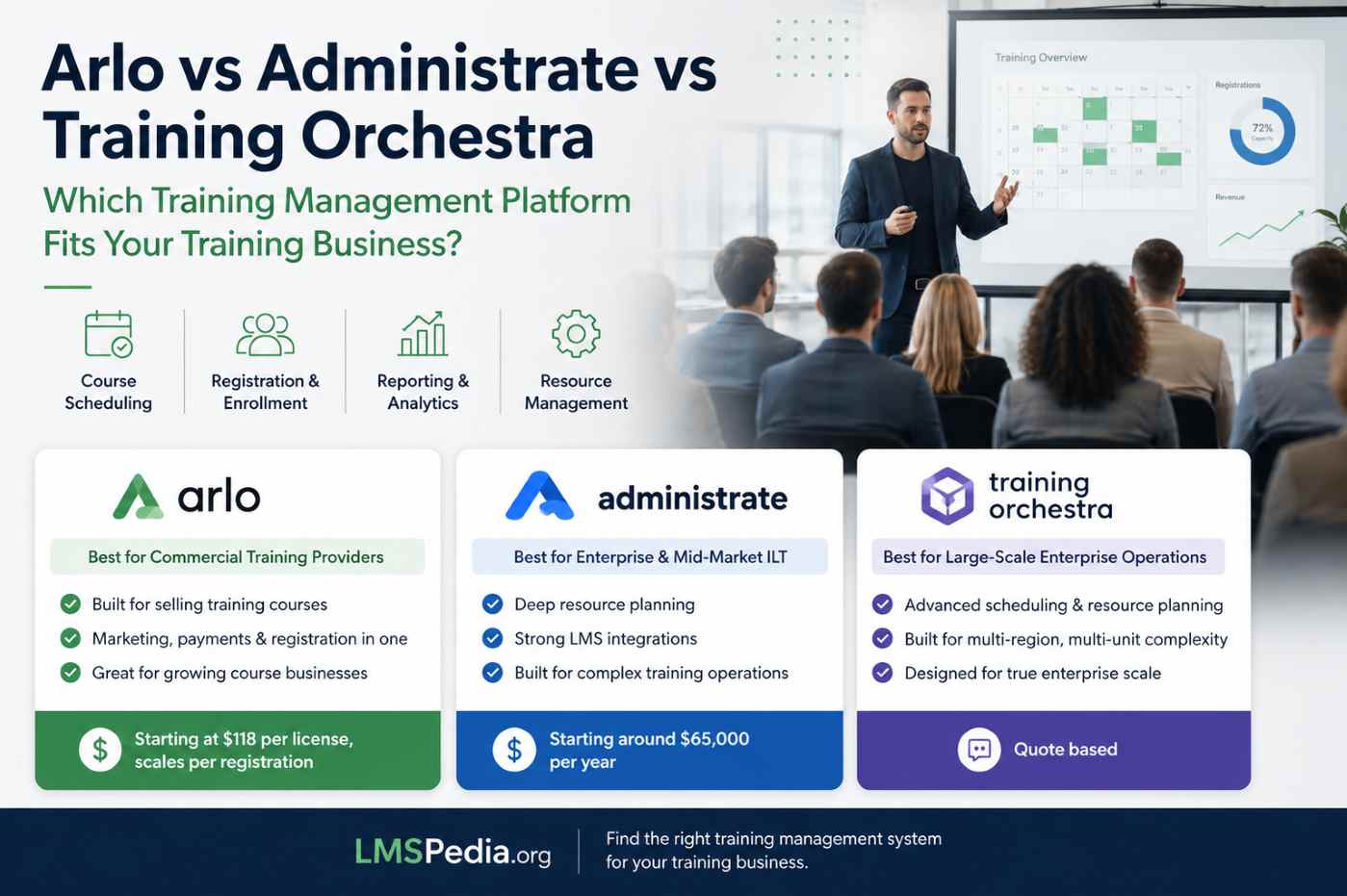
Arlo is built for commercial providers selling courses.
It holds a 4.5 out of 5 rating on G2 from 85 reviews, mostly from small businesses, and prices per registration on top of a base fee.
Administrate targets of enterprise and mid-market organizations
with deep resource planning and LMS integration. It starts around $65,000 a year and holds a 3.6 out of 5 rating on G2.
Training Orchestra goes furthest into enterprise scheduling depth,
built for organizations spanning multiple regions or business units, with pricing available only by custom quote.
Review data favors Arlo on ease of use and support,
but that reflects a genuine trade off, not a flaw in the other two. Simpler design usually means less configuration depth.
Match the platform to your actual scale.
The biggest name or the most feature rich platform isn’t automatically the right to buy for a mid-sized provider.
Core Similarities Across Advanced Training Management Systems
Shared Operational Foundations
All three software solutions operate as specialized training management systems. Specifically, they support organizations running instructor-led training at genuine volume. Traditional learning software focuses primarily on hosting self-paced digital content. Conversely, these operational platforms handle complex scheduling, resource allocation, and attendee registration. Beyond this core starting point, however, their architectural philosophies diverge sharply. Each system serves a distinct operational scale and business model. Consequently, comparing their underlying features clarifies which tool matches your enterprise.
Moving Beyond Standard LMS Limitations
Standard learning management systems struggle to manage live instructor calendars and physical classroom logistics. However, commercial training providers require robust tools to coordinate multi-day courses across diverse locations. These three platforms bridge the gap between customer-facing sales portals and back-end resource planning. Reviewing our comprehensive breakdown of a training scheduling system highlights essential operational components required for commercial delivery. Ultimately, specialized management software eliminates traditional administrative friction entirely.
Who Is Arlo Built For?
Commercial Providers Selling Public Courses
Arlo is built specifically for commercial training providers selling courses to the public and corporate clients. It combines registration, payment processing, marketing automation, and financial reporting into one unified system. The platform focuses heavily on selling training rather than just scheduling internal sessions. On platforms like G2 software reviews, Arlo earns high marks for user satisfaction. Most active reviewers represent small and mid-sized businesses. This demographic matches Arlo’s core commercial audience perfectly.
The Ideal Small Business Profile
Arlo suits organizations whose primary goal involves filling public seats and growing commercial revenue. It is a weaker fit for managing thousands of internal employees across a massive global enterprise. Reviewing our detailed look at Training Orchestra alternatives covers where Arlo fits against heavier enterprise solutions. Ultimately, commercial providers managing open enrollment sessions benefit greatly from Arlo’s streamlined storefront widgets.
Evaluate Your Storefront Needs
First, determine whether your business requires a shared public storefront. Next, verify if per-registration pricing aligns with your cash flow model before committing.
Who Is Administrate Built For?
Enterprise and Mid-Market Scale Operations
Administrate targets enterprise and mid-market organizations running high-volume instructor-led and blended training programs. It pairs deep resource planning capabilities with strong LMS integrations. Consequently, it suits complex training operations spanning multiple geographic regions. Pricing reflects that advanced scale. Reviewers on the Capterra directory note that annual agreements position Administrate firmly in the enterprise cost segment. Furthermore, a significant percentage of its user base comes from large enterprise corporations.
Justifying Enterprise Investments
For a mid-sized commercial provider, that investment level requires serious internal justification. You must weigh the platform’s advanced configuration depth against your actual training volume and operational complexity. Our direct simplitrain vs administrate comparison breaks down where enterprise platforms earn their premium pricing. Ultimately, high-end software requires heavy administrative oversight to deliver true value.
Validate Enterprise Complexity
A high starting investment only makes sense if your training volume is genuinely enterprise grade. Request a custom quote based on your actual data before assuming you need that tier.
Who Is Training Orchestra Built For?
Large-Scale Enterprise Resource Planning
Training Orchestra is built specifically for large-scale enterprise training operations. It suits organizations juggling complex scheduling, resource planning, and budget tracking across multiple business units. Furthermore, it leans further into enterprise scheduling depth than either Arlo or Administrate. That depth proves genuinely useful at true multinational scale. However, for a mid-sized provider, it often means paying for unnecessary complexity. Pricing remains strictly quote-based, reflecting custom enterprise deployments. Exploring our roundup of the best TMS for instructor-led training covers how Training Orchestra stacks up against lighter alternatives.
Comprehensive Pricing and Cost Structures
Comparing software costs requires analyzing how each vendor structures its licensing fees. Arlo starts around $118 per license, with additional fees scaling per registration as course volume grows. Administrate targets the high-end enterprise tier with annual agreements. Training Orchestra relies entirely on custom enterprise quotes based on organizational scale and operational complexity. As a general rule, Arlo suits providers wanting predictable, volume-based pricing. Conversely, Administrate and Training Orchestra suit larger, complex operations where custom enterprise proposals replace published rates. Understanding these economic models prevents unexpected budget deficits.
| Platform | Primary Target Audience | Pricing Architecture |
|---|---|---|
| SimpliTrain | Commercial providers and enterprise teams requiring flexible seat tiers. | Transparent flat-rate seat pricing with automated resource scheduling. |
| Arlo | Commercial training providers selling courses publicly. | Per-license starting rate with volume scaling per registration. |
| Administrate | Enterprise and mid-market ILT operations. | High-end annual enterprise agreements. |
Ease of Use, Support, and User Feedback
User review data provides clear signals regarding daily platform usability. Reviewers consistently rate Arlo higher than Administrate on both ease of use and ongoing support quality. Furthermore, users prefer Arlo’s rapid feature updates and intuitive interface design. This discrepancy does not make Administrate a weak product. Instead, it reflects a trade-off between Arlo’s streamlined, provider-focused design and Administrate’s configurable enterprise feature set. Training Orchestra aligns closely with Administrate on this trade-off, prioritizing scheduling depth over simplicity.
Strategic Selection Framework
Choosing the correct platform depends entirely on your operational scale and business model. Choose Arlo if you operate as a commercial provider selling courses to individuals or businesses. You will benefit from predictable, volume-based pricing and responsive customer support. Choose Administrate if you run high-volume, complex instructor-led programs at true enterprise scale and possess the budget to match. Choose Training Orchestra if your operation spans multiple global regions and requires heavy enterprise scheduling depth. For providers operating open enrollment public sessions, explore our dedicated guide to the best TMS for open enrollment training. Additionally, insights from the Association for Talent Development provide broader industry benchmarking data.
Conclusion
None of these three platforms is universally superior to the others. Each system is built for a completely different scale of training business. Arlo fits commercial providers who need to sell courses and grow revenue efficiently. Administrate fits enterprise operations requiring deep resource planning tools. Training Orchestra fits the largest corporate training operations spanning multiple global regions. Match the software platform to your actual operational scale rather than brand recognition alone. That strategic discipline prevents paying for unnecessary capabilities.
FAQ
Q1. Which platform is cheapest for a small or mid-sized training provider?
Arlo generally works out cheapest for smaller providers, since its prices per registration on top of a base fee rather than a large flat enterprise commitment. Administrate and Training Orchestra both target larger operations and price accordingly.
Q2. Is Administrate worth its enterprise price tag?
It can be, if your training volume and operational complexity genuinely match the enterprise scale. For a mid-sized provider without that complexity, the roughly $65,000 a year starting price is hard to justify against lighter alternatives.
Q3. Which platform has the best user reviews?
Arlo currently holds the strongest G2 rating among the three at 4.5 out of 5, and reviewers in direct comparisons rate head of Administrate on ease of use and support quality.
Q4. Does the Training Orchestra publish its pricing?
No. Training Orchestra requires a custom quote based on your scale and complexity, which is typical for platforms positioned at the top end of the enterprise market.
Q5. Can a training provider outgrow Arlo and need to move to Administrate or Training Orchestra?
Yes, this happens as a provider’s scale and complexity grow, particularly when training spans multiple regions, business units, or thousands of internal employees rather than public course sales.