LearnUpon vs TalentLMS: Corporate LMS Comparison and Pricing Guide
Modern learning management systems must align precisely with your organizational architecture to prevent massive administrative overhead. Consequently, choosing the wrong platform creates data silos, frustrates learners, and inflates IT budgets. When comparing learnupon vs talentlms, training directors evaluate two fundamentally different software philosophies. Specifically, TalentLMS prioritizes extreme ease of use, transparent pricing, and rapid deployment for growing teams. Conversely, LearnUpon delivers enterprise-grade scalability, robust multi-tenant architecture, and specialized external training tools. Furthermore, enterprise buyers should cross-reference vendor capabilities against a comprehensive benchmark of core training management system features to avoid functional integration gaps.
Selecting the ideal platform requires understanding your exact operational requirements. For instance, internal compliance training demands entirely different software mechanics than selling online courses to external B2B partners. Therefore, this comprehensive corporate lms comparison breaks down their distinct capabilities. Furthermore, we examine multi-portal architectures, evaluate third-party integration ecosystems, and decode talentlms vs learnupon pricing structures completely.
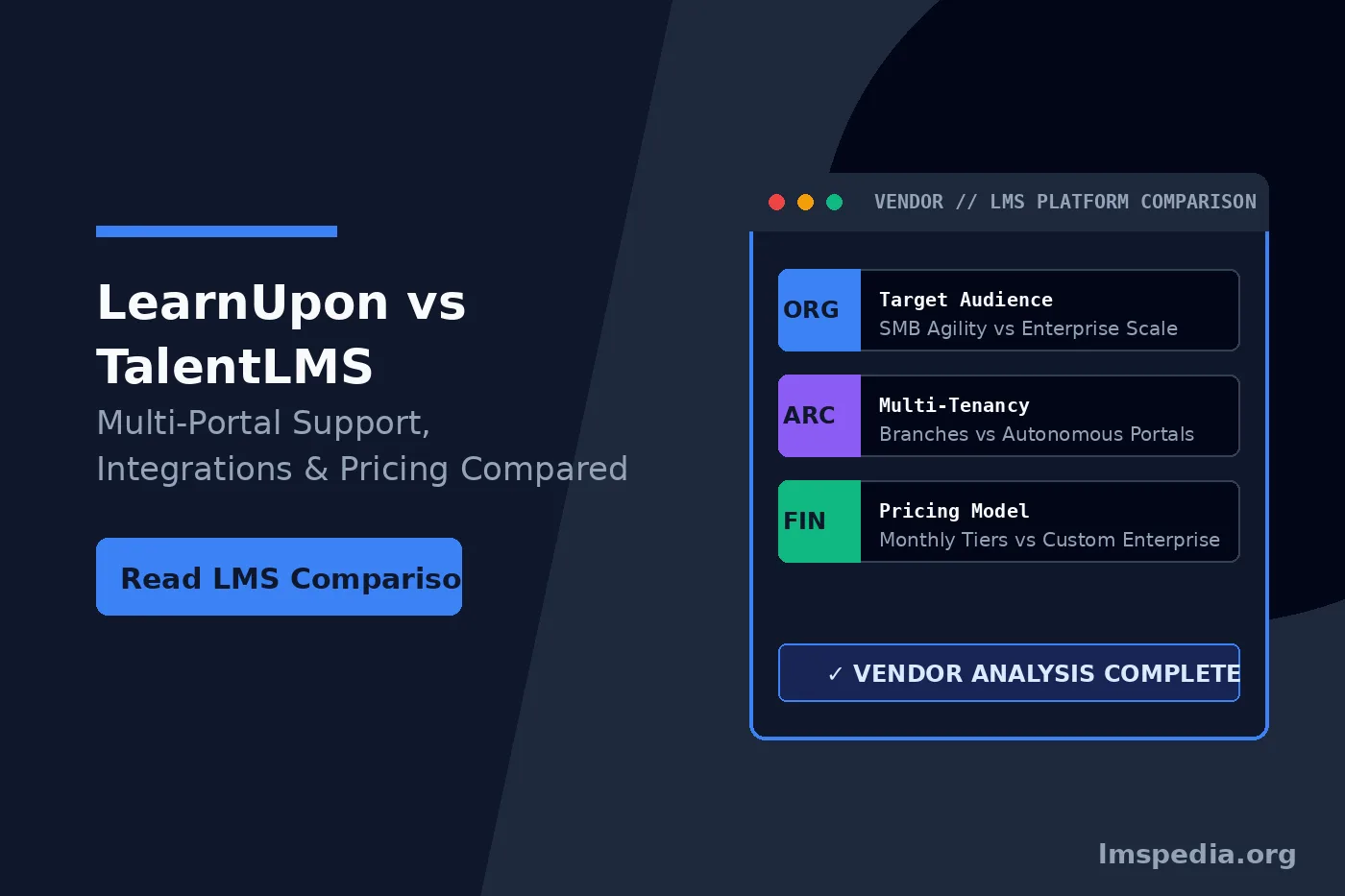
Target Audiences Differ Wildly: TalentLMS is engineered for SMBs prioritizing speed and ease of use, whereas LearnUpon targets mid-market and enterprise organizations with complex structural needs.
Pricing Transparency: TalentLMS offers transparent, tiered monthly pricing (starting at $119/mo) that fits predictable budgets. LearnUpon relies on custom, value-based enterprise contracts based on specific use cases. Branches vs Portals: TalentLMS uses “Branches” to separate internal departments, which are restricted by your pricing tier. LearnUpon utilizes premium, highly autonomous “Portals” specifically designed for external B2B customer education. AI Content Tools: TalentLMS provides “TalentCraft,” a robust AI engine that generates images, tests, and course text automatically. LearnUpon focuses on AI assessments and massive off-the-shelf content integration via Go1. Integration Strategies: TalentLMS integrates seamlessly with standard SMB tools like BambooHR and Zoom. LearnUpon provides deep, bidirectional integrations with enterprise platforms like Salesforce and HubSpot.
Key Takeaways

Architectural Philosophy and Target Audiences
Before analyzing specific software features, organizations must understand the target market for each system. Software companies build their underlying code to solve specific problems for specific demographics. Ultimately, aligning your business model with the vendor’s primary audience prevents severe technical debt.
TalentLMS caters heavily to small and medium-sized businesses. Epignosis, the parent company, built TalentLMS to simplify learning administration entirely. Consequently, the platform removes complex technical barriers, allowing non-technical HR managers to launch training programs in hours. Reviewers consistently praise its intuitive interface and frictionless onboarding workflows. Indeed, organizations prioritizing speed over complex customization find TalentLMS highly effective.
LearnUpon, on the other hand, explicitly targets mid-market businesses and large enterprises. The Dublin-based company engineered a platform capable of handling highly complex, matrixed organizational structures. Furthermore, LearnUpon divides its product offerings strictly by use case. They offer distinct packages for internal employee training, external customer education, and professional associations. If your organization manages thousands of learners across diverse global business units, LearnUpon provides the necessary structural rigidity.
Multi-Portal Support: TalentLMS Branches vs LearnUpon Portals
Organizations rarely train a single, uniform audience. Usually, they must train internal employees, external software customers, and channel partners simultaneously. Delivering tailored learning environments to these distinct audiences requires robust multi-tenancy. Consequently, a deep multi portal lms comparison reveals significant architectural differences between these two vendors.
The TalentLMS Branching Model
TalentLMS handles multi-tenancy through a feature called Branches. A branch functions as an independent training portal nested under your main account. Administrators can apply custom branding to each branch, assign unique courses, and segment user data cleanly. Specifically, a company might create one branch for the marketing department and a separate branch for the sales team.
However, TalentLMS restricts the number of branches you can deploy based on your pricing tier. The entry-level Core plan includes only one branch. Subsequently, the Grow plan permits three branches, while the Pro plan allows fifteen. Organizations needing unlimited branches must upgrade to the highest enterprise tier. Therefore, highly fragmented organizations must calculate these branch limits into their total operational budget.
The LearnUpon Portal Ecosystem
LearnUpon approaches multi-tenancy through premium, distinct Portals. Unlike simple internal branches, LearnUpon portals act as highly autonomous LMS environments. Moreover, each portal can feature distinct white-labeling, its own single sign-on configuration, and completely isolated reporting dashboards.
This absolute separation is particularly vital for external customer education. If a software company trains five different enterprise clients, they can provision five distinct LearnUpon portals. Consequently, each client accesses a personalized academy that feels like native software. Furthermore, each portal can utilize independent payment gateways. This allows organizations to manage complex international eCommerce sales seamlessly. When evaluating architectures for massive global deployment, analysts frequently compare these portal capabilities against open-source alternatives. Review our guide on Open LMS vs Totara Learn to understand how dedicated multi-tenancy scales across global compliance networks.
Evaluate Multi-Tenant Needs Early
First, map out all distinct external partner groups and internal divisions before selecting a tier. Ensuring your branching or portal limits match your organizational structure prevents expensive mid-contract upgrades.
Pricing Strategies and Financial Predictability
Budgeting for learning software frequently frustrates procurement teams due to hidden fees and unpredictable scaling costs. When analyzing talentlms vs learnupon pricing, buyers encounter two completely distinct revenue models. Understanding these models prevents massive cost overruns during your second year of deployment.
TalentLMS: Transparent Monthly Tiers
TalentLMS embraces absolute pricing transparency. They publish their pricing openly, allowing businesses to calculate costs immediately. Their financial model utilizes active user limits and strict feature gating.
-
Core Plan ($119/month): Supports basic API access, custom domains, and a single branch. However, it lacks advanced AI content tools.
-
Grow Plan ($229/month): Upgrades the system to support three branches and introduces premium AI content generation tools.
-
Pro Plan ($449/month): Expands capacity to fifteen branches, accommodating up to 1,000 active users effectively.
This transparent, tiered approach is highly attractive to small businesses. If an organization employs 200 people, they know exactly what their software will cost next year. Furthermore, TalentLMS allows month-to-month billing, offering incredible financial flexibility for seasonal training spikes.
LearnUpon: Value-Based Custom Licensing
Alternatively, LearnUpon operates on a strict enterprise sales model. They do not publish flat monthly rates on their website. Instead, prospective buyers must contact the sales team to negotiate a custom contract. LearnUpon bases its pricing on the specific use case, required user volume, and necessary implementation support.
-
Employee Plan: Designed for internal compliance and onboarding. The minimum threshold begins at 100 users.
-
Association Plan: Built for professional accreditation and revenue generation. The minimum threshold requires 150 users.
-
Customer Education Plan: Engineered for massive external reach. This premium tier requires a minimum of 300 users.
While this custom pricing model frustrates buyers seeking immediate quotes, it protects enterprise clients. Every LearnUpon contract includes a dedicated Implementation Consultant, technical support, and customer success management. Therefore, you pay for guaranteed software adoption rather than just raw server access. Before negotiating these complex enterprise contracts, training leaders should utilize advanced training needs assessment tools to quantify exactly how many active licenses they truly require.
Integration Ecosystems and Identity Security
A standalone LMS creates administrative nightmares. Your learning platform must communicate flawlessly with your HRIS, your CRM, and your video conferencing tools. Both vendors provide robust integration ecosystems, but they target different organizational needs.
Native Integrations and Workflows
TalentLMS provides excellent integrations for modern, agile workplaces. It connects natively with Zoom, Microsoft Teams, and BambooHR. Furthermore, enterprise platforms often synchronize core employee data from enterprise suites like Workday. Consequently, scheduling virtual instructor-led training takes seconds. Furthermore, it integrates with Stripe and PayPal for straightforward course sales. These connections satisfy 90% of standard small business requirements.
LearnUpon, conversely, builds integrations for heavy enterprise data flows. It features deep, bidirectional integrations with Salesforce and HubSpot. When a customer completes a training module in LearnUpon, the system automatically updates their Salesforce account record. Therefore, account executives can track client health scores based on educational engagement. Furthermore, LearnUpon provides comprehensive webhooks and open APIs for custom middleware connections.
SCIM and Identity Management
Manual user provisioning is a severe security vulnerability. If a terminated employee retains LMS access, they can download proprietary training manuals indefinitely. Both platforms mitigate this risk by supporting Single Sign-On via SAML 2.0.
However, enterprise security requires automated account provisioning and de-provisioning. Systems utilize the System for Cross-domain Identity Management to achieve this automation. When HR updates the central directory, SCIM instantly pushes those demographic changes into the LMS. To fully grasp why IT departments mandate this architecture, study our comprehensive guide explaining what SCIM is and how it powers identity security.
Content Creation and Artificial Intelligence
Historically, learning platforms merely hosted SCORM files created in external authoring tools like Articulate Storyline. Today, modern platforms integrate artificial intelligence directly into the LMS to accelerate course authoring.
TalentLMS and TalentCraft
TalentLMS recently launched TalentCraft, an integrated AI content creation engine. This premium feature generates comprehensive courses from simple text prompts. Furthermore, the AI can generate custom images, write video captions, and build automated multiple-choice tests instantly. The system even features a Learning Playground. This interactive space allows employees to practice real-world conversations without formal grading. Ultimately, these tools empower subject matter experts to build engaging content without instructional design degrees.
LearnUpon and Go1 Content
LearnUpon approaches content differently. While it offers AI generated assessments, its primary strength lies in content curation and structured learning paths. LearnUpon integrates natively with Go1, a massive third-party library of premium off-the-shelf courses. Consequently, organizations can instantly deploy thousands of compliance and leadership courses without writing a single word of text.
Furthermore, LearnUpon excels at dynamic rule automation. Administrators can build complex logic that automatically enrolls users into specific certification paths based on their job title or location. Designing these automated pathways effectively requires referencing core enterprise learning design and operational frameworks.
Reporting, Analytics, and E-Commerce
Data visualization is the ultimate deliverable of any learning platform. If executives cannot see completion metrics instantly, the software fails its primary business objective. Moreover, if you intend to sell courses, the platform must handle complex financial transactions securely.
Administrative Analytics
TalentLMS provides highly visual, out-of-the-box reporting. Managers can view infographic-style dashboards that highlight completion rates and active learners immediately. The platform removes friction, allowing frontline supervisors to monitor their specific teams effortlessly.
LearnUpon provides heavier, highly granular reporting engines. It allows administrators to build custom reports based on custom user data fields. Furthermore, you can schedule these reports to email executives automatically every Monday morning. However, managing this level of data requires strict administrative governance. Ensuring that supervisors only see their specific team’s data requires careful configuration. Review best practices on architecting clear LMS user roles and permissions to prevent data privacy violations. Furthermore, ensuring audit defensibility aligns with our guide on LMS for compliance training and audit evidence.
Selling Online Courses
For professional associations and commercial training companies, eCommerce functionality is mandatory. Both platforms allow you to sell courses, but they scale differently.
TalentLMS integrates with Stripe and PayPal. You can set up basic course catalogs, offer discount coupons, and process transactions easily. It works perfectly for simple B2C course sales. Conversely, LearnUpon handles complex B2B sales architectures. Because LearnUpon utilizes independent portals, you can establish separate storefronts with distinct branding for different target markets. Furthermore, LearnUpon allows you to sell bulk licenses. Consequently, a corporate client can purchase 50 seats in one transaction and distribute those seats to their employees internally.
Evaluating learnupon alternatives often leads buyers back to these two distinct approaches. If you need simple B2C sales, TalentLMS is highly efficient. If you manage complex B2B distribution networks, LearnUpon is the undisputed leader. Additionally, enterprise software strategies evaluated by analysts at Gartner reinforce these platform selection criteria.
Audit Reporting Permissions
Always test administrative reporting views across multi-tenant environments before launch. Restricting supervisor access correctly prevents accidental data leaks across isolated branch structures.
Conclusion
Ultimately, selecting the correct platform depends entirely on your organizational trajectory. If you need a frictionless, aggressively priced solution to onboard a growing internal team, TalentLMS deploys faster than almost any competitor in the market. Its transparent pricing and intuitive AI content tools deliver immediate return on investment.
However, if your business strategy relies on educating external customers, managing massive global subsidiaries, or integrating deeply with Salesforce, LearnUpon provides the necessary architectural horsepower. By investing in dedicated portals and sophisticated automated workflows, enterprise organizations eliminate administrative bottlenecks and transform their training departments into tangible revenue generators.
FAQ
Q1. Is TalentLMS better than LearnUpon?
Neither platform is universally “better.” TalentLMS is highly superior for small businesses that need rapid deployment and transparent pricing. LearnUpon is significantly better for large enterprises that require complex multi-portal architectures and deep Salesforce integrations.
Q2. What is the difference between a TalentLMS Branch and a LearnUpon Portal?
A TalentLMS Branch is a nested sub-environment used primarily to separate internal departments or small client groups. A LearnUpon Portal is a highly autonomous LMS instance featuring distinct white-labeling, independent SSO configurations, and dedicated eCommerce gateways for massive external audiences.
Q3. Does TalentLMS offer flat monthly pricing?
Yes. TalentLMS offers highly transparent flat-rate pricing. Paid plans begin with the Core tier at $119 per month and scale up to the Pro tier at $449 per month, depending on active user limits and branch requirements.
Q4. How does LearnUpon price its software?
LearnUpon uses a custom, value-based pricing model. They require buyers to contact sales for a specific quote based on their use case (Employees, Customer Education, or Associations) and their required user volume.
Q5. Can both platforms connect to my HR system automatically?
Yes. Both systems offer robust API integrations. TalentLMS features native connectors for systems like BambooHR. Both systems support SAML 2.0 Single Sign-On and can utilize SCIM protocols to automate user account creation directly from your central HR directory.