Most commercial training providers spend months developing a world-class curriculum, sourcing the best instructors, and building interactive SCORM modules. Yet, when it comes time to sell the program, they simply copy and paste a dry, academic syllabus onto their website. This is a critical marketing failure. Your target audience is not buying a list of learning objectives; they are buying a solution to a specific professional problem. Mastering training course description writing is the bridge between having a great educational product and actually generating revenue.
Whether you are selling B2B leadership workshops to corporate HR directors or offering technical certifications directly to individual professionals, your learner-facing content must be persuasive, clear, and action-oriented. In this comprehensive guide, we will explore the psychology of writing compelling course descriptions, provide actionable formulas for course copywriting for training providers, and demonstrate how to leverage a premium storefront like SimpliTrain to eliminate checkout friction. For more strategies on scaling your training sales, explore the LMSPedia platform.
Key Takeaways

Sell benefits, not features:
Buyers do not care how many PDFs or hours of video a course has; they care about how the course will solve their specific professional problems and advance their careers.
Use the PAS framework:
Structure your course descriptions using Problem, Agitation, and Solution. Hook the reader by calling out their pain point before introducing your course as the remedy.
Remove checkout friction:
Great course sales copy will fail if the checkout process is broken. Use a modern Training Management System (TMS) like SimpliTrain to provide a seamless, B2B-friendly e-commerce storefront.
Be hyper-specific about your audience:
Clearly define who the course is for (and who it is not for) to reduce bounce rates and ensure highly qualified enrollments.
Write for scannability:
Avoid dense blocks of text. Use bold headlines, short paragraphs, and action-oriented bullet points to make your learner-facing content easy to read on mobile devices.
The Problem with Traditional Training Catalog Writing
If you look at the average corporate training website, you will find course pages that read like university course catalogs from the 1990s. They are dense with industry jargon, overloaded with passive voice, and entirely focused on the features of the course rather than the benefits to the learner.
When potential buyers land on your course page, they are silently asking one primary question: “What is in it for me?” (WIIFM). Traditional training catalog writing fails because it focuses on the “what” (e.g., “This course includes 12 modules and a 40-page PDF”) instead of the “why” (e.g., “You will learn how to close enterprise deals 30% faster”). If you want to know how to describe a training course effectively, you must shift your mindset from that of an educator to that of a marketer.
Benefits Over Features
A feature is what the course has; a benefit is what the course does for the learner. Feature: “Includes a 2-hour video on Excel formulas.” Benefit: “Automate your weekly reporting and save 5 hours every Friday by mastering advanced Excel formulas.” Always sell the benefit.
The PAS Copywriting Formula for Course Sales Copy
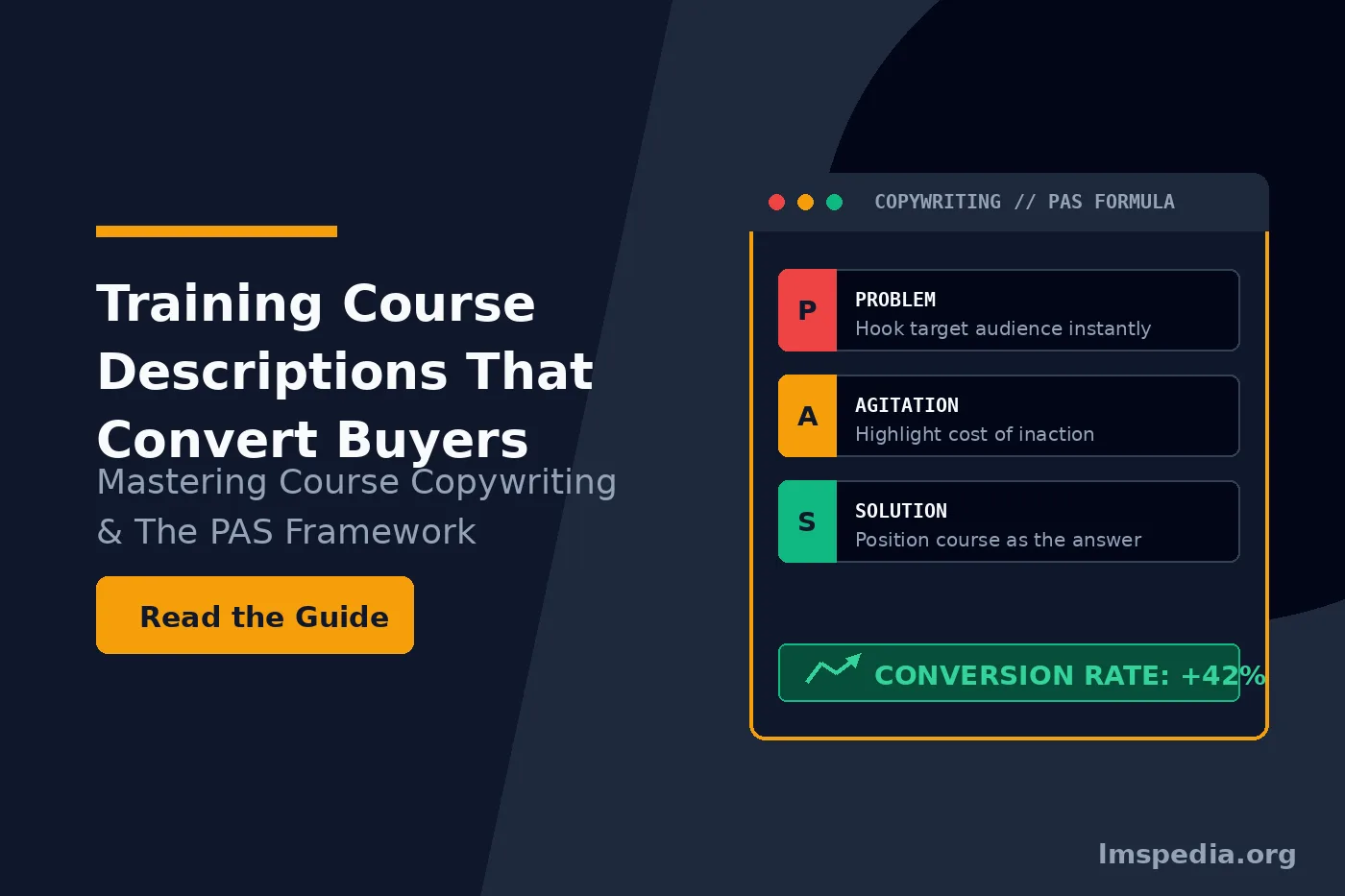
To consistently write course sales copy that converts, you do not need to hire an expensive advertising agency. You simply need to use proven copywriting frameworks. The most effective framework for training providers is the PAS formula: Problem, Agitation, Solution.
1. Problem: Hook the Reader Immediately
Start your course description by calling out the exact pain point your target audience is experiencing. If you are selling a time management course for managers, do not start with “Welcome to Time Management 101.” Start with the problem: “Are you spending 10 hours a week putting out fires instead of focusing on strategic growth?” This immediately signals to the buyer that you understand their daily struggles.
2. Agitation: Highlight the Cost of Inaction
Once you have identified the problem, agitate it slightly. Remind the buyer what happens if they do not solve this issue. “Every week you spend micromanaging your team is another week your competitors pull ahead, and another weekend you spend catching up on emails.” This creates emotional resonance and a sense of urgency.
3. Solution: Position Your Course as the Answer
Finally, introduce your training course as the definitive solution. “The Advanced Leadership Delegation Workshop provides a step-by-step framework to empower your team, reclaim your schedule, and eliminate operational bottlenecks in just three weeks.” By using the PAS formula, your training course description writing becomes a compelling narrative rather than a boring list of facts.
Step-by-Step Guide: How to Describe a Training Course
Once you have hooked the reader with your PAS introduction, you need to provide the logistical details in a way that is highly readable and scan-friendly. Use the following structural elements to build out the rest of your learner-facing content.
Who Is This Course For? (The Target Audience)
Be explicitly clear about who should—and should not—take this course. Ambiguity kills conversions. If a mid-level manager isn’t sure if a course is too basic for them, they will bounce off the page. Use bullet points to list the ideal job titles, experience levels, or specific scenarios that fit the course.
What Will You Learn? (Actionable Outcomes)
Instead of writing “Learning Objectives,” use a heading like “By the end of this course, you will be able to:” Follow this with three to five strong bullet points that start with action verbs. Avoid vague verbs like “understand” or “know.” Instead, utilize precise instructional design verbs such as “build,” “execute,” “calculate,” or “design.”
Instructor Credentials and Social Proof
Buyers need to trust the source of the information. Include a short, punchy bio of the instructor that highlights their real-world experience, not just their academic degrees. More importantly, include testimonials from past students. A quote saying, “This course helped me secure a $10,000 raise within three months,” is infinitely more powerful than any course sales copy you could write yourself.
Format for Scannability
Web users do not read; they scan. Use bold text for key phrases, short paragraphs (no more than 3 sentences), and ample bullet points. A massive block of text will immediately deter a busy professional from reading your description.
Course Copywriting for Training Providers: Before and After
Let’s look at a practical example of writing compelling course descriptions by transforming a weak, feature-driven description into a strong, benefit-driven narrative.
| Element | Bad Description (Feature-Focused) | Good Description (Benefit-Focused) |
|---|---|---|
| Headline | Introduction to Agile Project Management | Master Agile: Deliver Projects 2x Faster with Half the Stress |
| The Hook | This course covers the history of Agile methodologies and Scrum frameworks over 12 modules. | Tired of missed deadlines and scope creep? Learn the exact frameworks top tech companies use to ship products flawlessly. |
| Learning Objectives | Understand sprints. Know how to do a stand-up meeting. Learn about backlogs. | By the end of this course, you will: – Facilitate high-energy, 15-minute daily stand-ups. – Eliminate project bottlenecks using visual Kanban boards. – Protect your team from client scope creep. |
| The Close | Click here to register for the upcoming session. | Stop managing chaos and start leading high-performing teams. Secure your seat in our next live cohort today. |
Utilizing SEO in Your Training Course Description Writing
Even the most persuasive copy is useless if nobody can find your course on Google. Course copywriting for training providers must balance human psychology with search engine optimization (SEO).
Identify the primary keywords your target audience is searching for. If you are selling a safety certification, do not use a clever, vague title like “Shields Up: Workplace Protection.” Use the exact phrase your buyers search for: “OSHA 30-Hour Construction Safety Certification.” Weave these targeted keywords naturally into your H1 title, your H2 subheadings, and the first 100 words of your body copy. However, never sacrifice readability for keyword density. Google’s algorithms reward content that keeps users on the page, and bad, keyword-stuffed copy will cause them to bounce instantly.
Displaying Your Courses: Why You Need SimpliTrain
You have spent hours mastering how to describe a training course. You have written incredible, high-converting copy that perfectly targets your buyer’s pain points. However, if the user clicks “Buy Now” and is redirected to a clunky, broken checkout page, or forced to download a PDF registration form, you will lose the sale instantly. Great copy requires a seamless e-commerce experience.
This is where a premium Training Management System (TMS) like SimpliTrain becomes the ultimate sales enablement tool. SimpliTrain provides commercial training businesses with a stunning, customizable B2B storefront that displays your newly written course descriptions perfectly across both desktop and mobile devices.
When you use SimpliTrain, your learner-facing content is supported by a frictionless checkout process. Buyers can securely purchase single seats, buy bulk licenses for their entire corporate team, or enroll in complex blended learning paths with just a few clicks. Furthermore, SimpliTrain allows you to seamlessly schedule live training sessions and display real-time seat availability right next to your sales copy, leveraging scarcity to drive immediate conversions. By pairing world-class copywriting with the best TMS for open enrollment training businesses, you eliminate operational bottlenecks and maximize your revenue potential.
Leverage Scarcity and Urgency
If you are selling a live virtual class, use SimpliTrain to display “Only 3 Seats Remaining!” near the checkout button. Genuine scarcity is one of the most powerful psychological triggers in copywriting.
Conclusion
Effective training course description writing is a vital commercial skill that directly impacts your bottom line. Stop treating your course pages like university syllabuses and start treating them like highly targeted sales letters. By using the PAS copywriting formula, focusing relentlessly on learner benefits, formatting for web scannability, and optimizing for SEO, you can drastically increase your enrollment rates. Finally, ensure that your brilliant copy is housed on a modern, frictionless platform like SimpliTrain so that when a browser is finally ready to become a buyer, nothing stands in their way.
FAQ
Q1. How do you write a good training course description?
To write a good training course description, shift the focus from the course features to the learner’s benefits. Start by identifying the target audience’s primary pain point, explain the tangible outcomes they will achieve, use action-oriented bullet points for learning objectives, and include social proof like testimonials.
Q2. What is the PAS copywriting formula?
PAS stands for Problem, Agitation, Solution. It is a highly effective copywriting framework where you first identify the reader’s problem, agitate the problem by explaining the negative consequences of not solving it, and finally present your training course as the ultimate solution.
Q3. How do I optimize my course sales copy for SEO?
Identify the exact search terms your target audience uses (e.g., “Advanced Excel Training for Accountants” rather than “Spreadsheet Mastery”). Include these primary keywords naturally in your course title (H1), subheadings (H2), and within the first 100 words of your body text to help Google index your course page accurately.
Q4. How does SimpliTrain help improve course sales?
SimpliTrain provides a professional, highly customizable e-commerce storefront that displays your course descriptions beautifully. It eliminates checkout friction, allowing users to easily purchase single seats or bulk B2B corporate licenses, and displays live inventory (seat availability) to leverage urgency and drive immediate conversions.
Q5. Why is traditional training catalog writing ineffective?
Traditional catalog writing is often too academic, dense with industry jargon, and heavily focused on course features (like module counts) rather than the real-world value the learner will gain. It reads like a syllabus rather than a persuasive sales page.