Designing a Learning Data Warehouse: Star Schema for Training Analytics
Data architects face immense pressure to deliver actionable workforce intelligence. Building a robust learning data warehouse solves complex corporate reporting challenges. Traditional learning platforms rely heavily on normalized relational databases. These transactional systems, consequently, struggle to process heavy analytical queries. Executives demand real-time visibility into employee competency today. Technical teams must, therefore, decouple operational software from historical reporting infrastructure. Dimensional modeling provides the perfect architectural solution for educational datasets. This technical guide explores exactly how to structure a training analytics data model effectively. Separating analytics from daily operations ultimately protects system performance.
Extracting meaningful insights requires more than basic spreadsheet exports. Organizations must first centralize disparate data streams into a single analytical environment. Business intelligence teams must then evaluate the best LMS reporting and analytics platforms to visualize workforce capabilities. Connecting these platforms requires standardized data integration protocols. Building a dedicated data mart, furthermore, prevents catastrophic database locks during peak reporting hours. Standardizing metrics guarantees that different departments measure learner success identically. Investing in proper data architecture yields massive operational dividends. Scalable infrastructure ultimately transforms reactive training departments into predictive human capital engines.
Key Takeaways

Decoupling System Architecture:
Extracting analytical workloads from the transactional LMS database into a dedicated learning data warehouse prevents heavy reporting queries from crashing active production environments.
Dimensional Star Schema Design:
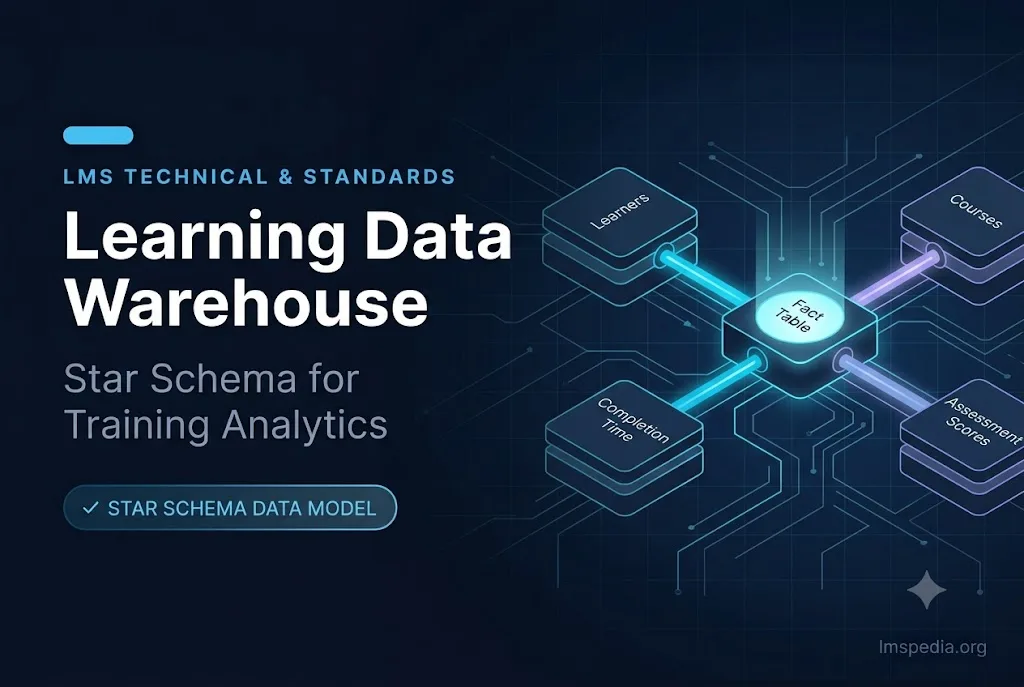
Building a training analytics data model utilizing a central Fact Table surrounded by descriptive Dimension Tables (Learner, Course, Time) enables lightning-fast business intelligence queries.
Managing Structural Changes:
Implementing Slowly Changing Dimensions (SCD Type 2) ensures that employee promotions or departmental transfers do not retroactively corrupt historical compliance and training reports.
Integrating xAPI Telemetry:
A modern learning data warehouse uses robust ETL pipelines to extract high-velocity JSON statements from Learning Record Stores, merging behavioral telemetry with traditional completion metrics.
Democratizing Enterprise Intelligence:
Connecting a clean star schema to visualization platforms like Tableau or Power BI allows non-technical executives to filter, slice, and analyze workforce capabilities instantly.
The Limitations of Transactional LMS Databases
Modern learning management systems process thousands of user interactions simultaneously. They utilize highly normalized database schemas to prevent data duplication. This transactional optimization creates severe bottlenecks for analytical reporting.
The Problem with Normalized Schemas
Relational databases break information down into dozens of interconnected tables. This structure allows the application to update records with lightning speed. An LMS can update a single course status without locking entire databases. Extracting data, however, requires joining multiple complex tables together sequentially. Generating comprehensive reports forces the server to execute massive computational loads. Organizations utilizing LMS reporting custom reports dashboards and data exports often experience significant delays. Complex SQL joins crucially consume vast amounts of server memory. Normalized schemas ultimately prioritize data writing over data reading.
Why Reporting Queries Crash Systems
Running heavy analytical reports during business hours jeopardizes system stability. Querying millions of historical completion records locks critical database rows. Active learners cannot launch courses or complete compliance quizzes. Administrators frequently encounter timeouts when exporting large organizational transcripts. Engineers must, therefore, conduct rigorous LMS load testing and performance benchmarking to identify breaking points. Separating the reporting layer from the application layer resolves these performance issues permanently. Replicating data to a dedicated warehouse restores operational speed. Front-line employees experience seamless learning while executives receive instantaneous reports.
Advanced Technical Strategy: Read Replicas
Deploy a read-only database replica for your business intelligence tools before building a full warehouse. This immediate architectural shift, consequently, prevents reporting queries from crashing your active production environment.
Dimensional Modeling: Building the Star Schema
Data architects must restructure normalized data into analytical formats. Dimensional modeling organizes data specifically for rapid querying and intuitive filtering. Building a star schema learning data framework accelerates business intelligence dashboards exponentially.
Defining the Fact Table
The fact table sits at the exact center of the star schema architecture. This table stores quantitative measurements and numerical performance metrics. Educational fact tables typically record course completions, assessment scores, and login durations. Every row in the fact table contains foreign keys linking to surrounding dimensions. This centralized structure allows analysts to aggregate millions of rows instantly. Creating a clear training data mart, furthermore, simplifies complex historical trend analysis. Fact tables must crucially contain additive metrics that sum together logically. A well-designed fact table serves as the numerical foundation of your warehouse.
Designing the Dimension Tables
Dimension tables provide the descriptive context surrounding your numerical facts. These tables surround the fact table like the points of a star. Common learning dimensions include the Learner Dimension, Course Dimension, and Time Dimension. The Learner Dimension stores employee names, departments, and regional locations. The Course Dimension contains curriculum titles, delivery methods, and credit hours. Analysts filter and group fact table metrics using these descriptive attributes. Dimension tables utilize denormalized structures to eliminate complex query joins entirely. Wide dimension tables ultimately allow business intelligence software to slice data effortlessly.
Handling Slowly Changing Dimensions
Corporate organizational structures change continuously throughout the fiscal year. Employees receive promotions, switch departments, and relocate to new regional offices. Data warehouses must track these changes without corrupting historical training records. Engineers implement Slowly Changing Dimension protocols to manage updates effectively. An SCD Type 2 configuration creates a new database row for every structural change. Organizations managing HRIS data syncs issues rely heavily on these historical tracking mechanisms. If an employee moves from sales to marketing, their past completions remain attributed to sales. Preserving historical accuracy ultimately ensures that departmental compliance metrics remain legally defensensible.
Operational Best Practice: The Time Dimension
Always build a dedicated Time Dimension table rather than relying on native SQL date functions. A dedicated table, specifically, handles fiscal quarters, corporate holidays, and regional time zones automatically for clean reporting.
Integrating xAPI and Enterprise Telemetry
Modern training extends far beyond basic course completions. Organizations now track interactive simulations, mobile learning, and on-the-job performance observations. The data warehouse must ingest unstructured telemetry alongside traditional relational records.
The Role of the Learning Record Store
The Experience API generates massive streams of JSON-formatted learning data. An organization must capture these statements using a dedicated Learning Record Store. This system validates the syntax of every incoming message. The Advanced Distributed Learning Initiative establishes strict compliance protocols for these data streams. Architects must, therefore, master querying an LRS to extract meaningful behavioral trends. The LRS acts as an operational staging area before data enters the main warehouse. Integrating xAPI telemetry ultimately provides unprecedented visibility into granular learner behaviors.
Extract, Transform, Load (ETL) Pipelines
Moving data from operational systems into the warehouse requires robust automation. Engineers build ETL pipelines to extract, clean, and load training records nightly. The pipeline first extracts data from operational software and human resources directories. It then transforms varying data formats into a unified organizational standard. Developers must understand how xAPI profiles explained dictate specific data vocabulary rules. Standardizing vocabulary ensures that identical activities map to the same database columns. Mapping Workday to LMS integration architecture schemas prevents employee identifier mismatches. Reliable ETL pipelines ultimately guarantee that executive dashboards display accurate intelligence.
Enterprise Analytics Platform Comparison
| Evaluation Criteria | SimpliTrain | Watershed LRS | Snowflake Data Cloud |
| Core Architecture | Unified training operations platform featuring robust, native data exports and automated report scheduling. | Specialized enterprise Learning Record Store designed explicitly for aggregating complex xAPI telemetry. | Cloud-native enterprise data warehouse utilizing separated storage and compute clusters for massive scale. |
| Dimensional Modeling | Provides structured, flattened CSV data exports ready for immediate ingestion into external data marts. | Utilizes a proprietary learning analytics schema optimized for exploring behavioral training statements. | Supports custom star schema learning data architectures designed entirely by internal engineering teams. |
| Data Ingestion | Automated API endpoints and webhooks synchronizing LMS completions with external HRIS directories. | Accepts high-velocity JSON streams from diverse platforms using certified xAPI conformity standards. | Requires external ETL pipelines (e.g., Fivetran, dbt) to ingest data from operational learning systems. |
| Target Audience | Training directors requiring immediate, out-of-the-box operational reporting without complex coding. | Learning analysts focusing deeply on instructional design optimization and cross-platform learning behaviors. | Enterprise data architects building centralized corporate data lakes encompassing all business units. |
Choosing the right platform depends entirely upon your organizational maturity. Teams needing instant visibility benefit greatly from built-in reporting engines. Massive global enterprises often require dedicated cloud warehouses to merge learning data with financial metrics. Evaluating LMS pricing by monthly active users helps forecast analytics expenses accurately. Technical teams must, therefore, prototype queries before committing to multi-year software contracts. Establishing clear data ownership crucially prevents vendor lock-in during future migrations. The selected infrastructure must ultimately empower business leaders to make rapid decisions.
Data Governance and Security Architecture
Aggregating enterprise training records creates a highly sensitive repository of employee information. Data warehouses store performance evaluations, compliance deficiencies, and personal identifiers centrally. Architects must, therefore, enforce strict security protocols to protect this aggregated intelligence.
Securing API Endpoints
Automated data pipelines require secure authentication to access operational databases. Engineers must configure modern authentication protocols for all data transfers. Developers must restrict access using OAuth scopes and tokens for LMS integrations to prevent over-permissioning. The World Wide Web Consortium outlines vital standards for secure web data transmission. Locking down API endpoints prevents malicious actors from intercepting sensitive employee records in transit. Encrypting data at rest within the warehouse ensures total cryptographic security. Zero-trust network architectures safeguard corporate human resources data effectively.
Regulatory Compliance and Auditing
Highly regulated industries face strict mandates regarding training data integrity. Pharmaceutical and aviation sectors must prove their records remain untampered over time. Database administrators must configure immutable audit logs tracking every user query. Compliance officers leverage these logs to prove historical data accuracy during external audits. The Institute of Electrical and Electronics Engineers provides rigorous frameworks for software reliability and data governance. Organizations must execute thorough computer system validation for an LMS and its connected data warehouse. Validated analytical environments satisfy strict federal regulatory scrutiny continuously.
High-Risk Regulatory Warning: Data Anonymization
Never expose raw personally identifiable information to general business analysts. You must, specifically, implement dynamic data masking to anonymize employee identities when analysts query the data warehouse.
Visualizing the Training Analytics Data Model
A sophisticated data warehouse provides zero value if stakeholders cannot interpret the metrics. Raw database tables overwhelm non-technical business leaders immediately. Organizations must, therefore, connect their star schemas to intuitive visualization tools.
Connecting BI Tools
Modern business intelligence platforms transform raw warehouse data into interactive executive dashboards. Analysts must establish direct database connections using secure driver protocols. Teams focus heavily on connecting xAPI data to Power BI and Tableau for dynamic visualization. The denormalized structure allows these tools to render charts instantly. Department managers can filter compliance metrics by region, role, or tenure seamlessly. Clear data visualizations expose hidden skill gaps that standard spreadsheet reports miss entirely. Accessible dashboards ultimately democratize data across the entire corporate enterprise.
Predictive Modeling and Machine Learning
Mature data organizations eventually transition from historical reporting to predictive modeling. An organized data warehouse provides the perfect training ground for machine learning algorithms. Data scientists feed historical completion rates and performance metrics into predictive engines. The algorithm identifies statistical patterns correlating specific training tracks with high employee retention. These predictive models can forecast impending compliance failures before they actually occur. Proactive administrators assign remedial training to at-risk employees automatically. Predictive analytics transforms the learning department into a strategic driver of corporate profitability. Organizations can prove this value using the Phillips ROI methodology applied directly to these data sets.
Conclusion
Designing a dedicated learning data warehouse revolutionizes enterprise workforce analytics. Decoupling analytical reporting from transactional databases eliminates severe system performance bottlenecks entirely. Utilizing dimensional modeling organizes complex educational metrics for rapid querying. This structured approach enables data analysts to merge compliance records seamlessly with broader human resources telemetry. Organizations gain unprecedented visibility into actual employee competence and operational readiness. Establishing robust ETL pipelines ensures that executive dashboards display accurate intelligence without manual intervention.
Investing in scalable analytical infrastructure protects corporate data while driving strategic business decisions. Secure API endpoints and immutable audit logs satisfy strict regulatory compliance mandates across all operational sectors. Connecting this refined data to modern business intelligence tools democratizes insights across the management hierarchy. A clean data warehouse provides the mandatory foundation for future predictive machine learning deployments. Transitioning from reactive spreadsheets to proactive data warehousing empowers enterprise organizations to maximize their human capital investments permanently.
FAQ
What is a learning data warehouse?
A learning data warehouse is a centralized, specialized database designed specifically to aggregate, store, and analyze massive volumes of historical training data, xAPI telemetry, and HRIS records for business intelligence reporting.
Why do reporting queries crash transactional LMS databases?
Transactional LMS databases use highly normalized schemas optimized for writing data quickly; executing complex analytical reports requires joining dozens of tables, which consumes massive server memory and locks database rows, causing active systems to crash.
What is a star schema in learning analytics?
A star schema is a dimensional modeling technique where quantitative metrics (like quiz scores and completion times) are stored in a central Fact Table, which is connected to denormalized Dimension Tables (like User, Course, and Time) to accelerate query performance.
How does a learning data warehouse handle employee department changes?
Data warehouses handle employee changes using Slowly Changing Dimensions (SCD); when an employee changes departments, the system creates a new historical record row rather than overwriting the old one, preserving the accuracy of past departmental compliance reports.
Why should organizations connect xAPI data to a data warehouse?
Connecting xAPI data to a data warehouse allows organizations to merge granular behavioral telemetry (such as video interactions or simulator usage) with traditional operational metrics, providing a comprehensive view of how training impacts actual business performance.