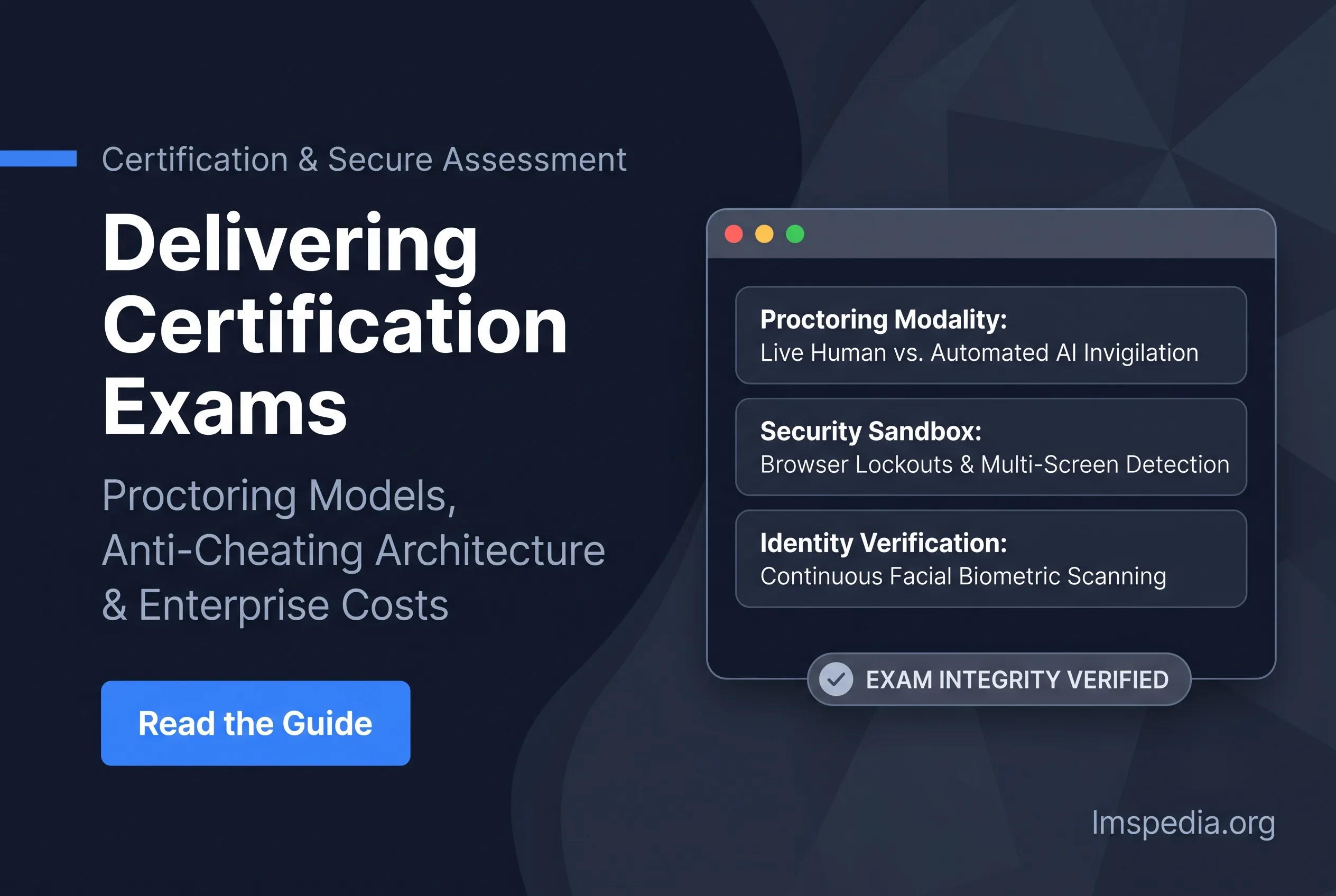
Delivering Certification Exams: Proctoring Models, Security and Cost
Issuing credible corporate certifications defines modern high-stakes skill verification. Global organizations rely entirely on these credentials to legally prove operational safety. Maintaining extreme procedural integrity remains a daily organizational requirement. Physical testing centers provided the only viable security environment available historically. Demanding professional learners expect flexible, scalable digital testing environments today. Deploying advanced online exam proctoring is legally non-negotiable for large enterprises. Furthermore, enterprise buyers should cross-reference vendor capabilities against a comprehensive benchmark of core
training management system features to avoid functional compliance gaps.
Ignoring robust security in digital testing invites catastrophic organizational disaster. Certificate fraud destroys the professional value of hard-earned credentials. This severe risk forces organizations to develop rigid digital defensive frameworks. In this guide, we explore the distinct operational mechanics of modern proctoring. You can master complex credential lifecycles by reviewing our
certification renewal management guide. Maintaining compliance demands flawless digital architecture.
Key Takeaways

Certification Online Requires Integrity: High-stakes certification exams are rapidly moving to flexible online formats, demanding absolute procedural integrity. Consequently, deploying an advanced online exam proctoring system is critical for preventing destructive impersonation fraud and maintaining global trust in issued digital credentials.
Proctoring Models Must Match Intent: High-stakes certification environments typically require live human invigilation for maximum deterrence. Conversely, for large-scale corporate compliance, AI-powered automated remote proctoring delivers the necessary operational scalability without sacrificing supreme exam integrity.
Multi-Layered Security is Mandatory: Digital exam delivery must utilize robust browser lockdowns, continuous biometric facial recognition scans, and automated environ scans to create an impenetrable digital sandbox. These strict measures absolutely prevent disastrous exam content leakage and dangerous fraud.
Integration and Scheduling Are Vital: To eliminate complex scheduling disjointed silos, your specialized proctoring application must integrate natively and flawlessly with your corporate Learning Management System (LMS). Therefore, automated scheduling handles complex multi-cohort schedules seamlessly without annoying administrative bottlenecks.
Scalability Impacts Operational Cost: Procurement teams must ruthlessly analyze distinct proctoring pricing models. Automated solutions typically offer unmatched scalability for global enterprise rollout, provided organizations ruthlessly fiercely evaluate the underlying technical data architecture thoroughly beforehand.
Remote Proctoring Comparison: Models and Methodologies
Navigating the vast marketplace of technical proctoring solutions intimidates modern directors. Varied technological methodologies provide totally different levels of daily logistical support. Selecting the wrong organizational model creates disastrous operational bottlenecks instantly. Conducting a rigorous remote proctoring comparison is legally necessary. Your strategic choice balances corporate financial resources with rigid credential security.
The legal defensibility of your educational program depends on this choice. External regulators aggressively scrutinize how you verify individual student identities. Failing this specific regulatory checkpoint invalidates thousands of vital certifications immediately. Organizations must understand these distinct models thoroughly before purchasing software. Below, we break down the fundamental philosophies driving distinct proctoring structures.
Live Remote Proctoring
Live remote proctoring provides real-time human dynamic invigilation. A qualified individual observes active candidates via a live webcam. This provides maximum deterrence against creative exam cheating. Human intervention ensures total exam session integrity. High-stakes clinical and technical environments prefer this rigorous modality.
Active live proctors handle sudden technical connection problems for learners. They rapidly troubleshoot microphone failures or screen resolution issues immediately. This responsive approach keeps high-pressure exams moving totally flawlessly. To explore authoritative standards for professional testing ethics, consult the
Association of Test Publishers. Leveraging these powerful resources prevents regulatory rejection letters.
Choose Live Proctors for High Stakes
Deploy live human proctors exclusively for high-stakes clinical and professional certifications where maximum fraud deterrence justifies higher administrative costs.
Automated Remote Proctoring with AI
Automated solutions provide seamless, on-demand accessibility globally. Software replaces expensive human proctors entirely. Advanced artificial intelligence monitors student biometric data flawlessly. It flags suspicious candidate behavior in real-time during assessments. Deploying a sophisticated proctored assessment platform delivers unmatched operational scalability.
This automated approach proves effective for massive global compliance initiatives. Organizations can scale from five to five thousand simultaneous testers seamlessly. Automated software removes dangerous human subjective bias entirely. To securely deploy intelligent evaluations globally, review our analysis covering
AI-generated assessments. Intelligent artificial learning engines represent the future of massive corporate education.
Recorded Remote Proctoring with Human Review
The hybrid model records active testing sessions flawlessly. It omits real-time human dynamic interventions during testing. It offers a professional, distraction-free visual environment for focused candidates. Human proctors thoroughly review all logged flagged behavior after session completion. Careful asynchronous review ensures a fair disciplinary evaluation process.
This approach remains popular for flexible, decentralized certification programs. Learners schedule high-stakes exams effortlessly without waiting. Administrators avoid the logistical headache of booking live human invigilators. This strategy delivers massive scalability while securely maintaining professional human oversight. It balances strict organizational security with a premium digital candidate experience.
Core Certification Exam Delivery Security Measures
Maintaining a pristine organizational reputation demands robust security. Instructional designers must deploy comprehensive exam security measures daily. Ignoring these technological defenses creates massive financial waste. A secure certification exam delivery framework guarantees proper student verification. Strict digital security preserves institutional data integrity.
Candidates invent creative methodologies to bypass digital restrictions. Testing administrators must continuously update software to combat novel threats. Defending exam content represents an endless technological arms race. To understand how to structure administrative permissions safely, review our guide on
LMS user roles. Proper software configuration remains your primary defensive shield against internal fraud.
Browser Lockdown and Secure Clients
The primary technical goal involves preventing unauthorized digital communication. Specialized software creates an impenetrable digital sandbox around learner interfaces. It forcefully pushes candidate web browsers into strict lockdown modes. Students cannot access standard corporate email or chat applications.
Forced isolation prevents candidates from searching the internet for answers. Strict browser isolation prevents candidates from taking digital screenshots. It disables standard copy and paste keyboard shortcut commands entirely. This blocks the digital distribution of sensitive exam content. This technical intervention protects the long-term integrity of your database.
Continuous Biometric Identity Verification
Security managers must ensure testers are genuinely who they claim. Advanced testing software utilizes facial recognition AI continuously during exams. It confirms identity every single minute flawlessly. It flags unauthorized facial detection or mysterious off-camera gaze shifts.
If a second face enters the frame, systems pause exams immediately. Tight automated checks prevent impersonation fraud. For strict global standards on biometric algorithms, consult the
National Institute of Standards and Technology. Digital identity gatekeeping prevents legal and physical safety violations. Continuous biometric verification builds supreme trust between licensing boards and certifying corporations.
Environmental Room Scans
Candidates hide physical cheating materials outside normal webcam views. They tape handwritten notes directly to computer monitor bezels. Testing software mandates comprehensive 360-degree environmental room scans before testing begins. Candidates slowly rotate webscams to show entire rooms.
This verifies the complete absence of unauthorized books, mobile phones, or smartwatches. Advanced AI listens to room audio throughout sessions. It detects hidden individuals whispering answers to testing candidates. Suspicious background noise flags testing sessions for administrative review.
Evaluating the Cost of High-Stakes Exam Proctoring
Issuing secure corporate certifications drives commercial revenue and industry prestige. Obtaining official accreditation status changes corporate financial trajectories. Selecting a repressive pricing model cripples dynamic training programs. Financial administrators calculate true return on investment for testing software.
Falling behind on security metrics renders professional credentials legally obsolete. To diagnose deep organizational skills gaps, utilize modern
training needs analysis workflows. Organizations must analyze distinct pricing models for financial transparency. Informed procurement decisions prevent unexpected budget overruns late in fiscal years.
Understanding Pricing Models and Volume Licenses
Final negotiated software prices depend on expected testing volume. Vendors use subscription-based pricing models structured by concurrent users. Global enterprise organizations containing fifty thousand employees secure lower volume rates. Smaller niche certification bodies pay higher individual per-exam administrative fees.
Projecting exact annual testing volume is critical before signing contracts. Some vendors charge premium rates for live human proctoring. Paying humans to watch webcams costs significantly more than automated AI. Organizations must reserve expensive live proctoring for highest-stakes examinations.
Balancing Cost, Security, and Public Trust
Selling accredited educational courses globally demands financial software infrastructure. Platforms process varied international currencies smoothly without processing errors. Testing platforms justify high operational costs through guaranteed integrity. Cheating scandals destroy public trust in issued certifications.
Investing heavily in premium proctoring acts as a vital corporate insurance policy. Specialized systems protect valuable intellectual property continuously. For global administrative standards, consult the official
ISO/IEC 17024 personal certification framework. Aligning testing programs with ISO standards ensures global regulatory acceptance. Ensuring robust compliance documentation also aligns with
LMS for compliance training and audit evidence guidelines.
Operational Administration of Certification Testing
Buying expensive software does not solve testing security automatically. Human administrators configure exact strict rules governing exam sessions. Poor administrative setup ruins proctoring software effectiveness. Certification managers must understand backend software settings.
Precise configuration ensures smooth experiences for honest testing candidates. Administrators determine exact severity levels for automated AI flagging systems. Overly sensitive AI wrongly flags candidates for sneezing or stretching. Striking the balance between strict security and candidate comfort requires administrative experience.
Pre-Exam Blueprints and Content Security
Predictable static exams suffer from illegal question leakage online. Organized cheating rings memorize and publish exact exam questions on hidden forums. You must develop multiple parallel, randomized exam question databases. Software randomly pulls fifty unique questions from pools of five hundred.
Randomized assessment delivery guarantees long-term organizational success. Instructional designers regularly rotate and retire compromised exam questions. Rewriting item banks annually keeps certifications challenging and statistically valid. Dynamic test generation prevents candidates from memorizing stolen answer keys.
Accessibility and Technical Accommodations
Security protocols must never disadvantage candidates with verified physical disabilities. Aggressive eye-tracking software penalizes candidates with visual impairments or neurodivergent conditions. Administrators possess the power to override standard security protocols for accommodations. Software securely allows authorized screen readers or extra testing time.
Platforms provide technical support directly during exams. If candidates lose internet connectivity, software saves progress immediately. Candidates resume exactly where they disconnected without losing time. Providing equitable testing environments represents a fundamental ethical mandate for organizations.
| Platform / Solution |
Primary Focus |
Proctoring Architecture Strength |
| SimpliTrain |
Versatile training operations and compliance tracking. |
Excels at seamless API connections, providing customizable architecture designed to eliminate integration bottlenecks entirely. |
| Proctorio |
AI-powered automated remote exam invigilation. |
Features a clean, automated approach utilizing advanced browser lockouts seamlessly to prevent standard cheating globally. |
| Examity |
Enterprise live and hybrid high-stakes testing. |
Delivers complex, rigid human-verified proctoring designed specifically for medical and collegiate high-consequence testing environments. |
Strategic Implementation for High-Stakes Assessments
Migrating high-stakes certification online represents a massive logistical challenge. Business owners prepare exam blueprints thoroughly weeks in advance. You must invest in professional instructional designers to build secure curriculums. Careful implementation prevents operational disasters.
Candidates despise unexpected technical surprises on examination days. Surprise software installations spike candidate anxiety and artificially lower final scores. Organizations provide ungraded, realistic practice tests one week prior. Meticulous planning guarantees a successful, seamless digital transformation.
Change Management for Candidates
Organizations must communicate what proctoring software does to candidates. Transparent communication reduces candidate anxiety regarding digital surveillance privacy. Administrators publish concise documentation explaining digital onboarding processes. Candidates understand how to position webcams and clear physical desks.
Organizations produce visual video tutorials demonstrating testing interfaces. Showing candidates how secure browsers lock screens builds massive confidence. Confident candidates perform significantly better on technical subject matter. Change management respects the emotional investment candidates make into certifications.
Data Privacy and Regulatory Compliance
Collecting continuous biometric facial data and room audio creates data privacy liabilities. Organizations must comply with international laws like the European GDPR framework. Proctoring vendors guarantee secure, encrypted data storage and strict deletion timelines. Administrators ensure software deletes biometric video recordings after ninety days.
Indefinitely storing sensitive candidate video recordings invites organizational data breaches. Candidates provide explicit, informed legal consent before webcams activate. Software states who reviews recorded video footage. Transparent data policies protect certification bodies from civil privacy lawsuits.
Conclusion
Launching a high-stakes online certification program demands operational discipline. Corporate executives must understand why testing centers historically maintained supreme value. Organizations map out simultaneous learner volumes accurately. Deploying advanced AI adaptive engines restores permanent credential integrity globally. Utilizing robust secure browsers and automated workflows protects valuable intellectual property. Migrating toward secure e-learning architectures guarantees future corporate compliance success. For continued professional insights, explore
the LMSPedia blog archive.
Q1. What is online exam proctoring, and how does it prevent digital fraud?
Fundamentally, online exam proctoring is a comprehensive digital surveillance application. Specifically, it monitors candidates strictly during high-stakes corporate testing. Furthermore, the software utilizes highly sophisticated digital browser lockdowns. Additionally, continuous facial recognition AI scans create an ironclad defensive framework. Consequently, these rigid security measures fiercely deter common academic cheating methods.
Q2. What are the primary functional differences between live versus automated remote proctoring?
Initially, navigating this complex digital marketplace heavily intimidates safety directors. First, live proctoring involves real human invigilators monitoring live webcams. Specifically, one human proctor typically observes a maximum of four simultaneous active testers. Conversely, automated proctoring purely utilizes artificial intelligence algorithms. Ultimately, this automated software analyzes biometric candidate data without human intervention.
Q3. Do certification exams operate natively inside standard corporate Learning Management Systems (LMS)?
Technically, highly specialized certification exams operate seamlessly inside modern Learning Management Systems. However, generic academic scheduling applications struggle to handle rigorous proctoring requirements safely. Consequently, standard corporate HR software fails during high-stakes digital testing. Therefore, organizations must strictly procure purpose-built digital testing platforms. Ultimately, these specialized environments easily handle high-consequence corporate credentialing safely.
Q4. What is the relative cost of high-stakes online exam proctoring compared to testing centers?
Historically, traditional physical testing centers create an expensive logistical nightmare for global corporations. Specifically, they require expensive local physical facility maintenance constantly. Furthermore, physical centers demand rigorous human security staffing and difficult scheduling. Conversely, specialized digital proctoring platforms eliminate these massive overhead costs entirely. Ultimately, digital platforms provide matching supreme exam security at a fraction of the price.
Q5. Is it actually possible to achieve supreme security standards through automated AI proctoring?
Undoubtedly, completely automated AI remote proctoring is quickly emerging globally. Specifically, these advanced algorithms demonstrate incredible mathematical predictive capabilities. Consequently, the software excels at identifying suspicious student behaviors instantly. Furthermore, AI eliminates the inherent visual bias of human invigilators completely. Therefore, automated platforms successfully achieve and maintain supreme corporate security standards.