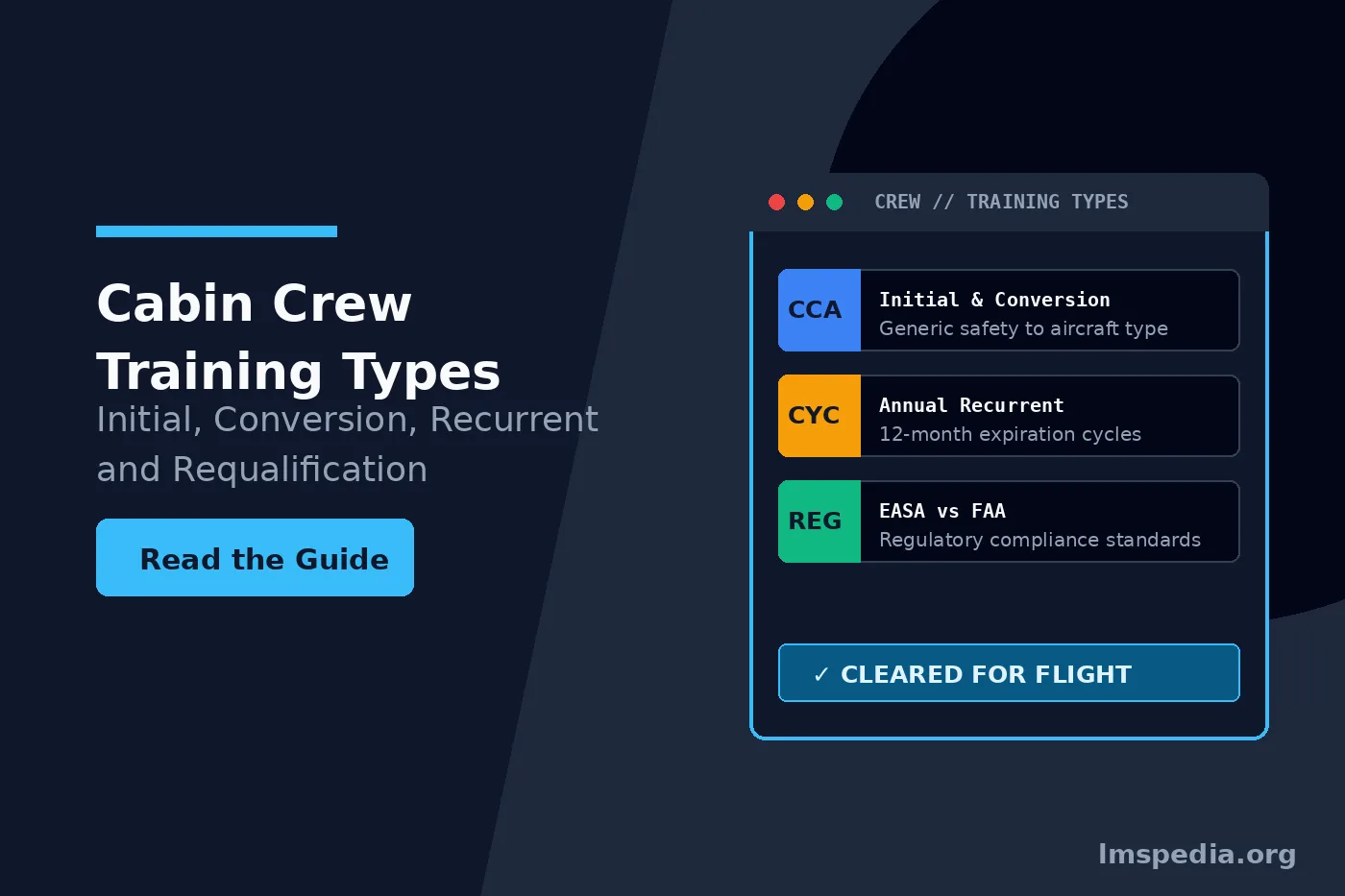
Cabin Crew Training Types: Initial, Conversion, Recurrent, and Requalification
Passengers primarily interact with flight attendants during meal service or boarding. However, hospitality remains a secondary function of the modern cabin crew. A flight attendant’s primary responsibility centers completely on cabin safety. Specifically, crew members execute rapid evacuations, manage medical emergencies, and extinguish in-flight fires. These high-stress scenarios are rare but potentially catastrophic. Therefore, civil aviation authorities enforce highly structured educational frameworks. These programs ensure crew members act decisively in life-or-death situations. Managing these diverse training lifecycles across thousands of crew members requires specialized infrastructure. Furthermore, training administrators must understand how these curricula function in operational practice. Selecting the proper training methodology ensures airline compliance across international airspace. Ultimately, structured education transforms commercial crew into certified frontline safety professionals.
Airlines must strictly categorize their instructional programs across every fleet. This operational mandate applies whether carriers operate under the
European Union Aviation Safety Agency, the
Federal Aviation Administration, or other national authorities. These cabin crew training types dictate exactly what instructors teach. Furthermore, they define how evaluators assess practical student competence. Regulatory standards also determine when a flight attendant can legally operate revenue flights. A single compliance failure grounds the crew member immediately. Consequently, scheduling uncertified personnel can delay or cancel entire flight departures. In this comprehensive guide, we examine the foundational categories of cabin crew training. Next, we will break down initial, conversion, differences, recurrent, and requalification pathways. Additionally, we analyze how modern airlines structure compliance systems to protect operational readiness.
Key Takeaways

Initial Training is the Foundation:
Cabin crew initial training imparts universal aviation knowledge, basic first aid, and survival skills. Under EASA, this results in a portable Cabin Crew Attestation (CCA) that belongs to the individual.
Conversion is Airline and Aircraft Specific:
Operator Conversion teaches a new hire the specific rules of the airline, while Type Conversion teaches the exact physical layout and emergency procedures of a newly assigned aircraft family (e.g., Boeing 777).
Differences Training Saves Time:
When moving between variants of the same aircraft family (like upgrading from an A320 to an A321), crew members only require short, targeted Differences Training rather than a full Type Conversion.
Recurrent Training Prevents Skill Fade:
Flight attendants must complete high-intensity recurrent training and practical emergency evaluations every 12 calendar months to legally remain on flight status.
Requalification is Tiered by Absence Length:
If a qualification lapses, the required requalification training scales based on the duration of the absence. A short lapse requires basic refresher modules, while a lapse over 3-5 years may force the crew member to repeat Initial Training entirely.
1. Cabin Crew Initial Training
Every commercial aviation career begins with rigorous initial instruction. Airlines require this foundational course for any individual who has never operated as commercial crew. Initial training imparts general aviation knowledge and baseline safety principles. Furthermore, instructors teach core emergency survival skills that apply across all aircraft types. Trainees master universal safety protocols before learning specific company procedures. In European jurisdictions, graduates receive a formal Cabin Crew Attestation upon completion. This attestation acts as a recognized professional license across European member states. Conversely, American carriers bundle this phase into airline-specific initial training programs. This unified American pathway culminates in a formal Certificate of Demonstrated Proficiency. For a broader overview of regulatory frameworks, review our guide explaining
cabin crew training types explained thoroughly. Ultimately, initial training establishes fundamental aeronautical competence for new flight attendants.
Core Modules of the Initial Curriculum
Initial training typically lasts between four and six weeks. Students complete over one hundred programmed classroom and practical simulator hours. First, students study aviation regulations and standard operating procedures. Trainees learn their legal responsibilities, chain of command protocols, and air transport laws. Next, aero-medical instruction prepares crew members to manage severe in-flight emergencies. Specifically, trainees treat hypoxia, execute cardiopulmonary resuscitation, and operate automated external defibrillators. Trainees also practice managing emergency childbirth and severe allergic reactions at cruising altitudes. Additionally, instructors emphasize passenger physiological reactions to pressurized cabin environments. Therefore, candidates develop acute diagnostic instincts alongside practical medical skills. Ultimately, foundational medical competence protects passengers during remote transoceanic crossings.
Practical survival and firefighting training form the next rigorous curriculum tier. Students put on protective breathing equipment and operate real fire extinguishers. Specifically, trainees physically extinguish actual fires inside simulated smoke-filled cabin trainers. Survival instruction covers extreme environments, including Arctic tundra, remote deserts, and dense tropical jungles. Furthermore, wet drills require life raft inflation and simulated passenger water rescues. The
International Civil Aviation Organization establishes global baseline principles for these survival exercises. Finally, Crew Resource Management teaches human factors, situational awareness, and threat management. Teams learn to challenge operational errors politely but assertively. Consequently, effective communication mitigates human error risks inside the aircraft cabin. Ultimately, initial curricula transform novices into capable aeronautical first responders.
Attestation Mobility
Under European regulations, the Cabin Crew Attestation belongs to the individual crew member. Therefore, when flight attendants switch European airlines, their new employer skips generic initial instruction completely.
2. Conversion and Differences Training
Flight attendants cannot legally board a passenger flight immediately following initial training. Specifically, they must master the operational procedures of their specific employer. Crew members must also understand the physical layout of their assigned aircraft models. This mandatory operational step makes conversion and differences training vital. Operator Conversion Training introduces company culture, bespoke operating procedures, and specific corporate security protocols. Furthermore, trainees study unique airline uniform standards, passenger service workflows, and proprietary customer interaction models. Even veteran attendants with twenty years of prior experience must complete operator conversion when joining a new airline. Consequently, operator conversion standardizes performance across diverse corporate flight operations. Ultimately, this phase aligns every crew member with company brand and safety standards.
Aircraft Type Conversion Training
Aircraft Type Conversion focuses entirely on the technical components of a specific aircraft family. For example, a crew member might transition from an Airbus A320 to a Boeing 777. This course requires intensive theoretical study and hands-on practical simulations. Specifically, flight attendants practice door operations inside Cabin Emergency Evacuation Trainers. Trainees memorize the exact cabin locations of emergency equipment. They locate fire extinguishers, oxygen bottles, first aid kits, and crash axes rapidly. Furthermore, attendants master door operation mechanics in both normal and emergency deployment modes. They also rehearse evacuation commands and slide-raft disconnection procedures repeatedly. Consequently, crew members build instinctual muscle memory for high-stress evacuation scenarios. Ultimately, type conversion certifies crew members to operate specific commercial aircraft safely.
Differences Training for Aircraft Variants
Differences training provides a shorter, highly targeted instructional syllabus. Airlines require this training when crew members operate variants within a certified aircraft family. For example, attendants qualified on the Boeing 737-800 require differences training for the Boeing 737-MAX. Trainees do not repeat the entire type conversion curriculum. Instead, they study only the physical and procedural modifications between the aircraft models. These variations include modified emergency exit operations, updated digital flight attendant panels, and reconfigured jumpseats. Furthermore, variations in emergency equipment stowage require hands-on verification. Differences training usually lasts between one and three operational days. Therefore, airlines expand crew flexibility without paying for redundant full-length type ratings. Ultimately, variant training maintains complete technical accuracy across modernized airline fleets.
| Training Category |
Operational Trigger |
Curriculum Focus |
Standard Duration |
| Initial Training |
Entering the commercial aviation profession |
Generic aviation safety, survival, first aid, and CRM |
4 to 6 Weeks |
| Operator Conversion |
Joining a new airline employer |
Company procedures, security manuals, and service culture |
1 to 2 Weeks |
| Type Conversion |
Assigned to an unfamiliar aircraft family |
Door mechanics, evacuation slides, and cabin layout |
5 to 10 Days |
| Differences Training |
Assigned to an aircraft variant within family |
Specific physical and system variations between sub-models |
1 to 3 Days |
3. Software Platforms for Crew Compliance Management
Coordinating complex cabin training across thousands of mobile crew members presents severe logistical challenges. Training managers must track expiring certifications, schedule flight simulators, and manage instructor availability. Spreadsheets fail to handle the volatile operational demands of modern airline scheduling. Therefore, aviation academies deploy specialized software systems to automate their compliance pipelines. Evaluating your training infrastructure becomes critical as your flight schedules expand. Furthermore, understanding essential
training management system features ensures comprehensive crew compliance tracking. The table below compares three prominent platforms utilized across commercial aviation operations.
| Platform |
Primary Operational Architecture |
Aviation Compliance Capabilities |
Target Customer Profile |
| SimpliTrain |
Unified training operations and resource management system |
Automated recurrency windows, mobile grading rubrics, and dynamic roster locks |
Commercial airlines, aviation training academies, and multi-station operators |
| CAE Pelesys |
Courseware delivery and basic crew compliance tracking platform |
Pre-built regulatory course libraries and traditional electronic examination logging |
Legacy flag carriers and large-scale aviation training networks |
| Mint TMS |
Resource management and simulator event scheduling system |
Advanced visual scheduling boards with basic qualification status checks |
Large commercial airlines managing complex simulator training centers |
4. Annual Recurrent Training and Cycles
Human operational memory degrades naturally over time. This skill fade poses a massive hazard for emergency procedures rarely used during normal flights. To prevent skill decay, civil aviation authorities strictly mandate recurrent training. This annual requirement ensures crew members maintain sharp physical and mental capabilities. Under almost all international jurisdictions, airlines must deliver recurrent modules every twelve calendar months. If a flight attendant misses their scheduled base-month window, their flight qualification lapses immediately. Consequently, automated rostering software removes the crew member from active flight status. Exploring our deep dive into
flight attendant recurrent training FAA EASA standards clarifies these strict timelines. Ultimately, recurrent training reinforces emergency readiness across the entire operating workforce.
The Recurrent Training Syllabus
Recurrent training functions as an intensive, condensed review of initial and type-specific safety procedures. Instructors deliver this comprehensive refresher over two to four days. First, the curriculum reviews recent regulatory changes, updated standard operating procedures, and company safety bulletins. Next, crew members complete theoretical examinations covering aircraft systems, dangerous goods, and aviation medicine. Attendants also execute practical simulator drills inside evacuation trainers. These drills test door operations, smoke hood donning, and rapid cabin decompression responses. Furthermore, instructors dedicate substantial time to Crew Resource Management refreshers. Teams analyze recent real-world aviation accidents and deconstruct human error chains. Consequently, crew members sharpen their communication and conflict-resolution habits annually. Ultimately, recurring assessments guarantee consistent operational safety standards.
Triennial Practical Drills
In addition to annual classroom refreshers, authorities mandate costly practical drills on a three-year rolling cycle. Every thirty-six months, crew members must execute physical survival drills in controlled environments. Specifically, attendants board survival life rafts in municipal pools or specialized aviation training tanks. Trainees also practice dragging incapacitated passengers through water while wearing life vests. Furthermore, crew members extinguish real flammable liquid fires inside enclosed live fire simulators. Attendants must also demonstrate physical operation of every aircraft exit type they actively fly. To schedule these complex cycles efficiently, airlines rely on
building a recurrency matrix to avoid compliance lapses. Therefore, operations teams maintain unbroken training cadence across rotating fleets. Ultimately, triennial drills preserve vital muscle memory for extreme physical survival scenarios.
Audit Triennial Windows
Do not confuse annual recurrent deadlines with triennial practical drill requirements. System administrators must track these two timelines independently to avoid accidental crew groundings.
5. Cabin Crew Requalification and Refresher Frameworks
Flight attendants take maternity leave, experience extended medical absences, or miss recurrent training deadlines. When qualifications lapse, crew members cannot legally fly revenue flights. To regain active flight status, attendants must complete structured requalification training. The duration and intensity of refresher modules depend directly on the length of operational absence. Aviation authorities recognize that a two-month absence requires a much lighter intervention than a two-year departure. Therefore, airlines structure requalification into progressive tiers based on elapsed calendar time. Understanding these tiers allows scheduling departments to budget simulator hours and classroom seats accurately. Consequently, airlines minimize the financial costs of returning grounded employees to the active line. Ultimately, requalification paths restore expired competencies systematically.
Industry Requalification Tiers
When an absence lasts less than six months, the attendant usually completes the missed annual recurrent training course. However, an absence extending between six and twelve months requires a dedicated refresher module. This expanded module reviews modified standard operating procedures and type-specific aircraft changes. Furthermore, absences ranging between twelve and thirty-six months demand massive educational interventions. The returning crew member must repeat significant portions of the original Aircraft Type Conversion course. Attendants must physically operate every emergency door exit and pass comprehensive written examinations. Finally, absences exceeding thirty-six months invalidate basic aeronautical qualifications. Under European rules, the individual’s Cabin Crew Attestation expires completely. Consequently, the airline must treat the returning worker as an entirely new hire. The candidate must retake initial training from day one. Ultimately, tiered requalification protects passenger safety by preventing unverified crew deployments.
6. Regulatory Frameworks: EASA vs FAA Comparison
The physical acts of fighting cabin fires or opening emergency aircraft doors remain universally identical. However, the administrative frameworks governing EASA and FAA training programs exhibit distinct structural philosophies. Under EASA, training architecture follows a strictly modular format. The European authority completely separates generic aeronautical knowledge from airline-specific procedures. This separation facilitates the free movement of aviation labor across European Union borders. An attested crew member can switch airlines without repeating basic aeronautical courses. Furthermore, European aviation academies must prepare their facilities using a
regulatory audit preparation checklist for approved training organisations to maintain accreditation. Consequently, the European modular system lowers onboarding costs for expanding regional airlines. Ultimately, modular certification provides flexibility for both airlines and frontline personnel.
Conversely, the American FAA views cabin crew training through the operational lens of the specific air carrier. The FAA mandates Initial, Transition, Differences, and Recurrent training categories. However, individual qualification remains tied directly to the airline approved training program. The FAA issues a Certificate of Demonstrated Proficiency only after the candidate completes company-specific curricula. Furthermore, American regulations require trainees to complete Initial Operating Experience on live revenue flights. During these flights, qualified check attendants observe and evaluate the candidate under genuine line conditions. If the trainee demonstrates consistent procedural competence, the airline signs off on their qualification. Therefore, the FAA system prioritizes operational integration within a single carrier ecosystem. Ultimately, both regulatory models achieve exceptional commercial safety standards through different administrative paths.
7. Digital Recordkeeping and Audit Readiness
Airlines manage vast quantities of sensitive qualification data across dispersed operational bases. During unannounced audits, civil aviation inspectors demand immediate proof of crew competence. If an airline cannot produce verifiable records for an active flight crew, inspectors issue heavy fines. Regulators can also suspend the airline operating certificate until the company resolves documentation errors. Therefore, modern carriers must maintain compliant digital archives for all crew qualifications. Establishing strict protocols for
aviation training records retention ensures carriers store documents securely. Furthermore, maintaining defensible compliance documentation through resources like our guide on
LMS for compliance training and audit evidence guarantees institutional readiness. Electronic systems must capture digital signatures, practical grading rubrics, and simulator logs automatically. Furthermore, automated tracking prevents administrative errors from escalating into expensive legal liabilities. Ultimately, digital infrastructure ensures permanent audit readiness across global station networks.
Modern training management systems integrate directly with daily crew rostering software. This integration creates an automated safety barrier against illegal flight assignments. Specifically, when a crew member qualification expires, the system locks their operational profile immediately. Schedulers cannot assign the uncertified attendant to upcoming passenger flights. Furthermore, the system alerts training managers sixty days before upcoming expirations. This early warning enables planners to schedule recurrent simulator sessions without disrupting daily flight rotations. Consequently, the airline avoids last-minute operational scrambles and expensive off-duty pay. Integrating training data with rostering systems streamlines cross-departmental communication significantly. Therefore, digital compliance automation protects flight reliability and corporate profitability simultaneously. Ultimately, secure record automation provides air carriers with complete operational peace of mind.
Enforce Rostering Hard Locks
Configure your crew management software to hard-lock crew scheduling sixty days prior to qualification expiry. Automated roster locks prevent non-compliant dispatch events during peak operational travel seasons.
Conclusion
Managing commercial cabin safety requires an uncompromising commitment to structured, continuous professional education. Comprehensive training transforms flight attendants into elite in-flight emergency managers. Crew members endure demanding initial training followed by rigorous conversion and differences modules. Airlines must maintain relentless operational vigilance when tracking annual and triennial recurrent qualifications. Proactive tracking avoids the substantial financial and logistical burdens associated with full employee requalification programs. Furthermore, deploying modern cloud compliance platforms automates expiration forecasting across thousands of active crew profiles. Automated systems eliminate human error, streamline recordkeeping, and prevent illegal flight scheduling. Aligning airline operations with strict international standards protects corporate reputations and preserves operational profitability. When unexpected emergencies occur at thirty-five thousand feet, structured training guarantees crew members respond flawlessly.