Training CRM vs TMS: Which System Owns Which Data
Commercial training providers face unique operational challenges as their course portfolios expand. In particular, educational businesses struggle to manage customer acquisition alongside complex event logistics. Executives frequently debate whether customer relationship management software or a training management system should govern daily operations. Consequently, teams suffer from data duplication, missed sales handoffs, and confused reporting when boundaries blur. Understanding the architectural boundary between these two enterprise platforms eliminates operational chaos. Furthermore, commercial education leaders should analyze their overall architecture by examining our comprehensive guide on the modern training company software stack to structure their tools properly.
Selecting appropriate operational software requires evaluating the functional divide between front-office sales and back-office delivery. To understand how operational execution interacts with learner digital environments, review our detailed comparison of TMS vs LMS for training providers. Additionally, managing corporate accounts requires tailored relationship workflows, as analyzed in our strategic assessment of a dedicated CRM for training providers. Ultimately, establishing clean data ownership boundaries satisfies strict quality management benchmarks outlined by the International Organization for Standardization.
Key Takeaways

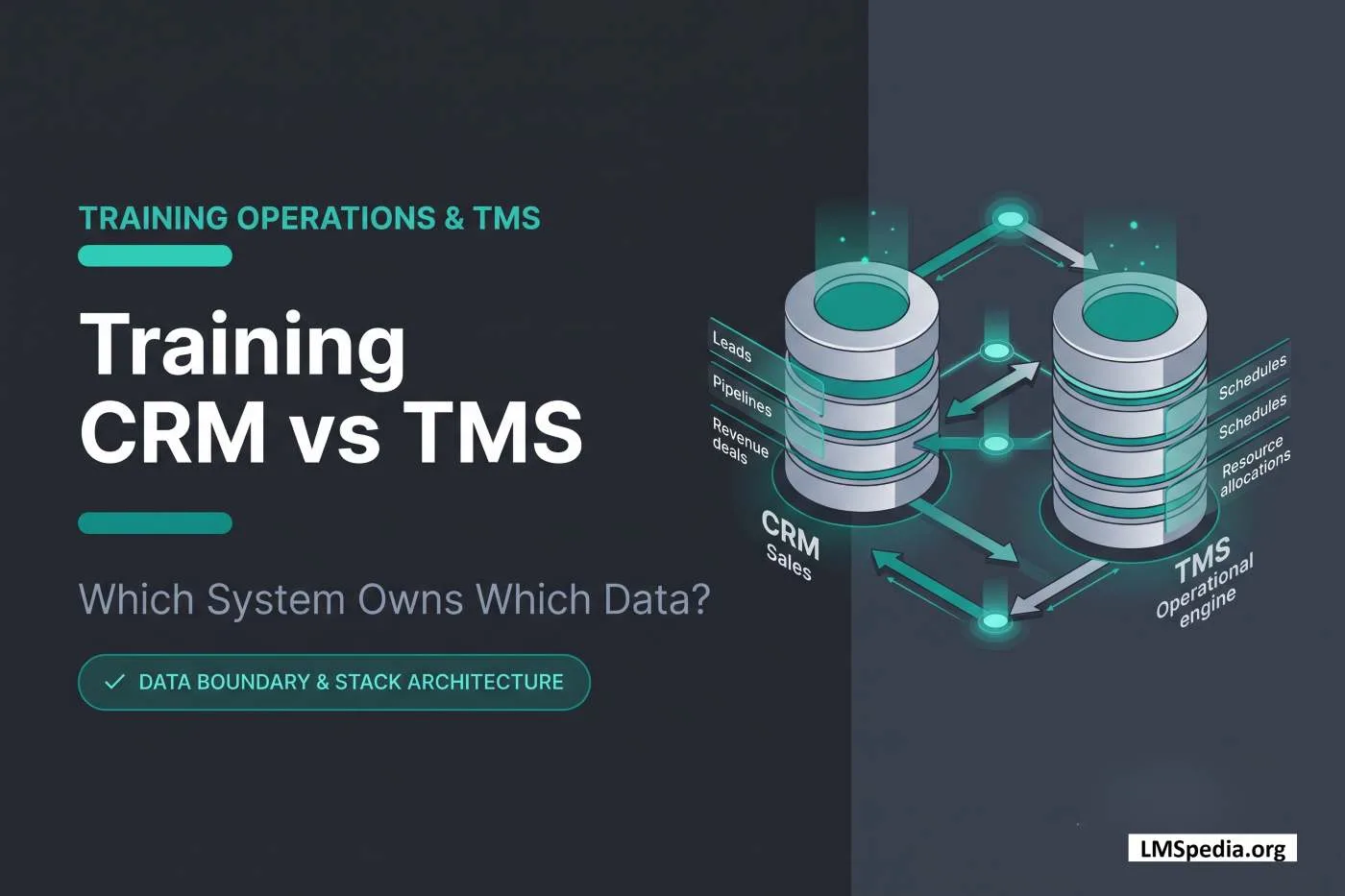
Clear Functional Mandates: The CRM governs top-of-funnel prospect acquisition and customer relationships, while the TMS controls back-office course logistics, scheduling, and resource allocation.
Strict Entity Ownership: Corporate accounts and sales leads belong exclusively inside the CRM, whereas course definitions, timetables, instructor rosters, and classroom capacities must be owned by the TMS.
Automated Closed-Won Handoffs: Marking an enterprise deal as Closed-Won in the CRM should automatically trigger an operational order in the TMS via API webhooks, eliminating manual data entry.
Avoiding CRM Over-Customization: Forcing a generic CRM to manage complex scheduling dependencies creates brittle, expensive, and unmaintainable technical debt.
Three-Tier Software Ecosystem: High-performing training businesses separate their architecture into three distinct layers: CRM for sales, TMS for delivery logistics, and ERP or accounting platforms for financial reconciliation.
The Core Operational Divide: Sales Pipeline vs Training Delivery
Defining the CRM Mandate in Commercial Education
Customer Relationship Management platforms focus squarely on external relationships, prospect communication, and revenue acquisition. Platforms like Salesforce or HubSpot track leads through multi-stage commercial sales funnels. Specifically, the CRM records every customer touchpoint, marketing email open, discovery call, and proposal submission. The sales team treats the CRM as their primary commercial command center.
However, general-purpose CRMs fail to understand the complex logistical dependencies of educational delivery. A standard CRM views a purchase as a closed-won transaction rather than an operational commitment. It cannot natively calculate room capacity limits, track instructor certifications, or manage multi-day timetables. Therefore, attempting to force course delivery workflows into a traditional CRM creates massive administrative friction. Sales tools exist to win contracts, not to run classrooms.
Moreover, modern sales teams require real-time visibility into historical account interactions. A CRM excels at aggregating communication records across multiple client stakeholders over several years. This commercial context empowers business development representatives to identify enterprise cross-selling opportunities effectively.
Defining the TMS Domain in Training Operations
In contrast, a Training Management System serves as the operational engine for educational logistics and course execution. The TMS manages everything required to deliver a course profitably after a customer signs a contract. Specifically, it schedules course dates, reserves physical classrooms, assigns certified trainers, and tracks resource costs. Operations teams rely on the TMS to ensure instructors arrive prepared and courses run smoothly.
Furthermore, the TMS governs the complex post-booking learner lifecycle. It automates joining instructions, dispatches pre-course reading materials, records attendance rosters, and tracks course completion statuses. Without a TMS, training coordinators must track these intricate logistics manually using fragile spreadsheets. Consequently, dedicated training operations software dramatically decreases administrative overhead while improving operational margins.
Operational stability also requires strict adherence to international project frameworks. Organizations frequently benchmark operational processes against standards published by the Project Management Institute. Structured resource workflows ensure consistent client satisfaction across international programs.
Mapping System Boundaries: Who Owns Which Data Entity?
Leads, Opportunities, and Corporate Account Data
Data ownership must remain absolute to prevent corrupting database synchronizations. First and foremost, the CRM must retain definitive ownership over all top-of-funnel entities. These entities include prospective leads, marketing campaigns, sales opportunities, and corporate business accounts. The CRM governs customer lifecycle stages from initial contact through formal quotation.
Consequently, the TMS should never originate prospective corporate accounts independently. When a salesperson creates an account inside the CRM, the platform assigns a unique global identifier. The TMS ingests this account identifier during synchronization to preserve relational database integrity. If marketing teams update a billing address or company contact, the CRM pushes that update downstream. The CRM remains the sole source of truth for commercial customer identities.
In addition, maintaining clean account hierarchies is critical for commercial training firms. Large enterprise clients often feature multiple subsidiary divisions and regional procurement offices. The CRM correctly maps parent-child account relationships, ensuring that commercial credit limits and master services agreements reflect corporate realities.
Course Catalogs, Timetables, and Scheduling Instances
Conversely, the TMS must hold absolute, non-negotiable ownership over course definitions and scheduling instances. A course is not merely a line-item product in a sales catalog. In reality, a training course consists of complex dependencies including duration hours, minimum attendee thresholds, and prerequisite credentials. The TMS defines these structural parameters.
Furthermore, the TMS manages the live master schedule across public and private course deliveries. When operations teams schedule a course date, the TMS calculates available seating capacity in real time. The TMS then pushes available course dates and remaining seat counts back to the CRM or public website. The CRM acts merely as a read-only consumer of scheduling availability data.
Because course metadata updates frequently, centralizing ownership within the TMS prevents embarrassing logistical errors. For instance, if an operations coordinator reschedules a class due to venue maintenance, the TMS updates the event once. Automated synchronization instantly reflects this adjustment across dedicated corporate client portals for training providers.
Resource Allocation, Instructors, and Facilities
Resource management represents another critical functional domain owned exclusively by the TMS. Educational providers must balance the finite availability of specialized instructors, simulation equipment, and training venues. A general CRM lacks the technical capacity to model resource conflict detection or instructor skill qualifications.
The TMS tracks instructor working hours, travel constraints, day rates, and pedagogical certifications. To optimize internal staffing efficiency, training directors rely on strategies detailed in our guide on trainer capacity planning metrics. Furthermore, tracking an accurate instructor utilisation rate ensures businesses balance delivery quality with overhead profitability. The TMS alerts coordinators instantly if an instructor booking exceeds statutory rest limits or overlaps an existing class.
Similarly, physical classroom allocations demand meticulous constraint mapping. The TMS ensures that practical workshops with specialized equipment receive correctly configured laboratory rooms. Storing facility attributes inside the TMS guarantees that training coordinators allocate spaces matching specific curriculum requirements.
Define Single Source of Truth
Establish the CRM as the master source for client billing records, while giving the TMS absolute authority over course dates, instructor assignments, and room capacity limits.
Public Course Bookings, Registrations, and Delegate Rosters
The boundary between commercial transactions and attendee rosters requires careful architectural structuring. When retail customers or corporate clients book seats on a public course, transaction data flows through specialized checkout engines. Training providers should explore advanced checkout configurations outlined in our analysis of a modern course booking system for training providers. Integrating these flows with a scalable training e-commerce gateway ensures instant payment processing without administrative intervention.
Once a booking occurs, the financial transaction records inside the CRM or ecommerce portal, but attendee delegate data belongs to the TMS. The TMS manages individual learner rosters, dietary requirements, emergency contacts, and prerequisite verification. Separating corporate purchaser records from individual delegate files protects sensitive learner information while keeping sales pipelines clean.
Additionally, privacy compliance mandates that commercial organizations handle personal learner data responsibly. Training providers operating across international borders must adhere to consumer protection frameworks published by the Federal Trade Commission. Segregating marketing lists from student operational rosters reduces compliance liabilities.
Integration Architecture: Building Bidirectional Synchronization
The Closed-Won Handoff Protocol
The most crucial touchpoint between a CRM and a TMS occurs during the sales handoff. In enterprise B2B training sales, an account executive negotiates a custom private course package with a corporate client. When the client signs the contract, the salesperson marks the opportunity as Closed-Won inside the CRM. This status change must trigger an automated integration workflow.
Specifically, an API webhook immediately transmits the opportunity details from the CRM to the TMS. The TMS ingests the corporate account ID, course type, agreed participant volume, and requested delivery timeframe. The TMS automatically creates an unconfirmed operational order and alerts the training operations coordinator. The coordinator then assigns an available instructor and reserves a suitable training room.
Automated handoffs completely eliminate manual data re-entry between commercial sales and delivery teams. Consequently, operations staff no longer waste hours decoding cryptic sales notes or chasing sales reps for basic booking details. Automation accelerates the transition from contract signature to active classroom delivery.
Preventing Duplicate Records and State Mismatches
Bidirectional synchronizations often suffer from duplicate records if developers design data flows carelessly. A common failure occurs when both the CRM and the TMS attempt to generate new contact records independently. To prevent synchronization collisions, technical architects must implement strict primary key mapping rules.
Under a robust architecture, the CRM creates and maintains the primary Contact ID for the corporate buyer. If an operational coordinator interacts with the buyer inside the TMS, the system references the original CRM Contact ID. Securing these automated pipelines requires modern token authorization models, as examined in our guide on OAuth scopes and tokens for LMS integrations. Furthermore, system developers must configure idempotent API endpoints to prevent duplicate records when network timeouts trigger retry attempts.
Similarly, state mismatches can disrupt financial reporting. If a customer cancels an enrollment directly with an operational coordinator, the TMS must transmit a cancellation webhook back to the CRM instantly. Immediate synchronization ensures that sales pipelines, billing projections, and commission calculations remain perfectly accurate across both platforms.
Implement Idempotent Webhooks
Configure all API webhooks connecting your CRM and TMS with unique transaction keys to prevent duplicate booking entries during network reconnects.
Common Architectural Pitfalls in Commercial Training Operations
Over-Customizing the CRM to Mimic a TMS
A widespread mistake among expanding training organizations is over-customizing a generic CRM. Business leaders frequently assume that adding custom objects to Salesforce or HubSpot is cheaper than purchasing a dedicated TMS. Consequently, internal IT teams spend hundreds of hours attempting to build course scheduling engines, room booking calendars, and attendance trackers inside the CRM.
Inevitably, this approach results in an unmaintainable architectural nightmare. Generic CRMs lack native logic for recurring session timetables, instructor accreditation expiry checks, and automated certificate distribution. Maintaining complex custom apex code or complex workflow rules drains technical resources and creates brittle operational dependencies. Purpose-built training management software delivers superior functional depth out of the box.
Moreover, custom CRM builds rarely scale when training providers expand internationally. Adding multi-currency public catalogs, diverse timezone scheduling, and specialized partner portals rapidly overwhelms custom CRM schemas. Using each tool for its intended purpose preserves software maintainability and team sanity.
Treating the TMS as an Accounting or Invoicing Engine
Conversely, some training organizations attempt to force their TMS to act as an enterprise resource planning or accounting system. While a modern TMS handles order creation, course pricing rules, and basic invoicing, it does not replace dedicated accounting software. A TMS cannot manage double-entry general ledgers, complex tax reconciliations, or comprehensive corporate balance sheets.
Therefore, the optimal integration architecture establishes a clean three-tier software model. The CRM captures sales demand, the TMS manages training delivery logistics, and dedicated financial software like QuickBooks, Xero, or NetSuite handles formal accounting. The TMS transmits completed course fulfillment data downstream to the accounting platform for revenue recognition. Maintaining clear operational boundaries protects financial auditability.
Attempting to bypass formal financial software invites significant regulatory compliance risks. Accounting departments require specialized controls, invoice audit trails, and strict tax compliance features that operational software cannot provide. Clear system boundaries ensure every corporate department operates with appropriate tools.
Maintain Three-Tier Architecture
Separate your technology stack into three clean tiers: CRM for customer acquisition, TMS for course logistics, and dedicated accounting software for ledger reconciliation.
Benchmarking Training Management and Operations Platforms
Selecting the right operational software requires commercial education providers to compare platform capabilities carefully. Software must streamline resource scheduling, automate client communications, and provide clean API endpoints for CRM integration. Below, we compare leading platforms based on their operational and integration architecture strength.
| Platform / Solution | Primary Architectural Focus | Operations & Integration Strength |
|---|---|---|
| SimpliTrain | End-to-end commercial training operations, resource logistics, and automated scheduling. | Excels at bidirectional CRM synchronization, automated instructor conflict detection, dynamic capacity management, and audit-proof event tracking. |
| Salesforce Education Cloud | Enterprise relationship management and educational constituent tracking. | Provides powerful CRM capabilities, extensive custom data modeling, and robust marketing automation, but requires significant custom development for complex course logistics. |
| Administrate | Enterprise training operations and continuous educational infrastructure. | Delivers comprehensive event scheduling, core resource management engines, and extensive developer APIs for complex corporate integrations. |
Establishing Unified Business Intelligence Across Both Systems
Synthesizing Commercial Pipelines With Resource Utilization
When training providers integrate their CRM and TMS correctly, executive leaders unlock unprecedented business intelligence. Combining sales pipeline velocity with operational capacity data enables precise revenue forecasting. Training leaders can instantly identify upcoming course dates that risk running below minimum profitability thresholds.
Furthermore, unified business intelligence bridges the traditional communication gap between sales teams and operations coordinators. Sales representatives can view live classroom seat availability directly within their CRM deal records. This real-time visibility prevents account managers from selling seats on fully booked courses or pitching dates without available instructors.
Additionally, operations managers can analyze historical course profitability by synthesizing CRM acquisition costs with TMS instructor fees and venue expenses. This granular financial transparency empowers executive teams to retire unprofitable course topics and double down on high-margin corporate training programs.
Eliminating Administrative Friction and Accelerating Growth
Ultimately, establishing clean data boundaries between the CRM and TMS transforms commercial education businesses. Automating routine administrative handoffs frees training coordinators to focus on learner satisfaction and instructor quality. Sales teams close deals faster because they possess instant access to live scheduling inventory.
Moreover, modern software architectures adapt effortlessly as organizations expand into new geographic markets or launch virtual learning channels. Clean API-driven integrations ensure that adding new tools or updating legacy systems does not disrupt core business continuity. Investing in clean data architecture establishes a scalable foundation for long-term commercial dominance.
Conclusion
Distinguishing between customer relationship management platforms and training management systems is essential for running a scalable education business. While the CRM drives commercial customer acquisition and manages sales funnels, the TMS governs the complex operational reality of course logistics, instructor schedules, and delegate rosters. Attempting to force one system to perform the duties of the other invariably produces administrative gridlock and data corruption. By establishing clean data ownership boundaries and implementing robust bidirectional synchronization, commercial training organizations eliminate operational bottlenecks, safeguard data integrity, and unlock sustainable long-term profitability.
FAQ
Q: What is the main difference between a training CRM and a TMS?
A: A training CRM manages prospective customer interactions, sales pipelines, marketing campaigns, and commercial contracts. In contrast, a TMS manages the operational logistics of delivering training, including course timetables, instructor assignments, venue reservations, and delegate rosters.
A: Standard CRMs lack native architectural support for multi-day course timetabling, trainer capacity conflict detection, classroom capacity tracking, and student attendance administration. Customizing a CRM to perform these tasks requires complex, brittle code that is expensive to maintain
Q: Which system should own corporate customer records?
A: The CRM must remain the primary source of truth for corporate account identities, billing addresses, and sales contact details. The TMS ingests this account information via API synchronization to ensure consistency across commercial and operational records.
Q: How should a course cancellation be handled between the two systems?
A: If a customer cancels through training operations, the TMS must immediately transmit an automated cancellation webhook back to the CRM. This ensures sales pipelines, commission calculations, and revenue reporting reflect accurate data in real time.
Q: Where does delegate attendance data belong?
A: Delegate attendance and individual learner information belong inside the TMS. Separating individual student profiles from high-level corporate buyer records keeps sales pipelines clean and ensures compliance with global consumer privacy regulations.