
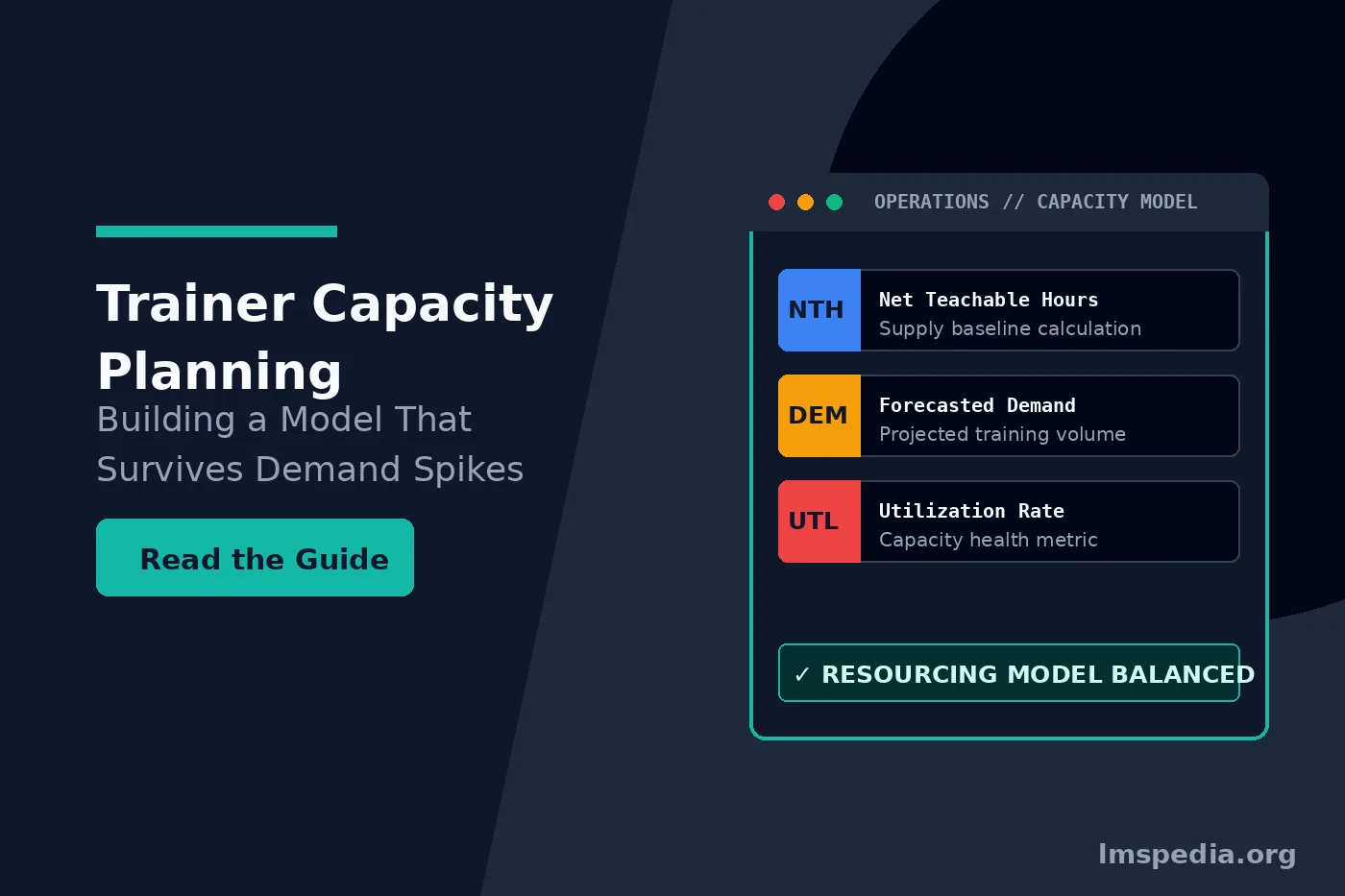
Trainer Capacity Planning: The Instructor Supply & Demand Model
Scaling an enterprise learning program exposes a critical operational bottleneck immediately. Specifically, sudden massive compliance recertifications cause organizational training demand to skyrocket overnight. Consequently, learning departments actively face reactive chaos without a mathematical scheduling framework. Therefore, developing a rigorous trainer capacity planning strategy remains an essential operational priority. Historically, human instructors suffered severe burnout when class sizes exceeded safe pedagogical limits. Today, a robust strategy guarantees instructional teams survive demand spikes safely. Organizations frequently fail because they rely on blind intuition over hard data. Specifically, they mistakenly assume one full time instructor translates to forty actual weekly teaching hours. Ultimately, this gross miscalculation ignores required preparation time and massive daily administrative overhead. In this comprehensive guide, we outline exactly how to build a robust training capacity model. Mastering these principles prevents catastrophic scheduling failures and protects educational integrity.
Key Takeaways

Gross Hours vs. Teachable Hours: Never assume an instructor’s 40-hour workweek equals 40 hours of teaching capacity. You must aggressively deduct time for preparation, travel, administration, and PTO to find the true Net Teachable Hours.
Forecast Three Demand Tiers: Accurate capacity models must account for predictable baseline demand, upcoming project-based demand, and an intentional buffer for urgent, ad-hoc requests.
Automate to Reclaim Capacity: Implementing SCIM provisioning and automated identity management drastically reduces the manual administrative burden on instructors, freeing them up to focus on actual facilitation.
Respect Regulatory Constraints: In industries like aviation or healthcare, capacity planning cannot rely on merely increasing class sizes, as this directly violates strict, legally mandated instructor-to-learner ratios.
Build an Overflow Strategy: Maintain a bench of internal Subject Matter Experts (SMEs) and pre-vetted external contract facilitators to absorb temporary volume spikes without permanently increasing full-time headcount.
Deconstructing the Trainer Resourcing Model
The Fallacy of Intuition Based Scheduling
First, a highly functional trainer resourcing model cleanly balances two conflicting operational forces. Specifically, it successfully balances inbound training requests directly against available outbound instructional hours. Consequently, operations managers must meticulously map out both sides of this massive equation. Therefore, when demand heavily outpaces supply, organizations must intentionally delay software rollouts. Alternatively, they must actively pay premium fees for highly expensive external contract facilitators. Transitioning away from intuition requires establishing concrete utilization benchmarks immediately. Furthermore, learning leaders must adopt strict data governance over their scheduling pipelines. Ultimately, applying mathematical rigor solves chronic understaffing problems entirely.
Defining Core Supply and Demand
Next, conflating total employment hours directly with actual teaching capacity represents a dangerous error. Specifically, an instructor working a standard annual schedule lacks continuous facilitation availability. Consequently, you must accurately calculate precise net teachable hours to build baseline metrics. Reviewing our comprehensive guide on trainer capacity planning provides deeper context. Therefore, this calculation strictly requires systematically deducting all non facilitation activities immediately. Ultimately, distinguishing true supply from raw headcount prevents severe operational mismanagement. Organizations cannot forecast accurately without understanding these fundamental differences.
Calculating True Instructor Supply
Deducting Non Teachable Time
First, immediately deduct all vacation days from the annual scheduling calendar. Next, subtract allocated sick leave and standard corporate holidays completely. Furthermore, actively deduct necessary instructional preparation time meticulously. You must also account for physical classroom teardown time entirely. Next, subtract massive administrative burdens like answering repetitive learner emails. Instructors also spend significant time grading complex technical assessments. Ultimately, completely deduct highly unrecoverable travel hours. Instructors often spend days physically traveling between distant regional corporate offices.
Consequently, completing these strict deductions reveals a startling operational reality. Specifically, highly limited actual annual teaching capacity becomes mathematically obvious. A highly utilized enterprise instructor typically yields approximately eight hundred teachable hours. Therefore, attempting to schedule any instructor beyond this specific threshold guarantees severe fatigue. Furthermore, ignoring these deductions destroys employee morale incredibly rapidly. Ultimately, building a realistic baseline protects your instructional workforce from massive burnout.
Establishing Net Teachable Hours
Next, understanding this strict physical limitation perfectly anchors highly accurate operational forecasting. First, calculate the gross available hours for your entire instructional department. Furthermore, multiply the standard weekly working hours by your total instructor headcount. Consequently, you establish the absolute maximum theoretical baseline for your organization. Then, aggressively apply the deduction formula across the entire staff pool. Ultimately, this specific calculation yields the final aggregate net teachable hours available. This final number dictates your actual delivery bandwidth perfectly.
Automating Administrative Overhead
Naturally, you must ruthlessly eliminate administrative tasks to proactively increase instructor supply. Specifically, manually managing user access heavily drains incredibly precious daily net teachable hours. Consequently, highly ambitious organizations successfully reclaim hundreds of instructional hours annually through automation. Therefore, connecting your software directly to corporate directory systems solves this issue. Implementing SCIM provisioning for LMS architectures massively frees your valuable instructors. Ultimately, eliminating manual data entry expands your raw facilitation capacity effortlessly.
Audit Admin Time
First, track exactly how much time instructors spend on emails weekly. Next, multiply this by your total headcount to calculate lost teaching capacity. Finally, automate those specific administrative bottlenecks immediately.
Forecasting and Quantifying Training Demand
Baseline Recurring Demand
Next, accurate capacity forecast training directly requires successfully anticipating organizational shifts early. Specifically, you must turn your complete attention toward quantifying inbound demand. Exploring strategies for training demand forecasting helps structure this exact analytical process. Consequently, understanding exact future training volume perfectly prevents catastrophic operational scheduling failures. Therefore, corporate demand generally falls into exactly three highly distinct operational categories. First, baseline recurring demand represents highly predictable organizational corporate training volume annually. Specifically, this strictly includes weekly new hire cohorts and standard annual compliance recertifications. Consequently, you can actively project this volume easily by deeply analyzing historical data.
Project Based Corporate Demand
Furthermore, project based demand stems from highly specific planned corporate business initiatives. First, consult resources from the Project Management Institute for structural project alignment. Specifically, a massive global software rollout drastically spikes internal training volume. Therefore, operations teams must actively embed themselves deeply inside the corporate project office. Consequently, early visibility into strategic projects prevents sudden unmanageable facilitation requests. Furthermore, managers can budget for external contractors well in advance. Ultimately, aligning learning schedules with overarching corporate initiatives guarantees adequate resource allocation.
Ad Hoc and Urgent Demand
Ultimately, highly urgent ad hoc demand strictly breaks totally rigid capacity models entirely. Specifically, sudden regulatory shifts instantly generate incredibly massive unexpected instructional requirements. Indeed, a mature robust instructor supply demand planning model intentionally leaves dedicated buffers. Therefore, reserve approximately fifteen percent of your total capacity for unexpected emergencies. Consequently, your learning department remains agile and highly responsive during sudden corporate crises. Furthermore, leaving empty buffer space prevents cascading schedule collapses. Ultimately, anticipating the unexpected safeguards your operational credibility continuously.
Software Tools for Training Capacity Management
Evaluating Resource Management Platforms
Managing massive spreadsheets to track instructor availability invites catastrophic scheduling errors. Specifically, complex formulas break easily under pressure. Furthermore, manual data entry creates severe operational friction daily. Therefore, enterprise organizations deploy dedicated resource management systems to automate these complex variables. Consequently, these platforms compare forecasted demand against net teachable hours instantly. Below, we compare three prominent software platforms used by global training departments. Ultimately, selecting the proper infrastructure prevents widespread instructor burnout and logistical failure.
| Platform | Core Capability | Target Audience |
|---|---|---|
| SimpliTrain | Automated resource allocation and dynamic instructor capacity forecasting. | Enterprise L&D teams and commercial training providers. |
| Training Orchestra | Complex multi location logistics and instructor financial utilization tracking. | Massive global corporate universities handling huge budgets. |
| Administrate | Broad business intelligence reporting with basic resource calendaring tools. | Mid market training organizations requiring basic scheduling. |
The Impact of Regulated Environments on Capacity
Strict Ratios and Certification Tracking
Undoubtedly, standard corporate environments frequently survive sudden demand spikes by increasing class sizes. Specifically, cramming forty learners into a standard twenty person room solves scheduling crises. However, this highly dangerous shortcut remains strictly illegal in regulated industries. Exploring guidelines from the Occupational Safety and Health Administration clarifies these hard limits. Consequently, highly regulated sectors aggressively demand perfect regulatory instructor to student ratios. Therefore, aviation and healthcare sectors absolutely require strict flawless planning methodologies continuously. Furthermore, exceeding ratio limits invalidates the training legally.
Human Factors and Instructor Fatigue
Furthermore, federal regulatory bodies rigorously audit training facilities to ensure compliance. Specifically, they actively ensure technical maintenance personnel receive adequately supervised instruction. Ultimately, assigning an uncertified expired instructor invalidates the entire educational event. Crucially, treating instructors merely as interchangeable spreadsheet cells actively invites severe human error. Specifically, instructors pushed to maximum utilization capacity suffer profound daily cognitive fatigue. Studying human factors in aviation maintenance reveals the exact dangers of cognitive exhaustion. Consequently, exhausted trainers become irritable and routinely skip critical practical safety procedures.
Therefore, pushing instructional staff beyond sustainable physical limits fosters a toxic operational environment. Ultimately, massive systemic schedule pressure severely degrades frontline safety and overall knowledge transfer. Furthermore, tired instructors fail to assess student comprehension accurately. Specifically, they rush through practical demonstrations to finish classes early. Consequently, poorly trained frontline workers cause expensive industrial accidents later. Therefore, protecting instructor bandwidth directly protects overall corporate safety metrics. Ultimately, human limits define actual operational capacity strictly.
Monitor Utilization Rates
First, calculate your instructor utilization rate every single month without fail. Next, if utilization exceeds eighty percent, hire contractors immediately. Ultimately, sustained high utilization destroys instructional quality and drives employee turnover.
Building the Training Capacity Framework
The Mathematical Model
Naturally, organizations must physically implement a highly structured digital capacity tracking mechanism. Specifically, a highly disciplined mathematical model perfectly establishes operational baselines. Consequently, you absolutely must heavily review this specific model monthly to reconcile projections. Therefore, operations teams smoothly adjust assumptions continuously based on real world data. Furthermore, historical accuracy informs future scheduling decisions flawlessly. Next, building templates ensures mathematical consistency across departments. Below, we accurately detail a clean framework template for your capacity modeling.
| Capacity Dimension | Metric Data Point | Calculation Methodology |
|---|---|---|
| Gross Supply | Total Annual Work Hours | Total FTE Instructors multiplied by total standard working hours. |
| Non Teachable Time | Admin, PTO, Travel, Prep | Historical admin time plus allowed physical paid time off. |
| Net Teachable Supply | Available Facilitation Hours | Gross supply directly minus all calculated non teachable time entirely. |
| Forecasted Demand | Total Required Class Hours | Baseline demand completely plus ad hoc overflow capacity buffers. |
| Utilization Rate | Capacity Health Metric | Forecasted demand strictly divided directly by net teachable supply. |
Tactical Strategies for Surviving Demand Spikes
Deploying Subject Matter Experts
Undoubtedly, completely unavoidable sudden operational demand spikes will occasionally exceed your internal capacity. Specifically, utilization rates rapidly push directly past healthy sustainable thresholds. Consequently, you must actively deploy immediate tactical overflow strategies. First, actively deploy internal subject matter experts to heavily co facilitate highly technical modules. Specifically, senior engineers possess invaluable deep domain expertise for complex classes. Consequently, the core learning team strictly must provide highly structured facilitation guides. Therefore, these temporary highly skilled instructors flawlessly deliver critical educational messaging. Ultimately, internal experts bridge severe short term capacity gaps.
Establishing an External Bench
Next, maintaining highly active master service agreements successfully guarantees emergency facilitation. Specifically, pulling highly skilled trainers seamlessly from external benches works perfectly. Organizations should consult industry benchmarks from the Association for Talent Development for standard contracting rates. Ultimately, highly targeted external contractor deployment safely remains cost effective during massive spikes. Therefore, building relationships with freelance instructional networks protects your departmental delivery capabilities. Furthermore, external trainers handle generic soft skills modules easily. Consequently, this frees your internal staff for highly proprietary technical instruction.
Pivoting to Asynchronous Modalities
Furthermore, entirely pivoting toward asynchronous digital modalities massively reduces live facilitation demand. Specifically, effectively flipping the digital classroom successfully preserves incredibly precious instructor hours. Indeed, asynchronous learning modules gracefully free human instructors for high value interventions. To explore sophisticated digital course building, compare AI course authoring tools compared in our latest review. Consequently, converting lecture heavy material into digital formats eliminates massive scheduling bottlenecks. Therefore, instructors only facilitate hands on practical workshops. Ultimately, blended learning strategies maximize both human capital and technological scale.
Conclusion
Operating a corporate learning department strictly without a formal mathematical model guarantees failure. Specifically, rigorous capacity planning actively transitions your busy department into a strategic partner. Consequently, meticulously calculating net teachable hours completely builds an entirely unshakeable operational foundation. Therefore, you can actively prove exactly when instructional headcount lacks sufficient depth. Furthermore, building dynamic capacity models prevents severe instructor burnout during peak demand cycles. Next, balancing predictable recurring demand against unpredictable ad hoc projects stabilizes your roster. Ultimately, leveraging modern software automates these incredibly complex mathematical utilization calculations perfectly. Indeed, accurately tracking supply against demand successfully ensures long term educational program success.
FAQ
Q1. What is trainer capacity planning?
Trainer capacity planning is the operational process of mathematically calculating the total available hours of an instructional team (supply) and balancing it against the projected volume of organizational training requirements (demand) to prevent scheduling conflicts and instructor burnout.
Q2. How do you calculate Net Teachable Hours?
Net Teachable Hours are calculated by taking an instructor’s total annual working hours (typically 2,080) and deducting all non-facilitation time, including paid time off, travel, administrative duties, and curriculum preparation time.
Q3. Why is it dangerous to target 100% instructor utilization?
Targeting 100% utilization leaves zero flexibility for unpredictable, ad-hoc business requests. More importantly, operating at maximum capacity continuously leads to severe cognitive fatigue, increasing the likelihood of human error and degrading the overall quality of instruction.
Q4. How can a capacity model help justify new L&D headcount?
A formal capacity model replaces emotional requests for more staff with objective, mathematical data. By showing executives that forecasted demand exceeds the hard limit of available Net Teachable Hours, you provide an undeniable business case for hiring additional instructors or contractors.
Q5. What should we do if training demand suddenly exceeds our instructor supply?
When demand outpaces supply, organizations should temporarily draft internal Subject Matter Experts (SMEs) to co-facilitate, leverage pre-vetted external contract trainers, or convert portions of the live curriculum into asynchronous e-learning modules to reduce the reliance on live facilitation.