GxP Training Matrix: Building a Compliant Pharmaceutical Training Framework
Pharmaceutical and biotechnology companies operate under strict regulatory oversight. Human error in manufacturing environments endangers patient lives and compromises product quality. Global regulatory bodies like the
U.S. Food and Drug Administration enforce strict Good x Practice rules. These guidelines require organizations to prove that employees are fully qualified. A meticulously maintained GxP training matrix proves this compliance.
Inspectors demand undeniable, timestamped evidence during facility audits. They select random employees and check historical training records. If records do not align with standard operating procedures, your facility faces severe penalties. To understand the software infrastructure required to track this data legally, review our guide on
computer system validation for an LMS. Furthermore, enterprise buyers should cross-reference vendor capabilities against a comprehensive benchmark of core
training management system features to avoid functional gaps.
Key Takeaways

Standardized Automation:
SCIM 2.0 is an open, standardized protocol that allows your central Identity Provider to automatically create, update, and suspend user accounts in your learning platform without requiring custom API coding.
Solves the JIT Flaw:
While Just-In-Time (JIT) provisioning is great for creating accounts during login, it cannot delete users. SCIM actively pushes deactivation commands in the background, making it far superior for corporate security.
Automates the Complete Lifecycle:
SCIM perfectly handles the Joiner, Mover, and Leaver processes. It creates accounts before a new hire’s first day, updates their training curriculum when they get promoted, and instantly revokes access upon termination.
Enhances Security Compliance:
Automated user deprovisioning guarantees that terminated employees lose access to proprietary training data immediately, satisfying the strict requirements of security audits like ISO 27001 and SOC 2.
Synchronizes Group Memberships:
Beyond individual users, SCIM can automatically push entire organizational group structures (like departments or regional teams) directly into the LMS, ensuring training assignments and reporting remain perfectly accurate.
Understanding the Core Function of a GxP Training Matrix
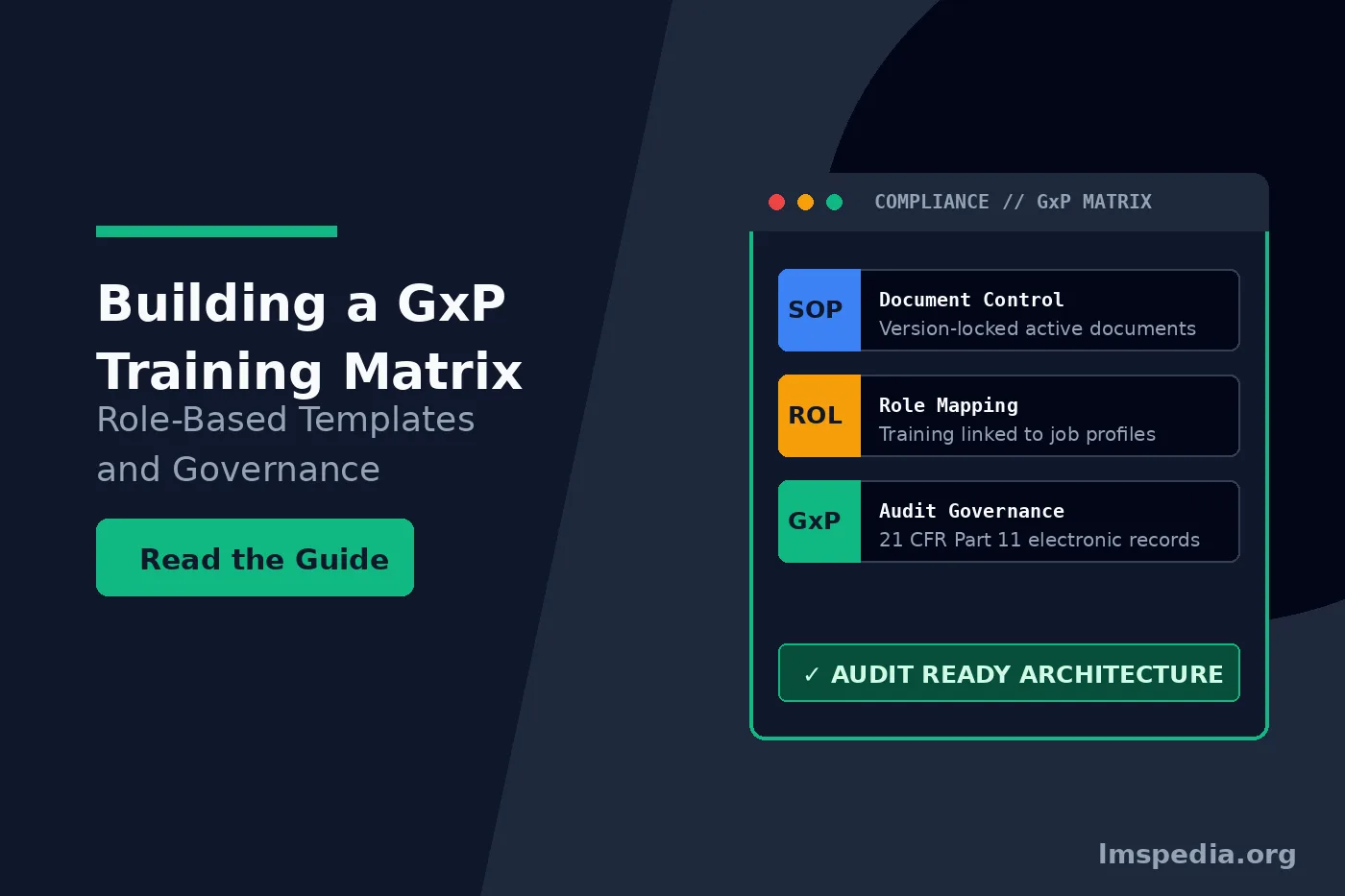
A GxP training matrix acts as a dynamic relational database for quality management systems. It connects active employees to operational documents they must master. This foundational document tells quality teams who needs to read specific manuals.
Organizations lacking structured matrices assign every standard operating procedure to every worker. This approach causes massive cognitive overload. Warehouse workers do not need calibration procedures for laboratory mass spectrometers. Precise matrices ensure employees consume only relevant content. This targeted approach increases knowledge retention and reduces wasted payroll hours. For overarching guidance on content structuring, consult resources on
training content library management.
The Principle of Job Description Training Linkage
FDA warning letters frequently cite failures in job description training linkage. Regulators mandate that mandatory training requirements must stem directly from documented job descriptions. You cannot assign training arbitrarily based on verbal manager agreements.
If human resources job descriptions state technicians sterilize cleanroom equipment, training matrices must assign those standard operating procedures. Quality assurance departments and human resources must work in perfect synchronization. Whenever job descriptions update, corresponding curriculums must update simultaneously. Establishing proper audit readiness aligns with our guide on
LMS for compliance training and audit evidence.
Utilize a Core Compliance Curriculum
Create a foundational core compliance curriculum for universal onboarding topics like Good Documentation Practices. Assign this universally on day one before specialized role curriculums.
Steps for Effective GxP Curriculum Design
Building compliant systems requires a phased, collaborative approach. Subject matter experts across organizations must contribute to curriculum design. You must follow a rigorous methodology to ensure absolute accuracy.
First, inventory all approved operational documents. Compile a master list of active standard operating procedures and policies. Every document must have a unique ID and version number. Exclude draft documents from active training lists completely.
Second, standardize organizational roles. Build matrices based on standardized job roles rather than individual employee names. Create profiles for titles like Quality Control Analyst or Manufacturing Floor Operator. Every employee must tie back to standardized HR profiles.
Third, map requirements to roles. Department managers and quality assurance leaders review document and role lists together. They decide which roles require training and determine required methods. To structure team permissions correctly, review best practices for
architecting clear LMS user roles and permissions.
Building a Role-Based Training Matrix Pharma Template
Visualizing complex data helps internal stakeholders and external auditors. Below is a simplified example of a role-based training matrix pharma template. An “X” indicates a mandatory training requirement for that specific job title.
| Document ID |
Document Title |
Manufacturing Operator |
QC Lab Analyst |
Warehouse Associate |
QA Reviewer |
| SimpliTrain |
Automated matrix tracking and role mapping. |
X |
X |
X |
X |
| SOP-101 |
Good Documentation Practices |
X |
X |
X |
X |
| SOP-205 |
Cleanroom Gowning Procedure |
X |
|
|
X |
| SOP-312 |
Bioreactor Setup and Cleaning |
X |
|
|
|
| SOP-440 |
HPLC Machine Calibration |
|
X |
|
|
| SOP-510 |
Pallet Jack Safety Protocol |
|
|
X |
X |
Visual grids allow managers to identify cross-training opportunities instantly. Managers know which new modules employees must complete before stepping onto manufacturing floors. Furthermore, evaluating enterprise platform scalability through
Open LMS vs Totara Learn helps technical teams compare multi-tenant structures.
Managing Matrix Governance and Version Control
Creating initial GxP training matrices is only the first phase. Maintaining absolute accuracy over time presents the true challenge. Pharmaceutical companies update operational documents constantly. Whenever procedures change, training matrices must react immediately.
Establish strict governance protocols for document revisions and change control. When quality teams update operational documents from version 1.0 to version 2.0, training matrices trigger retraining events automatically. Employees receive immediate notifications to read new versions and sign electronic acknowledgments. Furthermore, systems archive historical training data for version 1.0 perfectly. Reviewing European regulatory standards published by the
European Medicines Agency ensures complete cross-border compliance.
Transitioning from Spreadsheets to a Validated LMS
Startup biotechnology companies often manage job description training linkage using standard spreadsheets. This approach fails as companies scale. Spreadsheets lack automated version control and secure electronic signatures. Furthermore, spreadsheets do not provide unalterable audit trails. To understand how underlying data structures support immutability, review our guide on
21 CFR Part 11 audit trails for training systems.
Conclusion
Maintaining a flawless GxP training matrix protects businesses and patients who rely on medical products. Establishing rigid job description training linkage ensures employees possess required knowledge. Approach GxP curriculum design with meticulous attention to detail. Map standard operating procedures using role-based templates. Continuously update training curriculums to reflect dynamic manufacturing realities. Embrace validated digital learning platforms to automate compliance governance and foster a true culture of quality.
Q1. What exactly does SCIM stand for?
SCIM stands for the System for Cross-domain Identity Management. It is a standardized protocol created by the Internet Engineering Task Force to automate the exchange of user identity data between cloud applications and IT directories.
Q2. What is the main difference between SCIM and JIT provisioning?
Just-In-Time (JIT) provisioning only creates or updates a user account when that person actively attempts to log in. SCIM is an active synchronization engine that constantly pushes user creation, update, and deletion commands in the background, regardless of login activity.
Q3. Why is automated user deprovisioning important for an LMS?
Automated deprovisioning instantly revokes an employee’s access to the learning platform the moment they are terminated in the central HR system. This prevents disgruntled former employees from stealing proprietary corporate training materials or accessing sensitive internal data.
Q4. Can SCIM automatically assign training courses to employees?
While SCIM itself just transfers user data, the LMS can use the rich attribute data provided by SCIM (such as job title or department) to automatically trigger specific learning paths and compliance curriculum assignments the moment the account is created.
Q5. Does SCIM manage passwords for the users?
No, SCIM is strictly used for provisioning identity attributes and managing the lifecycle status of the account. Password management and the actual login authentication process are handled separately by Single Sign-On (SSO) protocols like SAML 2.0 or OpenID Connect.