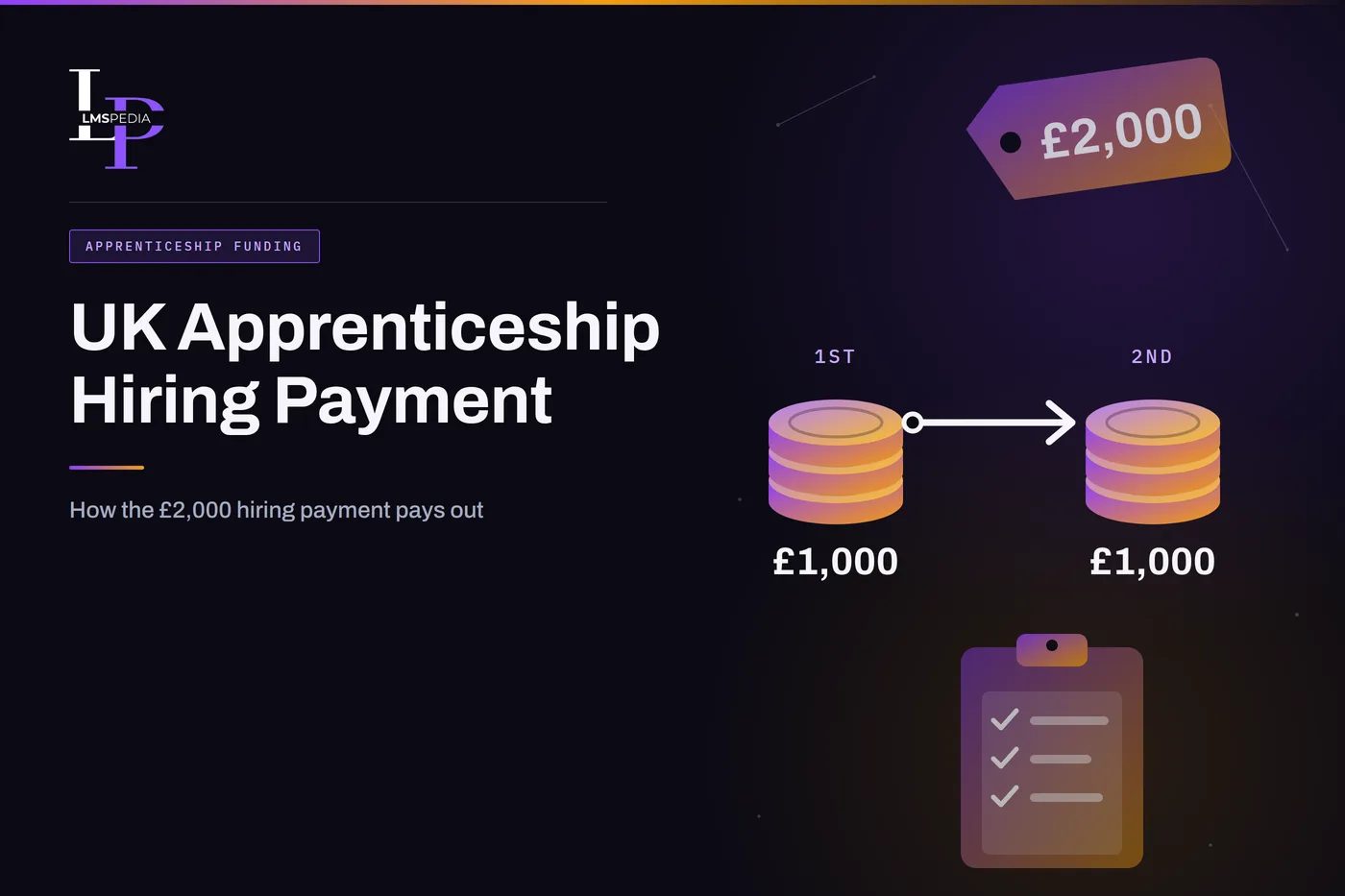
The UK Apprenticeship Hiring Payment gives eligible non-levy employers in England up to £2,000 for each new apprentice aged 16 to 24. It is paid in two £1,000 instalments, claimed by the training provider and passed on to you. You do not apply for it.
The scheme started on 1 October 2026, but as of October 2026 the Department for Education (DfE) says the earliest payments to providers are due in January 2027. So the practical questions are about timing, data and conditions, not about the headline figure.
This guide sets out the instalment timeline, the eligibility tests in the government’s own words, a worked example for a small employer and a checklist. It is based on published guidance, not on uptake data, because none exists yet.
What is the UK Apprenticeship Hiring Payment?
It is a government payment of up to £2,000 per apprentice for non-levy employers who recruit a new employee aged 16 to 24 into an apprenticeship starting on or after 1 October 2026. The money comes in two equal instalments, via your training provider, with no separate employer application.
DfE’s hiring payment help page states: “From 1 October 2026, you may be eligible for a hiring payment of up to £2,000 if you are a non-levy employer and recruit an apprentice aged 16 to 24 as a new employee.”
Note the words “up to” and “may be eligible”. Nothing is guaranteed until the checks described below pass.
The GOV.UK announcement of 1 October 2026 places the payment inside a £2.5 billion investment in the Youth Guarantee, which targets 50,000 more youth apprenticeships. CIPD has separately proposed a larger wage grant, which is only a proposal, as covered in our post on the CIPD Apprenticeship Guarantee proposal.
Which employers can claim the £2,000 hiring payment?
Only employers that do not pay the Apprenticeship Levy. The levy applies to employers with “an annual pay bill of more than £3 million”, according to GOV.UK levy guidance. The test is pay bill, not headcount, so a firm’s size alone does not settle it.
If your payroll sits under that threshold, you are non-levy for this purpose. If you belong to a group of companies, the guidance reviewed for this article does not explain how group structures are treated. Confirm your status with your payroll team and your training provider before you rely on the payment.
Which apprentices qualify for the payment?
Three tests apply. The apprentice must be aged 16 to 24, must start apprenticeship training on or after 1 October 2026, and must have started working for you no more than 90 days before that training began. Miss any one and the payment does not apply.
DfE’s wording on timing is: “the apprentice started working for you no more than 90 days before their apprenticeship training started.” There is one stated exception: “an apprentice who started working for you on 1 July or 2 July may be eligible if their apprenticeship training starts on 1 October.”
Three consequences follow from these tests:
- A long-serving employee who begins an apprenticeship will usually fail the 90-day test.
- An apprentice whose training started before 1 October 2026 is outside the scheme.
- A 15-year-old can qualify if their 16th birthday falls between the last Friday of June and 31 August, per the GOV.UK announcement.
Coverage reports that age is judged at the start of training. Ask your provider to confirm that for any apprentice close to the age limits.
When is each £1,000 instalment paid?
The first £1,000 is generated when the apprentice is still in learning at day 90. The second follows at day 365, or day 242 for shorter and foundation apprenticeships. As of October 2026, the earliest payments to training providers are due in January 2027, so no employer cash arrives in 2026.
The DfE technical funding guide from August 2026 says: “We will split these payments into 2 equal payments when the apprentice is still in learning at 90 days and 365 days.” For shorter courses, it adds that where the published “typical duration to gateway” is less than 12 months, or the apprentice is on a foundation apprenticeship, “the second payment will be generated at 242 days in learning instead of 365 days.”
| Apprenticeship type | First £1,000 | Second £1,000 |
|---|---|---|
| Standard (typical duration to gateway of 12 months or more) | Day 90, still in learning | Day 365, still in learning |
| Shorter (typical duration to gateway under 12 months) | Day 90, still in learning | Day 242, still in learning |
| Foundation apprenticeship | Day 90, still in learning | Day 242, still in learning |
Some reports describe 242 days as applying only to foundation apprenticeships. The funding guide covers both foundation and shorter apprenticeships, so trust the guide. Also, the separate £2,000 foundation apprenticeship incentive has three instalments and is not the same payment.
How do you claim the hiring payment?
You do not claim it. DfE says: “You do not need to apply for the hiring payment. We will automatically check whether you are eligible.” Your training provider receives the money and must pass it on. The GOV.UK announcement says providers “must pay the employer within 30 working days of receiving the money from the government.”
The DfE help page gives a shorter wording of “30 days”. The announcement is more specific, so plan around 30 working days, which is about six weeks.
What you can control is the data. DfE’s funding guide says it will validate employer HMRC PAYE data against provider records before paying. In practice:
- Link the correct PAYE scheme to the apprentice’s National Insurance number in your Apprenticeship Service account.
- Watch the account status, which shows “Checking employment status”, “Eligible” or “Not eligible”.
- Expect retries: DfE says that after a failed first check, the system tries three more times at 30-day intervals before the apprentice becomes ineligible.
Fix PAYE Before Day 90
Check the PAYE link in week one, not at day 90. A mismatch caught at onboarding is a ten-minute fix, while one found after the first check fails burns retries you may need later for a genuine payroll delay.
Does the apprentice need to stay employed or stay in learning?
DfE’s operative rules say the apprentice must be “still in learning” when each payment is due. Some coverage and an older GOV.UK page say the apprentice must still be employed. Trust DfE’s funding guide and help page, but meet both conditions: keep the apprentice employed and in their programme.
The GOV.UK “get funding” page said, when checked on 5 October 2026: “You’ll only get paid if the apprentice is still employed by you when each payment is due.” Its displayed update date was October 2024, so it may predate the new rules. Other coverage, including Make UK, describes the payment differently again, as three instalments, which conflicts with DfE’s two.
The guidance reviewed does not say what happens to a first instalment if the apprentice later leaves. Ask your provider and get the answer in writing.
What can you spend the payment on?
Almost anything tied to employing the apprentice, not just training fees. The money is a general contribution to the cost of having a young person on your payroll. The GOV.UK announcement says: “The employer can spend it on any costs related to their employment, for example their work equipment, travel costs or uniform.”
It does not use up your own funding. DfE’s funding guide says: “We fully fund these earnings and do not take them from the employer’s AS (apprenticeship service) account.”
The guidance reviewed does not address tax treatment. Ask your accountant how to record it. For wider context on where apprentice costs sit in a training budget, see our 2026 corporate training budget benchmarks.
Can you stack it with other incentives to reach £8,000?
Yes, in principle. DfE says employers “can claim more than one of the payments” on its financial support page, and the announcement says this funding “can be stacked with other support worth up to £6,000, so could form a substantive package of up to £8,000 per apprentice.” The conditions differ, so qualifying for every payment is unlikely.
The four payments DfE lists add up to £8,000 (£1,000 + £2,000 + £2,000 + £3,000). The guidance does not itemise the figure that way, so treat that sum as arithmetic, not a stated breakdown.
| Payment | Age condition | Schedule |
|---|---|---|
| £1,000 additional payment for hiring apprentices | 16 to 18 (or under 25 with an EHC plan or care leavers) | Two equal instalments, after day 90 and one year (day 242 if under 12 months) |
| £2,000 foundation apprenticeship incentive | 16 to 21 (plus listed groups under 25) | Three equal instalments |
| £2,000 apprenticeship hiring payment (non-levy) | 16 to 24, new employees | Two equal instalments, day 90 and day 365 (or day 242) |
| £3,000 Youth Jobs Grant | 18 to 24, unemployed and on universal credit for 6 months or more | £1,800 after 6 weeks, £1,200 after 18 weeks, paid by DWP |
Read the age columns together. Based on the table alone, an apprentice who is 18 is the only one who can meet every standard age band, and the Youth Jobs Grant also needs a six-month universal credit history. Check each condition separately instead of assuming the full £8,000.
DfE’s financial support page also lists no employer National Insurance contributions for apprentices under 25.
What does a worked example look like for a small employer?
Take a hypothetical non-levy employer that hires two apprentices on 1 October 2026. Apprentice A is 17 on a standard of 12 months or more. Apprentice B is 22 on a standard under 12 months to gateway. Both joined within 90 days of training starting. The sums use only the confirmed figures above.
A qualifies for the £2,000 hiring payment and the £1,000 additional payment for 16 to 18 year olds. B qualifies for the hiring payment only, assuming no EHC plan or care leaver status.
| Stage | Apprentice A (17) | Apprentice B (22) |
|---|---|---|
| Day 90 (around 30 December 2026) | £1,000 + £500 = £1,500 | £1,000 |
| Second stage | Day 365 (around 1 October 2027): £1,000 + £500 = £1,500 | Day 242 (around 31 May 2027): £1,000 |
| Total | £3,000 | £2,000 |
The employer’s total is £5,000 over about a year. The dates are calculated from the 1 October start date. The pages reviewed do not publish a counting convention, so treat them as approximate.
Cash timing matters more than the total. Day 90 falls at the end of December 2026, providers receive money from January 2027 at the earliest, and they then have up to 30 working days. Budget for the first payment arriving in February or March 2027, after you have already paid the apprentice for months.
What should you ask your training provider?
Ask your provider five specific questions before you sign, and get the answers in writing. The provider, not DfE, is your point of contact for the cash. Each question below targets a gap that the published guidance leaves open or only partly answers.
The five questions are:
- Which date do you use as the apprentice’s training start date?
- Will you tell me when you receive each instalment?
- Will you pass it on within 30 working days, and how?
- What happens to a payment if the apprentice leaves before it is due?
- Does your agreement mention the hiring payment at all?
Provider quality also matters because the second instalment depends on the apprentice staying in learning. Our post on apprenticeship achievement rate data shows how to read provider outcome figures.
Retention Protects Instalment Two
Treat the second £1,000 as a retention bonus you only earn if the apprentice is still in learning at day 365 or 242. Compare providers on achievement rates for your specific standard, because a provider that loses learners also costs you the second instalment.
What should you check before the next apprentice starts?
Work through the list below before the training start date. Most failed claims will come from mismatched data or a missed date, not from the rules themselves. Each item takes minutes to check, and together they cover every condition DfE has published so far.
- Confirm you are non-levy: annual pay bill under £3 million.
- Check the apprentice is 16 to 24 (or the 15-year-old exception) at training start.
- Confirm training starts on or after 1 October 2026.
- Confirm the apprentice joined you no more than 90 days before training starts.
- Add the apprentice to your PAYE scheme and link it to the National Insurance number in your Apprenticeship Service account.
- Ask the provider about the 30 working day pass-on and get it in writing.
- Diary day 90 and day 365 (or 242), and check your account status at each.
- Check which other payments in the table the apprentice qualifies for.
If you have no candidate yet, the announcement also mentions £100 million of expansion funding for Apprenticeship Brokerage. Our post on the Local Apprenticeship Service brokerage explains that route.
What should you do next?
This week, call your payroll lead and confirm your levy status, then email your training provider the five questions above. Do both before you finalise any start date. These two steps decide whether the payment can reach you at all.
Then build the cash into your plan as a reimbursement, not as up-front funding. Assume the first £1,000 arrives in early 2027 and the second a year or so after the start date.
Check the DfE help page again before each start date. The pages reviewed here were last updated on 30 September 2026, and funding rules can change. Before you commit budget, have your finance team or an adviser read the current guidance.
FAQ
Q1. Does the apprenticeship hiring payment apply to existing apprentices or existing staff?
Not to apprentices whose training started before 1 October 2026. For staff, DfE requires that the apprentice started working for you no more than 90 days before their training began, so a long-serving employee will usually fail that test. One stated exception covers apprentices who started work on 1 or 2 July and begin training on 1 October.
Q2. What happens if the apprentice leaves before the second instalment?
DfE’s funding guide says payments are generated when the apprentice is still in learning at day 90 and day 365 (or day 242 for shorter and foundation apprenticeships). An apprentice who has left learning would not meet that test at the later date. The guidance reviewed does not say whether a first instalment is affected, so ask your provider.
Q3. Is the £2,000 apprenticeship hiring payment taxable?
The DfE and GOV.UK pages reviewed for this article do not address tax treatment. The money can be spent on costs of employing the apprentice, such as equipment, travel or uniform, but how it is recorded in your accounts is a question for your accountant or HMRC, not something this guide can confirm.
Q4. Do I have to apply for the apprenticeship hiring payment?
No. DfE says you do not need to apply and that it will automatically check whether you are eligible. Your training provider receives the payment and passes it on. What you should do is make sure the right PAYE scheme is linked to the apprentice’s National Insurance number in your Apprenticeship Service account.
Q5. When will I receive the first £1,000 of the hiring payment?
The first instalment is generated at day 90 of learning, and DfE says the earliest payments to training providers are due from January 2027. Providers must then pass the money on within 30 working days, according to the GOV.UK announcement. For an apprentice starting on 1 October 2026, expect it in early 2027 at the soonest.
Q6. Can levy-paying employers claim the apprenticeship hiring payment?
No. The payment is for non-levy employers. The Apprenticeship Levy applies to employers with an annual pay bill of more than £3 million, according to GOV.UK, so the dividing line is pay bill rather than headcount. If you are unsure of your status, confirm it with your payroll team and your training provider before relying on the payment.