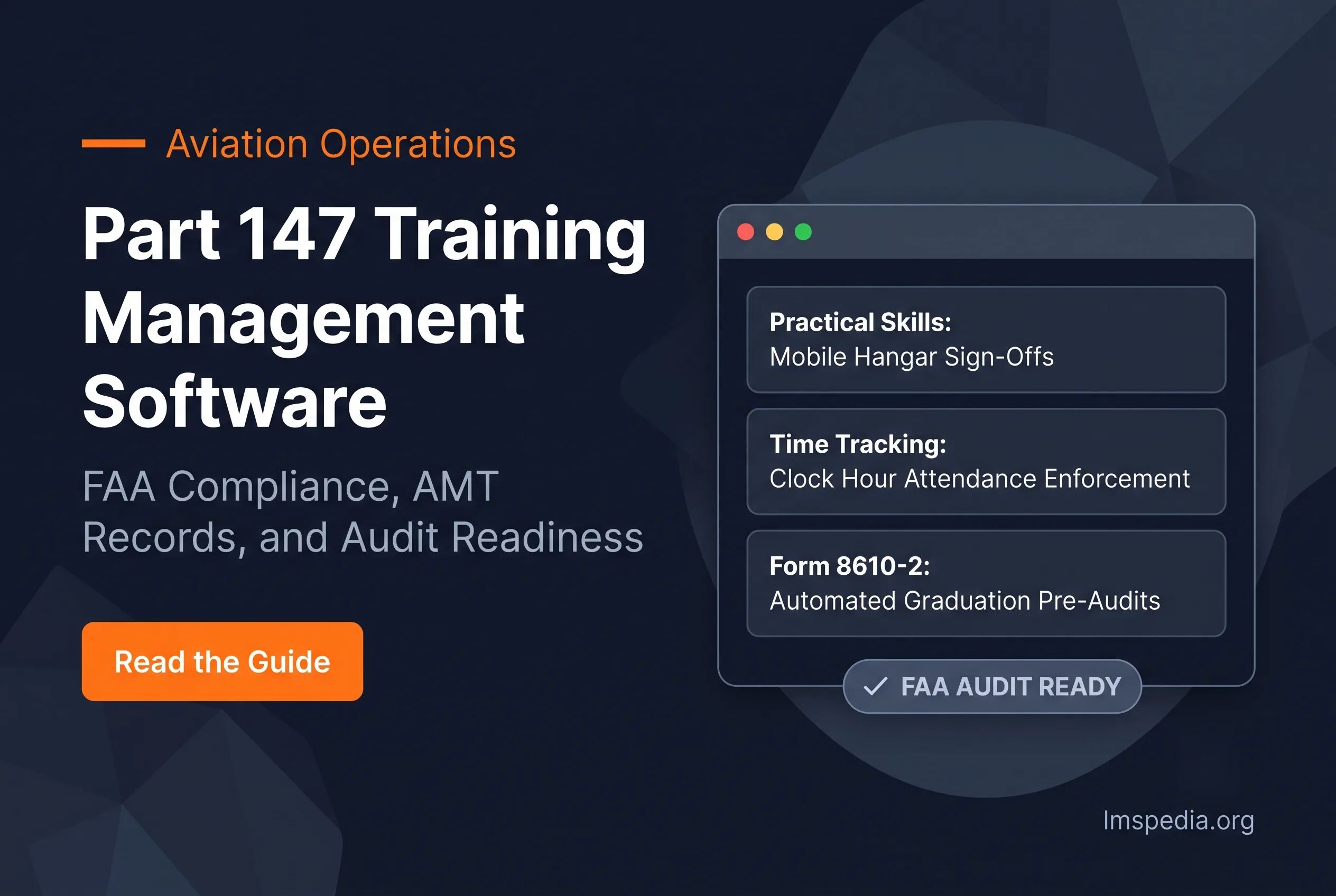
Part 147 Training Management Software for US Aviation Maintenance Schools
US aviation maintenance technician schools face intense regulatory oversight. Training certified aircraft mechanics requires uncompromising structural and procedural precision. Adhering strictly to complex
Federal Aviation Administration rules defines daily operations. Maintenance academies historically relied on manual paper logbooks and physical binders. Modern aviation educators must abandon these fragile physical workflows entirely.
Deploying modern Part 147 training management software is now an operational necessity. Specialized software allows institutions to track competencies, classroom hours, and shop practicals flawlessly. Digitizing operations protects institutions from catastrophic audit failures. Furthermore, enterprise buyers should cross-reference vendor capabilities against a comprehensive benchmark of core
training management system features to avoid functional compliance gaps.
Key Takeaways

Part 147 Rules Focus on Competency: Modernized FAA regulations prioritize performance-based learning and objective practical skills, requiring aviation schools to track granular competencies rather than simple classroom seat time.
Paper Logbooks Threaten Compliance: Physical sign-off sheets and binders are vulnerable to fluid damage, loss, and illegible entries, creating severe legal liabilities during unannounced FAA inspections.
Mobile Evaluation is Essential: Shop instructors require rugged mobile interfaces with offline caching to record student project grades, attach photo evidence, and sign off practical skills directly beside aircraft in Wi-Fi dead zones.
Automated Time and Attendance: Because the FAA enforces strict contact hour minimums, modern Part 147 platforms use digital timecards and geofencing to prevent subjective manual math and fraudulent attendance.
FSDO Approval Requires Transparency: Migrating to digital records necessitates early collaboration with local Flight Standards District Offices to ensure digital signatures and audit export formats satisfy federal inspectors.
The FAA Part 147 Regulatory Landscape for AMTs
The federal government regulates aviation maintenance technician schools under 14 CFR Part 147. The FAA establishes strict minimum curriculum requirements, facility standards, and instructional hour thresholds. Training institutions must prove that every graduating student meets rigid proficiency standards. These strict rules ensure that certified mechanics protect public aviation safety.
The regulatory environment underwent a massive transformation recently. Historically, the FAA enforced prescriptive seat-time requirements. Today, modern rules focus heavily on performance-based, competency-aligned educational frameworks. Training management architectures must adapt to track nuanced practical competencies.
The Evolution from Legacy Rules to Modern Standards
Legacy Part 147 regulations mandated rigid seat-time minimums across 1,900 total hours. Students spent fixed blocks of time inside classrooms regardless of personal aptitude. Recent regulatory revisions modernized these outdated constraints significantly. Academies now enjoy greater curriculum flexibility while maintaining strict safety standards.
Schools can align course content dynamically with current industry technology. Modern curriculums incorporate advanced composite materials and sophisticated digital avionics. However, this curriculum freedom demands significantly greater administrative tracking precision. Flight academies require flexible software that maps complex curriculum changes cleanly.
Understanding Core Practical and Didactic Requirements
An aviation maintenance curriculum divides into three distinct educational sections. Students must master foundational general maintenance principles first. Learners advance into specialized airframe structural systems next. Students complete demanding powerplant and propulsion modules finally.
Administrators must balance didactic lecture hours with practical laboratory shop time. Federal inspectors require separate, auditable records for both learning modalities. Generic academic software platforms fail completely in this dual-delivery environment. Specialized platforms ensure didactic theory and hands-on shop tasks remain synchronized.
The High Cost of Regulatory Non-Compliance
Failing a federal inspection causes devastating financial and operational consequences. The FAA can issue emergency suspensions against an academy operating certificate. An operating suspension immediately halts all active student training. Students cannot test for their Airframe and Powerplant ratings during investigations.
Non-compliance invites massive civil financial penalties from federal regulators. Institutional reputation suffers permanent damage within the aviation industry. Investing in dedicated compliance platforms represents critical business risk mitigation. Ensuring verifiable compliance documentation aligns with our guide on
LMS for compliance training and audit evidence.
Critical Challenges in Aviation Maintenance School Administration
Managing an aviation maintenance academy involves extreme administrative complexity. Registrars must track hundreds of discrete technical tasks for every individual student. Manual administrative processes quickly collapse under this massive operational weight.
The Fragility of Paper-Based Logbooks and Binders
Students historically carried physical logbooks throughout mechanical shop rotations. Instructors manually signed off individual riveting, welding, and engine inspection tasks using pens. Physical paper documents remain highly vulnerable to hangar shop hazards. Chemical solvents, hydraulic fluid, and physical wear destroy paper logbooks daily.
Losing a physical logbook destroys hundreds of hours of documented progress. Students face delayed graduations while administrators attempt to reconstruct historical records. Deploying dedicated records software permanently eliminates physical paper vulnerabilities. Cloud backups protect irreplaceable student progress permanently from workshop damage.
Managing Complex Curricula and Scheduling
Student cohorts progress through multi-year training pathways at varied operational speeds. Some learners excel rapidly at sheet metal fabrication but struggle with reciprocating engines. Instructors must coordinate remedial shop sessions without disrupting normal cohort progression. Scheduling hangar stalls, specialized tooling, and running aircraft requires intense logistical coordination.
Academic directors cannot rely on static desktop spreadsheets. Schools require dynamic scheduling engines that adjust to real-time student progress. Utilizing a structured
training scheduling system coordinates complex hangar resources smoothly. Digital scheduling maximizes hangar utilization and keeps students on track.
Instructor Qualifications and Practical Skills Standardization
The FAA strictly evaluates the qualifications of all instructional personnel. Shop instructors must hold active Airframe and Powerplant ratings for specific instructional areas. Institutions must demonstrate ongoing instructor standardization across practical grading evaluations. Two different instructors must grade identical student rivet patterns using identical objective criteria.
Training systems must enforce standardized digital rubrics across all lab environments. The software should alert administrators before instructor medical or inspection authorizations expire. Institutional benchmarks established by the
Aviation Technician Education Council provide helpful guidance. Structured standardization guarantees consistent educational quality across all shop classes.
FAA Audit Readiness
The FAA conducts unannounced inspections of Part 147 certified facilities. Your management software must generate complete student attendance logs and practical skill sign-offs instantly.
Essential Features of Part 147 Training Management Software
Selecting appropriate software requires an exhaustive technical feature audit. Commercial training systems must accommodate the unique nuances of aviation maintenance. Institutions must prioritize platforms offering purpose-built aviation compliance modules.
Automated Practical Skill and Lab Project Tracking
Platforms must support granular practical skill tracking on mobile tablets. Shop instructors require rugged mobile interfaces to evaluate students directly inside hangars. Instructors can grade complex maintenance tasks beside running aircraft engines effortlessly. The system must allow instructors to capture and attach photo evidence directly.
An instructor can photograph a student turbine borescope inspection immediately. The software binds that photographic proof permanently to digital student transcripts. This indisputable documentation creates an ironclad evidentiary defense for federal inspectors. Digital sign-offs elevate institutional credibility during intense accreditation renewals.
Integrated Time and Attendance Gatekeeping
Federal regulations strictly mandate verifiable contact hour tracking for every student. Students cannot earn completion certificates merely by passing academic quizzes. They must physically complete every required clock hour mandated within approved syllabi. Modern recordkeeping systems incorporate biometric scanners or geofenced mobile check-ins.
Software tracks exact arrival, break, and departure timestamps automatically. Platforms must flag unexcused absences and calculate exact make-up hour requirements. Automated attendance calculations eliminate subjective manual math and fraudulent attendance entries. Precise time tracking remains the single most scrutinized element during FAA inspections.
Architectural and Deployment Considerations for AMT Schools
Enterprise software performance depends heavily on underlying technical architecture. Aviation maintenance hangars present notoriously hostile environments for standard computer hardware. Procurement committees must evaluate how candidate platforms handle severe connectivity and environmental challenges.
Cloud Architecture vs On-Premises Hangar Servers
Institutions must evaluate the strategic merits of cloud versus on-premises software hosting. Flight schools historically hosted database servers within local administrative offices. Maintaining local servers requires costly on-site IT staff and regular hardware replacements. Local servers remain vulnerable to local utility blackouts and hardware failures.
Modern cloud architectures deliver automated backups, high availability, and military-grade encryption. Cloud platforms eliminate expensive on-premises maintenance overhead permanently. Multi-campus academies can centralize regulatory reporting across distributed geographic locations seamlessly. Cloud software ensures leadership maintains real-time operational visibility across all training facilities.
Offline Capability for Connectivity Dead Zones
Aviation maintenance hangars feature thick steel framing, corrugated metal siding, and reinforced concrete. Cellular signals and enterprise Wi-Fi rarely penetrate deep hangar work bays. Dedicated training software must feature native, resilient offline synchronization capabilities. Instructors must continue evaluating student engine overhauls without active network connections.
Mobile applications must cache evaluation data locally and securely. Apps synchronize all pending evaluations the moment devices reconnect to Wi-Fi. Flawless offline synchronization ensures uninterrupted instruction inside hostile electromagnetic environments. Software lacking offline capabilities fails immediately on realistic industrial hangar floors.
Buyer Evaluation: Comparing Aviation Maintenance Training Systems
Procurement teams can evaluate several distinct software platforms built for aviation training operations. Buyers must analyze how effectively each platform handles complex regulatory tracking versus general scheduling. Furthermore, enterprise software strategies evaluated by analysts at
Gartner reinforce platform selection criteria. Also, reviewing multi-tenant comparisons like
Open LMS vs Totara Learn helps facility teams evaluate large-scale architectures. Educational resources from the
Aircraft Owners and Pilots Association provide helpful baseline metrics.
| Platform / Solution |
Primary Focus |
Part 147 Compliance Strength |
| SimpliTrain |
Versatile training operations and compliance scheduling. |
Excels at automated curriculum mapping, granular competency tracking, and instant, tamper-proof audit reporting. |
| Talon Systems (ETA) |
Aviation training management for universities and military. |
Delivers rigid, proven curriculum tracking and student operations designed primarily for large-scale collegiate institutions. |
| AeroTrack |
Aviation maintenance and school operational management. |
Provides tight integration between physical aircraft maintenance logs, tool tracking, and student task sign-offs. |
Implementation Blueprint: Transitioning to Digital Recordkeeping
Adopting a new digital management platform represents a major operational transition. Institutions cannot switch software systems overnight without careful risk mitigation. Leadership must execute a structured, phased implementation blueprint.
Historical Data Migration and Digitization
Institutions must decide how to manage active student cohorts during migration. Migrating mid-career student records from paper logbooks into digital databases requires extreme care. Many academies run parallel paper and digital systems for a single transitional semester. Administrators can verify digital data accuracy against historical paper entries continuously.
Legacy student paper files must be securely scanned and archived into cloud repositories. Meticulous archival ensures schools satisfy multi-year record retention mandates safely. Establishing proper
aviation training records retention protocols guarantees institutional readiness. Clean baseline data prevents confusing discrepancies during subsequent federal compliance audits.
FSDO Inspector Collaboration
Institutions must involve local FAA Flight Standards District Offices early. Federal inspectors must review and approve transitions to digital recordkeeping systems. Administrators should invite their Principal Maintenance Inspector for formal digital software demonstrations. Inspectors can test digital signature security, audit exports, and curriculum compliance directly.
Addressing inspector feedback proactively prevents unexpected administrative pushback during operational deployment. Building collaborative relationships with FSDO offices guarantees smooth regulatory approval. Inspectors appreciate institutions that provide clear, standardized digital audit portals. Furthermore, maintaining strict security guidelines reinforced by
ISO standards ensures data integrity.
Conclusion
Modernizing an aviation maintenance academy requires operational commitment and technological investment. Institutions must recognize that fragile paper logbooks and manual spreadsheets introduce unacceptable regulatory risks. A single missing instructor endorsement can halt student graduations or prompt severe federal penalties. Transitioning to purpose-built digital compliance systems is an absolute operational necessity.
Deploying comprehensive digital tracking platforms automates practical skill verification, attendance gatekeeping, and graduation clearance. Modern cloud architectures with resilient offline capabilities ensure seamless operation within rugged hangar environments. Paperless management safeguards institutional accreditation, satisfies strict federal auditors, and trains the next generation of aircraft technicians safely.
Q1. What is the primary purpose of FAA Part 147 training management software?
Fundamentally, Part 147 training management software automates regulatory compliance, curriculum tracking, and student recordkeeping for FAA-certificated aviation maintenance technician schools. Specifically, it tracks required didactic hours, logs practical shop competency evaluations, monitors attendance, and generates verifiable transcripts required for students to sit for their federal Airframe and Powerplant examinations.
Q2. Can an aviation maintenance school use a standard university LMS like Canvas?
Typically, standard academic learning management systems fail completely in Part 147 environments. Specifically, generic platforms cannot handle clock-hour attendance tracking, tool crib calibrations, hangar maintenance squawks, or FAA-aligned practical skill evaluations. Therefore, schools require dedicated aviation training management software or specialized compliance overlays integrated with their primary university registrar.
Q3. How does Part 147 software handle poor Wi-Fi connectivity inside metal hangars?
Crucially, purpose-built aviation maintenance platforms feature native offline mobile applications. Specifically, instructors can grade practical tasks, capture photo proof, and apply digital sign-offs without an active network connection. Subsequently, the application stores records in an encrypted local sandbox and synchronizes automatically the moment the device reconnects to internet access.
Q4. What records must an aviation maintenance school retain for FAA inspection?
Specifically, certified schools must retain comprehensive records showing each student’s attendance, completed curriculum units, practical project grades, and instructor endorsements. Furthermore, institutions must maintain instructor standardization records and documentation verifying tool calibration. Ultimately, these records must remain accessible for federal inspection throughout the student’s enrollment and for a defined statutory period following graduation.
Q5. How does the software assist students with the FAA Form 8610-2 application process?
Primarily, modern compliance platforms feature automated pre-audit verification engines. Specifically, the software cross-references student transcripts against every statutory curriculum requirement to verify completion mathematically. Consequently, the system generates pre-populated, verified graduation documentation, enabling students to submit their Form 8610-2 to federal examiners without administrative errors or delays.