On October 2, 2026, LearnUpon announced that it was named a “Major Player” in the IDC MarketScape: Worldwide Employee Experience for Learning Experience Management 2026 Vendor Assessment. The IDC MarketScape learning experience management 2026 report sits behind a paywall, and the announcement comes from the vendor itself. As of October 5, 2026, our search found no public copy of the full report and no published placements for other vendors.
So this is not a ranking. It is a guide to reading an analyst vendor assessment as a buyer: what the label means in IDC’s own framework, what the announcement does and does not prove, and how to test any placement against your own requirements.
If you are building an LMS or learning experience platform shortlist, the useful question is not “who won?” It is “what can I verify, and what still has to be checked in a demo?”
What did LearnUpon actually announce about the IDC MarketScape?
LearnUpon said on October 2, 2026 that IDC named it a Major Player in its 2026 learning experience management vendor assessment. The company reports improved scoring in customer satisfaction, price model and offering structure, and functionality. The release gives no scores, no rank and no list of other vendors, according to LearnUpon’s own press release.
CEO and co-founder Brendan Noud credited the team and said the placement recognizes the company’s overall approach and capabilities. That is a vendor statement, not an IDC finding. The table below separates what is stated from what can be confirmed.
| Item | What is stated | Status as of October 2026 |
|---|---|---|
| Report title | IDC MarketScape: Worldwide Employee Experience for Learning Experience Management 2026 Vendor Assessment | As given in LearnUpon’s release |
| LearnUpon’s label | Major Player | Stated by LearnUpon, not independently confirmed |
| Score movement | “Notable improvements” in three areas | No numbers or baseline given |
| Other vendors | None named | Not public in what we found |
| Full report | Not linked in the release | Paywalled; 2026 price not verified |
What is the IDC MarketScape for learning experience management?
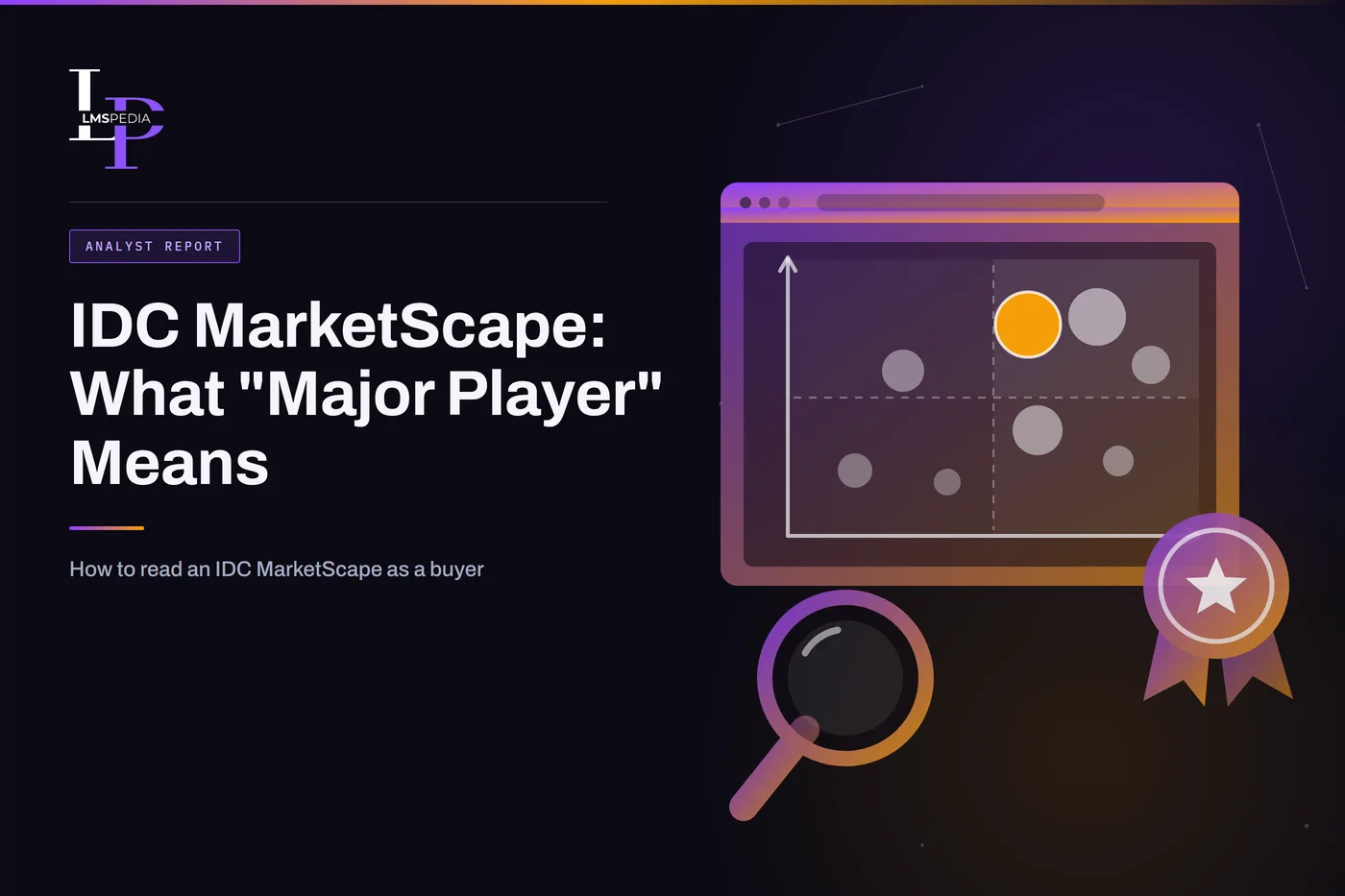
An IDC MarketScape is a vendor assessment that places suppliers on one chart. According to IDC, the two axes are capabilities and strategies, and the size of each bubble shows vendor market share. This report applies that model to learning experience management, or LXM, a category IDC ties to AI-enabled learning and skilling.
IDC’s 2024 edition abstract describes LXM as technology that directs relevant content and programs to employees at the right time. That is closer to an LXP than to a classic course-admin system. If the difference matters for your evaluation, our explainer on how an LMS differs from an LXP covers it.
IDC says the MarketScape serves two audiences. Buyers use it to find vendors that meet their selection criteria. Vendors use it to validate their competitive position and to support their marketing with third-party content. The same chart has to do both jobs, which is why a buyer should read it with the second purpose in mind.
Which vendors were in the previous edition?
IDC’s catalog listing for the 2024 edition names nine covered vendors: OpenSesame, Oracle, Cornerstone OnDemand, ExpertusONE, Adobe, Learning Technologies Group, Workday, SAP SuccessFactors and LearnUpon.
That list is for 2024 only. We could not find the 2026 vendor list, so do not assume it is the same.
What does “Major Player” mean in an IDC MarketScape?
IDC’s MarketScape methodology page names four chart segments: Leaders, Major Players, Contenders and Participants. It says the divisions between them change with the weighting of the two axes. It gives no one-line definition of each. So “Major Player” is a chart position, not a grade or a pass mark.
Three practical points follow from that.
- A segment is not a rank. Two vendors can share a segment and still sit far apart on the chart.
- The boundaries move with the weights IDC chooses for that market, and we could not verify the 2026 weights.
- The explanation of why a vendor sits where it does lives in the report text, not in the label.
Do not read “Major Player” as “second best” or “B grade”. Nothing public from IDC supports either reading.
The safest reading is narrow. LearnUpon was assessed in this report and placed in this segment. Anything beyond that, such as how it compares with a specific rival, needs the report itself.
Is this LearnUpon’s first IDC MarketScape placement?
No. LearnUpon also announced a Major Player placement in the 2024 edition of this report series, in January 2025, and IDC’s 2024 listing names LearnUpon among the vendors covered. So the label itself is unchanged. The new claim is improved scoring, which the 2026 release does not quantify.
That makes the repeat label a modest signal. It suggests continued coverage by the analyst, nothing more.
Ask Which Axis Moved
When a vendor says its scores improved, ask which axis moved, capabilities or strategy, and by how much. A label that stays the same can hide a large change on one axis, and only the excerpt page shows it.
Can you read the full IDC MarketScape report?
Not for free, as far as we could find. IDC sells MarketScape reports, and its catalog listing for the 2024 edition showed a price of $20,000 (as of October 2026). We found no 2026 listing and no public copy, and LearnUpon’s release does not link to one.
For the 2024 edition, some vendors published licensed excerpts on their own sites, and at least one asked for contact details first. Expect the same pattern for 2026 if a vendor chooses to share one.
When you ask a vendor for the excerpt, also ask for the document number and publication date. IDC’s citation rules for most research types ask vendors to footnote the document name, number and date, so a vendor should be able to provide them. A claim without those details is worth questioning.
Do vendors pay for IDC MarketScape placements?
IDC’s public pages do not say vendors pay to be included, and we found no public IDC statement either way on inclusion fees. What IDC does document is that vendors can license MarketScape content for marketing, and that reusing the chart graphic requires purchased rights.
IDC’s licensing and citation guidelines say longer excerpts may need separate fees. They also say vendors may announce MarketScape designations by press release.
For a buyer, the practical effect is this. The placement is analyst-assessed, but the public version of it is vendor-curated. You mostly see the placements, excerpts and charts that vendors chose to publicize, while the full chart shows every vendor assessed.
How do IDC and ISG analyst frameworks differ?
They answer different questions on different scales, so their labels do not convert. IDC plots capabilities against strategies. ISG’s Buyers Guide for Learning Platforms 2026 weights product experience at 80 percent and customer experience at 20 percent, according to ISG’s published executive summary.
Here is how the two compare on the points a buyer can check today:
- Labels: IDC uses Leaders, Major Players, Contenders and Participants. ISG’s executive summary lists LearnUpon among ten Exemplary providers.
- Scope: ISG says it evaluated 26 software providers. IDC’s 2026 vendor count is not public in what we found.
- Access: ISG’s executive summary is free to read. IDC’s full MarketScape is paid.
LearnUpon’s newsroom dates its own ISG announcement to September 1, 2026. A “Major Player” and an “Exemplary” provider are not the same claim, so do not stack them as if they were two votes on one scale.
How much weight should an analyst placement get in an LMS shortlist?
Use it to build the longlist and to cross-check vendor momentum. Do not use it to make the decision. A placement shows a vendor met an analyst’s inclusion bar and scored well against a general rubric. It cannot tell you whether the platform fits your integrations, compliance rules, admin skills or budget.
The table shows what each kind of evidence can and cannot tell you.
| Evidence | What it tells you | What it cannot tell you | Who controls it |
|---|---|---|---|
| Analyst placement | Analyst coverage and relative position on a general rubric | Fit with your requirements | Analyst, then vendor publicity |
| Vendor press release | What the vendor wants buyers to know | The scores, the rivals, the weights | Vendor |
| Requirements scorecard | How each vendor meets your must-haves | How the platform feels in daily use | You |
| Scripted demo | Whether your workflows can be completed | Long-term support quality | You and the vendor |
| Reference calls | Real rollout and support experience | Your own edge cases | Customers you choose to call |
For a fuller checklist of what to score, see our LMS vendor evaluation checklist.
How do you check a “Major Player” claim yourself?
Treat the claim as a lead and verify it in five steps. Each takes a short email or a few minutes of reading, and together they turn a headline into evidence you can use. Skipping them leaves you relying on the vendor’s summary of a report you have not seen.
- Get the exact report title, document number and publication date, and match them to IDC’s catalog.
- Ask for the licensed excerpt, not just the chart, and read the vendor’s own entry in it.
- Check the market definition. Confirm the report covers the type of platform you are buying, LMS or LXP.
- Ask which axis drove the vendor’s position and what changed since the previous edition.
- Turn each claimed strength into a demo task and a reference-call question.
The questions in our LMS buyer guide to vendor questions can be adapted for steps four and five.
Score Before You Read
Score every vendor on your own requirements before you look at any analyst chart. If the chart then changes your ranking, your scorecard is probably missing a criterion, and that gap is worth fixing.
Does a Major Player label say anything about LearnUpon versus its competitors?
Not on its own. With no competitor placements public, the label shows only that LearnUpon was assessed and positioned in that segment. If LearnUpon is on your shortlist, treat the announcement as a reason to look closer, then test the platform against your own use cases.
For a head-to-head view of one common alternative, see our comparison of LearnUpon versus TalentLMS. If you were hoping this announcement would settle which vendor leads the market, it cannot. Only the full report, read against your own requirements, could even start to.
What should you do next?
If a vendor on your list has cited an IDC placement, email them today. Ask for the document name, number and publication date, plus the licensed excerpt that contains their entry. Keep the answer in your evaluation file next to the demo notes.
If you are writing or updating a request for proposal, add one line to it. Require vendors to supply the source details for any analyst placement they cite. Our LMS RFP guide and template shows where such a line fits.
Then run your scorecard first and the analyst chart second. A placement can earn a vendor a closer look. Your requirements decide whether it earns a contract.
FAQ
Q1. What does Major Player mean in an IDC MarketScape?
IDC’s methodology page names four chart segments: Leaders, Major Players, Contenders and Participants. It says the divisions between them shift with the weighting of two axes, capabilities and strategies. IDC does not publish a one-line definition of each segment, so treat “Major Player” as a chart position, not a grade, and read the report text for the reasoning.
Q2. Is IDC MarketScape pay-to-play?
IDC’s public pages do not say vendors pay to be included, and we found no public statement either way on inclusion fees. IDC does state that vendors can license MarketScape content, and that reusing the graphic requires purchased rights. So the placement is analyst-assessed, but what you see publicly is vendor-curated.
Q3. Where can you find the full IDC MarketScape for learning experience management?
IDC sells MarketScape reports through its catalog. Its listing for the 2024 edition showed a price of $20,000 as of October 2026, and we found no public 2026 listing. Some vendors publish licensed excerpts, sometimes after a contact form. Ask the vendor for the document number, date and excerpt.
Q4. Was LearnUpon also a Major Player in the 2024 IDC MarketScape?
Yes. LearnUpon announced a Major Player placement in the 2024 edition of the same report series in January 2025, and IDC’s 2024 catalog listing names LearnUpon among the vendors covered. The 2026 label is the same segment, and LearnUpon says its scoring improved in three areas without publishing numbers.
Q5. How is an IDC MarketScape different from an ISG Buyers Guide?
They use different scales and labels. IDC plots vendors on capabilities versus strategies, with bubble size showing market share. ISG’s Buyers Guide for Learning Platforms 2026 weights product experience at 80 percent and customer experience at 20 percent, and evaluated 26 providers. A Major Player and an Exemplary provider are not directly comparable claims.
Q6. How much weight should you give an analyst placement when choosing an LMS?
Use it to build a longlist and to cross-check vendor momentum, not to decide. A placement cannot show whether a platform fits your integrations, compliance rules, admin skills or budget. Score vendors on your own requirements first, then confirm with a scripted demo, reference calls and a trial before comparing against the analyst chart.