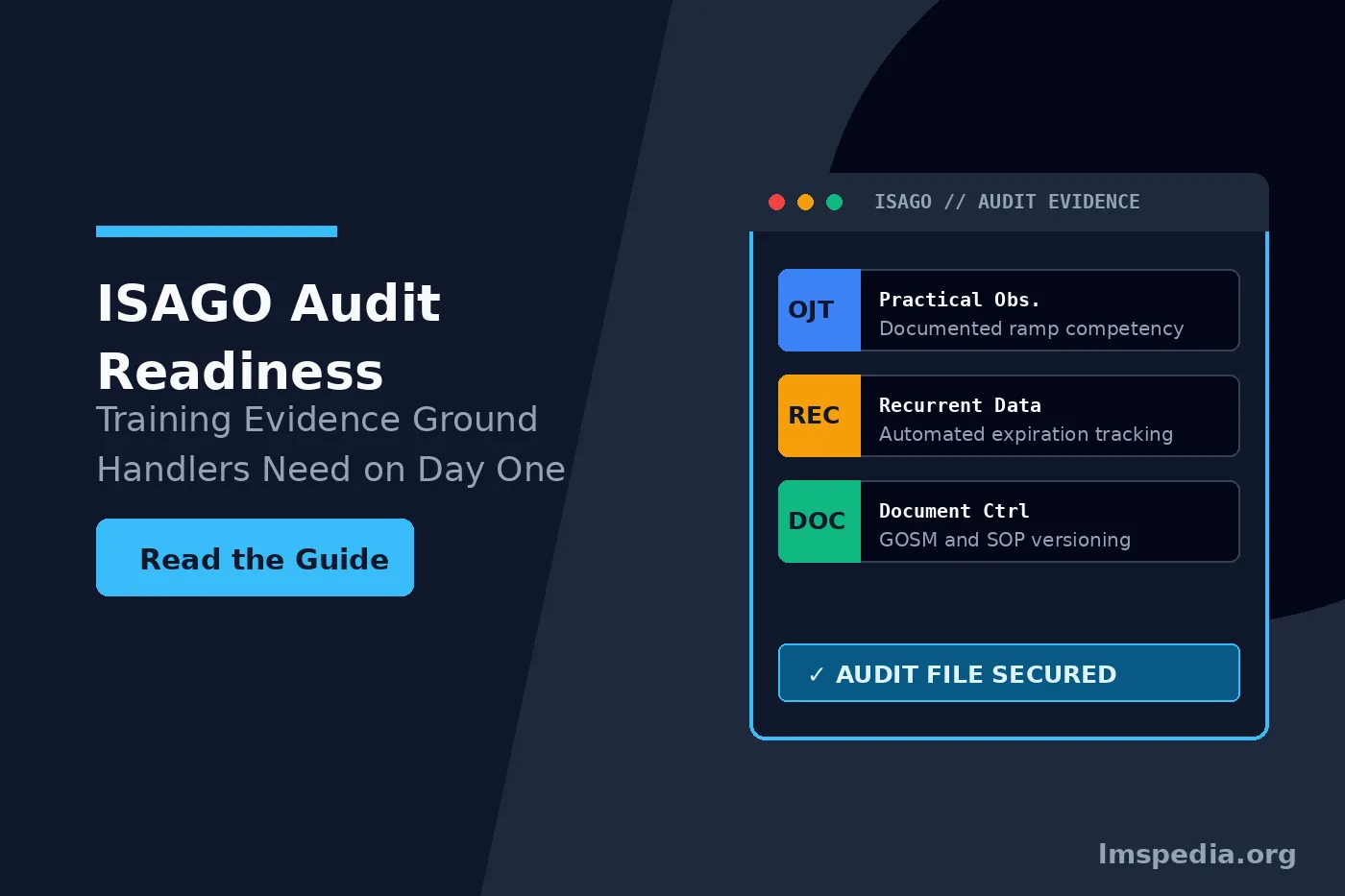
The aviation industry operates on a foundation of absolute safety and strict regulatory compliance. Ground service providers face immense pressure to prove their operational competence to airlines and international regulators. The primary mechanism for proving this competence is the IATA Safety Audit for Ground Operations. Passing this rigorous assessment requires flawless preparation. When auditors arrive at your station, they immediately scrutinize your workforce credentials. Therefore, implementing a robust isago audit training program is not optional. It is the core pillar of your operational survival.
Regulators and airline customers show zero tolerance for incomplete training records. If an auditor discovers that a pushback operator lacks a valid recurrent training certificate, they will immediately issue a critical non-conformity finding. This finding can jeopardize your entire certification status and cost your company lucrative airline contracts. To build a resilient compliance framework, organizations must understand exactly what evidence auditors expect to see. You can explore the foundational requirements of these systems in our guide on building a ground handling management system for airport training. In this comprehensive checklist guide, we will break down the exact training documentation and evidence you must present on day one of your assessment.
Key Takeaways

Audit Evidence is Paramount:
Auditors demand undeniable proof of competence. You must provide meticulously organized records of initial inductions, recurrent tracking, and practical on-the-job training assessments.
Align with IATA Standards:
Your internal training syllabus must explicitly align with the latest editions of the IATA Airport Handling Manual (AHM) and the IATA Ground Operations Manual (IGOM).
Implement a Strict Document Hierarchy:
Organize your compliance data into three clear tiers. Use a corporate Training Manual for policy, a Station Training Matrix for curriculum mapping, and individual digital files for granular employee proof.
Automate Recurrent Tracking:
Do not rely on manual spreadsheets to track expiration dates. Utilize an aviation-specific Learning Management System to automatically alert managers and block uncertified staff from the operational roster.
Prepare for Operational Spot Checks:
Auditors will interview frontline agents on the tarmac. You must conduct regular internal mock audits to ensure employees can confidently answer safety questions and demonstrate practical competence.
Understanding ISAGO Readiness and Training Mandates
The International Air Transport Association created the ISAGO program to standardize ground handling operations globally. The goal is to reduce accidents, lower airline costs, and ensure a unified approach to ramp safety. Achieving true isago readiness requires months of internal preparation. You cannot simply organize your files the week before the auditors arrive. You must cultivate a continuous culture of compliance where every training event is documented meticulously.
Auditors do not just want to know that you trained your staff. They want undeniable proof that your training aligns with the official IATA Airport Handling Manual (AHM) and the IATA Ground Operations Manual (IGOM). Specifically, they verify that your instructional design methodology produces competent, safety-conscious employees. For a deeper dive into aligning your curriculum with these global manuals, read our comprehensive guide on ramp safety training under IATA AHM and IGOM.
The Core Components of Ground Handling Audit Evidence
When the opening meeting concludes on day one, the lead auditor will request your training matrix and a sample of employee files. Producing this ground handling audit evidence swiftly and confidently sets a positive tone for the entire week. You must have three specific categories of evidence perfectly organized.
1. Initial Training and Onboarding Records
Every employee must complete a comprehensive initial training program before they ever step onto the live ramp. Auditors will select a random sample of recently hired employees and ask for their complete onboarding files. These files must include signed attendance sheets, theoretical exam results, and certificates of completion for all mandatory induction topics. Mandatory topics always include aviation security, dangerous goods awareness, and basic airside safety.
2. On-the-Job Training (OJT) and Practical Assessments
Classroom training alone does not satisfy IATA requirements. Ground handling is a highly physical profession. Consequently, auditors demand rigorous proof of On-the-Job Training. You must present documented practical assessments for every operational task. If an employee operates a lower lobe loader, the file must contain a practical observation rubric. This rubric must be signed by a certified trainer, explicitly stating that the employee demonstrated physical competence on that specific piece of equipment.
3. Recurrent Training Tracking
Aviation skills degrade over time. To combat this skill fade, regulators mandate strict recurrent training cycles. Most ground handling qualifications expire after twenty-four or thirty-six months. Your isago audit training evidence must prove that you track these expiration dates proactively. If an auditor finds a single employee operating with an expired dangerous goods certificate, you will fail that section of the audit. You must demonstrate how your system alerts managers before a qualification lapses.
Aligning with ISAGO GOSM Training Requirements
Your Ground Operations Safety Manual acts as the constitution for your local station. It details your specific local procedures, safety management system integrations, and reporting structures. Auditors will heavily scrutinize your isago gosm training records.
You must prove that every employee has read, understood, and been trained on the latest version of your safety manual. When you update the manual to a new revision, you must generate a new wave of training evidence. The auditor will check the revision history of the manual against your training logs. If revision four was published in January, but your staff training records still reference revision three in March, the auditor will flag a major document control failure.
To ensure your local manuals align perfectly with international safety management system requirements, you should review the ICAO Annex 19 safety management framework. Additionally, we provide actionable strategies for this alignment in our ICAO Annex 19 guide for ground handlers.
Structuring Your Document Hierarchy
Auditors appreciate structured, logical data. Handing an auditor a disorganized box of paper files invites unnecessary scrutiny. You must structure your ground handler compliance audit data into a clear, three-tiered hierarchy.
Tier One: The Corporate Training Manual
Your overarching Training Manual dictates your corporate philosophy. It outlines the minimum passing scores for exams, the required qualifications for internal instructors, and the specific syllabus for every job role. The auditor reads this document first to understand your intended baseline.
Tier Two: The Station Training Matrix
The Training Matrix is a massive spreadsheet or digital dashboard. It cross-references every job title at your station with every required course. The matrix allows the auditor to see exactly what a “Passenger Service Agent” needs versus a “Load Control Officer.” The matrix must clearly indicate the required initial durations and the recurrent frequencies for every single module.
Tier Three: The Individual Employee Record
This is the granular proof. When the auditor selects a specific employee from the roster, you must present a unified profile. This profile must contain their current valid certificates, historical training logs, practical sign-offs, and instructor feedback notes. The individual record must perfectly match the requirements dictated by the overarching Training Matrix.
Digitize Your Instructor Signatures
Auditors frequently reject paper forms if a signature is missing, illegible, or undated. You must transition to digital practical assessment forms on tablet devices. A digital system forces the trainer to sign and date the document before it can be submitted, eliminating simple administrative errors that cause audit findings.
Automating the Ground Handler Compliance Audit
Managing the training requirements for five hundred ramp agents across twenty different airline customers is mathematically impossible using paper and standard spreadsheets. Human error will inevitably cause a recurrent training date to slip through the cracks. To achieve sustainable compliance, ground service providers must utilize a specialized Learning Management System (LMS).
An aviation-specific LMS automates the entire compliance cycle. When you hire a new employee and assign them a job role, the system automatically triggers the correct learning path based on your training matrix. Furthermore, the system dynamically tracks expiration dates. It automatically locks the employee out of the roster software if a critical qualification expires. This hard stop prevents uncertified staff from ever touching an aircraft.
To ensure your digital systems maintain perfect historical accuracy during an audit, you must establish strict data governance policies. You can learn more about protecting your data integrity by reading our deep dive on Learning Record Store architecture and governance.
Day One Checklist for Training Managers
When the lead auditor walks into your conference room on Monday morning, you must have specific documents ready for immediate presentation. Delaying the delivery of these documents creates suspicion. Use this explicit checklist to prepare your digital or physical files for day one.
| Document Type | Description and Purpose | Audit Application |
|---|---|---|
| Approved Training Manual | The official manual detailing course syllabi, passing requirements, and instructor qualifications. | Establishes the baseline policy against which all employee records are judged. |
| Station Training Matrix | A visual map linking every station job title to its mandatory initial and recurrent courses. | Allows auditors to verify that the curriculum matches the operational duties. |
| Active Employee Roster | A current list of all active staff members, their ID numbers, and their assigned operational roles. | Used by auditors to select random employees for deep-dive file inspections. |
| Instructor Qualifications | Proof that your internal trainers hold valid certifications to teach subjects like Dangerous Goods. | Verifies that the people signing off on competencies are legally authorized to do so. |
| Sample Practical Rubrics | Blank copies of the checklists used by trainers to evaluate On-the-Job Training in the field. | Proves that practical assessments follow a standardized, objective methodology. |
Handling Auditor Interviews and Spot Checks
A comprehensive isago audit training preparation strategy goes beyond paperwork. Auditors do not solely rely on the documents you provide in the conference room. They will walk out onto the tarmac and speak directly with your frontline employees. This phase is known as the operational spot check.
The auditor will approach a ramp agent and ask them to explain a specific procedure. They might ask the agent how to identify a dangerous goods package or what to do if a fuel spill occurs. If your training records look perfect on paper, but the agent cannot answer basic safety questions, the auditor will issue a finding against the effectiveness of your training program.
You must prepare your staff for these interactions. Conduct internal mock audits regularly. Ask your supervisors to walk the ramp and quiz agents on the procedures outlined in the IGOM. This practice builds confidence and ensures that the theoretical knowledge taught in the classroom actually translates into practical operational awareness.
If you operate across multiple international stations, language barriers can severely impact training effectiveness and auditor interviews. It is critical that you deliver training in the native language of the workforce. To understand the complexities of global language management, review our guide on aviation training localisation.
Common Pitfalls in ISAGO Training Audits
Many ground handlers fail their initial ISAGO assessments because they commit preventable administrative errors. By studying the mistakes of others, you can proactively fortify your own ground handling audit evidence.
First, organizations frequently fail to document the transition between classroom training and independent operational duty. You must have a clearly signed “cleared for line operations” document in the file. Second, organizations fail to update their training materials when the IATA AHM publishes a new annual edition. Your training syllabus must specifically reference the current calendar year’s IATA regulations. Finally, training managers often fail to properly document the qualifications of their internal instructors. If an instructor teaches a specialized course but lacks the documented authority to do so, every certificate they issued becomes completely invalid in the eyes of the auditor.
You can cross-reference your internal safety protocols with the European framework by reviewing the official EASA ground handling operations guidelines.
Conclusion
Passing an IATA safety assessment requires far more than basic operational competence. It requires a relentless, uncompromising dedication to administrative perfection. Your isago audit training records are the ultimate proof of your commitment to aviation safety. By meticulously organizing your ground handling audit evidence, standardizing your practical assessments, and strictly tracking your recurrent deadlines, you guarantee a smooth inspection.
Do not wait until the month before the audit to review your files. You must achieve permanent isago readiness by automating your compliance tracking through specialized learning platforms. Ensure your staff masters the isago gosm training materials and prepare them confidently for frontline auditor interviews. When you treat your training documentation with the same level of seriousness as your physical aircraft handling, you will successfully navigate the ground handler compliance audit and secure your reputation as a world-class aviation service provider.
FAQ
Q1. What is the purpose of ISAGO audit training preparation?
The purpose of ISAGO audit training preparation is to ensure a ground handling organization can provide undeniable, standardized proof that its workforce is fully qualified, safety-conscious, and compliant with all IATA operational requirements.
Q2. What specific ground handling audit evidence is required on day one?
On day one, auditors typically request your approved corporate training manual, a comprehensive station training matrix, an active employee roster, proof of instructor qualifications, and a random sampling of individual employee training files.
Q3. How does ISAGO GOSM training impact the audit?
Your Ground Operations Safety Manual (GOSM) dictates local safety procedures. Auditors will verify that every active employee has completed documented training on the most current, active revision of that specific manual.
Q4. Why is practical on-the-job training critical for a ground handler compliance audit?
Aviation ground handling is a highly physical, high-risk profession. Classroom theory cannot prove physical competence. Auditors demand signed, standardized practical observation rubrics to prove an employee can safely operate heavy machinery around live aircraft.
Q5. How often must ground handlers complete recurrent training?
While specific durations vary based on local civil aviation authority rules and airline contracts, most critical ground handling qualifications require documented recurrent training and practical reassessments every twenty-four to thirty-six months.