Innform vs Typsy: Hospitality LMS and Staff Training Comparison
The hospitality sector operates under relentless operational pressure and staggering turnover rates. Specifically, annual turnover frequently exceeds seventy percent across hotels and restaurants globally. Consequently, general managers and human resource directors spend countless hours onboarding replacements constantly. Traditional paper manuals, shadowing shifts, and static video discs no longer work. Modern hospitality operators demand agile, mobile-first platforms to accelerate operational onboarding. Selecting the proper platform decreases time to competency while enforcing strict brand standards. In this comprehensive innform vs typsy evaluation, we analyze both platforms thoroughly. Next, we examine their architectures, content delivery methods, multi-unit governance, and commercial pricing. Ultimately, this detailed analysis helps you identify the ideal training platform for your frontline workforce.
Key Takeaways

Differing Core Philosophies:
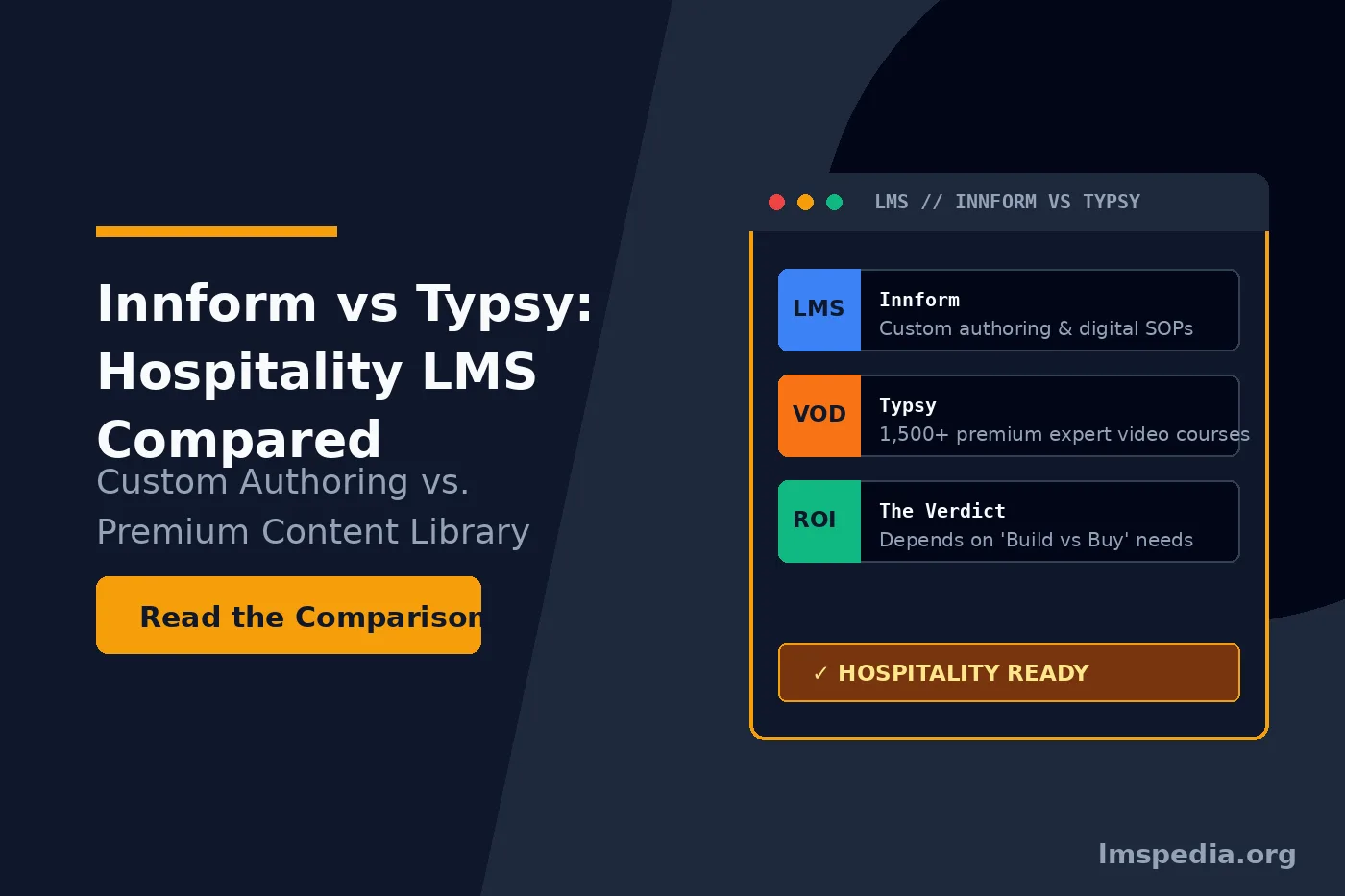
Innform is primarily a customizable Learning Management System (LMS) designed for authoring proprietary content. Typsy is a premium content provider offering thousands of expert-led hospitality videos.
Content Creation vs. Consumption:
Choose Innform if you need to build custom digital SOP manuals, upload existing SCORM files, and digitize your specific brand standards. Choose Typsy if you want to deploy ready-made, world-class culinary and service training instantly without an internal L&D team.
Language Support:
Both platforms excel in diverse environments. Innform offers instant translation features for 10 languages, while Typsy supports an impressive 40+ languages natively, making both excellent for international workforces.
Employee Retention Benefits:
Typsy issues industry-recognized credentials and badges upon course completion. This empowers the learner’s personal career path, making it a highly effective tool for employee engagement and retention.
Blended Learning Focus:
Innform offers robust blended learning capabilities, allowing managers to seamlessly mix digital compliance courses with scheduled, in-person practical assessments on the floor.
Core Philosophies: Custom LMS vs Premium Content
Evaluating hotel staff training systems requires recognizing their foundational operational differences. Operators cannot treat these tools as interchangeable software solutions. Doing so results in a severely misaligned software procurement process. Instead, businesses must evaluate how their internal resources match platform design goals. Next, we analyze the core architectural design of both systems.
The Innform Architecture: Centralized SOP Digitization
Developers created Innform as an agile learning management system for hospitality brands. The platform gives internal training departments total control over their training narratives. Specifically, it focuses heavily on native course authoring and digital standard operating procedures. Operations managers can convert complex kitchen manuals into searchable mobile guides rapidly. Furthermore, administrators can build bespoke onboarding tracks tailored to specific kitchen or front-desk roles. By streamlining onboarding workflows, organizations effectively reduce training admin time across all operating properties. Consequently, Innform functions as an operational software canvas for internal corporate knowledge.
The Typsy Ecosystem: Turnkey Video Streaming
Typsy operates on a fundamentally different instructional model. While the software provides essential learner management features, its primary asset remains its proprietary video catalog. Specifically, Typsy offers an expansive library of bite-sized, broadcast-quality video lessons. Global hospitality champions, Michelin-starred chefs, and beverage masters teach these video modules directly. Instead of filming proprietary service standards, operators deploy pre-built, internationally recognized training modules instantly. Furthermore, industry associations like the American Hotel and Lodging Association advocate continuous professional development for frontline teams. Consequently, Typsy provides an immediate shortcut to premium hospitality education without internal instructional design overhead.
Feature Breakdown: Content Creation and Course Libraries
The operational balance between building proprietary content and purchasing pre-made courses represents a critical decision. Hospitality operators must determine whether their brand standards require custom interactive builds. Conversely, generic hospitality skills may only require standardized industry video lessons. Next, we explore the content capabilities of both platforms in detail.
Custom SOP Manuals and Native Authoring
Innform excels when a hospitality business requires granular control over internal brand standards. For example, a boutique luxury hotel may enforce a proprietary twelve-step check-in sequence. Similarly, a fast-casual restaurant chain requires strict adherence to custom portioning and cooking guides. Innform includes an intuitive drag-and-drop course builder that eliminates the need for third-party authoring tools. Managers can embed recipe cards, uniform guidelines, equipment sanitation checklists, and compliance quizzes effortlessly. Furthermore, maintaining an organized digital repository aligns with best practices in training content library management. Consequently, frontline workers reference verified operating procedures directly on their smartphones during active shifts.
Industry-Recognized Credentials and Microlearning
Typsy focuses on delivering world-class foundational education through rapid microlearning. The platform features hundreds of concise courses covering food preparation, wine service, front-desk etiquette, and guest conflict management. Rather than presenting static text slides, Typsy relies on dynamic visual demonstrations. For instance, learners watch close-up demonstrations of cocktail preparation, table settings, and knife sharpening techniques. Crucially, completed courses award accredited digital certificates and skill badges. These verifiable credentials travel with the worker throughout their professional career. Therefore, workers feel genuine personal ownership over their development pathways. Consequently, providing accredited education boosts frontline employee retention significantly across high-turnover properties.
Digitize Operational Checklists
Convert physical opening and closing checklists into digital interactive modules. Requiring staff to complete quick photo-verified checks on mobile devices guarantees brand consistency across multiple property locations.
Multi-Property Management and Frontline Governance
Training a single boutique restaurant team presents minimal logistical complexity. However, coordinating education across fifty franchised properties with varying operational leadership creates immense friction. Centralized visibility and multi-property governance become vital operational requirements for multi-unit operators. Next, we examine how these platforms handle enterprise workforce administration.
Standardizing Franchise Operations
Innform provides robust multi-property administrative hierarchy structures. Corporate administrators can organize learners by geographical territory, property location, and specific job titles. Furthermore, administrators can configure customized onboarding pathways automatically. For example, a barback in Chicago receives a distinct operational curriculum compared to a front-desk agent in Atlanta. Additionally, regional directors monitor property compliance through real-time operational analytics dashboards. If a franchised property falls behind on mandatory food safety certifications, corporate managers intervene immediately. Evaluating systems tailored for deskless staff often leads buyers to examine Learner Mobile vs EdApp for frontline operational efficiency. Consequently, hierarchical governance ensures absolute operational standardization across distributed hospitality networks.
Visual Analytics and Compliance Oversight
Typsy delivers centralized governance through an intuitive, visual administrative console. Enterprise hospitality groups can review aggregate platform engagement metrics across global resort portfolios. Specifically, regional directors track overall course completion velocities, active learning hours, and certified staff percentages per property. This operational transparency allows leadership to benchmark properties against organizational key performance indicators. Furthermore, managers can identify high-performing locations and replicate their training strategies across lagging properties. Consequently, executive leadership maintains accountability across all operational tiers effortlessly. Ultimately, robust reporting bridges the communication gap between property general managers and corporate leadership.
Language Localization and Mobile Accessibility
According to research from the U.S. Bureau of Labor Statistics, the leisure and hospitality industry employs an exceptionally diverse, multilingual workforce. Consequently, delivering training exclusively in English creates severe operational vulnerabilities. Multilingual support represents an essential operational safeguard rather than a secondary feature. Next, we evaluate language localization across both systems.
Overcoming Language Barriers on the Floor
Typsy represents the definitive market leader regarding multilingual content delivery. Specifically, the platform provides closed captioning and localized interface support in more than forty global languages. Because the curriculum relies heavily on visual demonstrations, non-native speakers follow technical culinary and service techniques easily. For instance, a line cook can watch an expert chef demonstrate safe poultry handling while reading native subtitles. Furthermore, modern enterprises leverage AI translation for training content to accelerate global learning distribution. Therefore, visual instruction combined with localized subtitles eliminates language confusion entirely. Consequently, hospitality properties minimize food preparation errors and maintain safe sanitary environments.
Mobile Delivery and Offline Engagement
Hospitality workers rarely perform their daily responsibilities seated behind traditional desktop computers. Housekeepers, servers, valets, and line cooks spend their entire working shifts on the floor. Therefore, learning platforms must deliver responsive, native mobile experiences. Innform provides an intuitive mobile interface that allows employees to access standard operating procedures between shift tasks. Furthermore, implementing offline mobile learning safeguards access in basement kitchens or remote resort locations lacking cellular reception. When employees access critical operating guides instantly, operational friction decreases dramatically. Consequently, mobile accessibility transforms passive training into just-in-time operational support.
Prioritize Native Subtitles
Never force non-native speaking staff to complete compliance certifications in English. Utilizing native language subtitles improves comprehension scores, prevents workplace accidents, and protects your property against regulatory violations.
Hospitality Training Platform Comparison
Selecting an enterprise hospitality training system requires weighing software architectures against operational priorities. Agile restaurant brands require lightweight digital manuals, while luxury hotel networks demand deep compliance logging. To assist your software evaluation, the comparative table below outlines three prominent platforms serving the modern hospitality sector.
| Platform | Content Strategy | Operational Focus | Primary Target Audience |
|---|---|---|---|
| SimpliTrain | Unified custom authoring plus external content integration | Automated compliance tracking, multi-unit scheduling, and mobile execution | Commercial hospitality groups, hotel management companies, and enterprise franchises |
| Innform | Native drag-and-drop authoring with interactive SOP manuals | Custom digital onboarding, blended assessments, and internal knowledge bases | Boutique hotels, fast-casual restaurant chains, and independent operators |
| Typsy | Over 1,500 expert-led video lessons with accredited credentials | Turnkey professional upskilling, multilingual subtitles, and guest service mastery | International hotel chains, culinary schools, and luxury resort operators |
Commercial Pricing Structures and Procurement Realities
Hospitality profit margins remain notoriously thin across both lodging and food service sectors. Consequently, executive buyers must scrutinize software licensing models to prevent unexpected budget inflation. Both vendors structure their commercial licensing differently based on organizational scale and user volume. Next, we examine the pricing dynamics of both platforms.
Innform Commercial Licensing
Innform positions its commercial model to accommodate the seasonal fluctuations inherent to hospitality operations. The vendor provides a flexible per-user subscription model that scales alongside active monthly employee headcounts. This flexible structure benefits seasonal resort operators who experience massive workforce expansions during peak summer or winter periods. Furthermore, operators only pay for active team members utilizing the platform rather than maintaining inactive licenses year-round. Innform also offers a transparent trial period, allowing managers to test authoring tools before executing multi-year agreements. Therefore, growing hospitality brands maintain predictable software expenditures without paying for idle user seats.
Typsy Subscription Tiers
Typsy categorizes its commercial pricing across three distinct tiers tailored to varying customer profiles. First, individual professionals can purchase annual subscriptions to earn recognized certifications independently. Second, the vendor offers team-based licensing for single-location restaurants and independent hotels seeking turnkey onboarding. Finally, the enterprise tier delivers custom negotiated pricing for multinational hotel brands and large restaurant operators. This top tier unlocks single sign-on security, custom application integration, and dedicated customer success management. However, organizations must budget for ongoing library licensing fees rather than a one-time software purchase. Consequently, executives must weigh the continuous value of a premium video catalog against their annual software budget.
Audit Seasonal User Seats
Review your active user rosters quarterly to deactivate seasonal workers who have concluded their contracts. Pruning inactive user seats prevents unnecessary subscription fees and keeps departmental training budgets lean.
Operational Rollout and Change Management
Deploying new operational software across frontline hospitality teams requires structured change management. Staff members frequently resist platforms that feel like administrative chores. Therefore, training leadership must ensure the onboarding process remains frictionless, rewarding, and immediately useful on shift. Next, we explore best practices for deploying hospitality learning software successfully.
Fostering Frontline Adoption Through Microlearning
Frontline staff experience fatigue quickly when forced to complete lengthy digital courses after long shifts. Therefore, learning managers must configure training modules in concise microlearning segments. Structuring lessons into three-minute bursts allows workers to consume educational material during pre-shift team meetings. Furthermore, introducing gamification mechanics like points, badges, and team leaderboards drives healthy competition between shifts. For example, morning and evening service crews can compete for highest monthly compliance scores. Consequently, training transforms from an unwanted administrative burden into an engaging daily habit. Ultimately, short-form microlearning drives consistent completion rates across transient frontline teams.
Closing the Training-to-Performance Loop
A training platform must demonstrate tangible operational results to justify its budget allocation. Specifically, leadership must evaluate how completed training modules impact daily operational metrics. For instance, food and beverage directors should correlate completed wine service modules with higher average beverage sales per cover. Similarly, hotel general managers should measure guest satisfaction scores following front-desk service training. When operational metrics improve following targeted training campaigns, the return on investment becomes unmistakable. Therefore, training directors must review operational data alongside learning completion rates regularly. Consequently, learning initiatives align directly with core hospitality profitability and guest satisfaction metrics.
Strategic Decision Matrix: Selecting Your Platform
When to Deploy Innform for Your Properties
Deploying Innform represents the ideal strategic choice for hospitality operators prioritizing custom brand standards and internal knowledge management. If your property maintains proprietary culinary recipes, unique guest service rituals, or custom software workflows, Innform provides the tools to digitize those procedures. Its drag-and-drop course builder and interactive SOP features allow internal teams to build a proprietary corporate academy effortlessly. Furthermore, its flexible per-user pricing suits operators with fluctuating seasonal headcounts. Choose Innform if your primary objective involves capturing, standardizing, and enforcing proprietary operational workflows across your properties.
When to Implement Typsy Across Your Operations
Implementing Typsy is the optimal operational strategy for hospitality organizations seeking immediate access to elite, expert-led training without internal content development. If your management team lacks the bandwidth to film video lessons, write quizzes, and design curriculums, Typsy delivers a complete culinary and service academy out of the box. Its cinematic video library, multilingual subtitles, and industry-recognized credentials motivate frontline employees effectively. Furthermore, international hotel brands benefit immensely from its standardized service modules across diverse global regions. Choose Typsy if your primary objective involves elevating baseline hospitality skills, improving service standards, and providing accredited professional development.
Conclusion
The operational choice between Innform and Typsy centers on the classic dilemma of building custom training versus buying a curated content library. Innform empowers hospitality organizations to build, customize, and enforce proprietary standard operating procedures across distributed properties. Conversely, Typsy delivers immediate access to world-class hospitality education taught by internationally renowned industry experts. Both platforms resolve the critical challenge of frontline employee turnover, but they address the issue through entirely different architectural methodologies.
Evaluating your internal instructional design resources, brand customization requirements, and workforce demographics clarifies the ideal path forward. Operators with highly specific brand rituals and internal recipe manuals will find exceptional value in the authoring flexibility of Innform. Meanwhile, hospitality brands seeking rapid deployment, accredited certifications, and extensive multilingual support will thrive using the turnkey video catalog of Typsy. Selecting the platform that mirrors your operational reality elevates guest service standards, stabilizes frontline retention, and protects your property reputation permanently.
FAQ
Q1. What is the main difference between Innform and Typsy?
The primary difference is their core function. Innform is an all-in-one LMS that provides you with the tools (authoring, SOP manual builders, SCORM support) to create your own custom training. Typsy is a specialized content platform offering a massive library of high-quality, pre-recorded video lessons taught by global hospitality experts.
Q2. Does Typsy allow me to upload my own custom training courses?
While Typsy’s primary focus is delivering its own premium content library, their higher-tier Enterprise plans do offer functionalities to host custom content or integrate seamlessly into your existing enterprise LMS via API.
Q3. Is Innform suitable for a single restaurant, or is it only for large hotel chains?
Innform is highly scalable and suitable for both. Because they offer flexible, per-user billing and a user-friendly interface that requires no IT knowledge to set up, single-location restaurants can adopt it just as easily as multi-property hotel groups.
Q4. Do both platforms support mobile learning?
Yes. Both Innform and Typsy are designed specifically for the deskless workforce. They feature robust, mobile-first interfaces allowing staff to complete microlearning modules, check digital manuals, or watch video courses directly from their smartphones during a shift or on their commute.
Q5. How does Typsy price its platform for businesses?
Typsy offers tiered pricing. They have an Individual plan ($180/year), a Team plan ($120 per member/year for up to 100 members), and Custom Enterprise pricing for large groups that require advanced API integrations, SSO, and multi-property governance capabilities.