
Human Factors Maintenance Training: Mastering Aviation Safety
Modern commercial aviation operates with remarkable safety records. Millions of passengers board aircraft every single day. They trust complex mechanical systems will function perfectly at thirty thousand feet. However, behind every safe flight stands an army of skilled aircraft maintenance technicians. These engineering professionals work in high-pressure hangar environments. They battle aggressive shift schedules, complex wiring diagrams, and tight departure deadlines. Unfortunately, when accidents occur in aviation, root cause analyses frequently reveal human error as the primary culprit. Consequently, implementing rigorous human factors maintenance training has become an absolute necessity for modern repair stations. Furthermore, enterprise leaders must audit core training management system features to ensure comprehensive compliance tracking across global bases.
Understanding why qualified technicians make critical errors requires deep psychological insight. Regulatory bodies across the globe now mandate that maintenance organizations actively address behavioral safety. Organizations must train staff to recognize cognitive traps leading to catastrophic oversights. In this technical guide, we will explore foundational principles of behavioral safety. We will break down notorious dirty dozen aviation maintenance hazards. Additionally, we will examine strict regulatory expectations of part 145 human factors training. Finally, we will provide actionable blueprints for designing impactful Maintenance Resource Management curricula.
Key Takeaways

Validation is Legally Mandated:
Because training systems dictate who is qualified to manufacture drugs or medical devices, the FDA classifies them as GxP-critical. You must formally validate the software before utilizing it in a live production environment.
Transition from CSV to CSA:
The industry is abandoning exhaustive, screenshot-heavy Computer System Validation (CSV) in favor of Computer Software Assurance (CSA), which focuses testing efforts strictly on high-risk features that directly impact patient safety.
GAMP 5 Dictates Effort:
Most modern cloud-based LMS platforms fall under GAMP 5 Category 4 (Configured Products). You must validate your specific custom configurations rather than re-testing the vendor’s core source code.
The Golden Thread of Traceability:
You must maintain a Requirements Traceability Matrix (RTM). This document provides undeniable proof to auditors that every single business requirement (URS) was successfully tested and verified.
Validation is Continuous:
Securing your initial Validation Summary Report is only the beginning. You must utilize strict formal Change Control procedures to evaluate and re-test the software every time the vendor releases a new patch or system update.
The Evolution of Human Factors in Aviation Engineering
Shifting from Mechanical Blame to Systemic Analysis
In early decades of commercial aviation, safety investigations focused almost exclusively on mechanical breakdowns. If a component failed, engineers redesigned the physical part. If an engine stalled, metallurgists analyzed turbine blades. The industry largely ignored psychological conditions affecting technicians turning wrenches on hangar floors. This narrow perspective shifted dramatically as researchers recognized human fallibility.
Highly trained engineers are subject to physical fatigue, emotional stress, peer pressure, and cognitive biases. Aviation pioneers realized blaming individual mechanics after incidents solves nothing. Instead, organizations must analyze systemic environmental factors allowing human error. For broader overviews of managing complex frameworks, review our guide on AMT continuation training and rolling plans.
Global Regulatory Mandates
Today, regulatory agencies like the European Union Aviation Safety Agency and the United States Federal Aviation Administration treat human factors as core safety pillars. Furthermore, international bodies like the International Civil Aviation Organization establish baseline global standards. They require formal educational programs teaching mechanics how to recognize vulnerability. Consequently, organizations achieve higher compliance accuracy and operational safety.
Deconstructing the Dirty Dozen in Aviation Maintenance
Psychological Hazards in Hangar Environments
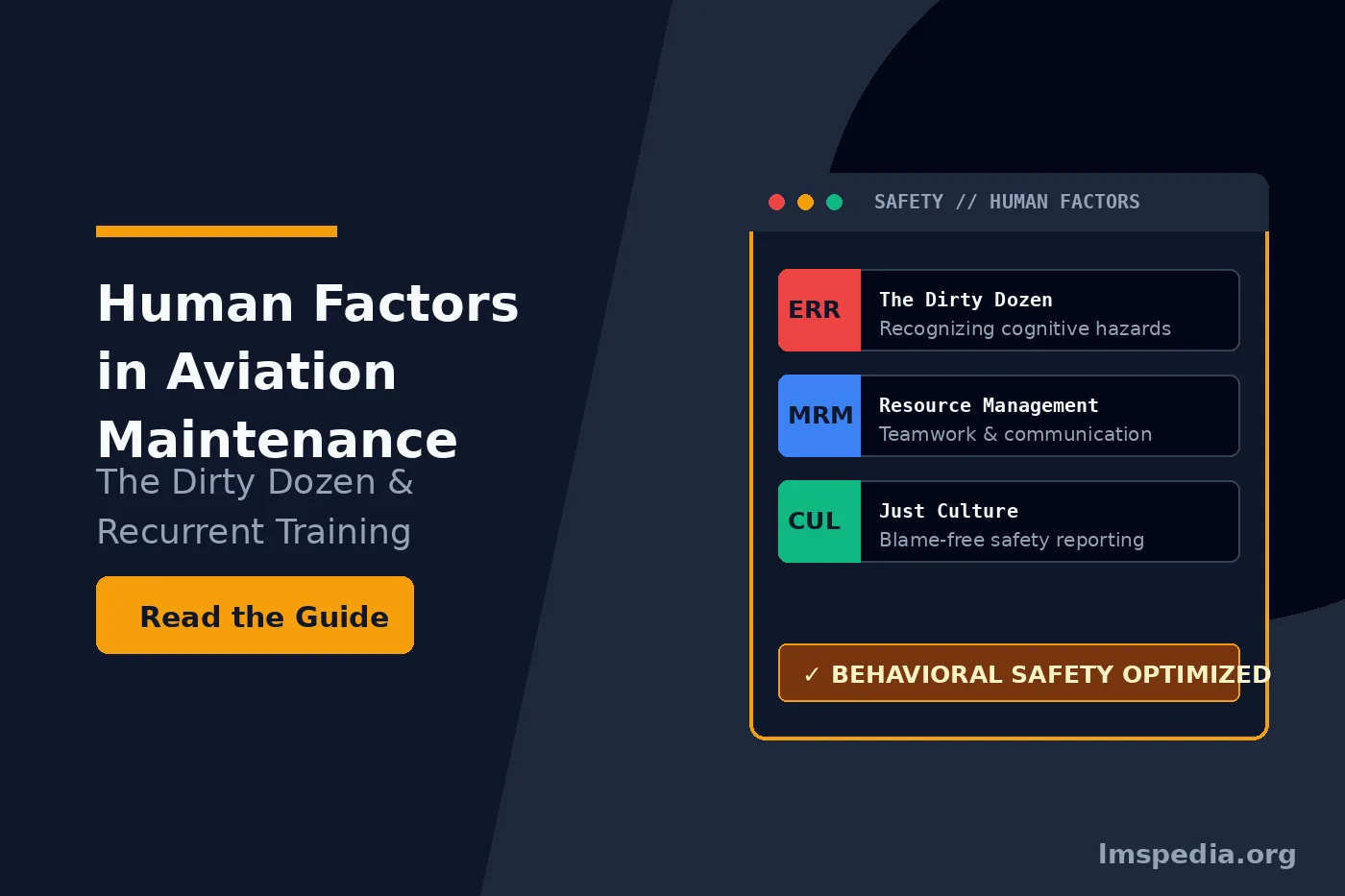
The cornerstone of effective educational programs is the Dirty Dozen framework. Originally identified by Gordon Dupont with Transport Canada, this framework categorizes twelve common human error preconditions. Every maintenance manager must understand these psychological hazards. Recognizing these cognitive triggers protects aircraft structural integrity.
Reviewing the Twelve Hazards
First, communication breakdowns cause severe workplace errors during shift handovers. Next, complacency creates blind spots when technicians perform repetitive tasks without finding defects. Furthermore, lack of knowledge occurs when engineers attempt complex repairs without proper technical documentation. Distraction resets working memory when supervisors interrupt technicians mid-task. Lack of teamwork impairs collaborative problem-solving across hangar bays. Fatigue impairs cognitive function and slows reaction times during double shifts. Toxic workplace norms create a dangerous normalization of deviance. Schedule pressure forces mechanics to rush critical inspection steps. Lack of resources leaves staff without calibrated test tools or updated manuals. Personal stress degrades situational awareness before technicians step onto flight lines. Lack of awareness causes technicians to miss long-term consequences of physical actions. Finally, ego prevents mechanics from admitting mistakes or asking for help.
Regulatory Compliance and Part 145 Requirements
Certificated Repair Station Obligations
Acknowledging psychological hazards is important, but authorities demand formal educational structures. Under international frameworks, certificated repair stations must incorporate behavioral safety modules directly into core manuals. For EASA organizations, mandatory part 145 human factors training is a strict prerequisite for maintaining operational certification. Regulatory audits scrutinize syllabi to ensure deep curriculum depth. Auditors want real world case studies and documented attendance logs. To ensure digital environments track certifications without errors, review our guide on selecting optimal training assessment tools. Furthermore, maintaining audit evidence aligns with our guide on LMS for compliance training and audit evidence.
Designing an Impactful Recurrent Training Curriculum
Interactive Learning and Hangar Workshops
Designing effective human factors maintenance training requires stepping away from static slide decks. Mechanics are hands-on professionals who tune out abstract psychological theories. Therefore, organizations must build engaging, interactive curricula. Phase one utilizes interactive digital e-learning modules. Phase two deploys hangar workshops analyzing historical incident root causes. Phase three incorporates peer briefings discussing shift handovers. Phase four engages leadership in safety forums.
| Curriculum Phase | Delivery Format | Core Learning Objectives | Evaluation Method |
|---|---|---|---|
| SimpliTrain | Automated scheduling and tracking. | Manage recurrent aviation training compliance. | Digital audit reports. |
| Phase 1 | Interactive E-Learning | Define the Dirty Dozen and core terminology | Digital Knowledge Checks |
| Phase 2 | Hangar Workshops | Analyze historical incident root causes | Group Root Cause Analysis |
Integrating Maintenance Resource Management
Borrowing concepts from cockpit resource management, Maintenance Resource Management adapts crew coordination principles to hangar floors. Effective mrm training teaches mechanics how to manage interpersonal conflict. Furthermore, it teaches staff to assert safety concerns when authority figures rush production. Effective training scheduling systems help coordinate these multi-tier workshops smoothly.
Encourage Anonymous Near Miss Reporting
Combine recurrent training workshops with a robust, anonymous internal reporting system. Encourage technicians to submit real near miss examples from your own hangar floor to make sessions hyper-relevant.
Fostering a True Just Culture
Differentiating Error from Recklessness
Organizations cannot teach human factors in environments driven by punitive fear. If mechanics believe admitting mistakes brings immediate termination, they conceal errors. Therefore, organizations must cultivate genuine Just Cultures. A Just Culture draws a transparent line between honest human error and reckless negligence. If technicians make mistakes due to fatigue, organizations treat events as learning opportunities. Conversely, willful protocol violations warrant disciplinary action. Frontline staff trust management when investigations remain objective and fair.
Tracking Training Data and Audit Readiness
Centralized Digital Recordkeeping
Implementing brilliant human factors curricula requires flawless administrative records. Auditors demand timestamped proof that technicians completed required training cycles on time. Many legacy organizations rely on manual spreadsheets, inviting missed deadlines. To guarantee absolute compliance, organizations must manage training records through secure digital platforms. Centralized software allows quality managers to pull employee transcripts instantly. Furthermore, organizations extract comprehensive analytics for surprise inspections. Explore our guide on LMS reporting, custom reports, and data exports. Additionally, implementing strict computer system validation for an LMS guarantees regulatory defensibility.
Audit Transcript Logs Regularly
Conduct monthly digital audits of employee training transcripts. Catching expired certifications before federal inspectors arrive prevents costly operational shutdowns.
Conclusion
Human error is an inevitable aspect of the human condition. However, catastrophic accidents resulting from that error remain preventable. By implementing structured human factors maintenance training, aerospace organizations equip engineering staff with necessary psychological tools. Mastering the dirty dozen aviation maintenance framework allows technicians to recognize vulnerability. Fulfilling part 145 human factors training mandates ensures repair stations stay compliant. Furthermore, embedding robust mrm training transforms workforces into collaborative safety cultures. Prioritizing behavioral safety protects frontline staff and guarantees public safety.
FAQ
What is LMS validation?
LMS validation is a formal, documented quality assurance process mandated by regulatory bodies like the FDA. It provides undeniable proof that a Learning Management System operates exactly as intended, securely tracks compliance training, and maintains accurate audit trails without technical errors.
What is the difference between CSV and CSA?
Computer System Validation (CSV) relies heavily on exhaustive documentation, requiring testers to write massive scripts and capture screenshots for every software feature regardless of risk. Computer Software Assurance (CSA) is a modern, risk-based approach that focuses rigorous testing only on features that directly impact patient safety or product quality, drastically reducing unnecessary paperwork.
What does IQ OQ PQ stand for in LMS validation?
It stands for Installation Qualification (proving the software was installed correctly), Operational Qualification (stress-testing the software’s functional limits and security features), and Performance Qualification (proving the software supports actual real-world business workflows).
Why do I need a Requirements Traceability Matrix (RTM)?
The RTM is the most critical document during a regulatory audit. It is a grid that connects every single business requirement to its corresponding test script, proving to the inspector that no critical software feature was skipped during the validation testing phase.
What happens if the software vendor updates the LMS after it is validated?
If the vendor releases an update, you must execute formal Change Control. Your quality team must review the release notes to determine if the update impacts critical GxP features. If it does, you must perform regression testing to re-verify compliance before accepting the update.