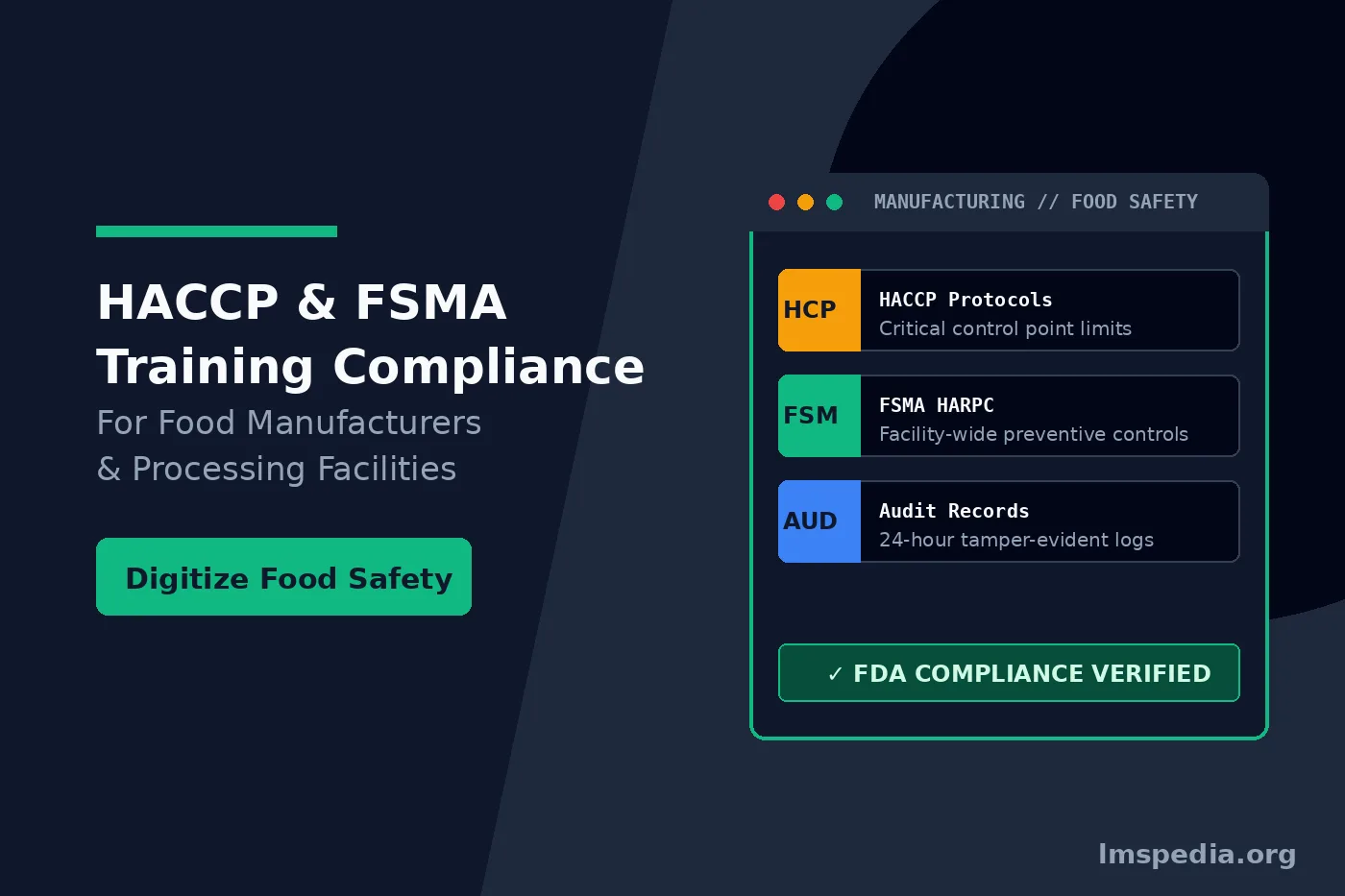
Food Safety Training Compliance: FSMA, HACCP, and PCQI Requirements
The global food supply chain operates with thin profit margins and zero tolerance for error. A single contamination event causes more than a local product recall. It brings heavy regulatory fines, lawsuits, and severe brand damage. These events can quickly bankrupt a business. To reduce these risks, the FDA created the Food Safety Modernization Act (FSMA). This law represents the biggest update to FDA food safety rules in over seventy years. FSMA completely changes how the industry operates. Companies must now actively prevent foodborne illnesses instead of just reacting to outbreaks.
This regulatory shift means generic training programs will fail legal tests. Federal inspectors want more than proof of an annual video. They actively audit your food safety training compliance setup. They check if frontline workers actually use specific preventive controls. You must digitize the shop floor to build a compliant system. You also need strict identity management and secure audit trails. This guide explains how modern food science meets enterprise learning. We will analyze specific haccp training requirements and unpack fsma pcqi training mandates. Finally, we will explore how to track certifications across diverse, high-turnover factories.
Key Takeaways

The Shift to Prevention:
FSMA transformed FDA oversight from reactive incident response to proactive prevention, demanding that training programs actively prove employees are executing facility-wide preventive controls, not just processing-line HACCP steps.
The PCQI Mandate:
A facility’s food safety plan must be designed and overseen by a Preventive Controls Qualified Individual (PCQI) who has passed FDA-recognized curriculum (like FSPCA) and bears direct responsibility for validating safety measures.
Specialized Rule Training:
FSMA requires distinct, tailored training across different operational vectors, including Intentional Adulteration (Food Defense), Sanitary Transportation, and Produce Safety protocols.
Language and Localization:
The FDA explicitly mandates that all food safety training must be delivered in a manner easily understood by the employee, requiring multi-lingual LMS delivery for diverse manufacturing workforces.
24-Hour Audit Readiness:
Under FSMA, specific traceability and compliance records must be produced within 24 hours of an FDA request. Manual paper tracking is a severe liability; facilities must utilize secure, 21 CFR Part 11-compliant LMS architectures to guarantee instant retrieval of tamper-evident records.
The Regulatory Paradigm Shift: From HACCP to HARPC
Understanding Evolving Federal Mandates
Compliance officers must understand changing regulations before buying training software. In the past, food manufacturers relied mostly on Hazard Analysis and Critical Control Points (HACCP). HACCP helps managers analyze and control biological, chemical, and physical hazards. A traditional HACCP plan looks only at the physical processing line. It identifies specific operational points like pasteurization ovens or metal detectors. At these specific points, workers can prevent, eliminate, or reduce hazards to safe levels.
Transitioning to Facility-Wide HARPC Plans
Today, regulations require a much broader approach. FSMA introduced Hazard Analysis and Risk-Based Preventive Controls (HARPC). The FDA finalized the Preventive Controls for Human Food rule in September 2015. This rule forces many food facilities to build a complete food safety plan. Companies must adopt Current Good Manufacturing Practices (CGMPs) and use facility-wide FSMA controls. A HACCP plan stops at the processing line. A FSMA or HARPC plan covers much more. It includes facility-wide sanitation, allergen management, supply chain checks, and food defense.
Your corporate training must reflect this massive expansion. Training managers cannot just assign an old HACCP e-learning module and claim FSMA compliance. Your training setup must map perfectly to the latest federal mandates. To stay updated, organizations should frequently reference the official FSMA Rules and Guidance for Industry. Furthermore, monitoring guidelines from the United States Department of Agriculture ensures comprehensive supply chain safety.
Deconstructing HACCP Training Requirements
Translating Food Science into Daily Actions
FSMA covers a broad scope, but HACCP remains the foundation for managing specific hazards. This is especially true in highly regulated sectors. For example, the FDA strictly enforces Juice HACCP and Seafood HACCP rules. You must build specific haccp training requirements into your Learning Management System (LMS). The curriculum must teach the seven core principles of HACCP. It must translate theoretical food science into clear daily actions for operators.
Hyper-Localized Operational Training
Food safety training cannot be generic. Suppose you assign an operator to a critical control point on a dairy line. Their training must detail the exact time and temperature parameters for pasteurization. It must teach them how to calibrate their specific thermometers. The course must explain the exact corrective actions to take if temperatures drop. Even a one-degree drop requires a specific response. You need hyper-localized, job-specific training modules instead of broad safety overviews.
Furthermore, the training must cover rigorous documentation steps for each critical control point. Managers must teach operators how to log data accurately. Workers might use traditional clipboards or digital tablets on the wet processing floor. Falsifying a log is a critical regulatory failure. Missing data entries at required times also triggers major compliance violations. Organizations can streamline this oversight by leveraging a robust training scheduling system.
The Mandate for FSMA PCQI Training
Defining the Preventive Controls Qualified Individual
The Preventive Controls for Human Food rule includes a strict mandate. The FDA requires a Preventive Controls Qualified Individual (PCQI) to develop the facility food safety plan. This is not just a fancy job title. The PCQI carries direct, heavy operational responsibility. They oversee food safety plans, validate preventive controls, and rigorously review facility records. Ensuring proper credentialing protects the entire manufacturing plant.
Legal Liabilities and Certification Tracking
A PCQI must complete FDA-recognized training to earn this legal designation. Alternatively, they can prove their qualification through extensive job experience. This role carries immense legal and financial liabilities. Therefore, organizations must strictly govern their internal fsma pcqi training programs. The industry universally recognizes the Food Safety Preventive Controls Alliance curriculum as the gold standard. It perfectly meets these FDA requirements.
Training departments must carefully track and renew all PCQI certifications. A facility might lose its only PCQI due to turnover. This instantly pushes the entire manufacturing plant out of legal compliance. It also risks an immediate operational shutdown. Reviewing health benchmarks from the Centers for Disease Control and Prevention helps teams understand outbreak prevention.
Specialized FSMA Training Mandates
Intentional Adulteration and Food Defense
The FDA introduced specific training requirements across almost all FSMA rules. Food companies must ensure every employee receives proper training for their specific role. An enterprise compliance program must track separate, specialized courses across different departments. For instance, the FDA requires certain facilities to build a rigorous food defense plan. Some employees work at operational steps containing significant vulnerabilities. The FDA mandates that companies train these specific workers to apply exact mitigation strategies. Furthermore, these employees must complete comprehensive food defense awareness courses.
Sanitary Transportation and Produce Safety
Sanitary transportation standardizes federal requirements for food refrigeration and storage during transit. Carriers must maintain sanitary conditions during transport. The law requires these carriers to train all transportation employees. The courses must cover potential food safety problems during transit. They must also teach proper sanitary practices to fix those problems. Finally, training must outline specific responsibilities of carriers and employees. Many organizations also handle raw agricultural goods. The Produce Safety rule dictates that produce handlers must learn basic food hygiene and safety. They must understand the importance of personal health and recognize bad produce.
Operationalizing Food Handler Certification Tracking
Overcoming Floor-Level Logistical Hurdles
The PCQI designs the safety plan, but the frontline workforce actually executes it. FDA rules state that companies must train all employees to keep food safe. Managers must tailor this training to specific daily duties. The courses must strongly emphasize food hygiene and personal health. Crucially, the FDA forces employers to deliver training in easily understood formats. This places the heavy burden of language translation and clear communication entirely on the employer.
Mobile Delivery and Multilingual Support
Managing food handler certification tracking is a massive logistical challenge for plant managers. Food factories typically operate twenty-four hours a day. They rely heavily on temporary contract labor to meet seasonal demand. They also frequently employ highly diverse, multilingual teams. A standard corporate LMS works fine for office workers. However, it will fail completely on a fast-paced factory floor. Operational training systems must support mobile delivery via ruggedized tablets to succeed.
Deploy Mobile-Ready Training
First, equip frontline factory workers with ruggedized mobile tablets. Delivering multilingual, offline-capable training directly on the shop floor eliminates attendance bottlenecks and boosts compliance rates.
| Compliance Category | Key Mandate | Operational Impact |
|---|---|---|
| FSMA PCQI | Design and validate food safety plans. | Requires specialized certification and continuous renewal tracking. |
| HACCP Controls | Monitor critical control points on processing lines. | Demands hyper-localized, job-specific operational training. |
| Food Defense | Mitigate intentional adulteration risks. | Mandates targeted awareness training for vulnerable facility zones. |
Architecting Defensible FSMA Training Records
Surviving Strict Federal Audits
FDA inspectors treat undocumented training as if it never happened. The regulatory mandates are very explicit. Companies must meticulously maintain records to prove they delivered required training. These records must include exact training dates and specific course topics. They must also capture exact identities of trained employees. Furthermore, FSMA Section 204(d) forces organizations to maintain true copies of traceability plans. Companies must produce these critical records within twenty-four hours of an official FDA request.
Securing Digital Compliance Ledgers
This aggressive timeline creates problems for older systems. Manual tracking using paper filing cabinets becomes a massive compliance liability. Your learning software must function as a secure, searchable digital ledger. Your fsma training records must survive strict federal scrutiny. Therefore, your systems must follow strong electronic signature rules, like FDA 21 CFR Part 11. Compliance officers should learn how to build these secure databases. Review this guide on configuring an LMS for compliance training and audit evidence for more details.
Scaling Operations with Enterprise Integration
Automating On-the-Job Evaluations
Maintaining continuous compliance across multiple plants requires deep software integration. Operations directors face complex challenges on the factory floor. They must use specialized manufacturing training programs and TMS platforms to succeed. Developers build these systems specifically to track on-the-job evaluations. The software manages shift schedules and links physical equipment certifications to digital e-learning. Furthermore, buyers should cross-reference vendor capabilities against essential training management system features to guarantee complete operational alignment.
Securing Digital Access via Identity Management
The constant turnover in manufacturing requires fully automated identity management. Temporary contracts end quickly, and managers frequently terminate employees. IT teams must instantly revoke digital access to proprietary recipe databases and internal systems. This prevents intentional food tampering. IT engineering teams can automate this entire process by connecting the LMS directly to HR directories. Teams must understand how SCIM protocols automate secure user provisioning. This knowledge is critical for maintaining digital security on the floor.
Unauthorized shift managers might try backdating training completions to hide compliance mistakes. System administrators must architect clear LMS user roles and permissions to stop this. Organizations protect their historical audit trails by locking down reporting access and enforcing strict data rules. Failing to secure these systems leaves the business vulnerable to massive penalties. The FDA can issue advisory letters, seize products, or force mandatory recalls. They can even suspend a facility legal registration to operate. Additionally, maintaining safety standards mandated by the Occupational Safety and Health Administration ensures complete facility protection.
Automate User Provisioning
First, connect your corporate HR directory directly to your learning management system using SCIM protocols. Automated provisioning revokes digital access instantly when temporary workers leave, preventing security breaches.
Achieving Continuous Compliance and Operational Resilience
Food safety compliance is no longer a simple yearly task. The FDA now pushes for continuous, proactive risk mitigation. Food manufacturers must treat workforce training with intense precision. They must inspect training programs as strictly as they inspect physical machinery. Relying on paper binders or basic spreadsheets exposes an enterprise to massive risks. It invites failed audits, operational shutdowns, and severe legal liability.
Organizations build a strong defense by creating a unified digital training ecosystem. This system must enforce strict haccp training requirements. It must manage certified fsma pcqi training lifecycles and automate food handler certification tracking across every shift. Automated identity management and secure audit trails must support your daily operations. With these tools, your facility does more than just survive an FDA inspection. It builds a powerful culture that permanently protects food safety and brand reputation.
FAQ
Q1. What is the difference between HACCP and FSMA HARPC?
HACCP (Hazard Analysis & Critical Control Points) is an established system focusing on specific points along a processing line where hazards can be controlled. FSMA introduces HARPC (Hazard Analysis and Risk-Based Preventive Controls), which expands the scope facility-wide to include sanitation, supply chain verification, allergen controls, and intentional adulteration defense.
Q2. Who requires FSMA PCQI training?
Under the Preventive Controls for Human Food rule, a Preventive Controls Qualified Individual (PCQI) is required to develop, oversee, and validate the facility’s comprehensive food safety plan. This individual must complete training equivalent to the FDA-recognized curriculum (such as FSPCA) or possess equivalent job experience.
Q3. What must be included in a compliant FSMA training record?
To survive an FDA audit, a training record must definitively prove that the training occurred. It must explicitly include the exact date of completion, the specific type of training delivered, and the verified identities of the employees who received the training.
Q4. Does FSMA require training for truck drivers and transport carriers?
Yes. The Sanitary Transportation rule requires carriers responsible for food transport to train all applicable employees on potential food safety problems during transit, required sanitary practices, and their specific operational responsibilities.
Q5. What happens if a facility fails an FDA FSMA compliance audit?
Noncompliance penalties are severe and can include formal advisory letters, administrative detention of products, court injunctions, mandatory product recalls, and the total suspension of the food facility’s FDA registration, effectively shutting down the business.