Operating a commercial aviation training facility requires navigating one of the most complex regulatory frameworks in the global transportation sector. Therefore, for independent training organizations providing simulation-based flight instruction to commercial air carriers and corporate flight departments, achieving and maintaining certification under the Federal Aviation Administration (FAA) is an operational imperative. Specifically, organizations must comply with the stringent mandates outlined within faa 14 cfr part 142. Ultimately, this regulatory chapter governs the certification and operation of training centers utilizing advanced flight simulation training devices.
Furthermore, unlike traditional flight schools operating light aircraft, a part 142 training center functions as a highly sophisticated educational logistics hub, frequently managing multi-million-dollar simulator bays and processing advanced type rating certifications for professional airline pilots. A single compliance failure in this environment does not merely result in a fine; it can legally ground an entire fleet of commercial pilots and instantly revoke the operating certificate of the facility. As a result, you can explore foundational regulatory compliance frameworks by reviewing expert LMSPedia resources.
Consequently, the journey to obtain an faa part 142 certificate is notoriously rigorous. It involves multiple phases of documentation review, facility inspections, instructor evaluations, and continuous regulatory oversight by a designated Training Center Program Manager. Organizations attempting to navigate this process using outdated administrative tools, manual spreadsheets, or generic enterprise software inevitably face severe operational bottlenecks and audit failures. Thus, to satisfy federal regulators, prospective and active training centers must build an airtight administrative infrastructure capable of managing dynamic instructor qualifications, complex curriculum versioning, and immutable electronic grading records. In this article, this comprehensive guide deconstructs the core part 142 certification requirements, details the exhaustive training center curriculum approval process, and provides a strategic blueprint for implementing resilient aviation recordkeeping systems.
Key Takeaways

The Unique Scope of Part 142: Unlike traditional flight schools, Part 142 training centers operate complex Flight Simulation Training Devices and provide critical contracted training services, such as type ratings, to commercial airlines and corporate operators.
Rigorous Curriculum Approval: Every syllabus must undergo a strict, multi-phase approval process coordinated by a Training Center Program Manager to ensure exact alignment with federal Airman Certification Standards.
Instructor Qualifications: Training Center Evaluators and instructors must maintain highly specific, curriculum-based qualifications. Training software must automatically block scheduling if a required medical certificate or observation flight lapses.
AC 120-78A Electronic Signatures: To legally migrate away from paper grading sheets, training centers must utilize software that supports immutable, cryptographically secure digital signatures that lock electronic training records permanently.
Mandatory PRD Integration: Part 142 operators are legally required to report specific pilot training milestones and check ride failures into the federal Pilot Records Database, requiring precise administrative data extraction tools.
Understanding the Scope of FAA 14 CFR Part 142
First, to establish a compliant operational baseline, procurement teams and aviation directors must understand where Part 142 fits within the broader aviation regulatory landscape. The Electronic Code of Federal Regulations, accessible via eCFR, distinctly separates training operations based on their operational scope and equipment utilized. For instance, Part 141 governs traditional flight schools conducting primary flight training largely in actual aircraft. Meanwhile, Parts 121 and 135 govern the internal training programs of commercial airlines and charter operators. Part 142, however, specifically targets independent training centers that rely primarily on advanced Flight Simulation Training Devices (FSTD) to deliver certification, type ratings, and recurrent training.
Additionally, a certified part 142 training center possesses the unique legal authority to provide contracted training services to commercial airlines. An airline operating under Part 121 can contract a Part 142 center to conduct their recurrent pilot training, provided the airline explicitly integrates and approves the curriculum of the training center within the specific operational specifications of the airline. Indeed, this symbiotic relationship forms the backbone of global aviation training, but it also creates a complex matrix of shared regulatory liability. Consequently, if the training center fails to document a required simulator maneuver properly, the FAA deems the airline pilot legally unqualified, exposing both the airline and the training center to severe federal enforcement actions.
Core Part 142 Certification Requirements
Obtaining an initial Part 142 certificate requires an organization to prove absolute competency across facility management, hardware maintenance, personnel qualifications, and administrative governance. Specifically, the FAA evaluates these capabilities through a rigorous, multi-phase certification process.
1. Facility and Simulator (FSTD) Standards
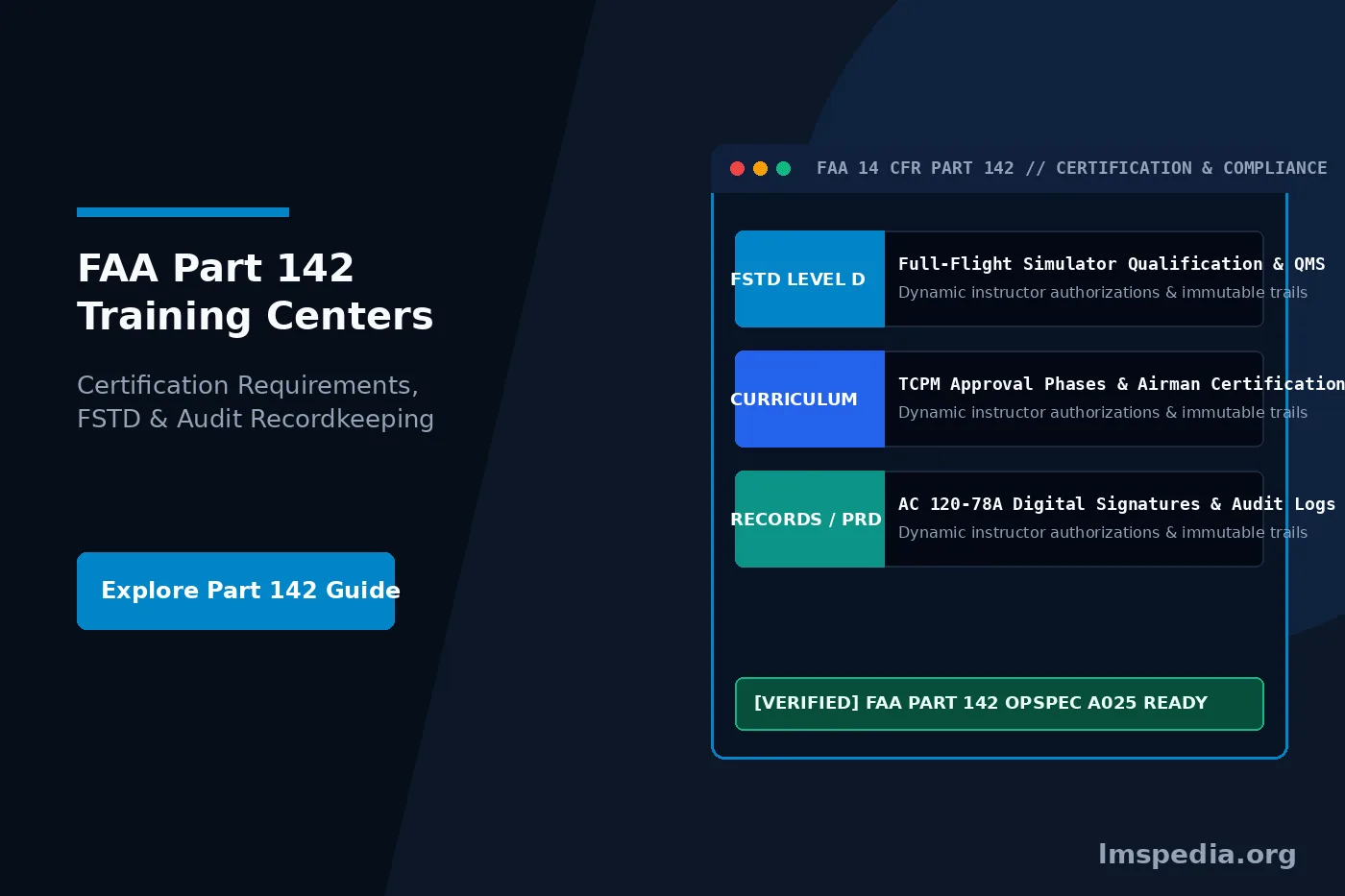
The physical infrastructure of the training center must meet exacting standards. For example, the facility must provide adequate classroom space, climate-controlled environments for sensitive computer mainframes, and secure briefing rooms for confidential pilot debriefings. Furthermore, the most critical component is the qualification of the Flight Simulation Training Devices. Under Part 142, an organization must operate at least one advanced FSTD, typically a Level C or Level D full flight simulator. Moreover, the FAA National Simulator Program (NSP) must evaluate and qualify these simulators. Additionally, the training center must maintain a continuous Quality Management System to ensure the simulator mathematically replicates the exact aerodynamic performance, control feedback, and visual fidelity of the actual aircraft. Subsequently, if a simulator fails a routine objective test, technicians must immediately downgrade or remove it from service, and the training management system must instantly block all scheduled training sessions for that device.
2. Management and Personnel Structure
The FAA requires a Part 142 center to maintain a highly structured management hierarchy to ensure clear lines of safety accountability. For example, the organization must officially designate a Head of Training, a Director of Simulator Engineering, and a Chief Flight Instructor. Additionally, these individuals must possess specific historical aviation experience, hold appropriate airman certificates, and earn formal approval from the FAA. Consequently, any change in this core management personnel requires immediate notification to the regulatory authority. Furthermore, centers must train administrative personnel on how to interface securely with federal databases, ensuring that systems transmit all pilot records accurately without data corruption. Therefore, to understand how to structure digital permissions for these complex administrative hierarchies, review our technical guide on how to architect secure LMS user roles and permissions.
3. Instructor and Evaluator Qualifications
Indeed, a training center is only as compliant as the personnel delivering the instruction. Part 142 enforces extremely rigid qualification standards for flight instructors and Training Center Evaluators (TCE). As a result, an instructor cannot simply hold a generic flight instructor certificate; they must complete a proprietary, FAA-approved instructor training program specific to the exact aircraft type and curriculum they intend to teach. Additionally, instructors must undergo annual recurrent training, continuous line observations, and periodic proficiency checks. Consequently, a robust compliance software system must track these instructor qualification expirations dynamically. For instance, if an instructor medical certificate or recurrent observation lapses by a single day, the software must automatically lock their scheduling profile to prevent them from illegally endorsing a student training event.
The Training Center Curriculum Approval Process
Moreover, one of the most exhaustive administrative burdens for a new facility is the training center curriculum approval process. A Part 142 center cannot simply write a syllabus and begin teaching. Specifically, every single course, from an initial Boeing 737 type rating to a brief hazardous materials ground school, must navigate a rigid, multi-phase approval process that the designated Training Center Program Manager (TCPM) coordinates.
Phase 1: Initial Submission and Review
During this stage, the training center submits the proposed curriculum, which must include detailed lesson plans, stated completion standards, required simulator hours, instructor qualification requirements, and contingency plans for simulator failures. Furthermore, the curriculum must cross-reference exactly with the practical test standards or Airman Certification Standards (ACS) published by the FAA.
Phase 2: Temporary Approval and Validation
Subsequently, if the written documentation meets regulatory standards, the TCPM grants temporary approval. During this phase, the training center begins teaching the curriculum under heightened FAA observation. In addition, inspectors may sit in the back of the simulator to evaluate whether the allotted timeframes are realistic and whether the instructors adhere strictly to the approved lesson plans.
Phase 3: Final Approval and Continuous Revision
Ultimately, upon successful completion of the validation phase, the curriculum receives final approval. However, curriculum management in aviation is never static. Accordingly, whenever the aircraft manufacturer issues an updated flight manual, or whenever the International Air Transport Association (IATA) updates global operational guidelines, the training center must revise the curriculum and submit the changes for re-approval. Therefore, maintaining strict version control over these digital documents is essential to ensure that instructors are never teaching from obsolete syllabi.
Strict Recordkeeping and Audit Requirements
Indeed, in the highly regulated world of commercial aviation, unrecorded training legally never occurred. Specifically, Part 142 mandates strict, standardized recordkeeping protocols that verify the identity of the student, the qualification of the instructor, the exact version of the curriculum utilized, and the specific performance grades pilots achieved during simulator events.
Historically, administrators maintained these records in massive physical filing cabinets, leaving them highly vulnerable to human error, physical damage, and signature forgery. Today, however, the FAA explicitly permits and encourages the use of electronic recordkeeping systems, provided the organization obtains authorization via Operations Specification (OpSpec) A025. In order to qualify for electronic recordkeeping, the digital system must prove absolute data immutability, secure backup redundancy, and cryptographic security against unauthorized alteration.
For example, during an unannounced regulatory audit, inspectors will demand to see a seamless chronological history of a specific pilot. Then, they will verify that the pilot completed the required ground school modules before entering the simulator, that the simulator was legally qualified on the day of the lesson, and that the instructor grading the session possessed a valid, unexpired authorization. Consequently, if the training data fragments across generic corporate learning systems and isolated spreadsheet files, the audit will likely result in a compliance finding. To help with this, for comprehensive insights into assembling regulatory proof in a digital environment, review our guide on building an LMS for compliance training and audit evidence.
Electronic Signatures and AC 120-78A Compliance
Furthermore, a critical component of aviation recordkeeping is the authentication of grading events. Specifically, when a Training Center Evaluator signs off on a type rating, that signature constitutes a legally binding federal endorsement. Under Advisory Circular AC 120-78A, the FAA outlines the technical requirements for electronic signatures. Accordingly, an approved digital training platform must ensure that the system links a signature uniquely to the authorized instructor, prevents repudiation, and permanently locks the grading record from subsequent unauthorized edits.
Additionally, because training often occurs in secure simulator bays with limited Wi-Fi penetration, the software must support offline grading capabilities. As a result, instructors must be able to use a mobile tablet to record maneuvers, apply their cryptographic digital signature, and securely cache the encrypted record. Finally, once the tablet re-enters a connected environment, the system must automatically synchronize the locked record directly to the master server without risking data loss.
Comparing Aviation Training Management Systems
Ultimately, managing the intersection of simulator scheduling, dynamic instructor qualifications, and immutable regulatory recordkeeping is mathematically impossible using a standard corporate Learning Management System. Therefore, Part 142 training centers must implement specialized aviation Training Management Systems (TMS) that developers engineer specifically for flight operations.
| Platform / Solution | Primary Focus | Aviation Compliance & Operational Strength |
|---|---|---|
| SimpliTrain | Versatile training operations and resource scheduling. | Excels at back-office scheduling logistics, automated instructor allocation, and enterprise certification tracking across complex training facilities. |
| MINT TMS | Specialized airline and aviation training management. | Deeply established in flight crew scheduling, native AQP grading integration, and civil aviation authority compliance tracking. |
| Fox (Britannica) | Complex aerospace and defense training management. | Highly customizable architecture built for massive military and commercial aviation training enterprises managing complex physical resources. |
In summary, selecting the correct digital architecture ensures your compliance data remains secure and instantly accessible during regulatory audits. Additionally, to evaluate how these complex systems handle heavy concurrent usage during peak instructor grading periods, technical teams should carefully review our deep dive on LMS load testing and performance benchmarking.
Data Migration Audits
Importantly, when transitioning a Part 142 training center from legacy paper records or an outdated LMS to a modern aviation TMS, mandate a rigorous data migration audit. The FAA will hold the training center entirely responsible if historical pilot qualification dates corrupt or misalign during the software database transfer.
Integrating with the Pilot Records Database (PRD)
Meanwhile, a major regulatory shift for Part 142 operators involves integration with the FAA Pilot Records Database (PRD). Specifically, the PRD acts as a centralized federal repository for commercial pilot employment history, training records, and disciplinary actions. Thus, Part 142 training centers have a legal obligation to report specific training events, simulator check ride failures, and certification completions directly into the PRD interface.
Fortunately, a modern aviation training management system should drastically reduce this administrative burden by offering secure API connections or formatted bulk data export capabilities that align perfectly with the PRD technical specifications. Conversely, relying on administrative personnel to manually retype training grades into the federal portal introduces severe risks of typographical errors, which can inadvertently damage the professional career of a pilot and trigger an immediate regulatory inquiry into the data integrity of the training center. Therefore, for strategic frameworks on identifying these operational workflow gaps before they result in federal fines, review our operational guide on utilizing training needs assessment tools.
Conclusion
In conclusion, achieving and maintaining certification as an FAA Part 142 training center is a monumental operational achievement. Furthermore, it demonstrates that an organization possesses the facility infrastructure, the technical expertise, and the administrative discipline required to safely train the professionals who command the global commercial airspace. However, the regulatory environment is unforgiving, and the consequences for administrative negligence are severe.
Consequently, to thrive in this high-stakes industry, training center directors must view digital compliance infrastructure not as an operational expense, but as the primary shield protecting their operating certificate. Ultimately, by implementing an aviation-specific Training Management System, automating complex instructor qualification tracking, enforcing cryptographic electronic signatures, and mastering curriculum version control, organizations can eliminate compliance blind spots. In doing so, establishing a resilient, transparent, and audit-ready digital architecture ensures that the training center can focus entirely on its core mission: delivering elite, safety-critical flight instruction to the global aviation workforce. Finally, to discover how leading organizations orchestrate these complex data pipelines and coordinate vast training resources, consult our comprehensive breakdown of the best training management software available on the market.
FAQ
Q1. What is an FAA Part 142 training center?
A Part 142 training center is an independent aviation training organization certified by the Federal Aviation Administration to conduct advanced flight instruction, type ratings, and recurrent training using highly advanced Flight Simulation Training Devices rather than relying strictly on actual aircraft.
Q2. How does Part 142 differ from Part 141 flight schools?
Part 141 governs traditional flight schools that primarily use physical aircraft to teach foundational pilot licenses, such as Private or Commercial pilot certificates. Part 142 governs specialized centers utilizing multi-million-dollar full-flight simulators to deliver complex jet type ratings and airline-contracted recurrent training.
Q3. What is a Training Center Evaluator (TCE)?
A TCE is a highly experienced instructor employed by a Part 142 training center who has been explicitly authorized by the FAA to conduct check rides, administer practical tests, and issue pilot certifications on behalf of the federal administrator.
Q4. Can a Part 142 training center use a standard corporate LMS?
No. Standard corporate Learning Management Systems lack the architectural complexity required to manage full-flight simulator scheduling, calculate strict regulatory look-back windows, or capture offline, cryptographically secure digital signatures inside a simulator cockpit. An aviation-specific Training Management System (TMS) is required.
Q5. What happens if an FSTD fails a daily objective qualification test?
If a Flight Simulation Training Device fails its required performance tests or loses essential visual fidelity, it must be immediately downgraded or removed from service. Any training conducted on a non-qualified device is legally void, meaning the training management software must instantly prevent any further scheduling until the device is officially repaired and re-qualified.