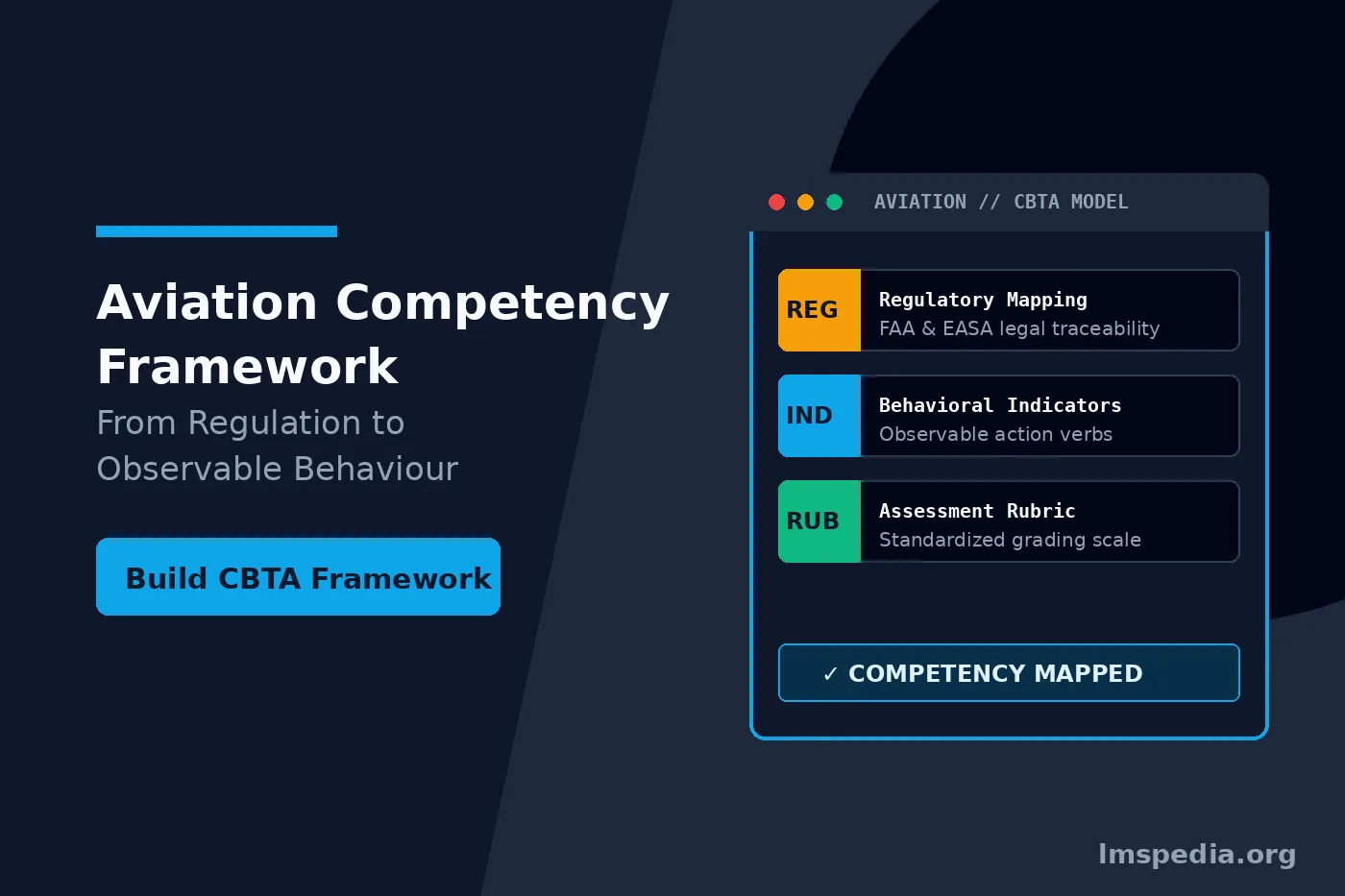
Designing an Aviation Competency Framework: From Regulation to Observable Behaviour
Historically, aviation regulators measured pilot and mechanic proficiency by simply counting logged training hours. However, this traditional approach fails to guarantee actual operational competence. A pilot sitting in a simulator for four hours does not automatically master complex system failures. Consequently, global regulators now mandate a complete shift toward Competency-Based Training and Assessment (CBTA). To implement this shift successfully, training organizations must build a robust aviation competency framework. This framework translates vague regulatory requirements into specific, observable human actions. Modern learning operations require robust digital environments to succeed. Therefore, enterprise leaders must evaluate core training management system features continuously.
Transitioning to a CBTA methodology completely disrupts traditional instructional design. Instead of grading students on a simple pass/fail metric based on multiple-choice exams, instructors must evaluate how effectively trainees apply knowledge in real-world scenarios. Therefore, mastering competency framework design aviation requires deep collaboration between subject matter experts, compliance managers, and instructional designers. In this comprehensive guide, we dissect core elements of a modern competency model airline. Furthermore, we provide actionable templates to build clear behavioural indicators cbta and structure internal assessment rubrics.
Hours Do Not Equal Competence: The aviation industry has shifted from counting logged training hours to Competency-Based Training and Assessment (CBTA) to ensure true operational capability. Use Concrete Action Verbs: Behavioral indicators must use observable verbs (e.g., “states,” “configures,” “identifies”) rather than unmeasurable verbs (e.g., “understands,” “appreciates”).
Standardize Instructor Grading: Implementing a strict 4-point competency assessment rubric prevents subjective grading and ensures standard evaluation across your entire training department. Integrate Human Factors: A complete competency model must actively assess Threat and Error Management (TEM) and non-technical skills, such as fatigue management and crew communication. Digitize for Traceability: Managing CBTA data requires a specialized LMS to track competency progression, trigger remedial training alerts, and secure digital records for regulatory audits.
Key Takeaways

Deconstructing the Aviation Competency Model
Hierarchical Layering of Competencies
An effective framework operates as a hierarchical structure. You cannot evaluate a broad concept like situational awareness directly. Instead, you must break that broad concept down into measurable components. A standard aviation competency model contains three distinct layers: the core competency, behavioral indicators, and assessment conditions.
First, the core competency represents the overarching skill category. Common examples include leadership and teamwork, problem solving, communication, and flight path management. Second, behavioral indicators describe exactly what students say or do to demonstrate that competency. Third, assessment conditions define specific environments where evaluations take place. Standardizing these indicators protects your training program from regulatory audit findings.
Standardize Evaluator Criteria
First, establish clear behavioral rubrics for every simulation scenario. Eliminating evaluator subjectivity prevents inconsistent grading across instructor teams.
Developing Observable Behavioural Indicators
Using Concrete Action Verbs
Writing effective behavioural indicators cbta requires precise language. You must eliminate all vague verbs like understands, knows, or appreciates. Instead, you must utilize concrete action verbs like states, configures, identifies, or delegates. If instructors cannot see or hear actions, they cannot use them as behavioral indicators.
Consider the core competency of communication on flight decks or in maintenance hangars. Stating that mechanics communicate well provides zero grading value. Instead, you must break this down into specific, observable actions. To align these behavioral indicators with legal mandates, maintenance organizations must review parallel frameworks. For example, studying rigorous standards of EASA Part 147 maintenance training organisation approvals helps developers draft indicators satisfying strict European safety mandates.
Building the Competency Assessment Rubric
Once you define observable behaviors, you must provide instructors with standardized grading scales. A well-designed competency assessment rubric prevents grade inflation. Furthermore, it allows organizations to track student progression from novice levels to absolute mastery.
Most aviation organizations utilize 4-point or 5-point grading scales. A standard 4-point CBTA scale generally follows this progression:
Integrating Threat and Error Management (TEM)
Modern competency frameworks must integrate Threat and Error Management directly into grading criteria. Aviation professionals do not operate in sterile, perfect environments. They constantly face external threats like severe weather and internal errors like misreading gauges. A robust aviation competency framework measures how effectively trainees recognize and mitigate these specific issues.
Consequently, your behavioral indicators must assess non-technical skills. Instructors must evaluate how crews manage fatigue, prevent miscommunication, and resist organizational pressure. If maintenance technicians sign off on faulty repairs because dispatchers pressured them, they fail critical competencies. Understanding root causes of these failures requires studying the Dirty Dozen framework of human factors and mapping those risks to assessment scenarios.
Aligning with Global Regulatory Standards
Your framework cannot exist in a vacuum. It must trace directly back to legal requirements published by your specific aviation authority. Whether you operate under Federal Aviation Administration, European Union Aviation Safety Agency, or International Civil Aviation Organization jurisdictions, regulators require absolute traceability. If auditors ask why you assess specific communication skills, you must point directly to underlying regulatory paragraphs.
For example, if you manage domestic repair stations in the United States, your framework must map to specific FAA mandates. You can review exactly how to structure these technical training alignments by studying FAA Part 145 repair station training program requirements. By mapping every behavioral indicator to regulatory codes, you bulletproof your training manuals against audit findings.
Maintain Regulatory Traceability
Always link competency criteria directly to specific civil aviation advisory circulars. Defensible regulatory mapping satisfies unannounced inspector inquiries instantly.
Digitizing the Framework within an LMS
Managing CBTA programs on paper spreadsheets is operationally impossible. Because instructors evaluate multiple competencies across hundreds of simulator sessions, data volumes become massive. Therefore, you must digitize your competency assessment rubric within specialized learning management systems.
When instructors grade sessions on digital tablets, LMS platforms instantly calculate trainee competency matrices. If students score poorly during consecutive simulator sessions, systems trigger automatic alerts to chief instructors. Furthermore, because these records act as legal proof of competence, they require strict digital preservation. Regulators dictate exactly how long you must securely store grading data. To guarantee your digital architecture meets these stringent archiving laws, consult our detailed guide on aviation training records retention requirements. Additionally, verifying compliance documentation through resources like our guide on LMS for compliance training and audit evidence ensures complete institutional readiness.
Securing Competency Data and Access Controls
Digitizing high-stakes assessment data introduces significant cybersecurity obligations. You must absolutely guarantee that only authorized evaluators can input or alter competency grades. If students can access systems and change their own grades, entire operating certificates are compromised.
To prevent unauthorized data manipulation, aviation organizations must implement automated identity management. Relying on manual password resets creates massive security vulnerabilities. Instead, enterprise IT teams deploy strict identity provisioning protocols. When HR promotes co-pilots to captains, central directories automatically upgrade LMS permissions instantly. To understand how to lock down assessment data permanently, review this technical explanation detailing what SCIM is and how it powers identity security.
Advanced Calibration and Data-Driven Remediation
Achieving true assessment standardization requires mandatory instructor calibration sessions. Even with perfect rubrics, human bias inevitably creeps into grading processes. Therefore, training departments must conduct regular normalization workshops where multiple instructors grade identical recorded simulator sessions. Comparing scores aligns expectations and ensures consistent evaluation standards across line stations.
When competency frameworks highlight specific deficiencies, organizations must implement data-driven remediation immediately. Traditional aviation training simply forced students to repeat lessons by rote memorization. Conversely, CBTA models allow instructors to pinpoint exact behavioral failures. Consequently, training departments design customized remedial modules focusing exclusively on cognitive gaps, saving simulator hours.
Furthermore, frameworks must remain living, evolving architectures. Safety management teams must continuously feed real-world operational data directly back into competency models. If line operations reveal systemic weaknesses in automation management, training departments must instantly update behavioral indicators to assess vulnerabilities during upcoming recurrent cycles.
Conclusion
The aviation industry can no longer rely on hours-based training to produce resilient professionals. Transitioning to strict CBTA methodology is the only proven method to ensure pilots, mechanics, and dispatchers handle complex modern operations. Building a rigorous aviation competency framework forms the absolute foundation of this operational shift.
By defining explicit behavioural indicators cbta, eliminating subjective grading through standardized assessment rubrics, and securing data within compliant digital architectures, organizations guarantee continuous operational safety. Ultimately, organizations mastering competency framework design aviation produce the safest, most capable aviation professionals globally.
FAQ
Q1. What is an aviation competency framework?
It is a structured training and evaluation model that breaks down broad aviation skills (like situational awareness or problem-solving) into specific, observable human behaviors that instructors can measure objectively during training.
Q2. What does CBTA stand for in aviation?
CBTA stands for Competency-Based Training and Assessment. It is a regulatory methodology that focuses on evaluating a trainee’s ability to apply knowledge and skills in real-world scenarios, rather than simply passing written exams or logging minimum flight hours.
Q3. What is a behavioral indicator in CBTA?
A behavioral indicator is a specific, observable action that demonstrates a competency. For example, instead of grading if a pilot “is a good leader,” the indicator measures if the pilot “delegates tasks clearly during an emergency.”
Q4. How do instructors grade competencies?
Instructors use a standardized competency assessment rubric, typically ranging from 1 to 4 or 1 to 5. The grade is based entirely on how much instructor intervention is required for the student to complete the task safely.
Q5. Why must an aviation competency framework link to regulations?
Aviation authorities (like the FAA or EASA) require training organizations to prove their courses meet legal safety standards. Mapping your internal competencies directly to regulatory codes provides the necessary legal traceability during safety audits.