HIPAA Security Awareness Training: Requirements, Frequency, and Compliance
Healthcare organizations frequently treat compliance training as a tedious annual checkbox exercise. However, when the Office for Civil Rights initiates an audit following a data breach, a generic sign-in sheet from a recycled video lecture will not protect your organization from seven-figure fines. Auditors do not merely check if training occurred; they actively investigate whether your hipaa security awareness training program directly mitigates realistic cyber threats against Protected Health Information. Building a defensible training architecture requires aligning your instructional design strictly with federal security safeguards. Furthermore, enterprise buyers should cross-reference vendor capabilities against a comprehensive benchmark of core training management system features to avoid functional compliance gaps.
Surviving a regulatory audit requires shifting from passive compliance to active risk management. Your curriculum must address exact vulnerabilities present in modern clinical environments, from ransomware attacks to improper physical access controls. In this comprehensive technical guide, we deconstruct core hipaa training requirements. Furthermore, we outline how to establish correct hipaa privacy training frequency, structure enterprise-grade curricula, deploy role-based learning paths, and bulletproof digital audit trails to withstand intensive federal scrutiny.
Differentiate the Rules: Your program must address both the Privacy Rule (handling physical and operational PHI) and the Security Rule (digital safeguards and ePHI). Move Beyond Annual Training: OCR expects periodic training, including new hire onboarding before EHR access, post-incident remediation, and regular micro-learning security updates. Clinical Relevance is Mandatory: Generic corporate cybersecurity training fails audits. Scenarios must reflect actual clinical environments, such as unlocked tablets in patient rooms or shared nurse station logins. Documentation is Your Legal Shield: Your LMS must capture timestamps, module version histories, exact assessment scores, and digital attestations to prove organizational diligence during an investigation. Automate User Provisioning: Integrate your LMS with your HR directory via SCIM to ensure training assignments update instantly when an employee changes departments or leaves the organization.
Key Takeaways

Deconstructing HIPAA Training Requirements and Liability
The Health Insurance Portability and Accountability Act divides its training mandates into two distinct regulatory frameworks: the Privacy Rule and the Security Rule. Conflating these two rules during curriculum development leaves massive compliance gaps that auditors instantly target during post-breach investigations. Official federal standards published by the U.S. Department of Health and Human Services outline precise administrative safeguards.
The Privacy Rule mandates that covered entities train all workforce members on specific policies concerning Protected Health Information. This training is highly operational. It dictates how nurses discuss patient data in hallways, how receptionists verify identities before releasing records, and how administrators handle medical release authorization forms. Conversely, the Security Rule focuses explicitly on electronic Protected Health Information. It requires a formal security awareness training program for all workforce members, focusing entirely on digital safeguards, password management, and malware defense.
Furthermore, under the HIPAA Omnibus Rule, these training requirements extend directly to Business Associates. Software vendors, cloud hosting providers, and third-party medical billing companies bear direct liability for electronic Protected Health Information breaches. If your hospital utilizes third-party contractors, your vendor management office must verify that those external entities conduct rigorous hipaa security awareness training meeting federal standards.
If your learning management system only delivers broad overview courses, you violate administrative safeguards. You must deploy targeted phi awareness training alongside highly specialized cybersecurity modules. To structure these specific role requirements properly, review our guide on building a GxP training matrix by role.
Establishing the Right HIPAA Privacy Training Frequency
The most common compliance failure involves training frequency. Regulatory text vaguely states organizations must provide training periodically. Consequently, many healthcare providers default to strict once-a-year schedules to minimize operational downtime. However, audit precedents clearly demonstrate annual training alone is legally insufficient.
To establish a defensible hipaa privacy training frequency, your compliance department must enforce a dynamic schedule:
-
New Hire Orientation: The Privacy Rule requires training within reasonable periods after joining workforces. Best practice dictates no employee receives Electronic Health Record access until passing baseline assessments.
-
Post-Incident Remediation: If departments fail phishing simulations or improperly dispose of records, regulators expect immediate, targeted retraining for those groups.
-
Material Change Updates: Whenever organizations upgrade software, alter cloud storage, or modify remote policies, they must push mandatory update training.
-
Monthly Micro-Learning: To combat forgetting curves, leading programs deploy three-minute micro-learning modules monthly to reinforce core security hygiene.
-
Annual Refresher: Comprehensive annual reviews remain mandatory to satisfy periodic requirements, updating staff on federal guidelines and policy shifts.
Enforce Remedial Retraining
First, deploy immediate micro-learning interventions following failed phishing tests. Documenting rapid corrective action proves proactive risk mitigation to federal auditors.
Role-Based Curriculum Customization
A fatal flaw in many compliance programs is deploying single, monolithic training courses for all employees. Cardiovascular surgeons, medical billing specialists, and IT network administrators interact with electronic health data in fundamentally different ways. Federal auditors look for customized training paths reflecting actual daily operational realities.
Clinical Staff: Training for frontline healthcare workers must focus heavily on physical and endpoint security. Scenarios should cover leaving workstations unlocked, discussing patient conditions in hallways, and strict prohibitions against taking clinical photographs on personal smartphones.
Administrative and Financial Staff: Personnel handling medical billing face different threat vectors. Their training must aggressively target social engineering, business email compromise, and spear-phishing attacks. Hackers frequently target these departments to reroute massive financial wire transfers or steal bulk patient identity profiles.
IT and Executive Leadership: System administrators require advanced security training covering server hardening, encryption standards, and rapid incident response protocols. Meanwhile, hospital executives must receive training on legal and financial ramifications of data breaches.
Curriculum Architecture: Combating Shadow IT and Modern Threats
Auditors heavily scrutinize course content. Purchasing off-the-shelf modules designed for corporate retail environments fails audit tests because scenarios lack clinical relevance. Your curriculum must map directly to specific implementation specifications while addressing modern behavioral threats like Shadow IT.
Shadow IT occurs when clinical staff use unauthorized software to streamline patient care. For instance, doctors might use unencrypted messaging groups to share diagnostic images, or nurses might use personal cloud storage for shift schedules. Your training must explicitly forbid these practices and guide employees toward approved, encrypted communication channels.
| Security Rule Standard | Required Curriculum Focus | Audit Survival Evidence |
| SimpliTrain | Automated HIPAA training tracking and role compliance logging. | Streamlines audit readiness and certification audit logs. |
| Security Reminders | Monthly micro-learning updates regarding emerging threats and ransomware tactics. | LMS logs showing consistent deployment and completion of security briefings. |
| Protection from Malware | Identifying suspicious attachments, avoiding unauthorized USB drives, and reporting anomalies. | Correlated data showing employees who failed simulations completed remedial training. |
| Password Management | Creating complex passphrases, utilizing multi-factor authentication, and forbidding password sharing. | Signed digital attestation policies confirming employees understand penalties. |
Every module must feature rigorous assessments. True or false questions do not prove competency. Instead, utilize scenario-based questions forcing learners to apply knowledge. For example, present scenarios where physicians discover unrecognized USB drives on reception desks and ask learners to identify correct corrective actions.
The Lifeline: HIPAA Training Documentation and Data Retention
In the eyes of federal auditors, undocumented training never happened. Meticulous hipaa training documentation serves as your only legal shield during investigations. If rogue employees cause data breaches, documentation proves organizations provided necessary resources and employees acted negligently outside established protocols.
Your Learning Management System must capture five critical data points for every training event:
-
Exact dates and timestamps of course completion.
-
Specific versions of training material presented.
-
Employee digital signatures or authenticated login credentials.
-
Assessment scores proving competency rather than passive attendance.
-
Specific learning objectives covered during sessions.
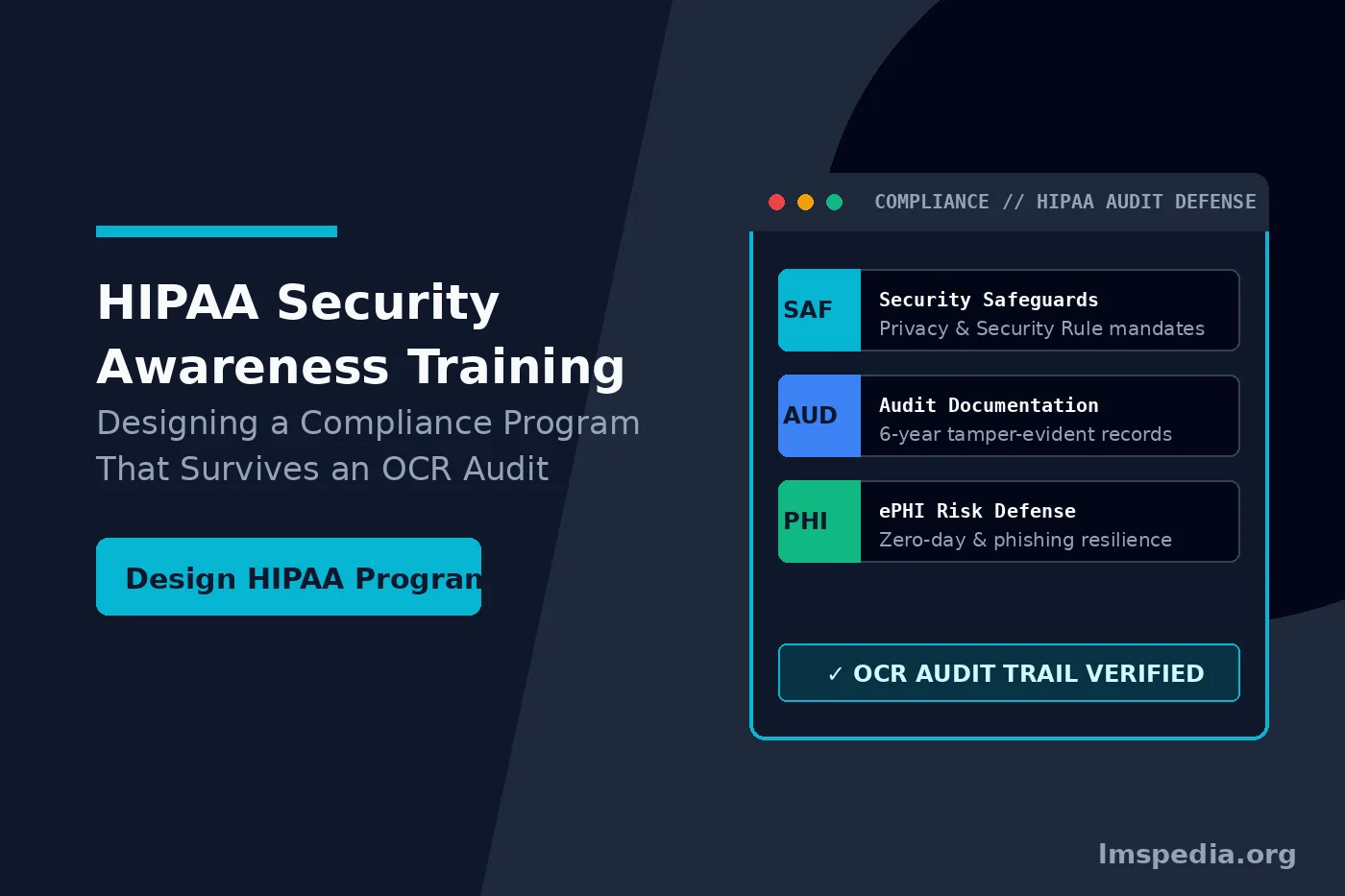
Federal regulations mandate retaining documentation for six years. To scale documentation securely across large hospital networks, your LMS must feature restrictive access controls. Frontline managers need reporting access to view team compliance, but they must not possess ability to alter completion dates. Structuring these permissions correctly is vital. You can review best practices by studying how to architect clear LMS user roles and permissions. Furthermore, robust cryptographic security guidelines from the National Institute of Standards and Technology reinforce corporate data protection standards.
Advanced Remediation and Continuous Calibration
Beyond initial training, robust compliance programs require continuous calibration. When internal clinical audits reveal recurring vulnerabilities, training departments must react instantly. Modern platforms allow administrators to trigger targeted micro-learning modules to specific departments based on operational failures.
If oncology wings exhibit higher click rates on simulated phishing emails, generalized annual training will not solve localized problems. Instead, administrators should deploy targeted remedial content specifically to those units. This surgical approach demonstrates to federal auditors that organizations actively monitor risk and remediate vulnerabilities proactively.
Securing Audit Trails with Enterprise Architecture
Maintaining accurate documentation becomes impossible if user data is corrupted. When nurses transfer departments, training requirements change instantly. If LMS platforms rely on manual data entry, profile updates will lag, resulting in missed departmental training and severe compliance liabilities.
To eliminate vulnerabilities, healthcare IT departments must integrate LMS platforms directly with central HR directories using automated provisioning protocols. Single Sign-On ensures secure authentication, while automated identity management pushes organizational changes in real time. Implementing this architecture guarantees terminated employees lose access instantly and new hires receive mandatory curricula on day one. Review this guide on how SCIM protocols automate secure user provisioning. Furthermore, enterprise software strategies evaluated by analysts at Gartner reinforce platform selection criteria.
Furthermore, managing training rollouts across massive hospital networks requires significant infrastructure planning. IT teams must consult LMS load testing and performance benchmarking protocols to ensure platform stability during compliance surges. Additionally, healthcare networks frequently acquire smaller practices. To manage scaling costs effectively, compliance directors should utilize training demand forecasting to allocate adequate licensing budgets.
Conclusion
When selecting foundational platforms to house sensitive compliance data, organizations must compare enterprise-grade systems capable of handling complex hierarchical reporting. Analyzing structural differences between scalable platforms, such as Open LMS vs Totara Learn, helps compliance officers choose learning engines robust enough to withstand intensive federal scrutiny.
A successful HIPAA security awareness program relies on rigorous systemic integration. By moving beyond generic annual videos, deploying role-specific curricula, enforcing strict documentation protocols, and leveraging automated enterprise software, healthcare organizations transform training departments. Instead of representing vulnerable compliance liabilities, training programs become primary lines of defense against cyber threats and regulatory fines.
FAQ
Q1. What is the difference between HIPAA Privacy and Security Rule training?
Privacy Rule training focuses on the organizational policies surrounding the permitted uses and disclosures of PHI. Security Rule training is a specific awareness program dedicated to protecting electronic PHI against digital threats, malware, and unauthorized system access.
Q2. How often does HIPAA require security awareness training?
HIPAA requires “periodic” training. Best practice dictates mandatory training upon hire (before system access), immediate retraining after security incidents or policy changes, and comprehensive annual refreshers combined with monthly security reminders.
Q3. What must be included in HIPAA training documentation?
Defensible documentation must include the employee’s name, the exact date of completion, the version of the course material used, the assessment score, and a digital attestation confirming the employee understands the policies.
Q4. Can we use generic cybersecurity training for HIPAA compliance?
No. While generic cybersecurity principles apply, auditors look for training that addresses the specific threats and implementation specifications (like log-in monitoring and malicious software protection) required by the HIPAA Security Rule in a healthcare context.
Q5. How long must an organization retain HIPAA training records?
Under HIPAA regulations, covered entities and business associates must retain required documentation, including training records and policies, for a minimum of six years from the date of its creation or the date when it last was in effect, whichever is later.