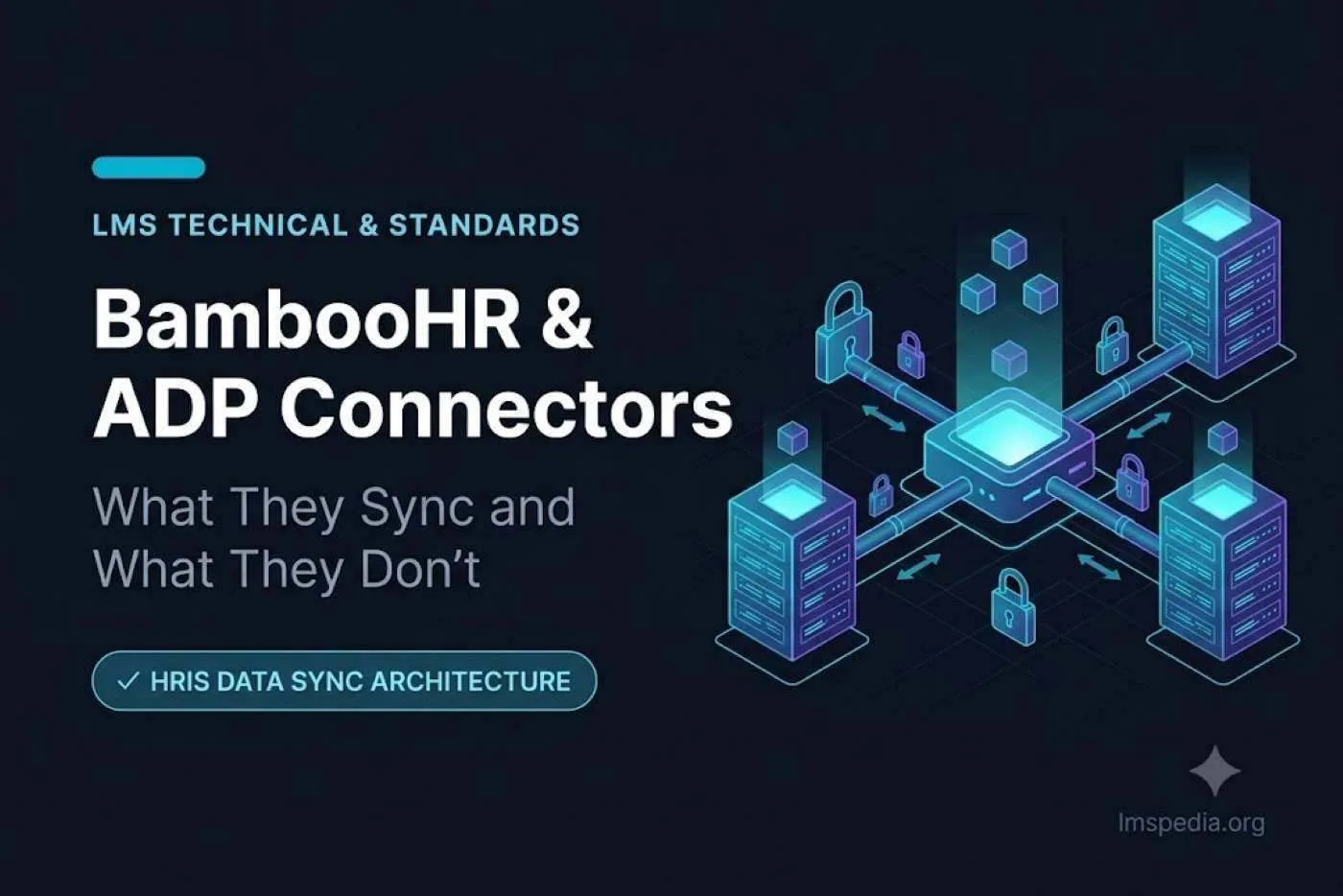
BambooHR and ADP LMS Connectors: What They Sync and What They Don’t
Modern corporate human resources departments rely on automated data pipelines to eliminate administrative friction. Specifically, deploying a dependable bamboohr lms integration ensures that employee directories match downstream learning records without manual file uploads. Human resource leaders often assume that pre-built connectors seamlessly bridge HR management platforms and learning management systems. However, packaged connectors frequently exhibit acute architectural limitations during enterprise operations. While basic worker profiles travel smoothly across API connections, complex organizational reporting structures often break. Consequently, training administrators waste valuable business hours manually correcting missing departments, broken hierarchies, and lost training history. System architects must examine connector capabilities before rolling out automated provisioning workflows. Therefore, organizations must analyze exact data mapping boundaries to prevent severe compliance errors.
Managing disparate employee systems requires transparent synchronization between core records and operational learning tools. Indeed, an effective hr system training sync must handle active onboarding, lateral promotions, and immediate access revocations. When employee data fails to sync, new hires cannot access mandatory compliance training on day one. Additionally, managers cannot view real-time qualification statuses for frontline teams. Forward-thinking companies often evaluate platforms because they deliver flexible API architectures that handle complex employee data models effortlessly. Selecting an enterprise learning system that provides the best LMS HRIS integration support remains critical for long-term scalability. This technical guide investigates API protocols, analyzes data boundaries between BambooHR and ADP, and provides practical troubleshooting frameworks.
Key Takeaways

Core Directory Primacy: BambooHR and ADP must serve as the uncompromised single source of truth; the LMS should ingest worker profiles as read-only data, preventing local overrides from causing sync collisions.
Packaged Connector Blind Spots: Pre-built connectors reliably sync basic demographics (name, email, job code, department), but consistently fail to construct complex matrix management reporting hierarchies ordotted-line supervisor relationships.
Transcript Passback Asymmetry: Most HRIS connectors provide one-way user provisioning; they cannot pass granular course interaction telemetry, quiz scores, or module-level bookmarks back to core HR files.
Defensive Rate-Limit Architecture: High-volume BambooHR API syncs must incorporate exponential backoff algorithms and batch pagination to avoid HTTP 429 throttling errors during enterprise onboarding sweeps.
Event-Driven Resilience via Queuing: Robust ADP integrations utilize event subscriptions paired with dead-letter isolation queues, ensuring malformed individual records never derail broader workforce synchronization jobs.
Architectural Foundations: How HRIS-to-LMS Connectors Operate
Enterprise human capital platforms manage employee identity data across secure, multi-tenant databases. However, different human resource platforms utilize distinct architectural philosophies to expose workforce data. Technical teams must understand these structural foundations before designing automated synchronization pipelines.
BambooHR REST API and Webhook Architecture
BambooHR delivers a straightforward developer interface built around conventional REST design principles. Specifically, developers utilize standard HTTP methods to interact with employee directory objects. The platform organizes worker records through clean JSON and XML payloads. Furthermore, the OASIS Open consortium establishes standard protocols for structured corporate data sharing. When an administrator adds an employee, BambooHR can dispatch real-time outbound webhooks to third-party endpoints. Developers explore these workflows using webhooks versus polling versus iPaaS architectures to balance network latency against system load. Consequently, modern learning platforms can ingest newly created employee files within seconds. However, technical leads must configure secure secret keys to verify incoming webhook authenticity. Verifying payload signatures ensures that external attackers cannot inject fraudulent employee profiles into corporate learning platforms.
ADP Marketplace and OpenID Connect Ecosystem
ADP operates a highly regulated, enterprise-grade cloud ecosystem through the ADP Marketplace. Specifically, configuring an adp lms connector requires navigating ADP’s federated identity framework. The Internet Engineering Task Force formalizes modern authentication under RFC 6749 and related identity specifications. ADP utilizes OpenID Connect alongside OAuth 2.0 to protect employee data across partner applications. Furthermore, an adp workforce now integration demands formal consent authorization from company account administrators. Once authorized, partner connectors query dedicated worker endpoints using encrypted API tokens. System administrators must understand how to manage OAuth scopes and tokens for LMS integrations to prevent expired credential outages. Unlike simpler REST environments, ADP enforces strict governance models across every published marketplace app.
Unifying Core Directories and Downstream Systems
Establishing an enterprise architecture requires designating authoritative data boundaries between platforms. Specifically, the core HR system must always serve as the primary source of truth for worker identity. Learning management platforms must ingest this incoming information as read-only attributes. If a local training coordinator edits a user department inside the LMS, the next automated sync will overwrite that change. Technical leaders frequently reference a dedicated LMS API integration guide for HRIS platforms to structure unidirectional data flows. Additionally, enterprise teams compare these lightweight sync pipelines against complex Workday to LMS integration architecture designs when assessing technical maturity. Maintaining clear administrative authority prevents data corruption across enterprise systems.
Advanced Technical Strategy: Signature Validation
Always implement cryptographic signature verification on incoming BambooHR webhook payloads. Validate the secret hash before parsing employee data to protect your learning environment from unauthorized injection attacks.
What Actually Syncs: Core Data Models and Identity Mapping
Packaged connectors automate basic administrative tasks by synchronizing essential demographic fields. When an organization provisions new accounts, standard field mappings populate student accounts instantly. Understanding which fields transfer smoothly allows administrative teams to plan automated course assignments accurately.
Standard User Attributes and Profile Ingestion
Basic demographic attributes transfer reliably across both BambooHR and ADP API integrations. Specifically, connectors ingest first names, last names, corporate email addresses, and unique employee identification numbers. Furthermore, connectors track employment status flags to determine platform access eligibility. When a worker transitions from active to terminated status in HR, the connector immediately suspends their LMS profile. Suspending profiles revokes platform login permissions while preserving historical training transcripts. Organizations often automate this provisioning layer using standardized SCIM provisioning for LMS protocols. System administrators also weigh the differences between just-in-time provisioning versus SCIM to balance directory synchronization timing. Standard demographic mapping eliminates repetitive user creation tasks for human resource coordinators.
Organizational Taxonomies, Job Titles, and Cost Centers
Enterprise learning assignments rely heavily on organizational categorization to route relevant coursework. Fortunately, both platforms map core business metadata into downstream learning profile fields. Specifically, connectors sync assigned job titles, home departments, physical office locations, and operational cost centers. When an employee transfers from customer service into field operations, the connector updates their departmental tag automatically. Consequently, modern LMS platforms trigger new curriculum enrollments based on these updated organizational attributes. Organizations routinely reduce training admin time through automation by linking dynamic user groups to incoming HR departmental tags. Automating role assignments guarantees that workers receive appropriate technical training without administrative oversight.
Automated Group Rules and Dynamic Learning Paths
Modern learning management systems utilize dynamic audience engines that evaluate incoming HR attributes continuously. Specifically, administrators build logical enrollment rules based on synchronized job codes and facility locations. For instance, an audience rule can specify that all workers with the warehouse technician title must complete equipment safety modules. When the HR connector imports a new warehouse hire, the learning platform executes the assignment rule instantly. Furthermore, dynamic audience rules re-evaluate user profiles whenever incoming API payloads reflect a promotion or transfer. If a worker transitions to management, the platform unenrolls them from operational tasks and assigns supervisory courses. Leveraging synchronized metadata ensures continuous compliance across shifting workforce populations.
Operational Best Practice: Unique Identifier Anchoring
Anchor your LMS user accounts exclusively to the immutable HR employee ID rather than corporate email addresses. Employees frequently change their names or email handles, but employee IDs remain permanent throughout their corporate tenure.
The Synchronization Blind Spots: What BambooHR and ADP Cannot Sync
Software vendors rarely highlight operational limitations when advertising turnkey marketplace integrations. In reality, significant functional blind spots exist between HR databases and learning platforms. Technical teams must prepare alternative operational strategies to handle data that packaged connectors cannot synchronize.
Dynamic Management Hierarchies and Matrix Reporting
Reporting line mapping represents one of the most frustrating failures in packaged HR connectors. While connectors can ingest an employee’s direct manager name, they struggle to construct functional managerial hierarchies inside the LMS. Specifically, packaged connectors rarely populate managerial escalation chains that grant supervisors visibility over team compliance. Furthermore, modern enterprises frequently utilize matrix management structures where workers report to multiple functional project managers. Neither the standard BambooHR nor ADP packaged connector accommodates secondary or dotted-line managers cleanly. Consequently, project leaders cannot track required safety certifications for their extended operational teams. Teams managing complex global directories often reference SAP SuccessFactors to LMS integration models to study advanced hierarchical mapping patterns.
Granular Course Progress vs. Binary Completion Flags
Corporate executives frequently expect training data to flow backward into central employee files automatically. However, standard connectors provide severely limited outbound synchronization capabilities. While an LMS tracks granular instructional telemetry, the HR platform only records high-level outcomes. Specifically, connectors cannot pass module-level progress, individual quiz scores, or video completion percentages back to core HR. At best, an adp lms connector returns a binary completion timestamp once a worker finishes an entire curriculum. Consequently, HR business partners cannot diagnose where learners encounter friction inside multi-part courses. Additionally, organizations must implement dedicated solutions for automating certificates and transcripts directly within the LMS to provide verifiable completion proof. Relying exclusively on HR records leaves corporate leaders blind to actual workforce learning progression.
Multi-Entity Tenant Separation and Regional Data Silos
Global corporations frequently manage multiple operating subsidiaries through distinct legal entities. Unfortunately, packaged HR connectors typically bind an entire LMS instance to a single corporate account. If an enterprise operates three distinct corporate legal entities inside ADP, the connector cannot route users into isolated LMS sub-tenants easily. Consequently, administrators must build manual data staging tables to segregate regional staff. Furthermore, transmitting employee records across regional borders triggers intense data privacy regulations. The National Institute of Standards and Technology publishes rigorous guidelines for protecting sensitive employee personally identifiable information. Organizations must maintain strict training data security and GDPR compliance when transferring personal data between cloud platforms. Packaged connectors rarely provide the granular field encryption required for strict multinational data sovereignty.
High-Risk Warning: Custom Field Ingestion
Do not assume standard connectors sync custom user attributes automatically. Custom fields created in BambooHR or ADP always require manual API schema mapping inside your integration middleware to avoid dropping critical metadata.
Technical Execution: APIs, Webhooks, and Error Governance
Maintaining a reliable integration pipeline requires active technical governance and error handling. High-volume employee transfers, network timeouts, and schema modifications can destabilize automated synchronization schedules. Technical teams must implement defensive monitoring to catch operational failures before data corruption spreads.
Managing BambooHR API Rate Limits and Throttling
Cloud infrastructure providers implement rate limiting to protect their web servers from excessive traffic. Specifically, executing bamboohr api training calls requires adhering to strict concurrency thresholds. BambooHR enforces an operational ceiling of approximately one hundred requests per minute across standard API keys. When an enterprise initiates a massive overnight directory synchronization, the learning system can exceed this limit rapidly. Consequently, the BambooHR gateway returns an HTTP 429 Too Many Requests response code. If the LMS integration script lacks retry logic, the entire synchronization halts midway through the employee directory. Developers must incorporate exponential backoff algorithms and batch pagination requests into their integration clients. Managing request velocity ensures uninterrupted synchronization during high-volume corporate onboarding cycles.
ADP Event Notifications and Subscription Management
Unlike simple polling scripts, modern ADP enterprise integrations utilize event-driven push notifications. Specifically, developers subscribe to ADP Worker Event notifications to receive real-time updates regarding employee lifecycle changes. When an HR specialist terminates an employee in ADP, the event service dispatches an immediate notification payload. Next, the LMS integration endpoint ingests the event and suspends the corresponding user profile instantly. However, maintaining event subscriptions requires continuous technical monitoring. If an enterprise integration endpoint drops offline during network maintenance, unprocessed event notifications accumulate inside ADP message queues. Integration developers must configure automated reconciliation jobs that periodically sweep for missed events. Routine reconciliation ensures that temporary network outages never create persistent data discrepancies.
Data Hygiene and Resolving Schema Mismatches
Data schema drift represents a persistent operational challenge in human resource systems integration. HR administrators regularly modify internal department codes, update job titles, or add custom dropdown selections inside core HR. If the downstream learning platform expects standardized alphanumeric strings and receives unexpected special characters, synchronization breaks. System administrators must inspect recurring patterns in HRIS data sync issues to resolve mapping mismatches rapidly. Building an intermediate validation layer catches malformed records before they enter the production LMS database. Furthermore, systems should quarantine failed records into dedicated inspection logs while allowing valid records to proceed. Proactive data hygiene safeguards enterprise training operations against unexpected schema modifications.
LMS Comparison for HRIS Connector Resilience
Enterprise buyers must evaluate prospective learning systems based on real-world integration capabilities. Selecting the wrong software architecture leads to expensive custom middleware development and continuous manual intervention. The comparative matrix below evaluates three prominent learning solutions across crucial HRIS connectivity and data governance dimensions.
| Evaluation Criteria | SimpliTrain | Cornerstone OnDemand | Docebo |
| Core HRIS Strategy | Native API-first architecture with pre-built bi-directional connectors for BambooHR, ADP, and custom HRIS endpoints. | Enterprise integration studio relying on complex packaged connectors, flat-file SFTP bridges, and middleware consulting. | Cloud connect framework featuring modular marketplace connectors and standard webhook recipe integrations. |
| Manager Hierarchy Ingestion | Automated multi-tier and matrix manager tree mapping with dynamic approval routing and team dashboard access. | Robust organizational unit hierarchy modeling; requires extensive technical configuration during implementation. | Standard direct manager sync; matrix reporting lines require custom user fields and manual audience segmentation. |
| Rate-Limit Handling & Retries | Built-in exponential backoff algorithms and automated dead-letter queues for seamless API rate-limit resilience. | Enterprise batch scheduling that processes records during off-peak windows to bypass standard API throttles. | Standard webhook retries; high-volume bulk synchronizations can encounter API gateway throttling issues. |
| Custom Field Mapping | Dynamic visual field mapper supporting real-time schema discovery and instant transformation rules. | Extensive enterprise custom field capabilities requiring certified technical consultants to adjust. | Self-service custom field configuration supporting standard string, date, and dropdown HR attributes. |
| Deployment Complexity | Fast-track deployment operational within days; requires minimal IT engineering overhead to maintain. | Lengthy enterprise implementation cycles often spanning several months of professional service engagements. | Modular setup requiring intermediate technical knowledge to configure webhook endpoints and web services. |
Selecting an ideal platform depends heavily on your organizational architecture and internal technical capacity. Mid-sized enterprises often lack dedicated software development teams to build custom integration bridges. Consequently, platforms offering native, self-healing connectors deliver immense operational value. Conversely, massive global conglomerates may prioritize legacy enterprise suites that support complex on-premise infrastructure. Regardless of platform choice, technical leaders must confirm that the system handles dynamic organizational hierarchies without manual maintenance.
Implementation Blueprint: Deploying and Testing HR Connectors
Deploying an automated HRIS connector requires methodical planning, structured sandbox validation, and disciplined cutover protocols. Technical teams should execute integration projects through a phased deployment framework. Adhering to structured milestones eliminates data loss and ensures uninterrupted employee access.
Phase 1: API Provisioning and Sandbox Configuration
Implementation begins with secure administrative provisioning inside both host environments. First, administrators generate dedicated API credentials with restricted permissions in BambooHR or the ADP Marketplace. Security leads must ensure that the service account accesses only the minimum required employee fields. Next, developers configure a non-production sandbox environment that mirrors production data structures. Connecting sandbox systems allows technical teams to test API calls safely without impacting active employee records. Furthermore, engineers must verify that OAuth redirect URLs and cryptographic certificates function properly. Establishing a pristine sandbox foundation ensures that subsequent data tests yield accurate operational insights.
Phase 2: Roster Reconciliation and Field Mapping Audits
Before enabling automated sync routines, technical teams must perform an exhaustive data hygiene audit. Specifically, coordinators must compare current HR rosters against existing user accounts inside the LMS. Identify and resolve duplicate employee profiles, outdated email addresses, and conflicting employee identification numbers. Next, map every required LMS attribute to its corresponding source field in the HR database. Pay special attention to custom attributes, such as regulatory job roles and professional license categories. Validating field mappings prevents downstream enrollment automation from misinterpreting user qualifications. Once the data audit concludes, execute a test synchronization containing fifty diverse employee profiles. Verify that each test profile populates correctly before proceeding to enterprise cutover.
Phase 3: Production Cutover, Dead-Letter Queues, and Monitoring
The final implementation phase transitions the integration pipeline into live production operations. First, schedule the initial enterprise baseline synchronization during off-peak weekend hours. Monitor API response times, memory consumption, and data transfer rates continuously throughout the initial run. Next, configure automated dead-letter queues to catch any employee records that fail validation checks. If an individual record fails due to a missing postal code or invalid character, the system isolates it without halting the broader batch. System administrators should configure automated alerts that notify operations teams whenever quarantine queue depths exceed established thresholds. Establishing proactive monitoring guarantees that technical teams resolve synchronization anomalies before employees experience access disruptions.
Conclusion: Constructing an Unbroken HRIS-to-LMS Data Flow
Automating workforce data synchronization represents a foundational milestone in modern enterprise learning operations. Relying on manual spreadsheet uploads or fragmented administrative workflows introduces unacceptable compliance risks and operational delays. By implementing robust connectors between central human resource directories and operational learning platforms, organizations establish pristine data integrity. Core employee attributes flow continuously into learning environments, granting newly onboarded personnel immediate access to essential safety and compliance curricula.
Furthermore, technical leaders must remain vigilant regarding the operational limitations of packaged connectors. Recognizing synchronization blind spots around matrix reporting lines, custom fields, and granular transcript passback enables teams to design effective architectural workarounds. Investing in modern API architectures, implementing defensive rate-limiting controls, and establishing proactive error monitoring protects systems against operational disruption. Ultimately, an integrated human capital and learning technology ecosystem empowers organizations to maintain rigorous compliance, elevate employee development, and scale training operations with absolute confidence.
FAQ
What employee data fields sync automatically between BambooHR and an LMS?
Standard connectors reliably sync core demographic and organizational fields, including employee ID, first name, last name, work email address, employment status (active/terminated), job title, department, office location, and cost center.
Can an ADP LMS connector pass training completion certificates back into ADP?
Most standard ADP connectors pass only high-level binary completion records (course title and completion date) into the employee’s central profile. They cannot transfer granular data such as PDF certificates, individual test scores, or module progress; organizations must issue and archive certificates directly inside the LMS.
What happens to an employee’s LMS training history when they are terminated in BambooHR?
When an employee is terminated in BambooHR, the automated connector updates their LMS profile status to suspended or inactive. This revokes platform login permissions and cancels upcoming course enrollments while permanently preserving historical transcripts and compliance audit logs.
Why do BambooHR API integrations occasionally fail during large overnight synchronizations?
Failures typically occur because the synchronization script exceeds BambooHR’s API rate limit (typically around 100 requests per minute). Without exponential backoff retry logic, the server returns an HTTP 429 error, which halts the sync job.
Can BambooHR or ADP connectors map dotted-line or matrix managers into the LMS?
Standard packaged connectors almost universally fail to map matrix or dotted-line reporting relationships. They sync only the primary direct manager assigned in the core HR profile. Supporting matrix management requires custom API middleware or advanced audience rules configured directly inside the LMS.