Aviation Security Training (AVSEC): ICAO Annex 17 Standards and Compliance
Global aviation operations face persistent security threats today. Safeguarding international civil aviation requires rigorous operational discipline across all borders. The International Civil Aviation Organization establishes strict global security standards. Aviation security developed reactively following major unlawful interference incidents. Proactive international training frameworks ensure rapid threat detection worldwide. Fulfilling mandatory AVSEC training requirements remains an absolute operational necessity. Furthermore, enterprise buyers should cross-reference vendor capabilities against a comprehensive benchmark of core
training management system features to avoid functional compliance gaps.
Airlines and airport authorities must prove baseline competency for every credentialed employee. Non-compliance invites severe federal penalties, revoked operating certificates, and dangerous vulnerabilities. In this guide, we examine international training mandates under global treaties. Modern aviation organizations maintain permanent audit readiness through structured digital systems.
Key Takeaways

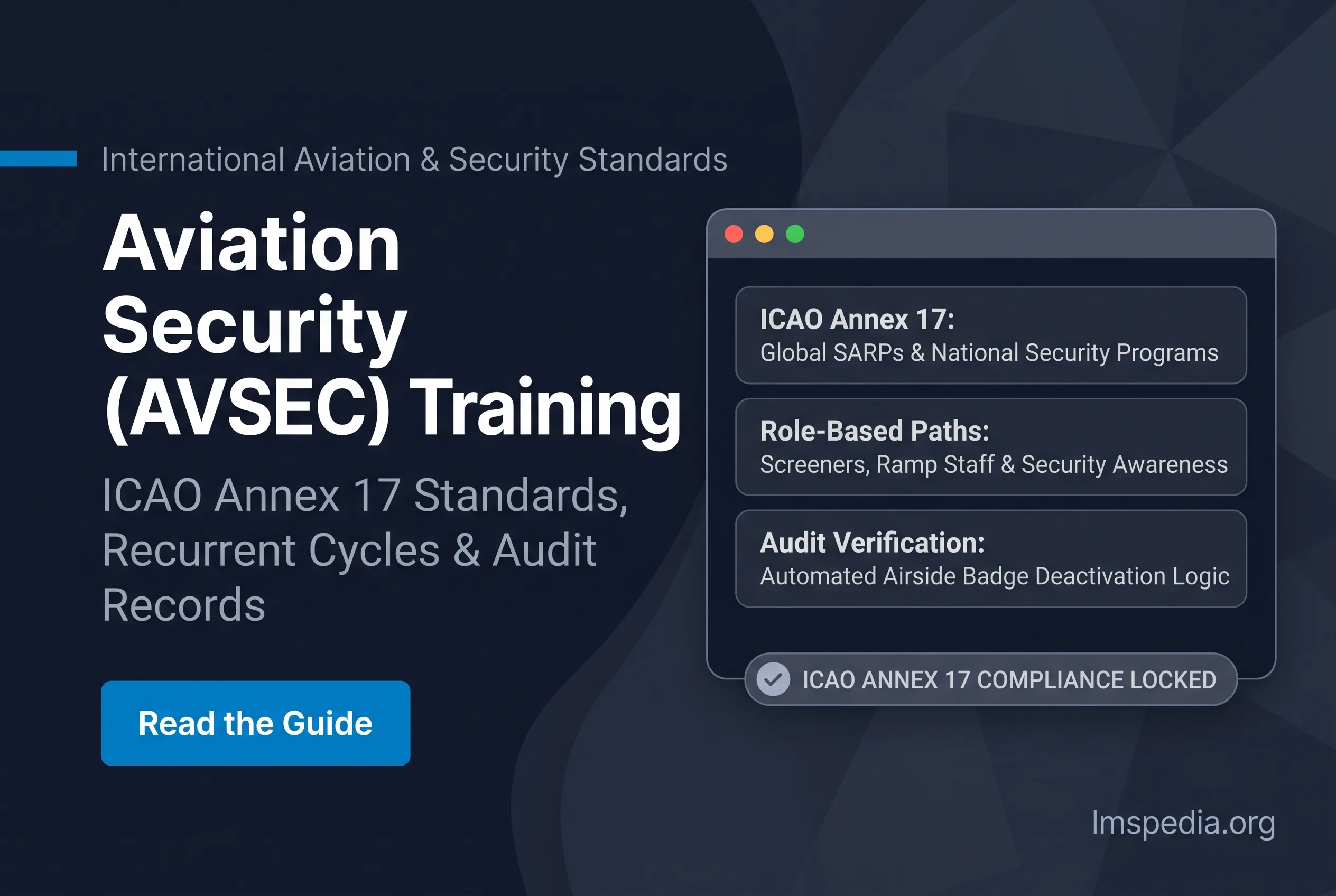
Annex 17 Establishes Global Standards: ICAO Annex 17 legally obligates contracting states to develop National Civil Aviation Security Programs, standardizing baseline security requirements across airports worldwide.
Training Must Align with Operational Roles: Aviation security instruction requires role-specific pathways, including specialized X-ray screening for officers, ramp security for handlers, and general situational awareness for retail staff.
Recurrent Training Defeats Skill Decay: Because human cognitive vigilance naturally degrades over time, mandatory recurrent training cycles and simulated threat image projections are essential to maintain screening proficiency.
Records Serve as the Burden of Proof: In regulatory administrative law, unrecorded training never occurred; institutions must maintain immutable, timestamped digital records to survive unannounced state security audits.
Software Must Integrate with Physical Badging: Enterprise training systems should communicate bidirectionally with airport access control databases, automatically deactivating security badges when certifications expire.
Understanding ICAO Annex 17 and Global Security Standards
ICAO Annex 17 serves as the bedrock of global aviation security. The document outlines international standards and recommended practices for member states. All signatory nations must translate these global rules into statutory domestic law. The primary objective is protecting passengers, flight crews, and ground infrastructure. Participating states establish detailed national security programs governing every airport operator.
The treaty requires every state to establish a National Civil Aviation Security Program. This domestic framework legally binds airlines, airport operators, and air cargo providers. Each distinct entity must maintain an approved internal training program. For official regulatory documentation, consult the formal
ICAO Annex 17 security standards portal. International harmonization prevents hostile actors from exploiting weaker regional screening checkpoints.
The Mandate for Structured ICAO Annex 17 Training
Airport operations relied on fragmented, localized security instructions historically. Modern treaties require structured training for all aviation personnel. Standard operating procedures must align precisely across domestic and international airports. A security officer in London applies identical baseline principles as an officer in Tokyo. Standardized training establishes an unyielding global defense perimeter.
Standardized instruction ensures rapid interoperability during sudden international crisis situations. Multinational task forces coordinate joint security responses without administrative confusion. This structural alignment elevates global aviation resilience significantly. Unified training standards eliminate critical communication gaps across international borders. Establishing robust
aviation training records retention protocols guarantees institutional readiness.
National Quality Control and State Oversight
Annex 17 mandates continuous quality control oversight from civil aviation authorities. State regulators inspect airports using the Universal Security Audit Programme. Government inspectors conduct unannounced security audits, practical tests, and record reviews. Commercial operators must maintain complete, auditable proof of staff qualification.
Domestic authorities possess legal powers to levy massive civil financial penalties. Regulatory bodies will suspend terminal operating licenses if staff training lapses. Rigorous internal oversight represents the single most effective legal shield against regulatory sanctions. Institutional compliance remains a daily operational priority.
Core AVSEC Training Requirements by Personnel Category
Aviation security responsibilities vary widely across diverse airport operational departments. Baggage screeners require entirely different competencies than ramp baggage handlers. Standard regulations demand customized educational pathways for each distinct job description. Administrators cannot deploy generic training courses to all staff members. Establishing proper compliance tracking aligns with our guide on
LMS for compliance training and audit evidence.
Dedicated security officers require rigorous technical instruction and initial certification. Screeners must master complex X-ray image interpretation and threat identification algorithms. Officers demonstrate flawless proficiency in physical pat-down searches and explosive trace detection. Their training includes extensive simulator hours using computer-based threat image projection.
Screening Personnel and Technical Competency
Screeners pass periodic practical recertification examinations to maintain active credentials. Testing verifies officer ability to detect concealed firearms, knives, and improvised explosives. Failure to detect simulated threats triggers immediate operational suspension and mandatory retraining. Continuous screener competency testing protects access control boundaries directly.
Utilizing a structured
training scheduling system coordinates complex screener rotation calendars smoothly. Automated scheduling prevents qualification lapses during high-volume travel seasons. Rigorous testing standards elevate baseline security performance across terminals.
Ground Handling and Airside Access Staff
Ramp operators, refuelers, and baggage handlers operate in sensitive airside zones. These workers interact directly with commercial aircraft on active airport aprons. Ramp staff undergo comprehensive airside security training prior to badge issuance. Ground teams learn vehicle checkpoint inspection rules and challenge procedures.
Baggage handlers understand hold luggage security screening workflows thoroughly. They identify unauthorized luggage tampering and irregular baggage tags immediately. Vigilant ramp personnel prevent illegal contraband smuggling into aircraft cargo holds. Furthermore, structuring team permissions correctly requires insights on
architecting clear LMS user roles and permissions.
Security Awareness Training for Airport Personnel
General commercial airport workers require baseline educational courses. Janitorial crews, retail cashiers, and restaurant employees work within public terminal halls. Implementing comprehensive security awareness training turns non-security staff into active observers. Employees learn to identify unattended luggage and unusual loitering patterns.
Awareness training details explicit, rapid emergency reporting protocols for airport staff. Workers learn how to notify operations centers without alarming traveling passengers. Trained commercial tenants expand terminal surveillance coverage beyond dedicated police units. Utilizing tools aligned with
modern training needs assessment protocols helps agency leaders quantify requirements.
Flight Crew and In-Flight Security Measures
Airline pilots and cabin crew members represent the final physical line of defense. Flight crews complete mandatory aviation security courses covering unruly passenger management. Flight attendants master verbal de-escalation strategies and physical restraint methodologies. These techniques enable crews to subdue aggressive passengers safely without diverting aircraft.
Pilots receive specialized instruction regarding secure flight deck door operational protocols. Training mandates strict door access procedures to prevent unauthorized cockpit entry. Rigorous crew training ensures total control inside pressurized commercial aircraft cabins.
Regulatory Audit Best Practice
Civil aviation inspectors verify training records against airport security badge databases. Your software must automatically revoke airside access badges the instant an employee security certification expires.
Architecting an Aviation Security Training Program
Developing an enterprise-grade security training program requires meticulous pedagogical planning. Instructional designers translate dense legal mandates into engaging, practical educational courses. Organizations implement structured instructional systems design methodologies to achieve compliance. Curriculum development begins with an exhaustive organizational threat assessment.
Training departments establish clear, measurable operational performance indicators for every module. Learning objectives define exact observable behaviors during realistic security emergencies. Structured instructional design guarantees tangible behavioral improvements across airport staff. Evaluating enterprise platform scalability through
Open LMS vs Totara Learn helps technical teams compare multi-tenant structures.
Hybrid Instructional Delivery and Threat Intelligence
Modern aviation training combines multiple educational delivery modalities to maximize retention. Foundational legal theory deploys efficiently through computer-based training modules. Classroom lectures provide deep theoretical context regarding explosive characteristics and human psychology. Self-paced digital learning frees up valuable classroom time for instructor-led discussion.
Security curriculums adapt dynamically to evolving real-world geopolitical threat landscapes. Training directors incorporate declassified intelligence briefs into recurring instructional materials. Courseware updates regularly address emerging cyber-physical threats, drones, and 3D-printed weapons. Intelligence-led instructional design keeps frontline screening personnel prepared against sophisticated adversaries.
Managing Recurrent Training Cycles and Combating Skill Decay
Human cognitive performance and vigilance degrade over time without regular reinforcement. Security officers who rarely encounter prohibited items become susceptible to visual fatigue. International aviation security treaties mandate recurring refresher courses for all badge holders. Maintaining scheduled recurrent training cycles represents an indispensable operational requirement.
Automated tracking systems prevent high-volume employee cohorts from missing mandatory deadlines. Training managers track varied recurrent intervals across multiple distinct departmental teams. Systematic recurrent education ensures procedural compliance remains consistent throughout careers. Furthermore, enterprise software strategies evaluated by analysts at
Gartner reinforce platform selection criteria.
Digital Recordkeeping, Evidence Collection, and Audit Defense
Executing world-class security training means nothing if an organization cannot prove it. In regulatory administrative law, unrecorded training legally never occurred. Aviation authorities maintain zero tolerance for missing, incomplete, or disorganized training records. Enterprise organizations implement modern digital software platforms to manage compliance data.
Digital recordkeeping eliminates severe risks inherent to physical paper filing systems. Paper documents are vulnerable to physical misplacement, coffee spills, and fire damage. Centralized digital databases ensure immediate, secure document retrieval during unexpected government inspections.
| Platform / Solution |
Primary Focus |
AVSEC Compliance Strength |
| SimpliTrain |
Versatile training operations and compliance scheduling. |
Excels at automated recertification tracking, credential gatekeeping, and audit-proof digital record reporting. |
| Comply365 |
Aviation operations and regulated document distribution. |
Delivers mobile compliance tracking, secure manual distribution, and flight crew curriculum delivery. |
| SafetySkills |
Industrial safety and broad environmental e-learning. |
Offers commercial microlearning modules focused on occupational safety and basic facility hazard awareness. |
Building a Sustainable Security Culture
True aviation security extends far beyond simple administrative checklists and annual exams. Software systems and legal mandates provide necessary structure, but human vigilance prevents attacks. Aviation leaders must cultivate an organizational culture that prioritizes security daily. Every employee feels personally responsible for safeguarding passengers and ground infrastructure.
Organizations establish confidential, non-punitive incident reporting systems for all staff. Employees report suspicious activities and honest mistakes without fear of termination. Safety directors identify and correct procedural vulnerabilities before adversaries exploit them. Combining comprehensive training, modern software, and positive security culture guarantees unmatched international aviation safety. For continued professional insights, explore
the LMSPedia blog archive.
Conclusion
Compliance with international standards protects passengers and critical infrastructure globally. Structured training programs eliminate communication gaps across international borders. Automated digital recordkeeping systems ensure permanent audit readiness during sudden state inspections. Maintaining rigorous training standards safeguards commercial aviation integrity.
Q1. What is ICAO Annex 17, and why is it legally binding for airports?
Fundamentally, ICAO Annex 17 is an international treaty annex containing mandatory Standards and Recommended Practices for civil aviation security. Specifically, when sovereign nations ratify the Chicago Convention, they commit to translating these global standards into domestic law. Consequently, domestic regulators like the FAA enforce these rules directly upon commercial airlines and airport operators. Ultimately, compliance is non-negotiable for any facility operating international flights.
Q2. Who must complete aviation security training at a commercial airport?
Primarily, every single individual granted unescorted access to security-restricted airside areas must complete approved aviation security training. Specifically, this includes security screeners, commercial pilots, flight attendants, ramp baggage handlers, and maintenance technicians. Furthermore, non-operational personnel such as retail workers, janitors, and restaurant staff must complete mandatory security awareness training before receiving airport identification badges.
Q3. How often must aviation personnel complete AVSEC recurrent training?
Typically, international regulations require frontline screening officers to complete formal recurrent training every twelve months. Furthermore, general airport personnel and airline flight crews renew their security certifications on a twelve-to-twenty-four-month cycle depending on domestic state regulations. Consequently, automated compliance software issues advance notifications to ensure employees recertify before their security credentials expire.
Q4. What specific training records must an airport produce during an audit?
During an official inspection, administrators must produce verified student attendance logs, exact completion timestamps, quiz scores, and active instructor credentials. Furthermore, inspectors review the specific curriculum syllabi and course version history used during instruction. Ultimately, modern digital training management software preserves these records in tamper-proof formats, allowing operators to generate comprehensive compliance exports instantly.
Q5. Can an airport use a generic corporate LMS for AVSEC training compliance?
Typically, generic corporate learning management systems struggle to handle the specialized requirements of aviation security. Specifically, standard HR platforms lack native integrations with physical airport access control systems and automated badge deactivation triggers. Therefore, aviation organizations require specialized training management systems capable of handling complex recurrent recertification workflows and immutable regulatory audit trails.