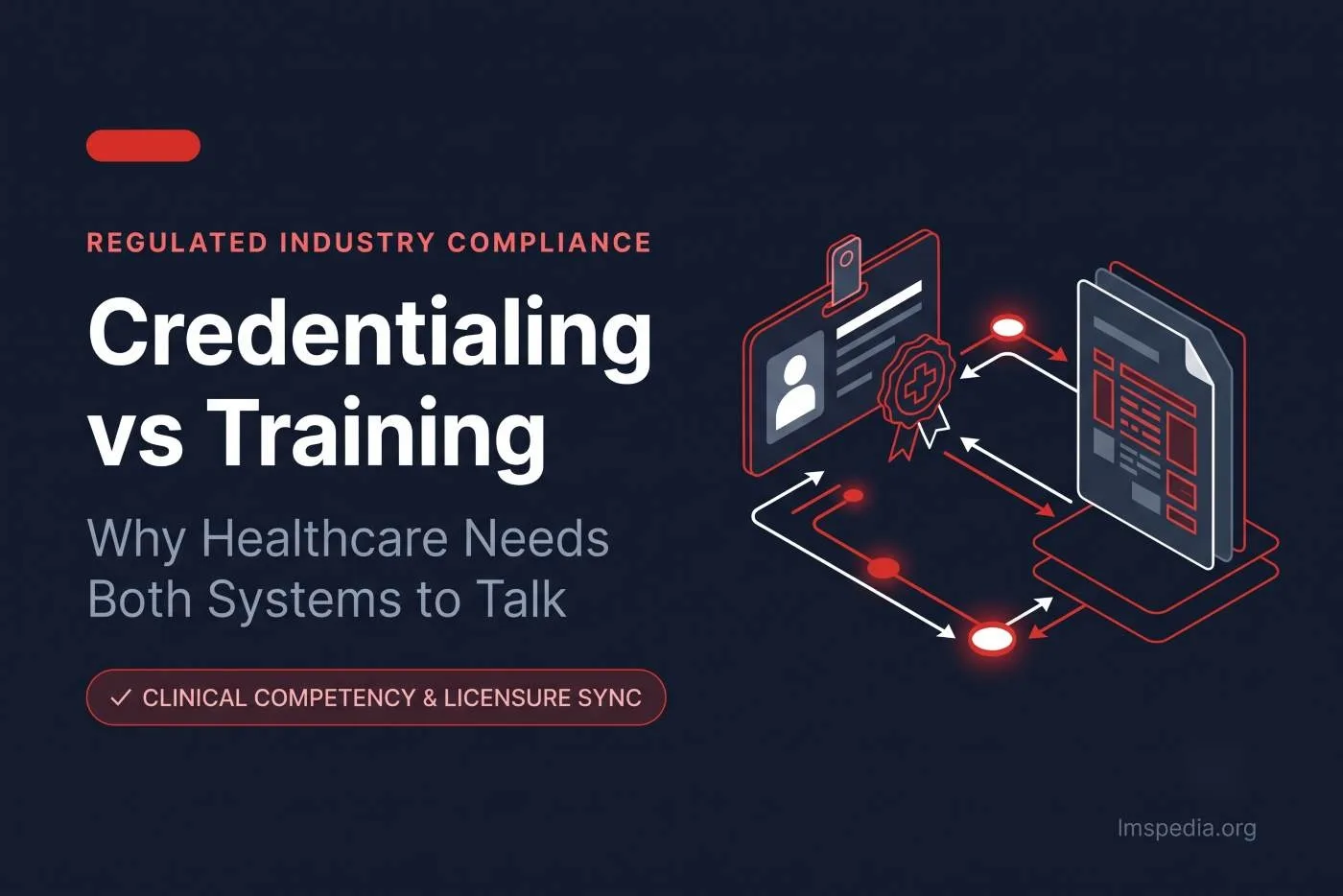
Credentialing vs Training: Why Healthcare Needs Both Systems to Talk
Modern healthcare systems operate under intense clinical and regulatory pressures. Specifically, hospital administrators must manage physician qualifications with absolute precision. However, most institutions maintain two completely disconnected administrative software systems. Medical staff offices manage primary source credentialing in one isolated database. Meanwhile, clinical education departments track mandatory hospital training inside a separate learning management system. Consequently, these operational silos create hazardous blind spots that threaten patient safety daily.
Operating these critical platforms independently introduces severe organizational and legal vulnerabilities. For example, a surgeon might possess an active medical license but lack verified training on a newly installed robotic surgical system. Conversely, a travel nurse might complete clinical onboarding modules while their state license undergoes disciplinary suspension. Therefore, implementing an integrated healthcare credentialing lms strategy has become an urgent priority for modern health systems. Exploring our benchmark of the best LMS for healthcare helps clinical leaders identify platforms built for regulated environments. Furthermore, selecting dedicated training software for healthcare providers ensures seamless data exchange across disparate departmental software tools.
Ultimately, clinical competence requires both legal authority and demonstrated operational capability. Healthcare providers cannot deliver exceptional patient care when administrative systems operate in isolation. Hospital executives must build automated bridges between medical staff credentialing and workforce learning platforms. When these systems communicate continuously, health systems eliminate compliance gaps, reduce malpractice liabilities, and streamline administrative operations across every clinical department.
Key Takeaways

Distinct Administrative Objectives: Medical staff credentialing verifies external legal qualifications and historical education, while clinical learning management systems govern dynamic operational competencies and device-specific proficiencies.
Dangerous Shift Scheduling Blind Spots: Disconnected systems permit clinicians with active state licenses to execute procedures without verified training on specialized medical technonogy or hospital emergency protocols.
Automated Privileging Gating: Integrating credentialing software with an LMS allows health systems to lock clinical privileges automatically until providers complete required hands-on simulations and digital training modules.
Elimination of Administrative Waste: Automated API synchronization removes manual data entry, eliminating human transcription errors and saving hundreds of administrative hours spent verifying provider records.
Permanent Regulatory Audit Readiness: Unifying provider credentialing and competency records satisfies strict Joint Commission, NCQA, and CMS inspection standards, protecting hospitals from conditional accreditations.
The Structural Divide: Provider Credentialing vs Training
Healthcare organizations routinely confuse provider credentialing with continuous workforce training. Although both workflows safeguard patient care, they serve fundamentally different administrative purposes. Understanding these distinct operational roles is the first step toward effective system integration.
What Medical Staff Credentialing Governs
Medical staff credentialing establishes legal authority and professional standing. Specifically, credentialing specialists execute rigorous Primary Source Verification (PSV) for every licensed provider. They verify medical degrees, residency completions, fellowship certificates, and active state medical licenses directly with issuing bodies. Furthermore, credentialing teams query the National Practitioner Data Bank to audit malpractice histories and regulatory disciplinary actions. The National Committee for Quality Assurance establishes strict operational guidelines governing these verification procedures.
Additionally, credentialing directly dictates clinical privileging. Hospital committees review provider experience to define exactly which surgical operations or diagnostic procedures an individual may perform. These formal reviews recur every two years through rigorous re-credentialing cycles. Consequently, credentialing records reflect external legal standing and historical professional qualifications. However, credentialing databases rarely track real-time procedural competence or internal hospital policy updates.
Credentialing workflows also involve extensive committee reviews and executive sign-offs. Department chairs and medical executive committees must approve clinical privileges formally. This administrative process often requires months of background research and document verification. Because credentialing focuses primarily on external validation, it moves slowly. Therefore, credentialing systems cannot adapt quickly to rapid operational changes on active clinical floors.
What Clinical Learning Management Systems Control
In contrast, clinical learning management systems govern dynamic operational competencies. Training platforms deliver and track internal educational curriculums across the entire workforce. These requirements encompass mandatory annual safety refreshers, electronic health record workflows, and patient handling protocols. To maintain audit defensibility, organizations must deploy an LMS for compliance training and audit evidence capable of generating immutable digital records.
Furthermore, clinical training platforms validate specialized high-risk skills continuously. Nurses and physicians must demonstrate practical mastery over specialized medical devices, arterial lines, and resuscitation algorithms. These assessments require structured evaluations, return demonstrations, and preceptor sign-offs. Unlike static medical degrees, operational competencies expire rapidly without continuous re-validation. Learning management systems track these rolling expiration cycles automatically, ensuring staff maintain sharp clinical reflexes.
Moreover, clinical education adapts immediately to emerging medical guidelines. When a hospital updates its central line infection protocols, clinical educators deploy microlearning modules across all surgical units. The training platform records instant comprehension data and assessment scores. Consequently, the learning management system reflects day-to-day operational readiness rather than historical licensing benchmarks.
The Hidden Risks of Operational Silos in Healthcare
Disconnecting credentialing databases from learning management software generates acute operational risks. When systems fail to share qualification data, administrative blind spots emerge across hospital departments. These blind spots endanger patients and expose healthcare facilities to massive regulatory fines.
Clinical Shift Scheduling Blind Spots
Hospital scheduling coordinators face immense pressure to fill clinical shifts quickly. Unfortunately, schedulers rarely possess real-time visibility into multiple disconnected software databases. A hospital scheduler might verify that an anesthesiologist holds active medical staff privileges inside the credentialing database. However, that scheduler cannot see that the provider missed mandatory malignant hyperthermia emergency simulations tracked inside the learning system. Consequently, the provider receives assignments to high-acuity surgical cases without verified emergency readiness.
Similarly, travel nurses and per diem clinicians introduce immense scheduling vulnerabilities. Healthcare facilities rely heavily on contingent labor to manage staffing shortages. When staffing agencies deploy nurses, credentialing teams collect baseline state licensure records. Meanwhile, hospital clinical education departments struggle to assign unit-specific safety orientations before the clinician’s first shift. Assigning unoriented providers to active nursing floors creates immediate clinical error hazards.
Furthermore, manual verification workflows between departments waste valuable administrative hours. Medical staff coordinators spend days emailing clinical educators to confirm training completions for re-credentialing packets. Often, emails go unanswered or paperwork gets misplaced. This administrative friction delays provider onboarding, leaving vital clinical departments understaffed and financially constrained.
Block Shift Scheduling on Lapsed Credentials
Configure automated API triggers to block clinicians from active scheduling rosters immediately whenever either their primary medical license or mandatory life-support competency expires.
Regulatory Compliance and Survey Liabilities
Regulatory audit teams inspect provider documentation with uncompromising scrutiny. Accreditation surveyors from The Joint Commission frequently evaluate medical staff files against active patient charts during unannounced inspections. Surveyors trace a patient’s care pathway and pull complete qualification dossiers for every clinician who treated that patient. If an auditor discovers a clinician with active privileges who lacks documented annual competency evaluations, citations follow immediately.
Additionally, regulatory penalties for credentialing oversights extend into corporate compliance. Federal agencies levy severe financial penalties against institutions that permit non-compliant providers to bill federal programs. Health systems must also protect sensitive workforce data during credentialing audits. Integrating robust digital protocols supports designing a HIPAA security awareness training program that survives an audit cleanly. Documentation discrepancies signal systemic administrative neglect to state investigators.
Unannounced surveys can result in devastating conditional accreditation statuses or lost Medicare funding. When surveyors identify disconnected recordkeeping, they expand audit sample sizes instantly. Hospital administrators must then dedicate hundreds of emergency hours to manual document reconciliation. Operating integrated qualification software eliminates these audit panics permanently.
Core Capabilities of an Integrated Healthcare Credentialing LMS
Unifying provider credentialing with clinical education requires sophisticated software architecture. Modern health systems must deploy integrated platforms capable of automated bidirectional data exchange. Let us explore the core capabilities an integrated system must deliver.
Unified Licensure Tracking Healthcare Architecture
An integrated architecture establishes a continuous, automated feedback loop between credentialing records and learning profiles. When a medical staff coordinator verifies an updated state medical license, that verified renewal pushes to the learning system instantly. Conversely, when a surgeon completes a specialized fluoroscopy radiation safety module inside the LMS, that certification receipts to the credentialing file immediately. Health systems streamline this documentation using tools for automating certificates and transcripts across enterprise databases.
Furthermore, automated data synchronization eliminates manual data entry completely. Administrators no longer re-type license numbers, expiration dates, or board certifications across multiple standalone tools. Removing manual touchpoints eradicates human data transcription errors entirely. Clean, synchronized records ensure that both departments view identical, accurate provider profiles at all times.
Additionally, integrated systems track rolling expiration deadlines across multiple regulatory bodies simultaneously. The software monitors DEA registrations, state controlled-substance certificates, basic life support cards, and specialized clinical proficiencies in a unified dashboard. Automated alert sequences notify providers and department managers ninety days before credentials lapse. Proactive notifications prevent sudden licensing expirations that disrupt operating room schedules.
Dynamic Competency Management and Privileging Gates
Integrated platforms enable automated privileging gates for specialized clinical procedures. For example, a hospital might acquire new high-definition laparoscopic surgical towers. The medical executive committee mandates that surgeons complete manufacturer-specific equipment training before exercising laparoscopic privileges. In an integrated environment, the credentialing system locks the provider’s laparoscopic privilege status automatically.
Next, the surgeon completes interactive digital modules and attends hands-on dry-lab simulations tracked by the learning platform. The qualified proctor signs off the practical evaluation directly inside the mobile interface. Once the LMS records verified completion, it fires an automated status update to the credentialing database. The credentialing system unlocks the surgical privilege instantly without human administrative intervention.
This automated gating mechanism guarantees absolute alignment between training and clinical execution. Healthcare providers can never exercise specialized privileges without documented proof of operational training. Consequently, the organization establishes an airtight defense against clinical negligence claims. Patients receive care exclusively from thoroughly trained, fully verified medical practitioners.
Automate Pre-Privileging Verification
Link clinical privileging categories directly to LMS module completions so specialized surgical privileges unlock automatically only after verified skills sign-offs occur.
Technical Integration Architectures: Making Systems Communicate
Bridging the technological gap between credentialing software and learning management systems requires robust engineering patterns. Modern enterprise IT teams utilize flexible, secure integration frameworks to ensure real-time data integrity. Let us examine the technical mechanisms that power unified healthcare ecosystems.
RESTful APIs, Webhooks, and Event-Driven Synchronization
Legacy healthcare IT environments relied heavily on brittle, overnight batch file transfers via secure FTP. If a physician’s license was suspended at 9:00 AM, downstream systems remained oblivious until the midnight batch executed. Modern healthcare demands real-time, event-driven data flows powered by RESTful APIs and secure webhooks. Modern cloud software communicates transactions in milliseconds.
Under an event-driven architecture, discrete business actions trigger immediate data updates. When a credentialing specialist revokes a clinical privilege, the credentialing platform broadcasts an encrypted webhook payload. Downstream learning systems and scheduling engines ingest this webhook instantly, revoking course certifications or blocking shift assignments. Real-time synchronization eliminates latency, keeping patient safety safeguards permanently synchronized.
Furthermore, modern API connections support granular data filtering. IT architects map specific JSON attributes between platforms while protecting sensitive employee information. Systems transmit strictly necessary identifiers without exposing personal banking details or home addresses. Disciplined data scoping preserves employee privacy while maintaining continuous operational alignment.
Identity Governance and Enterprise Role Mapping
Centralized identity governance underpins successful multi-system integrations. Healthcare organizations employ diverse worker classifications, including employed physicians, contracted locum tenens, voluntary community doctors, and allied health professionals. Managing user identities across disparate software tools requires standardized unique identifiers. Systems must index provider profiles using their permanent National Provider Identifier (NPI) rather than proprietary local account numbers.
Additionally, enterprise platforms enforce strict role-based access boundaries to protect institutional integrity. Medical staff coordinators maintain exclusive administrative rights to verify licenses and approve privileges. Conversely, clinical nurse specialists manage skills checkouts and educational courseware. Regulatory guidelines published by the Centers for Medicare & Medicaid Services mandate strict audit trails for workforce qualification data. Standardized identity frameworks guarantee complete accountability across every administrative action.
Moreover, directory synchronization tools automate user onboarding and offboarding workflows. When an affiliated physician retires, updating their master record inside the enterprise identity provider deactivates accounts across all secondary systems simultaneously. Automated de-provisioning eliminates orphaned accounts and shields healthcare networks from unauthorized access vectors.
Benchmarking Healthcare Credentialing and LMS Solutions
Evaluating enterprise healthcare software requires analyzing both credentialing depth and instructional delivery capabilities. Many generic corporate tools lack specialized medical privileging tools or clinical competency frameworks. Healthcare procurement committees must evaluate specialized software engineered specifically for clinical workflows. Below, we compare leading enterprise platforms based on their healthcare compliance and integration capabilities.
| Platform / Solution | Primary Focus | Healthcare Credentialing & Training Strength |
|---|---|---|
| SimpliTrain | End-to-end commercial training operations, resource logistics, and automated credential scheduling. | Excels at role-based competency tracking, automated recertification alerts, real-time API integrations, and audit-proof digital qualification records across complex healthcare workforces. |
| symplr | Healthcare governance, risk management, and provider credentialing. | Delivers comprehensive primary source verification, provider enrollment, and committee management, but requires third-party LMS integration for deep clinical course authoring. |
| MedTrainer | All-in-one healthcare compliance, clinical education, and credentialing. | Provides pre-built medical compliance courses, basic provider credentialing workflows, and document management tailored primarily for outpatient clinics and ambulatory centers. |
Strategic Implementation Roadmap for Hospital IT and Medical Staff
Aligning two historically disconnected departments requires careful organizational change management. Hospital leadership must establish structured implementation milestones to ensure seamless technical and cultural alignment. Let us review the critical steps for building an integrated qualification framework.
Step-by-Step System Alignment
The implementation journey begins with a comprehensive data dictionary audit. Medical staff leaders, clinical education directors, and enterprise IT architects must convene to analyze existing data fields. Teams must identify every credential, certification, and competency tracked across both platforms. Next, eliminate duplicate data tracking and designate an authoritative single source of truth for each specific attribute.
For example, designate the credentialing platform as the exclusive master record for state medical licenses, DEA numbers, and board certifications. Conversely, establish the learning management system as the authoritative master for BLS/ACLS certifications, equipment proficiencies, and annual compliance courses. Once data boundaries are finalized, software engineers configure automated API mapping protocols. Testing data flows thoroughly inside sandbox environments prevents data corruption during initial deployment.
Furthermore, cross-departmental training ensures that administrative staff understand integrated workflows. Credentialing specialists must learn how LMS completions affect privileging statuses. Similarly, clinical educators must recognize how licensing updates flow from medical staff files. Mutual operational understanding fosters long-term interdepartmental collaboration.
Continuous Audit Readiness and Risk Mitigation
Once technical integrations go live, health systems must establish continuous monitoring protocols. Internal quality assurance teams should conduct randomized monthly audits comparing active clinical schedules against qualification databases. If an audit uncovers an uncredentialed provider scheduled for a clinical shift, administrators must investigate the integration pipeline immediately.
Additionally, automated reporting engines deliver weekly compliance summaries directly to clinical department chairs. Dashboards highlight upcoming credential expirations, incomplete educational tracks, and unverified privilege requirements. Transparent visibility empowers clinical leaders to intervene proactively before providers reach non-compliant statuses. Continuous operational oversight turns stressful accreditation surveys into routine administrative verifications.
Finally, healthcare institutions must review integration logic annually. As state medical boards update licensing mandates and clinical guidelines evolve, software configurations must adapt accordingly. Establishing an agile administrative governance committee ensures that your integrated qualification architecture remains permanently aligned with changing healthcare regulations.
Standardize on National Provider Identifiers
Use the National Provider Identifier as the primary master key across both credentialing and LMS databases to eliminate duplicate records and ensure flawless user profile mapping.
Conclusion
Healthcare delivery operates in an environment where administrative oversights carry life-or-death consequences. For decades, healthcare institutions permitted medical staff credentialing and workforce clinical training to operate inside separate organizational silos. However, modern regulatory scrutiny, complex clinical technology, and high-velocity staffing models render disconnected systems entirely obsolete. Treating provider credentials and clinical competencies as separate entities creates dangerous compliance gaps and elevates patient safety risks.
Building an automated, bidirectional integration between credentialing platforms and learning management systems establishes an unshakeable operational shield. Unifying these systems ensures that licensed providers possess validated clinical competencies before exercising specialized patient privileges. Automated license tracking, real-time privilege gating, and synchronized scheduling protect health systems from catastrophic accreditation citations and malpractice liabilities. By investing in integrated digital architectures, healthcare organizations eliminate administrative friction, protect operating margins, and ensure that every patient receives treatment from thoroughly qualified, verified healthcare professionals.
FAQ
What is the core difference between healthcare credentialing and clinical training?
Credentialing focuses on primary source verification of medical degrees, state licenses, board certifications, and malpractice histories to establish legal practice authority. Clinical training inside an LMS tracks active procedural skills, annual safety requirements, medical device checkouts, and hospital-specific policies.
Why do disconnected credentialing and training systems create legal liability?
Operating these systems in silos allows providers to practice without verified operational training on hospital-specific equipment or protocols. In malpractice litigation, plaintiffs easily exploit discrepancies between active clinical privileges and unverified or expired training records.
How does an integrated healthcare credentialing LMS automate clinical privileging?
When a new clinical procedure or surgical tool requires prerequisite training, the credentialing platform locks the corresponding privilege. Once the clinician completes the required courseware and practical checkouts in the LMS, an automated webhook triggers the credentialing system to unlock the privilege instantly.
What primary identifier should healthcare IT use to sync credentialing and LMS profiles?
Health systems should always use the provider’s 10-digit National Provider Identifier (NPI) as the universal master key. Relying on internal employee numbers or email addresses creates synchronization errors, particularly for contracted locum tenens and voluntary medical staff.
How does integrating credentialing and LMS platforms improve Joint Commission survey outcomes?
Joint Commission surveyors cross-reference patient medical charts with provider personnel files during tracer methodology audits. An integrated platform allows compliance teams to export complete qualification dossiers, containing active licenses, verified privileges, and timestamped training records, in seconds.