First, global commercial aviation demands absolute operational perfection continuously. Specifically, minor technical errors cause catastrophic fatal disasters instantly. Consequently, international regulatory bodies mandate strict organizational safety frameworks. Therefore, aviation companies must adopt formal safety management systems actively. Historically, airlines treated safety as a purely reactive operational function. Today, modern regulations require incredibly proactive hazard identification strategies entirely.
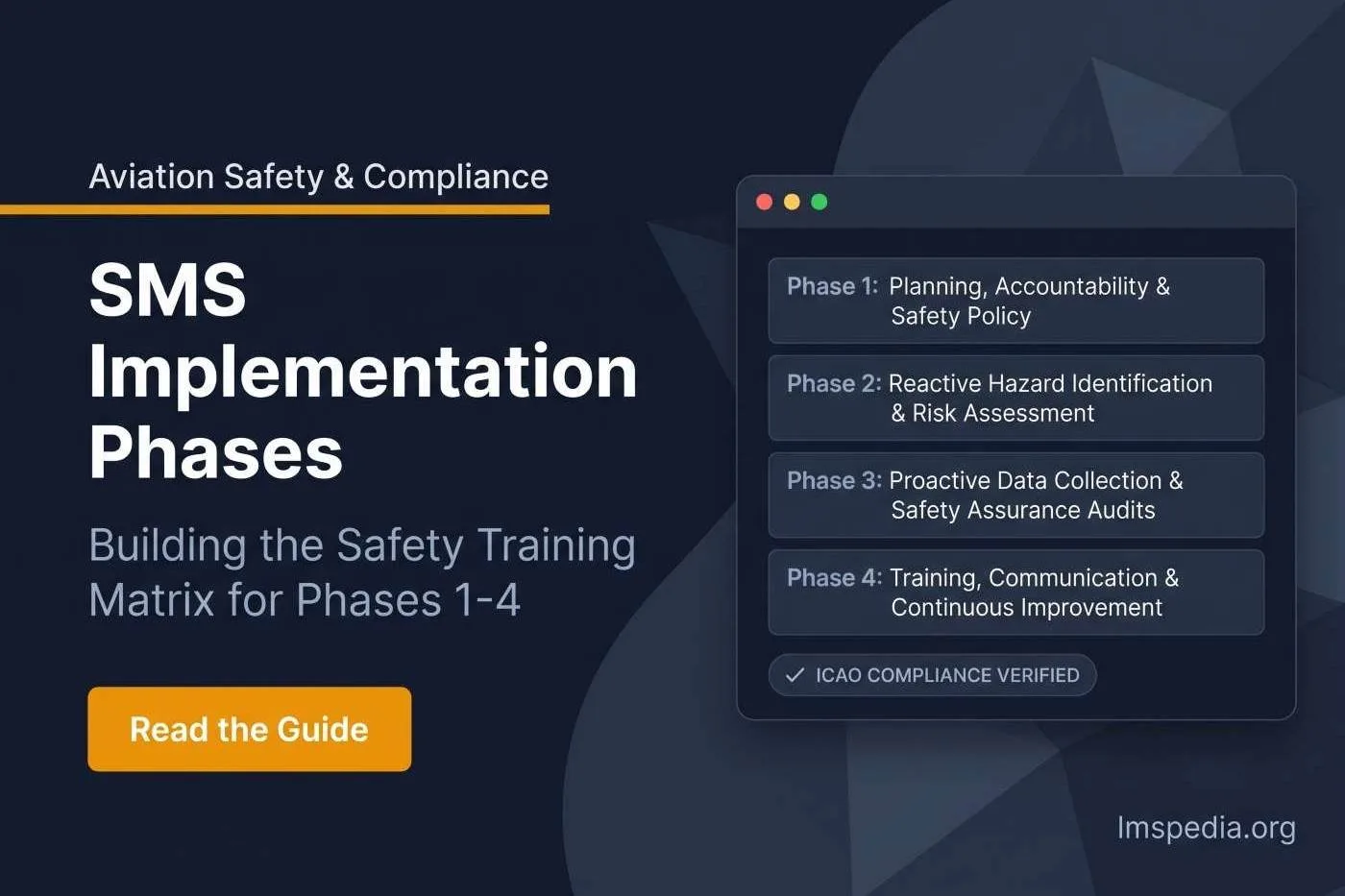
Furthermore, executing this massive cultural shift requires structured educational intervention. Specifically, organizations must actively develop a highly detailed sms training matrix. Consequently, this matrix maps exact educational requirements to specific job roles. Ultimately, proper educational planning guarantees total regulatory compliance across all departments. In this comprehensive guide, we explore the four distinct implementation stages. Additionally, to master broader aviation compliance, read our aviation security training guide.
Key Takeaways

Four Phases are Mandatory: Aviation regulators like ICAO and the FAA strictly explicitly completely mandate a highly specific four-phase implementation sequence natively. Specifically, organizations completely absolutely cannot legally jump directly to proactive hazard identification without completely safely building foundational reporting culture first.
The Matrix Dictates Compliance: A highly accurate sms training matrix strictly explicitly exactly maps completely specific educational requirements directly to distinct job titles. Consequently, this highly vital document completely perfectly ensures that executives, managers, and frontline workers purely receive highly relevant targeted instruction.
Phase 1 Focuses on Leadership: The absolute first implementation stage strictly actively heavily targets top accountable executives and dedicated safety implementation managers entirely. Therefore, these specific leaders absolutely must deeply actively master their strict personal legal liabilities and fundamental gap analysis methodologies perfectly.
Phase 2 Normalizes Reporting: During the highly vital second stage, absolutely every single organizational employee absolutely must successfully complete basic hazard reporting training. Ultimately, this heavily actively normalizes totally transparent internal communication and strictly builds massive vital trust in non-punitive disciplinary policies entirely.
Software Automates Recurrent Cycles: Manually attempting to completely actively safely track complex recurrent annual safety training deadlines using basic spreadsheets completely totally fails. Indeed, aviation organizations absolutely firmly must heavily rely completely on highly advanced digital learning platforms to guarantee total permanent audit readiness.
Understanding Safety Management System Training Phases
Fundamentally, implementing a massive enterprise safety framework takes significant time. Specifically, organizations cannot instantly deploy complex safety protocols overnight successfully. Consequently, global regulators developed four highly distinct safety management system training phases. Therefore, aviation companies must systematically build their safety architecture completely sequentially. Ultimately, skipping any specific phase guarantees catastrophic organizational compliance failures natively.
Furthermore, educational requirements drastically change during every single implementation phase. Specifically, initial phases heavily require basic broad organizational safety awareness. Conversely, later phases strictly demand highly advanced analytical risk assessment skills. To understand specific regulatory foundations deeply, heavily consult the official ICAO Safety Management documentation. Indeed, aligning your educational matrix directly with ICAO perfectly guarantees success.
The Phased Deployment Methodology
First, this phased approach effectively prevents massive organizational change fatigue entirely. Specifically, busy frontline workers completely reject sudden massive procedural overhauls natively. Consequently, introducing core safety concepts gradually actively builds massive employee trust. Therefore, management can successfully foster a genuinely positive reporting culture organically.
Additionally, regulators actively audit airlines based strictly on these specific phases. Specifically, inspectors verify that internal sms training requirements match the current phase. Consequently, producing an accurate training roster protects the vital operating certificate. Ultimately, this highly structured methodology systematically transforms total organizational behavior permanently.
SMS Phase 1: Planning and Organization
Naturally, the absolute first step involves securing total executive leadership commitment. Specifically, the accountable executive must formally define the corporate safety policy. Consequently, organizations appoint a dedicated safety manager to lead the implementation. Therefore, phase one strictly focuses on building the foundational administrative architecture. Below, we explicitly detail the exact educational requirements for this initial stage.
Furthermore, this early stage requires highly targeted executive leadership education primarily. Specifically, top executives must actively understand their strict personal legal liabilities. To master basic organizational skills gap analysis, review our training needs assessment tools 2026. Indeed, a thorough baseline assessment completely dictates your entire phase one strategy.
Phase 1 Training Matrix Requirements
First, the matrix must explicitly assign specialized instruction to the accountable executive. Specifically, this module completely covers ultimate legal accountability and resource allocation. Consequently, executives learn exactly how to actively sponsor a positive safety culture. Therefore, leadership understands that safety directly drives long-term commercial financial profitability.
Next, the designated safety implementation team requires highly intensive technical instruction. Specifically, they must master formal gap analysis methodologies and project management. Furthermore, general frontline employees require only a very basic introductory briefing. Ultimately, frontline staff just need to understand what SMS actually means fundamentally.
SMS Phase 2: Reactive Safety Management Processes
Crucially, the second distinct stage introduces basic reactive safety management processes entirely. Specifically, organizations must safely establish a totally confidential internal reporting system. Consequently, employees must feel completely empowered to report honest mistakes voluntarily. Therefore, developing a strict non-punitive disciplinary policy becomes absolutely legally critical. Below, we deeply explore the specific educational modules required right now.
Furthermore, investigators must successfully learn exactly how to analyze known historical incidents. Specifically, this highly reactive approach strictly fixes problems that already occurred. For detailed technical methodologies regarding incident investigation, thoroughly read the FAA Safety Management Systems guidance. Ultimately, mastering reactive analysis perfectly builds the foundation for future proactive measures.
Phase 2 Training Matrix Requirements
First, every single organizational employee must absolutely complete mandatory reporting training. Specifically, the matrix assigns a module explaining exactly how to submit hazard reports. Consequently, workers confidently learn what specific events trigger a formal safety report. Therefore, widespread educational participation completely normalizes transparent internal communication across all departments.
Additionally, dedicated safety investigators require highly advanced analytical skills instruction now. Specifically, they must master root cause analysis and basic human factors engineering. Furthermore, operational department managers learn exactly how to respond to submitted reports. Indeed, managers actively learn to fix systemic flaws instead of blaming individuals.
SMS Phase 3: Proactive and Predictive Processes
Undoubtedly, advancing into phase three actively represents a massive organizational maturity milestone. Specifically, the company stops waiting for dangerous accidents to physically happen first. Consequently, safety teams actively deploy highly proactive hazard identification methodologies daily. Therefore, this completely shifts the entire corporate focus toward advanced risk mitigation. Below, we thoroughly examine the complex educational requirements for proactive safety management.
Furthermore, predictive systems actively monitor massive streams of normal daily operational data. Specifically, algorithms actively flag completely tiny deviations before they cause huge disasters. To effectively manage these complex compliance workflows, explore our highly detailed training compliance management software guide. Ultimately, proactive education permanently stops catastrophic fatal accidents entirely.
Phase 3 Training Matrix Requirements
First, the matrix must explicitly assign advanced risk assessment training to managers. Specifically, leaders absolutely must actively master formal risk probability and severity matrices. Consequently, managers learn exactly how to calculate the precise numerical risk index. Therefore, they successfully implement highly effective corrective actions to completely eliminate hazards.
Next, dedicated safety analysts require totally advanced data mining and predictive training. Specifically, they learn exactly how to interpret flight data monitoring trends accurately. Furthermore, frontline workers receive refresher training on identifying incredibly subtle operational hazards. Indeed, this sophisticated training completely transforms ordinary employees into active safety sensors.
SMS Phase 4: Operational Safety Assurance
Ultimately, the final fourth stage perfectly guarantees total continuous operational safety improvement. Specifically, the organization actively thoroughly measures the effectiveness of its safety controls. Consequently, management actively conducts highly rigorous internal safety audits and complex evaluations. Therefore, sms phase 1 2 3 4 implementation completely culminates in total assurance. Below, we completely detail the specific educational demands of this final phase.
Furthermore, safety assurance actively relies heavily upon incredibly pristine operational data integrity. Specifically, auditors actively compare theoretical safety policies against actual daily physical practices. For comprehensive global standards, strictly review the official IATA Safety Management framework thoroughly. Indeed, achieving phase four totally signifies absolute world-class aviation safety maturity.
Phase 4 Training Matrix Requirements
First, internal safety auditors absolutely must successfully complete highly rigorous formal certification. Specifically, the matrix explicitly assigns advanced compliance auditing and inspection methodology modules. Consequently, these internal auditors actively learn how to conduct completely unbiased departmental evaluations. Therefore, they successfully totally uncover deeply hidden systemic organizational non-compliance issues rapidly.
Additionally, top executive leadership absolutely requires highly advanced safety performance monitoring instruction. Specifically, executives actively learn how to properly interpret complex safety performance indicators. Furthermore, continuous improvement training perfectly guarantees the safety system constantly successfully evolves daily. Ultimately, this highly specialized education firmly locks permanent safety culture into place.
Structuring the Safety Training Matrix Aviation
Naturally, physically building a safety training matrix aviation standard requires extreme organizational precision. Specifically, the physical document cross-references every single job title against mandatory courses. Consequently, a simple spreadsheet totally fails to manage complex recurrent training cycles effectively. Therefore, modern aviation organizations strictly utilize highly advanced digital learning management software. Below, we explicitly outline exactly how to construct this vital compliance document.
Furthermore, the matrix must perfectly cleanly define exact initial and recurrent frequencies. Specifically, some specific modules legally require completely mandatory refresher courses every year. To successfully manage complex recurrent cycles securely, carefully read our guide on LMS for corporate compliance training. Ultimately, a completely robust digital matrix entirely survives highly aggressive federal audits flawlessly.
Aligning Roles with Competencies
First, administrators absolutely must correctly group all organizational employees into specific functional tiers. Specifically, standard tiers highly typically include executives, operational managers, and frontline personnel. Consequently, the matrix explicitly defines exactly which specific courses apply to each tier. Therefore, baggage handlers absolutely do not waste time taking advanced executive legal training.
Next, the matrix actively completely tracks the precise completion dates for every employee. Specifically, digital systems actively trigger totally automatic warnings before an employee certificate expires. Furthermore, specialized maintenance repair organizations heavily rely on incredibly complex role-based matricies constantly. To understand maintenance-specific workflows thoroughly, consult our part 147 software configuration guide. Indeed, proper digital tracking totally prevents catastrophic massive federal regulatory fines entirely.
Comparing SMS Training Management Platforms
Undoubtedly, manually attempting to safely track complex safety matrices using paper completely fails. Specifically, aviation authorities strictly demand highly immediate, totally immutable digital training records instantly. Consequently, corporate procurement teams must totally rigorously carefully evaluate highly specialized digital platforms. Therefore, selecting the absolute perfect software platform dictates your entire total compliance success. Below, we thoroughly directly compare several leading commercial enterprise digital safety management systems.
Furthermore, these highly specialized platforms completely automate incredibly tedious manual administrative tracking tasks. Specifically, they cleanly successfully integrate your entire safety matrix directly into daily operations. Ultimately, deploying powerful enterprise software actively guarantees incredibly smooth, totally seamless regulatory audits.
| Platform / Solution | Primary Focus | Matrix Tracking Strength |
|---|---|---|
| SimpliTrain | Versatile training operations and totally dynamic complex compliance scheduling globally. | Excels at totally automated role-based matrix execution securely providing totally immutable digital audit trails flawlessly. |
| Coruson (Ideagen) | Heavy aviation safety reporting and massive global incident management natively. | Provides highly rigid SMS integration specifically designed strictly to perfectly link reported hazards directly to training. |
| Q-Pulse | Enterprise quality management and highly strict aviation regulatory compliance workflows. | Delivers extremely complex document control heavily utilized specifically for managing totally massive corporate phase four audits. |
Furthermore, highly ambitious enterprise aviation organizations absolutely must explicitly deeply ask vendors questions. Specifically, you absolutely firmly completely must entirely verify if the highly expensive platform totally gracefully handles complex recurrent deadlines.
Conclusion
In conclusion, completely successfully implementing a massive organizational safety system strictly requires deep operational patience natively. First, highly dedicated safety directors absolutely must strictly methodically follow the completely mandatory four-phase deployment sequence perfectly. Next, intelligent organizational administrators absolutely firmly must build a completely rigorous, totally highly accurate educational matrix entirely. Furthermore, actively properly educating every single employee heavily completely ensures massive long-term permanent cultural transformation globally.
Consequently, attempting to aggressively completely rush this incredibly highly complex process heavily guarantees severe operational failure. Ultimately, heavily actively applying these specific highly proven educational frameworks permanently completely elevates standard airline operations beautifully. Therefore, ambitious global aviation enterprises absolutely must aggressively actively heavily invest in modern digital tracking software immediately. Indeed, totally completely mastering proactive hazard identification absolutely remains the absolute ultimate master key to permanent aviation safety.
FAQ
Q1. What exactly is an SMS training matrix and why is it legally required?
Fundamentally, this highly specific vital document strictly explicitly thoroughly maps completely mandatory safety courses directly against distinct organizational job roles. Specifically, aviation regulators highly strictly explicitly actively demand this totally formal document to visually physically verify enterprise educational compliance perfectly. Consequently, the matrix completely highly perfectly ensures that baggage handlers absolutely do not actively entirely waste time taking advanced executive courses. Therefore, maintaining a highly accurate, totally completely entirely updated digital matrix completely totally perfectly protects the airline operating certificate permanently.
Q2. What specific safety training absolutely must occur during phase one implementation?
Crucially, phase one strictly explicitly actively primarily targets top organizational leadership and the totally dedicated internal safety implementation team natively. Specifically, the accountable corporate executive absolutely explicitly actively must successfully complete specialized highly targeted training covering ultimate legal liability completely. Furthermore, the dedicated safety team strictly explicitly actively must master fundamental highly complex gap analysis and totally basic project management. Ultimately, general frontline operational workers simply actively merely explicitly receive a totally highly basic introductory briefing explaining SMS fundamentals entirely.
Q3. How does proactive safety management training significantly differ from reactive training?
Initially, highly reactive safety training strictly entirely actively focuses completely on investigating highly dangerous historical accidents that actually physically occurred. Specifically, investigators absolutely firmly actively completely learn exactly how to successfully apply highly complex root cause analysis to past failures natively. Conversely, totally proactive training explicitly actively highly completely empowers analytical managers to actively safely successfully identify highly dangerous future hazards entirely. Therefore, proactive education completely entirely successfully shifts the totally massive corporate focus completely toward preventing disasters before they actually happen.
Q4. What specific role does safety assurance training actively play in phase four?
Ultimately, phase four explicitly actively completely strictly heavily focuses entirely on totally guaranteeing total continuous permanent organizational safety improvement natively. Specifically, dedicated internal safety auditors absolutely firmly actively completely must master highly complex formal compliance auditing and internal inspection methodologies flawlessly. Consequently, these highly trained auditors strictly actively continuously heavily actively evaluate completely whether theoretical safety policies physically totally actually work. Indeed, this highly advanced specialized education firmly securely permanently successfully actively locks a completely world-class continuous safety culture directly into place.
Q5. Can generic corporate software actually safely successfully track aviation SMS training requirements?
Typically, totally completely standard highly generic corporate human resources software totally completely entirely highly aggressively absolutely fails aviation regulatory audits completely. Specifically, standard basic platforms absolutely entirely completely firmly lack highly rigid complex native recurrent tracking and totally immutable digital compliance trails. Consequently, highly regulated aviation enterprises absolutely strictly completely totally must intentionally specifically procure entirely specialized digital safety training management systems permanently. Therefore, totally highly specialized software cleanly absolutely safely seamlessly perfectly handles incredibly complex totally overlapping annual training deadlines perfectly securely natively.