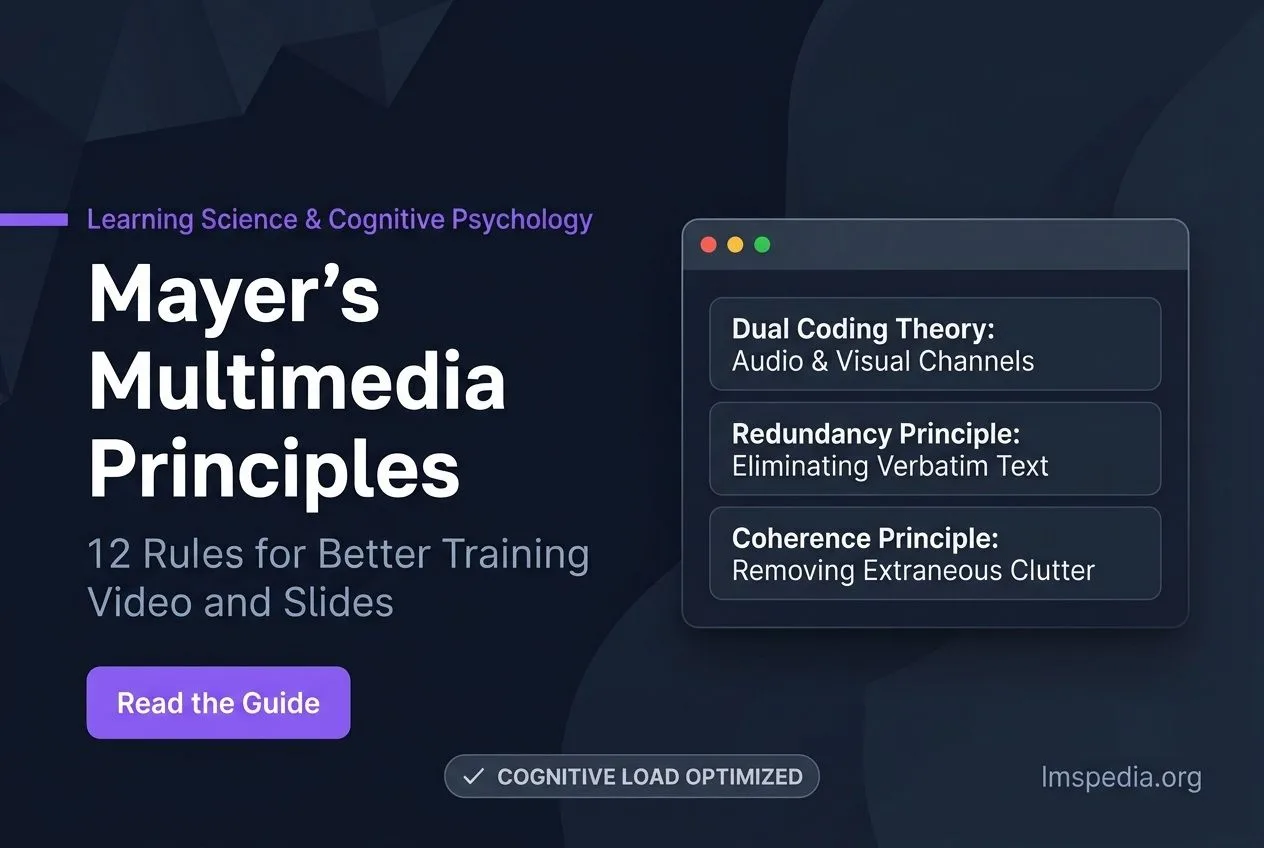
Mayer’s Multimedia Principles: Science-Based Corporate Training Design
Corporate training once relied on passive presentation models. Slides crammed with heavy text and random clip art often destroy learner focus. Cognitive psychologist Richard Mayer formulated twelve multimedia rules to fix this. His evidence-based framework transforms confusing slideshows into powerful educational tools. Instructional designers previously ignored brain processing limits. Today, applying Mayer multimedia principles guarantees much higher knowledge retention. For broader digital content strategies, review insights on
AI course authoring tools compared. Poorly designed content wastes corporate budgets as overwhelmed learners quickly forget lessons. Building brain-friendly digital courses creates a massive organizational competitive advantage.
Key Takeaways

Humans Have Dual Channels: The human brain completely biologically utilizes two totally distinct channels for completely active mental processing natively. Specifically, one specialized channel exclusively processes visual information actively, while the other completely separate channel actively processes auditory sounds exclusively.
Never Read Slides Aloud: The highly powerful redundancy principle strictly explicitly heavily dictates that you absolutely must never entirely read on-screen text aloud verbatim. Consequently, this highly terrible practice actively entirely forces the visual channel to improperly process text while simultaneously looking at the critical graphic.
Remove Extraneous Clutter: The absolute core foundational coherence principle explicitly stringently demands the total absolute removal of all totally unnecessary decorative graphics immediately. Therefore, loud background music and highly completely irrelevant visual stock photos absolutely completely severely distract the active brain from processing essential learning objectives.
Pacing Prevents Overload: The highly incredibly effective segmenting principle actively strictly requires completely breaking highly massive complex corporate lessons into highly manageable short digital chunks. Ultimately, this completely heavily actively gives the incredibly busy learner adequate physiological time to completely fully digest one highly technical concept completely.
Keep It Conversational: The highly effective psychological personalization principle explicitly strictly proves that highly incredibly formal, totally academic language completely completely destroys learner social engagement. Indeed, actively utilizing completely relaxed conversational scripts featuring friendly words like you and we actively heavily fosters much deeper generative mental processing globally.
The Foundation: Dual Coding Theory and Cognitive Load
The human brain processes digital information through two distinct channels. It uses one channel exclusively for visual imagery and a separate channel for auditory sounds. This biological reality anchors dual coding theory. Instructional designers must balance both channels during course creation. However, both mental processing channels have strict operational bandwidth limits. Cramming technical data into one channel causes cognitive overload. Consequently, overwhelmed learners stop processing new educational information. For authoritative psychological research, consult the
American Psychological Association database. Balancing these dual channels drastically improves permanent long-term memory formation.
Reducing Extraneous Processing and Coherence
Digital designers must eliminate unnecessary decorative course elements. Extraneous mental processing distracts busy learners from core curriculums. Extra graphics force the brain to process useless background noise. Several psychological rules address reducing these visual distractions. Furthermore, minimalist design actively focuses learners on training objectives. Clean visual slides prevent visual channel exhaustion. To explore broader digital design standards, review core
training management system features. Pure visual simplicity represents the highest form of instructional design sophistication.
Eliminate Decorative Clutter
Remove stock photos and background music that do not directly support the learning objective to prevent cognitive overload.
Signaling and Redundancy Principles
The signaling principle demands clear visual cues for important information. You must highlight critical text using bold fonts or contrasting colors. Vocal emphasis guides learners toward vital abstract concepts. Visual signaling tells the brain what to process first. Busy learners waste no energy searching for context. Furthermore, the redundancy principle solves a massive corporate design flaw. You must never read on-screen text aloud verbatim. For academic details on cognitive rules, visit the official
University of California, Santa Barbara portal. Replacing massive text paragraphs with clean voiceovers entirely prevents rapid cognitive exhaustion.
Managing Essential Load and Spatial Contiguity
Some corporate training topics remain inherently complex. Essential processing refers to the required mental effort for baseline comprehension. Instructional designers must carefully manage how this complex information enters memory. Pacing the delivery of information prevents sudden learner burnout. Additionally, spatial contiguity mandates placing related text and graphics together. Never place a complex diagram legend on a separate slide. Making learners scan back and forth wastes precious cognitive energy. Integrating descriptive labels directly onto diagrams drastically improves visual comprehension. For technical instructional frameworks, review standards on
EASA Part 147 maintenance training organisation approvals.
Temporal Contiguity and Segmenting
Temporal contiguity requires presenting corresponding audio and visuals simultaneously. Do not show an animation and explain it afterward. The brain must process explanations precisely while watching movement. Separating audio destroys internal mental connection processes. Perfectly synchronized timing locks newly acquired knowledge into long-term memory. Furthermore, the segmenting principle requires breaking massive lessons into small digital chunks. Designers must divide long videos into distinct short chapters. Allowing learners to pause gives the brain time to digest concepts. Modern microlearning strategies rely entirely on this segmenting rule.
Modality and Pre-Training Principles
Deciding how to deliver information heavily impacts knowledge retention. You must choose strategically between text, spoken audio, and visual graphics. Furthermore, the pre-training principle involves introducing core vocabulary before main lessons. Clearly define technical acronyms before starting complex modules. Learners waste no mental energy decoding basic terminology later. Pre-training acts as a crucial cognitive warmup for demanding subjects. Enterprise software strategies evaluated by analysts at
Gartner reinforce structured content delivery standards.
Modality and Multimedia Principles
The modality principle states that humans learn better from spoken words. Relying on printed pictures alongside written text produces worse educational results. Shift text-heavy slides into spoken audio narration instead. This strategy leverages the auditory channel for verbal processing. Ultimately, this frees the visual channel to focus on animations. Furthermore, the multimedia principle dictates using words and pictures together. Humans learn better from combined multimedia than from text alone. Combining text with visual diagrams grounds abstract concepts into physical reality. Furthermore, verifying compliance documentation through resources like our guide on
LMS for compliance training and audit evidence ensures complete institutional readiness.
Fostering Generative Processing and Personalization
True deep learning occurs when students organize and integrate new data. Generative processing represents this meaningful cognitive integration phase. Designers must encourage the brain to form critical neural connections. The brain learns best when it feels socially connected to instructors. Cold, sterile corporate environments shut down generative processing centers. The personalization principle requires writing audio scripts using a conversational tone. Using words like you and we directly engages learners. Formal academic language alienates busy frontline employees. Conversational scripts trick the brain into paying closer attention. For structuring user engagement safely, review guidelines on
LMS user roles and instructor permissions.
Voice, Image, and Authoring Tools Comparison
The voice principle demands using a friendly human voiceover. Robotic machine voices destroy the psychological social learning connection. Investing in professional human narration yields permanent educational dividends. Additionally, the image principle proves that showing the instructor face is unnecessary. A visible talking head video distracts learners from critical diagrams. Removing the webcam feed forces visual attention back onto curricula. Furthermore, instructional designers require sophisticated tools to execute these rules. A chosen digital authoring tool must synchronize audio and visual elements. Reviewing enterprise deployment architectures like
Open LMS vs Totara Learn helps organizations select proper hosting frameworks.
| Platform / Solution |
Primary Focus |
Multimedia Principle Strength |
| SimpliTrain |
Versatile training operations and dynamic content deployment. |
Excels at clean content delivery ensuring spatial congruity across mobile screen sizes. |
| Articulate Storyline 360 |
Deep interactive authoring and massive corporate e-learning development. |
Provides precise visual timeline features designed to master temporal contiguity. |
| TechSmith Camtasia |
Video editing and rapid screen recording capabilities. |
Delivers excellent visual signaling tools like dynamic cursor highlights. |
Conclusion
Mastering these twelve psychological rules transforms standard corporate education. Expert designers must eliminate extraneous visual clutter to protect the fragile human brain. Content creators must synchronize spoken human audio with relevant visual diagrams seamlessly. Speaking conversationally engages busy learners on a meaningful social level. Ignoring these strict scientific guidelines guarantees an unengaging student experience. Applying proven cognitive rules elevates boring presentation slides into powerful digital training. Organizations must train instructional designers on these exact psychological frameworks immediately. Respecting how the fragile human brain functions remains the master key to digital learning success. For continuous professional insights, explore
the LMSPedia blog archive.
Q1. What is the absolute core concept behind Mayer's multimedia learning principles?
Fundamentally, this highly incredibly specific scientific psychological framework dictates exactly how the sensitive human brain actively processes digital educational content. Specifically, Richard Mayer scientifically empirically proved that human beings biologically learn significantly better from combined words and visual pictures together. Furthermore, his highly meticulously structured twelve distinct rules actively perfectly completely prevent severe cognitive overload during incredibly complex digital educational courses. Therefore, correctly completely applying these highly specific rules perfectly totally optimizes entirely how totally new technical information physically safely enters the human memory.
Q2. How does the active redundancy principle directly improve corporate e-learning courses?
Crucially, the redundancy principle actively heavily violently attacks the incredibly completely common totally terrible habit of reading dense text slides aloud. Specifically, when a human narrator actively reads highly identical on-screen text, the active learner brain actively violently suffers massive severe cognitive overload. Consequently, the highly overwhelmed brain completely violently fiercely struggles to actively completely synchronize the heavily written text with the exact spoken words. Ultimately, entirely completely radically removing the heavy complex on-screen text entirely perfectly totally forces the fragile brain to actively listen and actively watch properly.
Q3. What exactly is the strict modality principle in multimedia corporate training?
Essentially, this highly incredibly important cognitive rule explicitly formally states that humans actively organically learn complex technical concepts better using spoken audio narration. Specifically, it completely heavily highly advises entirely strictly against strictly actively completely using heavily printed text explicitly alongside highly visually complex animated graphics. Consequently, actively completely shifting the heavy totally textual explanations entirely completely radically over to the auditory channel effectively safely completely frees the visual channel. Therefore, the active corporate learner totally completely fully possesses the absolute completely necessary internal mental capacity to closely safely watch the highly visual animation.
Q4. Why is the vital pre-training principle absolutely necessary for complex technical subjects?
Naturally, highly incredibly complex technical corporate subjects totally actively contain completely massive huge amounts of incredibly highly specialized vocabulary and highly confusing acronyms. Specifically, the pre-training principle heavily actively entirely requires entirely explicitly totally defining these highly confusing completely unknown technical terms absolutely before the core lesson begins. Consequently, the active corporate learner completely entirely absolutely does not actively heavily waste precious cognitive mental energy violently entirely decoding basic terminology later. Indeed, this highly brilliant, totally effective psychological strategy highly effectively actively entirely successfully serves as a completely perfect necessary cognitive warmup for highly stressed students.
Q5. Does actively adding soft background music actually improve digital training videos?
Absolutely, actively adding highly completely totally irrelevant background music completely entirely violently violates the highly strict coherence principle completely totally aggressively perfectly. Specifically, totally highly completely unnecessary background audio actively fiercely heavily forces the fragile human brain to entirely completely process completely totally useless peripheral auditory information. Consequently, this absolutely entirely heavily actively drastically immediately completely severely actively heavily limits the absolute total remaining active mental bandwidth explicitly completely available for learning. Therefore, intelligent instructional designers absolutely firmly strictly heavily must totally intentionally completely explicitly ruthlessly entirely permanently eliminate all completely non-essential background audio immediately entirely natively.