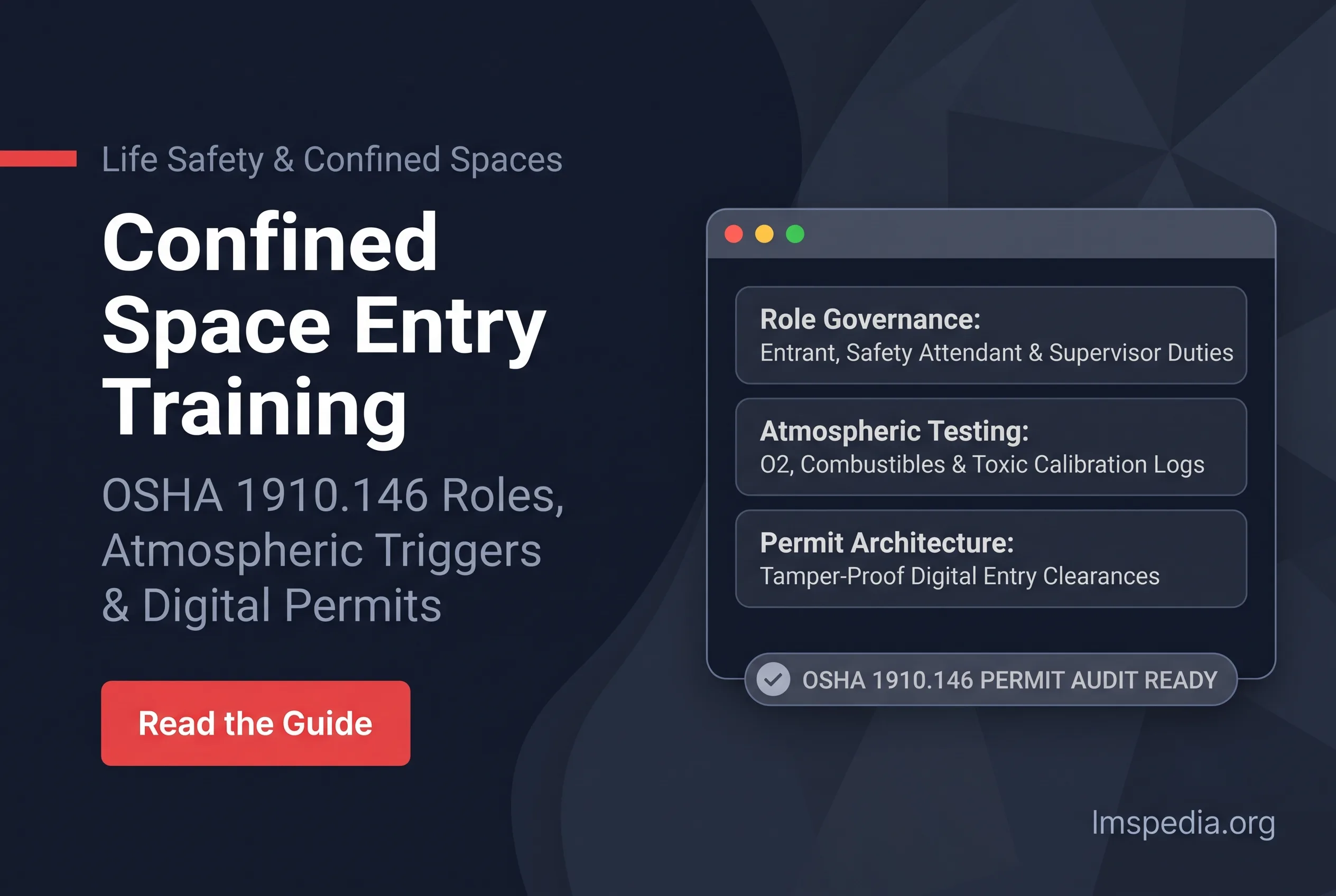
Confined Space Training Compliance: OSHA 1910.146 Roles, Testing, and Records
Heavy industrial facilities harbor dangerous enclosed workspaces daily. Empty storage tanks, deep sewers, and underground vaults present extreme physiological hazards. Strict federal regulatory agencies enforce comprehensive worker safety education programs. Fulfilling mandatory confined space training requirements remains an absolute operational priority. Unauthorized entries and disorganized rescue attempts cause tragic industrial fatalities.
Occupational safety regulations establish rigid operational entry controls. Facility employers must ensure verifiable human competence before allowing personnel inside hazardous chambers. In this guide, we explore federal compliance mandates. Additionally, we analyze distinct operational responsibilities governing every entry team member. To understand adjacent industrial educational frameworks, review our guide covering
training compliance management software. Furthermore, enterprise buyers should cross-reference vendor capabilities against a comprehensive benchmark of core
training management system features to avoid functional compliance gaps.
Key Takeaways

OSHA 1910.146 Mandates Precise Classification: Employers must systematically actively evaluate complex workplaces to successfully identify permit-required confined spaces containing deadly atmospheric, engulfment, or severe structural hazards before ever allowing employee entry.
Three Roles Require Distinct Training: Internal entrants, exterior safety attendants, and responsible entry supervisors definitively possess entirely unique legal duties, strictly requiring highly specialized, totally role-based instruction rather than basic generic safety courses.
Atmospheric Testing Must Follow Hierarchy: Safe pre-entry atmospheric testing absolutely actively requires a highly strict continuous sequential order: testing ambient oxygen content first, dangerous flammable gases second, and highly toxic chemical contaminants third.
Retraining is Entirely Event-Driven: Beyond purely optional annual refreshers, mandatory retraining completely becomes legally necessary whenever physical workplace conditions change, digital permit programs update, or active workers heavily exhibit dangerous operational performance deficiencies.
Digital Permits Ensure Audit Readiness: Securely deeply deeply preserving highly immutable digital entry permits, multi-gas calibration logs, and timestamped training certificates totally successfully actively creates an entirely impenetrable evidentiary trail that safely withstands highly unannounced federal safety audits.
Understanding OSHA 1910.146 Training Requirements
Federal safety regulations dictate strict parameters for enclosed industrial operations. Standard 29 CFR 1910.146 governs general industry spaces across the United States. Facility employers must systematically evaluate physical properties for hazardous enclosures. Understanding OSHA 1910.146 training standards forms the baseline for enterprise compliance. This federal regulation establishes enforceable legal duties for facility management teams.
The regulation differentiates between standard and hazardous enclosed areas. Standard enclosed spaces possess restricted entry or exit portals. Permit-required spaces contain deadly atmospheric, engulfment, or structural hazards. For definitive statutory guidance, review official
OSHA 1910.146 permit-required confined spaces standard documentation. Safety directors must classify every enclosed area before launching operational entries.
Defining a Permit-Required Confined Space
An enclosed industrial area qualifies as a confined space by meeting three criteria. It must be large enough for an employee to enter bodily. It must possess limited or restricted physical means for entry or exit. Structural developers did not design the structure for continuous employee occupancy.
Deadly permit spaces contain additional severe health or physical hazards. Specific spaces might contain hazardous or oxygen-deficient atmospheres. Alternatively, spaces might contain loose physical materials capable of engulfing entrants. Implementing permit-required confined space training becomes legally mandatory. Proper physical classification prevents accidental worker fatalities.
Atmospheric Hazards and Testing Thresholds
Invisible atmospheric contaminants represent the leading cause of entry fatalities. Hazardous atmospheres kill unprotected workers quietly without immediate sensory warning signs. Instructional training must emphasize rigorous multi-gas atmospheric testing. Frontline workers must test internal air before opening any physical access hatch.
Internal oxygen levels must remain between 19.5% and 23.5%. Airborne flammable gas concentrations cannot exceed 10% of their lower flammable limit. Toxic air contaminants like hydrogen sulfide require continuous monitoring. Executing proper atmospheric testing protocols guarantees human survival inside high-risk vessels.
Atmospheric Testing Hierarchy
Atmospheric testing inside confined spaces must follow a strict sequential order. First, test for ambient oxygen. Next, test for flammable gases. Finally, test for toxic contaminants.
General Industry vs Construction Standards
Corporate employers must distinguish between general industry and construction regulations. Federal standard 29 CFR 1926 Subpart AA governs active construction projects. Complex construction standards mandate coordination across multiple site subcontractors. Primary host employers must communicate known underground hazards directly to prime contractors.
Strict construction standards require continuous atmospheric monitoring whenever feasible. Basic general industry regulations sometimes permit periodic testing under controlled conditions. Safety managers must apply the correct regulatory standard to their environment. Applying the wrong regulatory framework invites federal citations.
The Core Roles: Attendant, Entrant, and Supervisor Training
Executing safe vessel entry requires disciplined, synchronized team coordination. Strict federal standards establish distinct legal boundaries for three primary roles. Industrial employers must deliver tailored attendant, entrant, and supervisor training programs. Corporate administrators cannot rely on generic digital training modules.
Role confusion causes catastrophic delays during atmospheric emergencies. If an exterior attendant panics, internal entrants lose their primary safety lifeline. Specialized instruction ensures every team member understands their distinct boundaries.
Authorized Entrant Responsibilities and Hazards
Authorized entrants pass through primary physical access portals. These entrants perform maintenance, structural inspection, or cleaning tasks inside. Entrants face direct physical exposure to acute atmospheric and physical hazards. Dedicated entrants must master the proper use of personal protective equipment.
Entrants must understand toxic chemical exposure symptoms and early warning signs. Dizziness, nausea, or eye irritation require immediate voluntary physical evacuation. Working entrants must maintain continuous verbal communication with exterior attendants. Proactive entrant self-awareness prevents sudden fatal incapacitation.
The Vital Role of the Safety Attendant
Designated safety attendants remain stationed directly outside entrance portals. This professional monitors the physiological status of all internal entrants. Focused attendants must never abandon their assigned exterior post. Assigning unrelated secondary tasks to active attendants violates federal regulations.
Vigilant attendants track digital atmospheric testing levels from the exterior. If internal air conditions deteriorate, attendants order immediate total evacuation. Untrained attendants often die attempting unauthorized, spontaneous physical rescue attempts. Attendants must initiate non-entry mechanical rescue mechanisms exclusively.
Entry Supervisor Accountability and Permit Authorization
Designated entry supervisors assume ultimate operational and legal accountability. Supervisors visually verify that pre-entry safety measures are complete. Supervisors inspect mechanical ventilation equipment, lock-out tags, and digital air monitors. Responsible supervisors sign formal entry permits to authorize entry operations.
Supervisors terminate physical permits once work concludes. Similarly, supervisors cancel active permits if unexpected severe hazards emerge. Supervisory operational rigor maintains institutional safety discipline daily.
Essential Equipment and Rescue Preparation
Theoretical classroom knowledge means nothing without reliable safety equipment. Safe vessel entry relies upon sophisticated digital atmospheric and mechanical ventilation tools. Comprehensive training curriculums must feature practical, hands-on operational equipment mastery. Organizations must educate staff on mechanical limitations and proper device maintenance.
Deploying defective safety equipment creates a false sense of security. Poorly calibrated multi-gas monitors fail to register invisible gases. Teaching proactive equipment inspection protocols safeguards human lives.
Ventilation Systems and Air Purging
Mechanical ventilation blowers represent primary defenses against toxic atmospheric hazards. Heavy industrial blowers force clean external air into enclosed spaces. Continuous air movement displaces flammable vapors and toxic carbon monoxide. Technicians must learn how to calculate necessary air exchange rates.
Training must warn against blowing toxic exhaust fumes into vessels. Technicians must place mechanical intake blowers far away from gasoline generators. Proper ventilation setup prevents respiratory emergencies.
Emergency Rescue Services and Medical Protocols
Corporate employers must establish designated, trained emergency physical rescue services. Relying on standard municipal emergency services requires formal advance coordination and signed confirmation. Local municipal fire departments must verify physical availability and equipment capabilities. Many massive industrial facilities maintain dedicated, on-site industrial rescue squads.
Rescue personnel must practice simulated extractions every twelve months. Elite rescue teams practice patient packaging and high-angle rope retrieval systems. For verified technical safety research, consult the official
NIOSH confined spaces safety and research repository. Rapid extraction capabilities save unconscious workers during atmospheric emergencies.
Determining Confined Space Refresher Frequency
Human cognitive safety competence degrades over time without active practice. Workers forget specialized entry procedures and emergency non-verbal communication hand signals. Corporate safety directors must understand statutory confined space refresher frequency rules. Regular educational training cycles represent a core operational responsibility.
Missing mandatory deadlines violates federal occupational safety standards. Federal compliance inspectors hunt for outdated physical employee training records. Proactive educational reinforcement prevents operational complacency.
Event-Driven Retraining Triggers
OSHA relies on dynamic event-driven training triggers. Immediate retraining becomes mandatory whenever workplace operating conditions change. Structuring a physical vessel or introducing new industrial chemicals triggers immediate retraining. Exposed workers must understand new hazards before resuming physical entries.
Revising organizational entry permit programs requires immediate workforce instruction. Introducing new electronic digital permits or updated gas monitors demands operational retraining. Administrators cannot wait for arbitrary annual corporate training calendars. Operational workflow updates mandate immediate educational intervention.
Addressing Employee Performance Deficiencies
Safety managers must enforce retraining whenever performance deficiencies appear during inspections. If employees intentionally bypass ventilation rules, their formal qualification lapses. Supervisors must remove dangerous workers from active entry operations. Suspended workers must complete remedial instruction before returning to work.
Near-miss safety incidents serve as immediate organizational retraining triggers. Post-incident investigations highlight critical procedural breakdowns. To structure effective remedial safety programs, consult our guide featuring
compliance training examples. Targeted corrective retraining corrects unsafe behaviors before fatal accidents occur.
Annual Refresher Best Practices and Practical Drills
Federal regulatory standards establish minimal legal thresholds rather than optimal practices. Progressive industrial enterprises implement mandatory annual refresher courses voluntarily. Annual refreshers review multi-gas calibration, non-entry mechanical extraction, and continuous air monitoring. Workers maintain operational familiarity with complex safety equipment.
Annual practical drills build physiological muscle memory. Donning heavy self-contained breathing apparatuses inside simulated vessels builds operational confidence. For industry consensus standards, consult official
American Society of Safety Professionals (ASSP) guidelines. Practical drills bridge theoretical knowledge and real-world execution.
Managing Chemical, Physical, and Atmospheric Testing Records
Executing safety protocols means nothing without verifiable digital documentation. Regulatory inspectors assume undocumented safety practices never happened. Industrial facilities must maintain auditable digital safety records. Maintaining fragile physical paper sign-in rosters introduces massive compliance risks.
Multi-Gas Detector Bump Tests and Calibration Logs
Electronic multi-gas monitors require continuous, verifiable technical maintenance. Authorized technicians must perform a documented daily bump test before using instruments. Bump tests verify internal sensor responsiveness and alarm activation thresholds. Full technical gas calibrations must occur at scheduled manufacturer intervals.
Enterprise organizations must log bump test and calibration results digitally. Smart docking stations upload calibration records to secure cloud databases. Safety directors can prove instruments operated accurately during historical entries. Automated digital calibration logging eliminates manual recordkeeping errors.
Creating Tamper-Proof Digital Entry Permits
Corporate employers must retain completed confined space entry permits for one full year. Federal OSHA standard 1910.146 requires an annual review of completed permits. Retrospective reviews identify hidden operational vulnerabilities and programmatic flaws. Migrating to electronic permit management systems represents an operational advantage.
Digital permits capture immutable timestamps, electronic supervisor signatures, and gas readings. Secure digital records prevent field technicians from backdating safety permits. To explore dedicated digital platforms, review
the best safety training software. Immutable digital permits protect organizations during civil legal disputes.
Audit Readiness for Federal Compliance Officers
Unannounced federal safety inspections test digital training rosters. Inspectors interview random floor technicians to verify cognitive training retention. If workers fail to explain attendant duties, severe citations follow. Internal administrative documentation must link curriculum objectives to individual employee records.
Administrators must produce verified digital employee training certificates within minutes. Digital certificates must display employee names, digital signatures, and training dates. Complex records must identify curriculum versions and certifying instructors. Pristine recordkeeping turns unexpected inspections into routine verifications.
| Platform / Solution |
Primary Focus |
Confined Space Compliance Strength |
| SimpliTrain |
Versatile training operations and compliance scheduling. |
Excels at automated certification tracking, rigid role-based safety assignments, and audit-proof digital record archiving. |
| Vector Solutions |
Heavy industrial safety and EHS tracking. |
Delivers specialized interactive 3D simulations covering atmospheric hazards and permit-required space protocols. |
| SafetySkills |
Occupational health and safety microlearning digital courses. |
Offers interactive mobile software modules focused on entrant, attendant, and supervisor duties. |
Building an Uncompromising Safety Culture
Administrative compliance checklists alone cannot guarantee human safety. Procedures remain useless if workers bypass safety rules to save time. Enterprise leadership must cultivate an uncompromising organizational safety culture daily. Frontline workers must feel empowered to halt unsafe entries without fear of retaliation.
Operational supervisors must model compliance by enforcing strict permit rules consistently. Publicly celebrating near-miss reporting encourages transparent communication across departments. Combining rigorous training, modern software, and positive safety culture protects workers. Furthermore, enterprise software strategies evaluated by analysts at
Gartner reinforce safety platform criteria.
Conclusion
Managing enclosed industrial vessel operations requires uncompromising operational discipline and technical precision. Employers must recognize that enclosed permit spaces present immediate life-safety risks. Toxic atmospheres, flammable vapors, and engulfment hazards kill unprotected workers rapidly. Establishing rigorous physical safety protocols represents a fundamental moral obligation.
Deploying role-specific educational training programs empowers entrants, attendants, and supervisors simultaneously. Enforcing dynamic event-driven retraining triggers ensures employee competencies match industrial hazards. Transitioning to immutable digital permits and automated recordkeeping guarantees regulatory audit readiness. Proactively prioritizing frontline worker safety preserves profitability and saves human lives. For continued professional insights, explore
the LMSPedia blog archive.
Q1. What is the primary operational difference between a confined space and a permit-required space?
Fundamentally, a standard confined space possesses limited entry or exit portals. Furthermore, these structures are not designed for continuous human occupancy. However, a permit-required confined space contains severe physical or environmental hazards. Specifically, permit spaces feature hazardous atmospheres or materials that could engulf an entrant. Additionally, they may contain inward-converging structural walls or exposed mechanical risks. Consequently, hazardous permit spaces strictly demand formal entry authorizations. Therefore, they also require specialized protective equipment.
Q2. Can an exterior attendant enter a confined space to rescue an unconscious entrant?
Strictly speaking, safety attendants must never physically enter a confined space to attempt a spontaneous rescue. Historically, more than half of confined space fatalities involve untrained rescuers attempting unauthorized extractions. Instead, dedicated attendants must remain completely outside the portal. Consequently, they must initiate non-entry mechanical retrieval systems exclusively. Furthermore, vigilant attendants rapidly summon designated internal emergency rescue teams. Ultimately, these specific teams conduct specialized interior extractions safely.
Q3. How often does federal OSHA legally require confined space refresher training?
Officially, OSHA 1910.146 does not mandate an arbitrary annual refresher calendar for general industry compliance. Instead, mandatory retraining remains entirely event-driven. Specifically, it requires immediate instruction before initial job assignments. Furthermore, retraining is mandatory whenever operational duties or space hazards change. Additionally, immediate retraining becomes legally mandatory whenever an employee demonstrates severe operational performance deficiencies. However, leading industry consensus standards strongly recommend annual refreshers. Ultimately, these practical refreshers proactively prevent cognitive skill degradation.
Q4. What specific digital records must an employer retain after a confined space entry?
Specifically, corporate employers must retain all canceled permit-required entry permits for at least one full calendar year. Additionally, industrial facilities must maintain verifiable employee training records. Specifically, these records contain worker names, digital signatures, and training dates. Furthermore, records must clearly identify the exact certifying instructor. Moreover, organizations must meticulously document daily multi-gas detector bump tests. Ultimately, regular technical calibration logs legally prove precise equipment accuracy.
Q5. Who is legally authorized to officially sign and approve a confined space entry permit?
Specifically, only the designated and properly trained entry supervisor holds the legal authority to sign an entry permit. Consequently, the accountable supervisor must visually inspect all complex pre-entry preparations personally. Furthermore, they must successfully verify all active internal atmospheric test results. Additionally, the supervisor explicitly confirms immediate emergency rescue availability. Therefore, the supervisor’s digital signature legally certifies that all necessary precautions have been executed. Ultimately, this signature guarantees a completely safe physical entry operation.