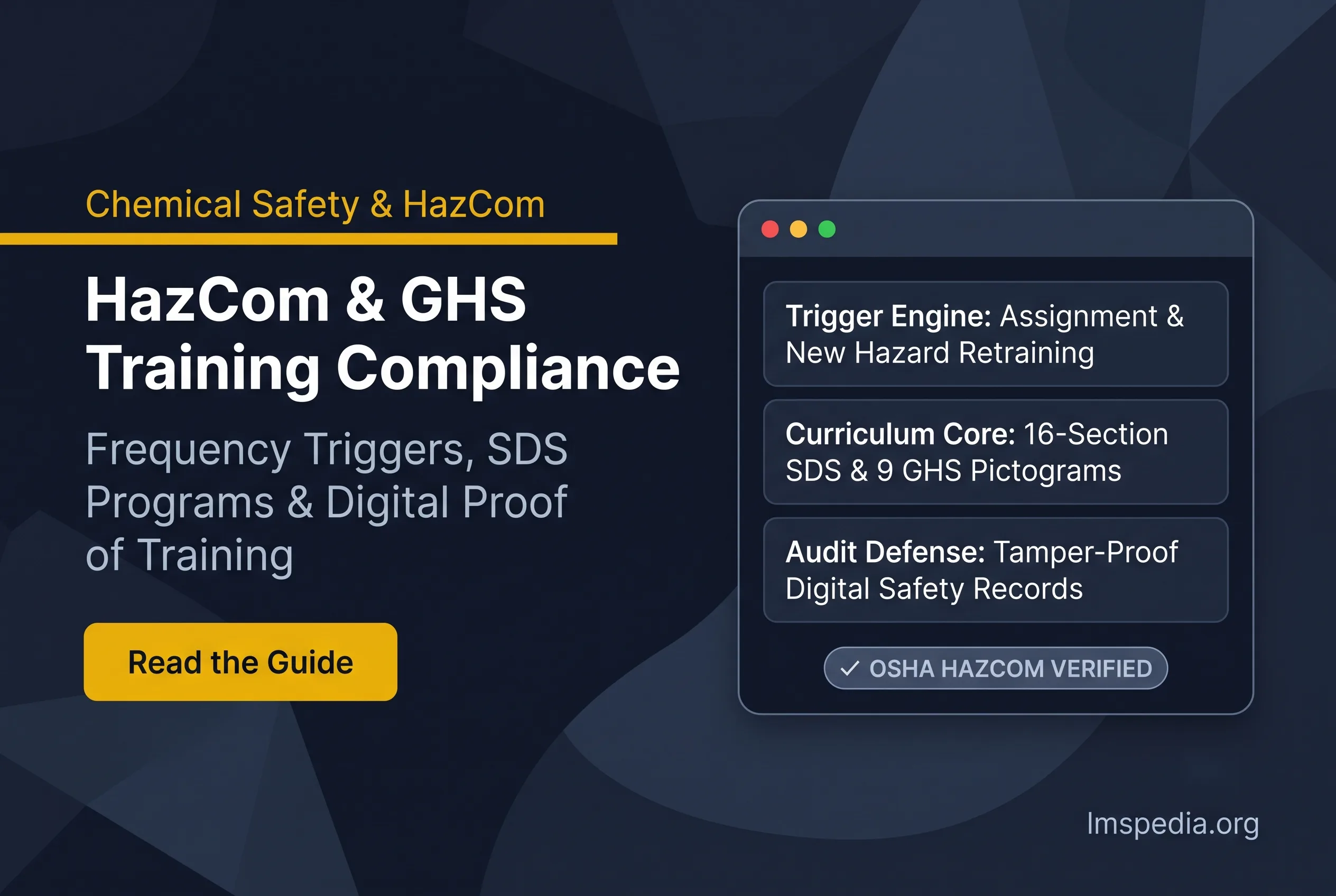
HazCom and GHS Training Compliance: Frequency, Content and Proof
Chemical exposure presents severe health risks to industrial employees globally. Millions of workers handle dangerous, toxic substances daily. Federal agencies aggressively enforce strict hazcom training requirements across all industrial sectors. Historical chemical manufacturers utilized conflicting warning labels and contradictory safety sheets. Today, a unified global standard dictates precise chemical safety protocols. Furthermore, enterprise buyers should cross-reference vendor capabilities against a comprehensive benchmark of core
training management system features to avoid functional compliance gaps.
Organizations must deploy comprehensive educational programs to protect their vulnerable workforce. Ignoring vital educational mandates invites catastrophic legal liabilities. In this guide, we break down specific GHS training compliance rules. Additionally, proactive safety managers leverage automated tools like a
training scheduling system to track recurrent training windows seamlessly.
Key Takeaways

Training is Event-Driven: Unlike standard annual compliance, HazCom training must occur at initial assignment and immediately whenever a new chemical hazard category is introduced to the workplace.
GHS Standardization is Mandatory: Organizations must utilize the Globally Harmonized System (GHS), teaching employees to instantly recognize the nine specific hazard pictograms and uniform signal words.
SDS Navigation Saves Lives: A core requirement of any hazard communication program is teaching workers how to locate, read, and understand the 16-section Safety Data Sheet (SDS) during an emergency.
Generic Content Fails Audits: Federal regulations require training to cover the specific hazards present in the actual workplace; off-the-shelf videos without site-specific customization violate compliance rules
Immutable Records are Critical: In the eyes of regulators like OSHA, undocumented training never occurred. Digital tracking systems ensure organizations can instantly produce timestamped completion records during unannounced inspections.
Understanding OSHA HazCom Training Requirements
Regulatory agencies refuse to tolerate corporate ignorance regarding workplace chemicals. Employers possess a fundamental legal duty to inform workers about chemical hazards. Federal regulations mandate formal hazard communication programs for every affected facility. Missing these critical compliance targets results in massive financial penalties instantly. For definitive federal guidance, consult the official
OSHA Hazard Communication Standard documentation closely. Safety managers must understand who requires this specialized instruction daily. Failing to train temporary contract workers creates immense shared legal liability.
Industrial workers historically suffered from severe toxic exposure without understanding risks. Labor advocates fought aggressively for the worker fundamental right to know. Employees hold a strict legal right to understand exact workplace chemical hazards. Safety training cannot remain a passive administrative checklist. Employers must actively ensure complete comprehension of all chemical dangers.
The Shift to the Globally Harmonized System (GHS)
International global trade demanded a standardized approach to chemical classification. Regulatory bodies adopted the Globally Harmonized System rapidly. This comprehensive framework standardizes toxicological classifications and physical hazard warnings. Your internal corporate training must explicitly cover these universal international standards. To explore the exact origins of this international framework, review the
UNECE GHS guidelines directly. Standardizing visual labels reduces fatal workplace accidents globally and eliminates language barriers across global supply chains.
Any employee exposed to hazardous chemicals requires formal safety training. Defining physical exposure often confuses corporate human resources departments. Exposure legally includes routine daily handling and foreseeable emergency chemical spills. Warehouse workers, janitorial staff, and laboratory technicians require immediate instruction. Administrative staff working adjacent to manufacturing floors require awareness training.
Avoid Generic Refreshers
Federal auditors scrutinize generic hazard communication videos. Train workers on actual chemical hazards present in their specific physical workplace.
Frequency Rules and Event-Driven Training Triggers
Federal compliance officers audit training expiration dates during unannounced inspections. OSHA dictates specific timing rules for hazard communication education. Unlike standard corporate HR regulations, this safety standard relies heavily on event-driven triggers. Administrators must actively monitor workplace changes closely rather than relying on annual calendars. Static spreadsheets fail to manage complex, dynamic training triggers safely. Safety managers need automated digital alerts to maintain absolute legal compliance.
Employers must train workers at the exact time of their initial assignment. Employees must understand chemical risks before touching hazardous containers. Putting new hires on warehouse floors without prior instruction violates federal law. Organizations must integrate this curriculum directly into mandatory onboarding workflows.
Core Content for an SDS Training Program
A fully compliant curriculum must cover specific technical safety components. Employees must thoroughly learn how to detect the physical presence of hazardous chemical releases. They must understand acute and chronic health hazards of workplace chemicals. Furthermore, an effective training program details personal protective equipment protocols perfectly. Building a comprehensive curriculum guarantees workers survive toxic emergencies.
Workers must recognize distinct warning signs of dangerous chemical leaks immediately. Training must cover visual cues, distinct odors, and automated environmental sensor alarms. Employees learn to trust their immediate senses and facility monitoring equipment equally. Furthermore, some highly toxic gases remain odorless and invisible to the naked eye. Workers must understand how to read personal wearable gas monitors accurately.
Managing Chemical Safety Training Records and Audits
Delivering safety training means nothing without proper documentation. In strict regulatory administrative law, unrecorded training never happened. Organizations must maintain impeccable chemical safety training records digitally. Vulnerable manual paper filing cabinets present an unacceptable operational risk for massive industrial operations. Paper records succumb to water damage, accidental fires, or malicious tampering.
During unexpected OSHA inspections, administrators have limited time to produce training logs. Auditors demand attendee names, timestamps, and exact curriculum topics immediately. Establishing robust
LMS for compliance training and audit evidence ensures absolute readiness. Missing digital timestamps or forged attendance signatures trigger severe financial citations. Furthermore, structuring user access controls correctly is vital. Review best practices for securing environments by studying how to
architect clear LMS user roles and permissions.
Digitize Attendance Logs
Eliminate paper sign-in sheets immediately. Automated digital timestamps protect your organization from costly citations during sudden regulatory audits.
Comparing Safety Training Management Platforms
Generic human resources software struggles to handle rigorous industrial compliance rules safely. Corporate procurement platforms must explicitly serve high-consequence environments. Furthermore, enterprise software strategies evaluated by analysts at
Gartner reinforce platform selection criteria. Reviewing multi-tenant comparisons like
Open LMS vs Totara Learn helps facility teams evaluate large-scale architectures. To review broad workplace safety advocacy strategies thoroughly, consult vital resources from the
National Safety Council.
| Platform / Solution |
Primary Focus |
Industrial Compliance Strength |
| SimpliTrain |
Versatile training operations and dynamic compliance scheduling. |
Excels at automated certification tracking, localized safety assignments, and securely preserving immutable audit records. |
| Vector Solutions |
Industrial safety and high-risk management training. |
Provides a massive library of 3D animated hazard courses specifically built for manufacturing environments. |
| SafetySkills |
Environmental Health and Safety digital e-learning. |
Delivers highly engaging, interactive OSHA-compliant modules integrated seamlessly with robust tracking dashboards. |
Conclusion
Maintaining strict chemical safety compliance requires continuous, unwavering operational vigilance. Massive industrial employers must treat hazard communication as a critical, life-saving operational protocol. Complex global organizations must embrace standardized GHS formats across all internal educational materials. Safety managers must track dynamic, event-driven training triggers flawlessly to remain fully compliant.
Leveraging modern training management software eliminates dangerous administrative blind spots. Automated digital systems ensure remote frontline workers constantly receive localized hazard instruction. Aggressively proactive safety education prevents catastrophic workplace injuries and shields organizations from devastating regulatory fines. For continued professional insights, explore
the LMSPedia blog archive.
Q1. Who is legally required to receive HazCom training?
Primarily, any employee who may be exposed to hazardous chemicals under normal operating conditions requires formal training. Furthermore, this mandate includes employees who could be exposed during foreseeable emergencies. Therefore, warehouse staff, production line workers, and maintenance technicians all fall strictly under this requirement.
Q2. How often does OSHA require HazCom refresher training?
Strictly speaking, OSHA does not mandate a rigid annual refresher schedule for hazard communication. Instead, employers must provide training at the time of initial assignment. Additionally, they must conduct immediate retraining whenever a new physical or health hazard is introduced into the work area. However, industry best practices strongly recommend annual refreshers to prevent safety complacency.
Q3. What is the difference between a hazard category and a specific chemical?
Crucially, OSHA requires retraining for new hazard categories, not necessarily new chemical brands. For example, if your workers already safely handle several flammables, introducing a new brand of flammable solvent does not trigger mandatory retraining. Conversely, if you introduce a corrosive chemical for the first time, you must conduct immediate training on corrosive hazards.
Q4. What must a compliant Safety Data Sheet (SDS) training program include?
Specifically, an effective SDS curriculum must teach workers the standardized 16-section document format. Furthermore, employees must learn exactly how to interpret acute health hazard statements. Additionally, they must understand how to rapidly locate critical first aid measures and appropriate personal protective equipment (PPE) requirements.
Q5. Why is digitizing chemical safety training records important?
Fundamentally, manual paper records easily become lost, damaged, or forged, inviting massive regulatory fines. Conversely, a digital Learning Management System automatically records exact completion timestamps, verifies quiz scores, and generates immutable audit trails. Ultimately, this allows safety managers to produce flawless compliance data instantly during high-pressure regulatory inspections.