
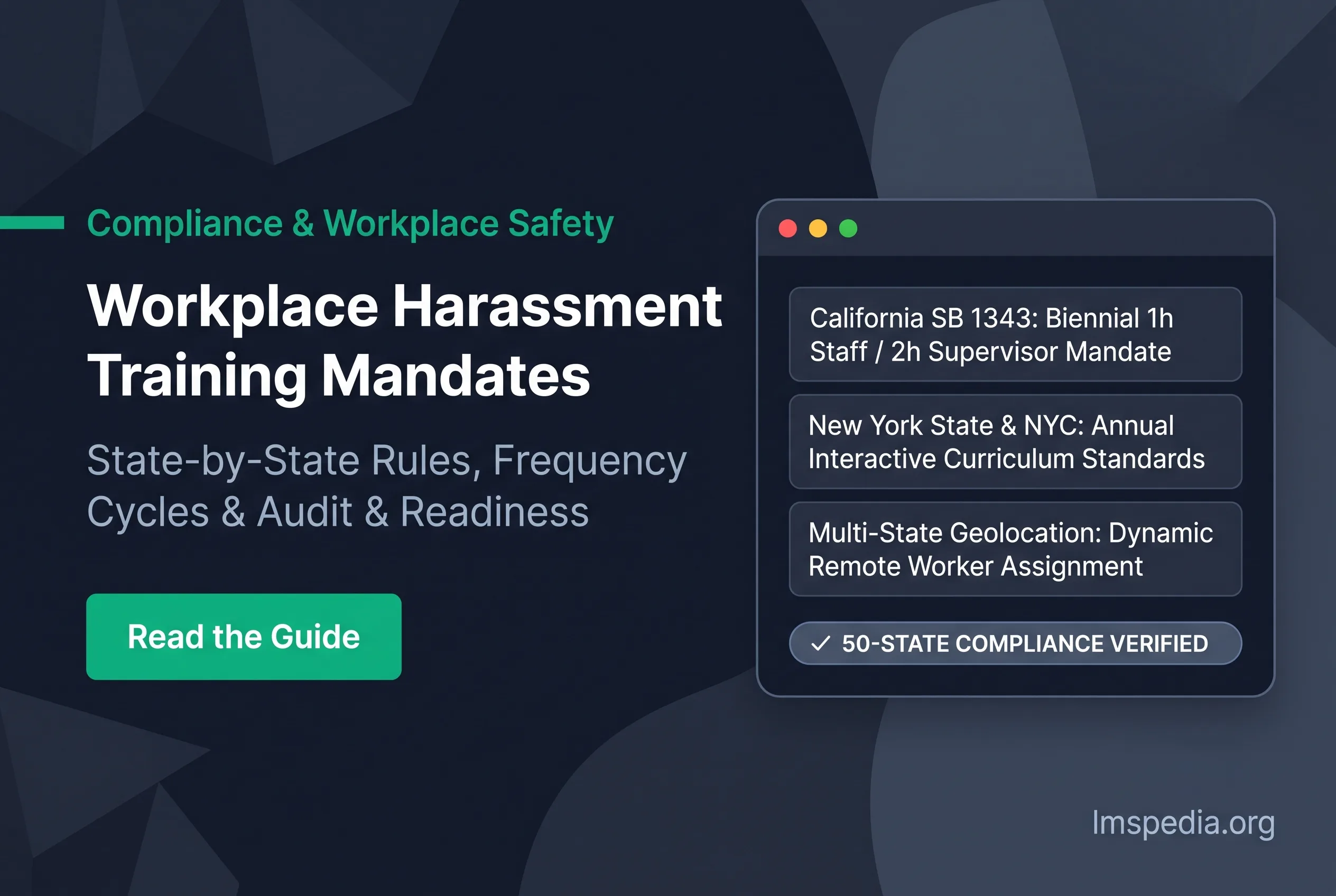
First, managing corporate compliance presents significant operational challenges for distributed human resources departments. Specifically, navigating employment law across multiple regional jurisdictions requires constant vigilance. Consequently, understanding harassment training state requirements remains an absolute priority for modern employers. Historically, the Equal Employment Opportunity Commission (EEOC) established foundational federal anti-discrimination guidelines. However, state legislatures have aggressively implemented their own mandatory statutory educational frameworks.
Therefore, relying strictly on federal recommendations leaves organizations highly vulnerable to localized civil liability. Ultimately, employers must deploy targeted, state-specific educational programs to satisfy statutory standards. In this comprehensive guide, we analyze the core sexual harassment training mandates across key jurisdictions. Furthermore, we examine the software infrastructure necessary to maintain permanent audit readiness across a national workforce. Additionally, you can explore foundational regulatory learning frameworks by reviewing expert LMSPedia resources.
Key Takeaways

Federal Guidelines Differ From State Laws: While federal EEOC guidance establishes broad protections, individual states enforce mandatory, legally binding training rules with specific content requirements.
Jurisdictional Rules Depend on Employee Location: Multi-state employers must train remote workers according to where the employee physically works, not where the corporate headquarters resides.
California SB 1343 Sets Rigorous Standards: California requires employers with five or more workers to deliver two hours of training for supervisors and one hour for non-supervisory employees every two years.
Interactivity Is a Legal Prerequisite: Passive policy distribution violates mandates in New York and California; courses must incorporate practical scenarios, knowledge checks, or interactive Q&A.
Audit Documentation Must Be Maintained: Employers must preserve immutable digital records, including completion dates, attendance logs, and course outlines, for at least two to five years.
Understanding Harassment Training State Requirements
Undoubtedly, the legal framework governing workplace conduct has transformed substantially over recent years. Initially, federal statutes served as the singular compliance benchmark for corporate training initiatives. Today, individual states proactively dictate the exact terms of mandatory workplace training. Consequently, a generic, off-the-shelf national training video no longer satisfies statutory auditors.
Instead, organizations must tailor curriculum deployment directly to the physical locations of their workers. Specifically, states enforce conflicting rules regarding trainee coverage thresholds and instructional duration. For instance, certain states mandate training strictly for supervisory leadership. Conversely, other jurisdictions require rigorous instruction for every part-time worker, temporary hire, and independent contractor.
The Legal and Financial Risks of Training Non-Compliance
Critically, failing to satisfy state-level educational mandates triggers severe administrative and financial repercussions. For example, state enforcement agencies can assess escalating civil fines against non-compliant entities. Moreover, plaintiff attorneys aggressively weaponize training non-compliance during wrongful termination or hostile work environment litigation. Consequently, failing to maintain complete training transcripts severely weakens standard affirmative legal defenses.
Furthermore, regulatory agencies routinely initiate broad systemic investigations following individual employee formal grievances. Ultimately, these regulatory audits disrupt routine operations and erode investor confidence. Therefore, forward-thinking executives treat compliance education as essential risk mitigation. Indeed, maintaining verifiable learning records provides crucial protection during civil litigation and administrative hearings.
State Training Compliance Matrix: Key Jurisdictions
Currently, no universal legislative standard exists across the United States. Instead, states establish distinct curriculum content requirements, delivery methods, and recency intervals. As a result, maintaining a dynamic state training compliance matrix remains vital for multi-state employers. Below, we summarize the primary statutory mandates governing the most heavily regulated jurisdictions.
| Jurisdiction | Employer Threshold | Mandated Frequency | Core Curriculum Requirements |
|---|---|---|---|
| California | 5 or more workers | Every 2 years | 2 hours for supervisors; 1 hour for non-supervisors. |
| New York | 1 or more workers | Annually | Interactive curriculum with practical scenarios and remedies. |
| Illinois | 1 or more workers | Annually | Specific industry modules for hospitality establishments. |
| Connecticut | 3 or more workers | Within 6 months of hire | 2 hours for all employees with periodic refreshers. |
| Delaware | 50 or more workers | Every 2 years | Interactive training covering harassment and retaliation rules. |
| Maine | 15 or more workers | Within 1 year of hire | Specific supplemental administrative training for supervisors. |
California SB 1343 Training Mandates
Specifically, statutory rules established under california sb 1343 training represent exceptionally strict corporate standards. First, California requires employers with five or more employees to deliver structured instruction. Moreover, supervisors must complete two hours of comprehensive education. Meanwhile, non-supervisory personnel must complete a one-hour training module.
Furthermore, workers must repeat this instructional curriculum every two years. Crucially, California mandates explicit coverage of abusive conduct prevention and workplace bullying. Additionally, the curriculum must address gender identity, gender expression, and sexual orientation discrimination. Ultimately, the California Civil Rights Department rigorously audits institutional training compliance records. Therefore, human resources teams must preserve timestamped records confirming timely course completions.
New York State and New York City Requirements
Similarly, new york harassment training statutes enforce aggressive employer compliance standards. First, every private and public employer in New York State must provide annual training. Notably, this statutory rule applies regardless of total employee headcount. Additionally, the state mandates that educational programs must be interactive.
For example, courses must incorporate participant knowledge checks or practical scenario exercises. Furthermore, the New York State Department of Labor requires employers to publish written complaint policies. Additionally, New York City employers with fifteen or more workers face supplemental local mandates. Consequently, urban employers must address bystander intervention and administrative reporting procedures. Finally, organizations must provide instructional materials in each worker’s primary spoken language.
Illinois Workplace Transparency Act
Moreover, the Illinois Workplace Transparency Act mandates comprehensive statewide workforce training. Under this statute, all Illinois employers must deliver annual sexual harassment prevention education. Specifically, the curriculum must outline clear definitions of unlawful conduct and statutory reporting paths. Furthermore, the state requires dedicated educational units addressing retaliatory conduct protections.
In addition, Illinois enforces supplemental training rules for restaurants and bars. Consequently, hospitality operators must train workers on industry-specific hazards and manager interventions. To understand effective instructional design frameworks for complex regulatory topics, review our compliance training examples analysis. Ultimately, failing to train Illinois workers invites severe statutory penalties from state human rights commissions.
Connecticut, Delaware, and Maine Mandates
Meanwhile, other regional jurisdictions enforce distinct regulatory timelines. First, Connecticut mandates two hours of training for all workers at firms with three or more employees. Furthermore, new staff must finish this instruction within six months of employment commencement.
Similarly, Delaware requires sexual harassment training for employers with fifty or more workers. Specifically, Delaware employers must deliver interactive coursework every two years. Finally, Maine mandates training for businesses employing fifteen or more workers. Under Maine law, onboarding staff must complete instruction within one year of starting work. Additionally, Maine supervisors must receive targeted instruction regarding immediate managerial responsibilities.
Sector-Specific State Mandates
Beyond general corporate rules, several states enforce sector-specific training standards. For instance, Washington State mandates specialized anti-harassment programs for isolated hospitality and retail staff. Specifically, hotel and janitorial personnel must learn physical safety protocols alongside harassment prevention. Furthermore, properties must supply panic buttons to isolated frontline workers.
Similarly, California enforces specialized training for seasonal agricultural labor and farm contractors. Consequently, generic office-based scenarios fail to satisfy regulatory auditors in these sectors. Instead, training directors must deliver localized scenarios reflecting daily physical work environments. Ultimately, understanding these sector nuances prevents regulatory exposure in specialized industries.
Managing Multi-State Compliance for Remote Workforces
Undeniably, modern distributed work models complicate corporate compliance operations. For instance, a company headquartered in Texas might employ remote professionals residing in California or New York. Legally, employment law mandates govern based on where the worker physically performs their duties. Therefore, the employer must deliver California-compliant or New York-compliant coursework to those remote individuals.
Consequently, manual administrative spreadsheets cannot scale across modern distributed workforces. Instead, enterprises must implement automated learning platforms featuring geographic auto-assignment logic. Specifically, the system must detect employee state residency and instantly assign the correct localized module. To explore next-generation compliance architectures, read our guide on LMS for corporate compliance training 2026.
Architecting Roles and Permissions for Compliance
Crucially, managing sensitive training records across distributed teams requires robust data governance. Specifically, regional HR managers require localized administrative visibility without compromising global corporate data. Furthermore, auditors must receive secure, temporary access to inspect verification artifacts during official investigations.
Consequently, learning management systems must support granular, role-based permission tiers. Specifically, system architects must separate learner, instructor, and auditor permissions securely. To configure these administrative tiers properly, review our technical breakdown on how to architect secure LMS user roles and permissions. Ultimately, structured permissions protect confidential employee records from unauthorized internal exposure.
Interactive Verification Mandate
Importantly, simply having workers sign an electronic handbook acknowledgment fails state compliance standards in New York and California. Specifically, statutory rules require interactive participation. Therefore, your learning platform must log participant quiz answers, scenario decisions, or live question submissions to prove legal compliance during audits.
Procuring Compliant Curriculum: Build vs. Buy
Inevitably, learning leaders face a strategic operational dilemma regarding compliance content. Specifically, teams must decide whether to develop custom courses internally or license commercial courseware. Historically, large corporations favored custom internal development to align with bespoke corporate branding. However, maintaining customized compliance content represents an immense ongoing financial burden.
For example, state legislatures routinely amend statutory definitions, reporting timelines, and protected classifications. Consequently, internal teams must constantly rewrite scenarios and rebuild digital assets to maintain legal alignment. Conversely, specialized compliance vendors employ full-time legal teams dedicated to regulatory tracking. Therefore, commercial vendors automatically update curriculum packages the exact day statutory revisions take effect. Ultimately, licensing vendor courseware significantly reduces corporate legal risk while lowering ongoing operational overhead.
Essential Recordkeeping and Audit Defense
Fundamentally, delivering training content represents only half of the regulatory mandate. In the eyes of administrative law, unrecorded compliance training never actually occurred. Therefore, organizations must establish tamper-proof digital recordkeeping procedures across all business units. Specifically, records must detail learner identities, completion timestamps, course versioning, and assessment outcomes.
Furthermore, states like California explicitly mandate maintaining compliance training records for at least two years. However, legal defense specialists recommend retaining all compliance logs for a minimum of five years. Consequently, this extended retention window covers relevant statutes of limitations for civil employment litigation. Ultimately, organizations must export structured verification packages instantly during formal discovery. To streamline this reporting workflow, check out our guide on LMS reporting, custom reports, and data exports.
Comparing Compliance Tracking Software Solutions
Naturally, tracking disparate state renewal timelines manually invites administrative failure. Therefore, enterprises deploy specialized learning and compliance management software to automate instructional distribution. Below, we compare leading software solutions based on their automated compliance tracking capabilities.
| Platform Solution | Primary Focus | Compliance & Multi-State Operational Strength |
|---|---|---|
| SimpliTrain | Versatile training operations and compliance scheduling. | Excels at localized training assignments, automated recency tracking, and unified multi-location compliance scheduling. |
| Docebo | Enterprise learning management and AI delivery. | Offers scalable audience rules and localized content delivery for enterprise global workforces. |
| Cornerstone OnDemand | Comprehensive talent and regulatory compliance. | Provides enterprise-grade compliance tracking, advanced reporting, and integrated audit record archives. |
Ultimately, selecting an automated operational system eliminates human scheduling errors. Furthermore, modern platforms deliver automated notifications to managers before employee certifications lapse. Consequently, automated escalation pathways prevent accidental non-compliance across distributed business units.
Building a Sustainable Compliance Training Strategy
Beyond mere legal box-checking, effective training programs actively shape organizational workplace culture. Therefore, organizations must integrate compliance education into broader talent development roadmaps.
Moving Beyond Checkbox Compliance
Too often, organizations treat mandatory harassment training as a tedious administrative chore. Consequently, employees rush through digital slides without internalizing critical behavioral expectations. Instead, instructional designers should build compelling, realistic narrative scenarios. Ultimately, relevant training helps staff recognize nuanced interpersonal dynamics and microaggressions.
Continuous Training and Refreshers
Furthermore, relying solely on biennial training cycles allows critical compliance knowledge to fade. Therefore, leading organizations distribute brief microlearning refreshers throughout the operating year. For instance, quarterly case reviews keep anti-harassment standards fresh in employee minds. Ultimately, continuous education fosters an inclusive and psychologically safe corporate environment.
Conclusion
In conclusion, navigating state-level workplace harassment training mandates requires constant operational diligence and technical structure. First, employers must look beyond broad federal guidelines to address localized statutory requirements. Furthermore, organizations must tailor instructional duration, delivery methods, and content to the physical jurisdiction of every worker. Consequently, understanding jurisdictional rules prevents unexpected regulatory fines and legal exposure.
Ultimately, leveraging an automated, modern compliance platform streamlines these complex multi-state operational demands. By implementing automated geographic enrollment, maintaining tamper-proof audit trails, and delivering interactive content, companies protect their workers and corporate standing. Finally, to discover tools capable of coordinating enterprise training logistics, examine our detailed review of the best training management software.
FAQ
Q1. Which US states legally require sexual harassment training?
Currently, several states mandate workplace harassment training by statute. Specifically, California, New York, Illinois, Connecticut, Delaware, and Maine enforce strict statewide requirements. Additionally, specific municipalities, such as New York City, enforce supplemental local mandates. Furthermore, other states strongly incentivize formal training by offering affirmative defense protections during civil litigation.
Q2. How does California SB 1343 define employer training thresholds?
Under California SB 1343, employers with five or more employees must provide formal harassment prevention training. This employee count includes full-time, part-time, seasonal, and temporary workers. Covered employers must provide at least two hours of training to supervisors and at least one hour to non-supervisory personnel every two years.
Q3. Do employers need to train remote workers residing out of state?
Yes, employment compliance mandates apply based on the physical location of the worker. If an employee resides and works remotely in New York, the employer must provide New York-compliant training. The geographical location of the company headquarters does not override localized state workplace mandates.
Q4. Can an employer satisfy New York mandates with a static handbook acknowledgment?
No, New York State explicitly prohibits passive policy reviews as a substitute for training. State law mandates that all anti-harassment training must be interactive. Therefore, digital learning modules must include participant checkpoints, scenario questions, or real-time surveys to satisfy statutory standards.
Q5. What records must an employer retain to prove training compliance?
Employers must maintain comprehensive records verifying individual employee participation. Documentation must include the full legal name of the employee, date of completion, specific course version taken, training modality, and passing assessment scores. Organizations should retain these digital logs for a minimum of three to five years to ensure complete audit defense.