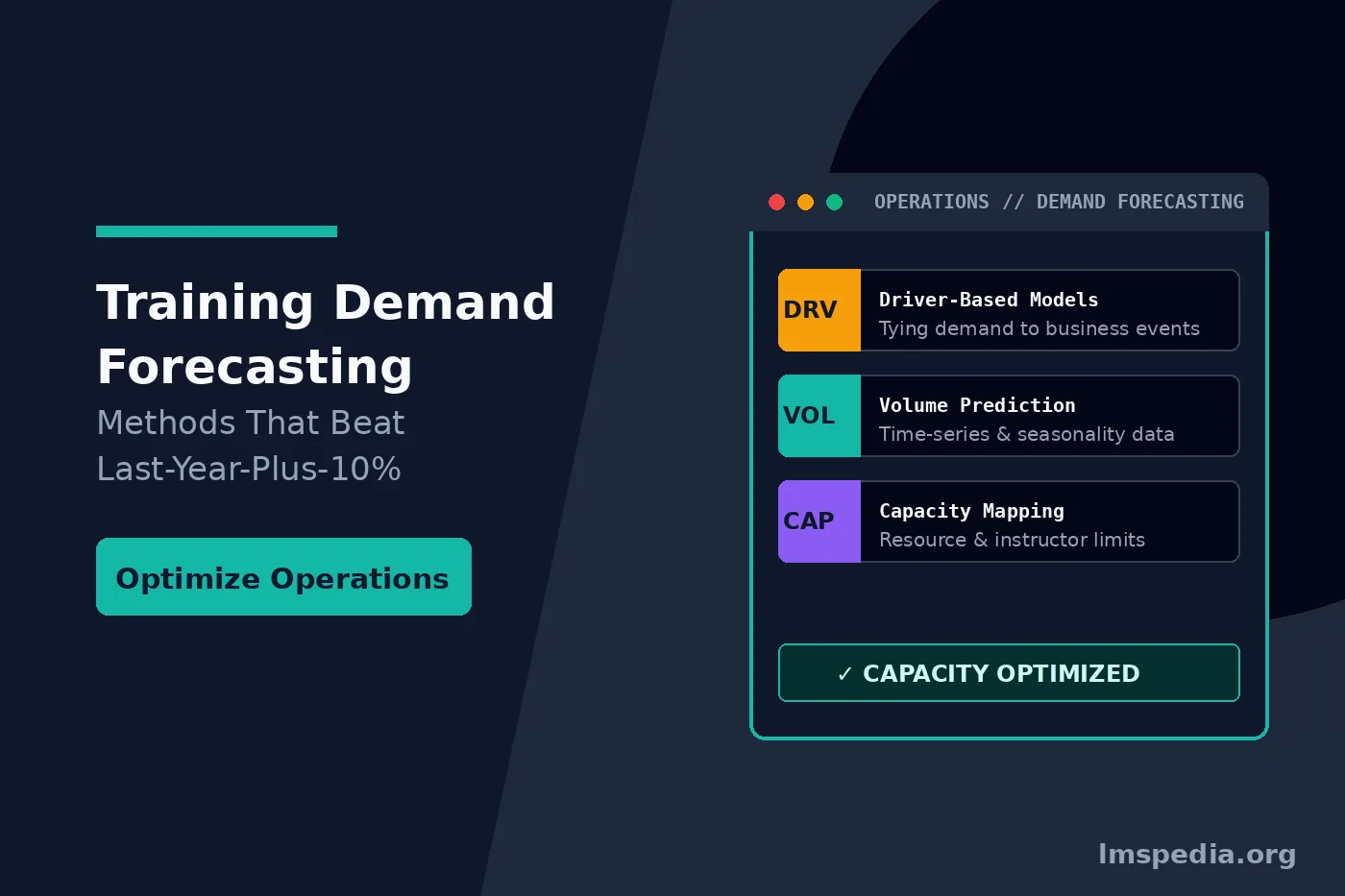
For decades, learning departments relied on a lazy planning metric: “Last year’s enrollment plus ten percent.” In a static economic environment, this rudimentary approach might occasionally prevent disaster. Today’s enterprise landscape is volatile. Rapid tech shifts, restructuring, and compliance changes are constant. Relying solely on historical data now guarantees operational failure. You might over-provision expensive instructors and destroy profit margins. Alternatively, you could under-provision server capacity and infuriate sudden influxes of learners.
Empty classroom seats represent unrecoverable sunk costs. These include instructor salaries, facility rentals, and administrative overhead. Conversely, waitlisting a required compliance course creates severe legal liability. It also severely delays employee productivity. The financial stakes of poor capacity planning are simply too high to leave to basic spreadsheet extrapolation.
Modern learning organizations must operate profitably and efficiently. This requires treating educational offerings like a global manufacturing supply chain. You must transition from reactive scheduling to proactive training demand forecasting. Operations teams must implement predictive models and integrate HR growth metrics. They should also map capacity constraints and leverage specialized software. This allows them to predict resource needs months or years in advance. This guide deconstructs the flaws of baseline historical planning. We will explore advanced methodologies for training pipeline forecasting and precise enrolment prediction.
Key Takeaways

Abandon Baseline Guessing:
The “last-year-plus-10%” model fails because it ignores shifting market drivers, new product rollouts, and sudden changes in corporate hiring strategies.
Leverage Driver-Based Models:
The most accurate forecasting method ties training demand directly to concrete business events, such as a mandate to hire 500 new sales reps or the rollout of a new enterprise software system.
Account for the Churn Multiplier:
Training forecasts must account for corporate attrition. Even if total headcount remains flat, a 15% turnover rate requires provisioning onboarding resources for the massive influx of replacement hires.
Translate Demand to Capacity:
Knowing 2,000 people need training is useless without calculating the exact number of instructors, virtual Zoom licenses, and LMS server capacity required to deliver it without crashing.
Automate the Logistics:
Managing complex, high-volume forecasts requires transitioning from manual spreadsheets to a specialized Training Management System (TMS) capable of algorithmic scheduling and conflict resolution.
The Fatal Flaw of “Last-Year-Plus-10%”
Historical baseline forecasting assumes that the conditions of the past will perfectly replicate themselves in the future. Suppose a provider sold 1,000 seats for an “Intro to Python” course in 2024. The baseline model dictates preparing for 1,100 seats in 2025. This model completely ignores external market drivers, shifting industry standards, and internal corporate pivots.
What if a major competitor releases a free, high-quality Python alternative? A sudden corporate hiring freeze in software engineering could also disrupt plans. Furthermore, a major Python version update might mandate urgent retraining for senior developers. This would completely alter your target demographic. Historical data cannot answer these questions. Consequently, demand planning training business leaders who rely solely on rearview-mirror metrics will inevitably misallocate their annual budgets.
Furthermore, the modern corporate environment is battling the rapidly shrinking “half-life of learned skills.” In technology and engineering sectors, a specific technical skill may now become obsolete within 2.5 years. Using five years of historical data for a software certification means analyzing dead data. Demand curves for dying technologies do not slope gently downward. They fall off a cliff once a superior tool achieves market dominance.
Predicting learner volume requires first identifying the specific skills your market actually needs. This foundational step requires moving beyond simple annual surveys. Organizations should deploy advanced training needs assessment tools to map upcoming capability gaps against the corporate strategic roadmap. Once you know exactly what needs to be taught, you can begin calculating how many people need to learn it.
Advanced Core Methodologies to Forecast Course Demand
To accurately forecast course demand, organizations must blend quantitative data analysis with qualitative market intelligence. Implementing a multi-model approach smooths out statistical anomalies and provides a highly defensible budget request to the Chief Financial Officer.
1. Quantitative Time-Series Analysis (with Seasonality and Anomaly Correction)
Basic historical data is flawed within static formulas. However, it provides a critical baseline when adjusted for cyclical trends and outliers. Time-series forecasting analyzes past enrollment data while factoring in distinct seasonality. For example, IT training companies often see massive enrollment spikes in November. Corporations are burning through remaining end-of-year training budgets. Conversely, severe dips occur in August due to European holidays.
Analysts apply advanced statistical models like ARIMA or Holt-Winters Exponential Smoothing to historical LMS data. This calculates seasonal indices accurately. This mathematical approach prevents operations teams from panicking over a temporary summer enrollment dip that is entirely statistically normal. Crucially, operations analysts must clean their data before running these models. A sudden regulatory shift causing a massive spike in March 2023 is a statistical anomaly. Failing to isolate and remove that outlier will permanently corrupt your time-series forecast for all future Q1 projections.
2. Driver-Based Forecasting (The Corporate Multiplier)
This is the most accurate forecasting method for internal corporate learning departments. Driver-based forecasting ties training volume directly to specific, known business events (the drivers). It shifts the conversation from “what did we do last year?” to “what is the business attempting to execute this year?”
A VP of Sales announcing plans to hire 200 new Account Executives in Q3 is a hard driver. Each new hire requires a 40-hour boot camp, five e-learning modules, and live management coaching. Therefore, the Q3 enrolment prediction for the sales onboarding curriculum is explicitly calculated based on the HR hiring mandate.
Other critical internal drivers include Mergers and Acquisitions (M&A). Suppose your company acquires a smaller firm with 500 employees. Driver-based forecasting mandates routing these personnel through compliance and cybersecurity onboarding. This must happen within 60 days of closing. Driver-based models operate on absolute mathematical certainty regarding corporate intent.
3. The Delphi Method (Qualitative Consensus)
When launching an entirely new course where zero historical data exists, quantitative models fail. In these scenarios, organizations utilize the Delphi Method. This involves assembling a panel of Subject Matter Experts (SMEs), Sales Directors, and Product Managers. The panel is presented with market research regarding the new course topic and asked to independently estimate demand.
These estimates are aggregated, anonymized, and redistributed for a second voting round. The group also reviews reasoning behind extreme estimates. This iterative process eliminates the “loudest voice in the room” bias. Senior executives can often have unrealistic expectations about course popularity. After several rounds of anonymous refinement, the group converges on an accurate consensus forecast.
4. Machine Learning and Multivariate Predictive Analytics
For massive, global enterprise learning networks, manual forecasting is giving way to AI-driven predictive analytics. Modern data lakes ingest unstructured enterprise data. This includes Slack sentiment analysis, IT ticket volumes, and macroeconomic indicators.
Machine learning models spot trends quickly. A 15% increase in Azure-related IT tickets might indicate engineering deployment struggles. The algorithm then forecasts a localized demand spike for Azure training. It prompts the learning department to provision resources proactively. This represents the pinnacle of proactive training pipeline forecasting.
Commercial Training: CRM Pipeline as a Leading Indicator
For B2B commercial training providers (companies that sell training to other corporations), internal HR drivers are useless. Instead, they must integrate their Training Management System (TMS) directly with their Customer Relationship Management (CRM) platform.
In the commercial sector, the CRM pipeline is the ultimate leading indicator of future resource demand. A sales team might move a massive contract into the “Verbal Agreement” stage. Operations should not wait for signatures to provision instructors. Operations directors can apply probability weightings to the CRM pipeline. This mathematically forecasts required instructor hours and server bandwidth 90 days out. Integrating CRM probability logic with TMS scheduling prevents firms from selling unfulfillable contracts.
Integrating Corporate HR Data: Attrition, Mobility, and the Churn Multiplier
For corporate universities, training pipeline forecasting relies entirely on your Human Resources Information System (HRIS) connection. Training demand is a direct mathematical derivative of employee headcount fluctuations, but relying on “total headcount” is a dangerous oversimplification.
A sophisticated forecasting model must calculate the “Churn Multiplier.” Your organization might maintain 5,000 employees but suffer 15% annual attrition. You are not planning for a static workforce. You must provision onboarding resources for the 750 new employees hired simply to backfill the churn. The total headcount never changed, but the training department absorbed 750 onboarding lifecycles.
Furthermore, internal mobility—promotions and lateral department transfers—triggers massive training demands. Promoting an individual contributor to management triggers mandatory leadership training. It also requires conflict resolution workshops and HR compliance modules. A lateral transfer from Marketing to Product Management triggers a total cross-skilling requirement.
Managing the digital logistics of this constant, churning workforce requires automated infrastructure. Manually creating LMS accounts for 500 new hires is a severe operational bottleneck. Assigning their specific departmental curriculum takes too long. Enterprise IT architectures solve this by linking the central HR directory directly to the learning platforms via automated identity management. Engineering teams must review how SCIM protocols automate secure user provisioning. This guarantees forecasted demand flows into actual system access without manual intervention.
Scenario Planning: Building Agile Capacity Buffers
No forecast is perfectly accurate. Recognizing this, elite operations teams employ scenario planning to build flexible capacity buffers. Instead of generating a single rigid number, they generate three specific forecasts: Best Case, Worst Case, and Most Likely Case.
Your “Most Likely” forecast might indicate 40 instructor-led sessions. However, the “Best Case” scenario might demand 60. Operations teams must identify a contingency plan. This involves cultivating trusted external contract trainers available on short notice. Alternatively, teams can secure scalable virtual classroom licenses for immediate expansion. Scenario planning guarantees a pre-approved tactical response when reality diverges from forecasts.
Translating Demand into Logistical Resource Capacity
Predicting that 2,000 learners need a November course is useless without logistical delivery capacity. The ultimate goal of training demand forecasting is resource optimization. Once the demand volume is established, operations teams must translate those learner numbers into specific, physical and digital capacity requirements.
| Resource Category | Capacity Calculation Metric | Risk of Under-Forecasting |
|---|---|---|
| Instructor Utilization | Total forecasted classroom hours divided by the maximum billable hours per instructor. | Severe instructor burnout, forced class cancellations, and reliance on expensive emergency trainers. |
| Physical / Virtual Classrooms | Forecasted concurrent sessions mapped against available physical rooms or virtual license limits. | Double-booked rooms, inability to host sessions, and degraded learner experiences. |
| Server Infrastructure | Forecasted concurrent digital logins mapped against current LMS hosting tiers. | Catastrophic database crashes during peak compliance deadlines or major corporate software rollouts. |
| Content Development (ISD) | Forecasted course requirements multiplied by standard Instructional Design ratios. | Rushed, poor-quality course material; missed launch deadlines; use of outdated legacy content. |
| SME Availability | Hours required from internal Subject Matter Experts to validate technical content prior to launch. | Technical inaccuracies in training material, leading to critical operational errors. |
| Support Operations | Ratio of forecasted active learners to standard tier-1 helpdesk support tickets. | Massive IT ticket backlogs, locked-out users, and a plummeting Net Promoter Score. |
The digital infrastructure component is frequently overlooked until a disaster occurs. Massive spikes in digital users require proactive server architecture testing. An organization-wide cybersecurity mandate could easily collapse an untested system under concentrated load. Scaling digital capacity requires deliberate engineering stress tests. IT departments must execute rigorous LMS load testing and performance benchmarking. This validates server auto-scaling configurations before the surge hits.
Leveraging TMS and Algorithmic Scheduling
Managing complex variables like instructor availability and room conflicts is impossible using spreadsheets. Organizations that master demand planning training business logic rely heavily on specialized Training Management Systems (TMS).
A TMS differs fundamentally from a standard LMS. An LMS delivers e-learning content to students. A TMS focuses entirely on back-office logistics and physical resource optimization. A robust TMS algorithmically maps forecasted sessions against available instructors. The software instantly cross-references certifications, contracted hours, and vacation schedules. This prevents illegal or impossible rosters.
Organizations must deploy specialized software architectures to eliminate human error from the scheduling matrix. Explore the specific technical configurations required for automated course scheduling and TMS setup to streamline your back-office operations.
Furthermore, managing these operations globally introduces complex financial variables. London-based instructors traveling to New York create complex accounting issues. Departments must calculate cross-departmental chargebacks, multi-currency expenses, and regional taxes. Forecasting is not just about seats; it is about forecasting the precise budget required to execute the delivery. Training directors should consult comprehensive guides on managing training operations management at scale to structure these frameworks.
Treating corporate learning as an unpredictable, reactive expense center is a fundamental operational failure. By discarding the outdated “last-year-plus-10%” mentality and adopting rigorous training demand forecasting, learning departments transform into strategic, data-driven business units. Mastering training pipeline forecasting guarantees operational efficiency. Teams can utilize driver-based models or conduct time-series analysis for seasonal spikes. Leveraging advanced algorithmic TMS software also optimizes capacity mapping. Accurate enrolment prediction guarantees your organization always possesses sufficient resources. You will have the exact instructors, classrooms, and servers required for flawless execution.
FAQ
Q1. What is training demand forecasting?
It is the analytical process of predicting the future volume of learners, required courses, and necessary instructional resources using statistical modeling, business drivers, and qualitative analysis, rather than simply guessing based on past performance.
Q2. What is driver-based forecasting in corporate learning?
Driver-based forecasting calculates training needs based on specific, planned business events. Instead of looking at past data, it looks at future drivers—like a planned merger, a new software implementation, or a hiring surge and calculates the exact training volume required to support that specific event.
Q3. How does the Delphi Method work for forecasting new courses?
When there is no historical data for a new course, the Delphi Method gathers independent predictions from a panel of subject matter experts. Their estimates are aggregated, anonymized, and reviewed iteratively until the group reaches a highly accurate consensus on anticipated demand.
Q4. What is the difference between an LMS and a TMS in demand planning?
An LMS (Learning Management System) is primarily designed to deliver e-learning content to the student. A TMS (Training Management System) is an operational tool designed for the back-office; it handles resource forecasting, automated instructor scheduling, cost tracking, and complex logistical logistics.
Q5. Why is HR data critical for training pipeline forecasting?
Because training volume is mathematically tied to employee movement. Accurate forecasts require real-time HR data regarding anticipated new hires, internal departmental transfers, promotion rates, and projected employee attrition (churn).