
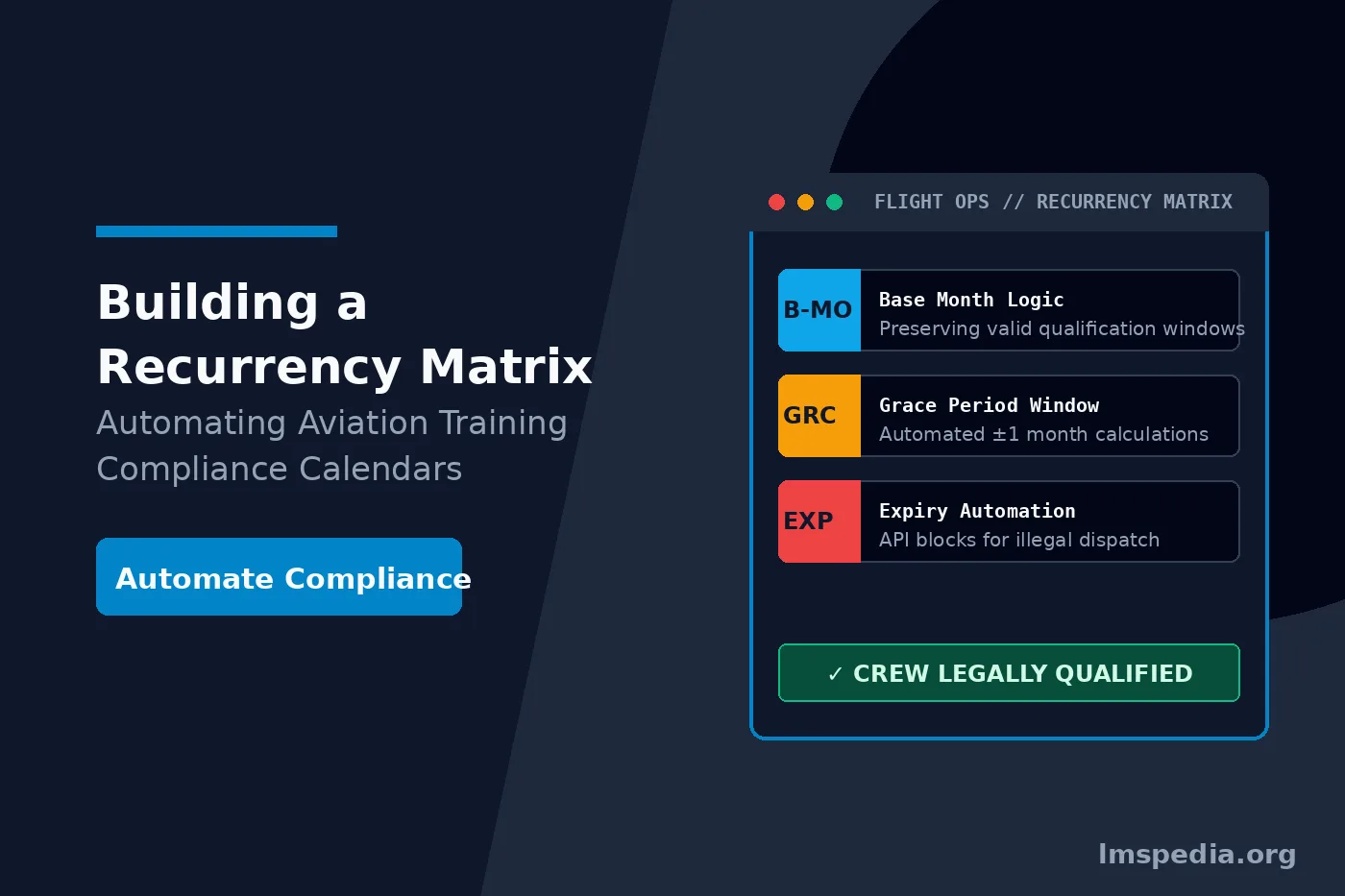
In the highly regulated aviation industry, a single expired certification grounds a crew member, disrupts the rostering schedule, and ultimately costs the airline thousands of dollars in operational delays. Historically, airlines and maintenance organizations managed these complex expirations using fragile, interconnected spreadsheets. However, relying on manual data entry to track volatile certification lifecycles is a catastrophic compliance risk. To guarantee operational readiness and survive rigorous safety audits, aviation training departments must engineer a dynamic, automated training recurrency matrix.
A recurrency matrix is not merely a list of expiration dates. It is a complex architectural blueprint that maps specific job roles to regulatory training mandates, calculates intricate grace periods, and triggers automated alerts before a crew member loses their legal operating privileges. In this technical guide, we deconstruct the mechanics of recurrency tracking aviation. We will explore how to calculate standard base months, structure an enterprise-grade aviation compliance calendar, and implement training due date automation to permanently eliminate manual tracking errors.
Key Takeaways

The Matrix Architecture:
A recurrency matrix must map specific job profiles to exact regulatory codes, defining the exact validity period and grace window for every individual training event.
The “Base Month” Challenge:
Standard LMS expiration logic (365 days) fails in aviation. Aviation software must support “Base Month” logic, preserving a pilot’s original qualification month even if they complete recurrent training early within an approved grace period.
Conditional Logic is Required:
Expiration rules often change based on variables like an employee’s age (e.g., medical certificates) or accumulated flight hours, requiring dynamic software rather than static spreadsheets.
API Integration with Rostering:
The ultimate compliance safeguard is integrating the automated recurrency matrix directly with the crew scheduling system via API, physically preventing the dispatch of an expired crew member.
Proactive Escalation:
An effective system does not wait for expiration. It uses staggered, automated alerts at 90, 60, and 30 days to ensure training is scheduled well before the legal grace period closes.
The Anatomy of a Crew Currency Matrix
Unlike standard corporate learning where a course is taken once, aviation training is cyclical. Pilots, cabin crew, dispatchers, and maintenance technicians operate under strict currency requirements. If a pilot does not complete their recurrent simulator check within the legally mandated window, they instantly lose their legal authority to fly. A robust crew currency matrix tracks these overlapping lifecycles simultaneously.
Building this matrix requires defining three core dimensions for every single training event:
- The Qualification Profile: What exact combination of courses, simulator checks, and line checks constitutes a valid qualification for a specific aircraft type (e.g., A320 Captain vs. B737 First Officer)?
- The Validity Period: Exactly how many months is the specific training event legally valid?
- The Regulatory Reference: Which specific paragraph of the national aviation authority’s legal code dictates this requirement?
Mapping these requirements accurately is critical, as the rules vary significantly depending on the operator’s jurisdiction and the specific crew position. To understand the baseline timelines that dictate these matrix calculations for flight crews, organizations must review standard pilot recurrent training requirements and frequency guidelines.
Decoding Aviation Grace Periods and Base Months
The primary reason standard Learning Management Systems (LMS) fail in aviation environments is their inability to handle “Base Month” logic. In a standard corporate LMS, if a user completes an annual course on March 15th, the system sets the expiration date to March 15th of the following year. In aviation, this static 365-day calculation violates regulatory scheduling practices.
Aviation authorities, such as the FAA and EASA, utilize a “Base Month” (or “Reference Month”) system to provide rostering flexibility. If a pilot completes their initial qualification in October, October becomes their permanent base month for that specific requirement. When their annual recurrent training is due the following year, the regulations typically provide an “eligibility window.”
This window usually spans three months: the month prior to the base month, the base month itself, and the month following the base month. If the pilot completes the training at any point within this three-month window, they retain their original October base month for the subsequent year. This prevents a pilot’s training due date from slowly creeping earlier into the year simply because they completed their recurrency check a few weeks early to accommodate a flight schedule.
If your training software cannot calculate this exact three-month sliding window and lock the original base month, your scheduling department will be forced to calculate dates manually, inevitably leading to a grounded aircraft.
Architecting the Matrix: A Structural Template
To digitize your compliance tracking, you must first construct a standardized data architecture. Below is a foundational template demonstrating how a training recurrency matrix should be mapped before it is imported into a database.
| Training Code | Course Description | Target Audience | Validity (Months) | Grace Window | Regulatory Ref (EASA/FAA) |
|---|---|---|---|---|---|
| SIM-REC-01 | Operator Proficiency Check (OPC) | Flight Crew (All) | 6 Months | Base Month ± 1 | ORO.FC.230 |
| CRM-ANN-02 | Crew Resource Management (Recurrent) | Flight & Cabin Crew | 12 Months | Base Month ± 1 | ORO.FC.115 |
| DGR-CAT-10 | Dangerous Goods (Cat 10) | Flight Crew / Dispatch | 24 Months | Base Month – 3 | IATA DGR 1.5 |
| MED-C1-00 | Class 1 Medical Certificate | Flight Crew | 12 (or 6 if >60 yrs) | Up to 45 days prior | MED.A.045 |
Notice the complexity in the final row. A Class 1 Medical Certificate’s validity period changes dynamically based on the age of the crew member. A static spreadsheet cannot calculate a rule that states: “Validity equals 12 months, unless the pilot’s date of birth indicates they are over 60 years old, in which case validity equals 6 months.” This level of conditional logic requires specialized, aviation-grade software.
Transitioning to Training Due Date Automation
Once the logic of the training recurrency matrix is finalized, organizations must transition to absolute training due date automation. This shift eliminates the administrative overhead of cross-referencing flight logs with Excel trackers.
An automated architecture operates on a continuous feedback loop. When a ground instructor grades a trainee in the digital system, or an examiner signs off on a simulator session on a tablet, the training management system instantly updates the employee’s compliance profile. The system calculates the new expiration date based on the specific base-month logic configured for that course. Simultaneously, the system projects the next required training date onto the organization’s centralized aviation compliance calendar.
This automated calendar must feature proactive escalation protocols. The system should not simply wait until a qualification expires to send an alert. Instead, it must trigger a staggered notification sequence:
- 90 Days Out: Automated alert sent directly to the Crew Rostering/Planning department to block out simulator time.
- 60 Days Out: Notification sent to the individual crew member and the Chief Pilot alerting them of the impending training window.
- 30 Days Out (Entering Grace Period): Critical alert generated for the compliance officer. The crew member is flagged in the rostering system with a “warning” status.
- 0 Days (Expiration): Hard lock engaged. The system communicates via API to the flight operations software, legally barring the crew member from being assigned to a live flight.
Integrating with Crew Rostering Systems
The ultimate goal of recurrency tracking aviation is seamless integration with crew scheduling software (such as AIMS, Sabre, or Jeppesen). If your training system and your rostering system operate in isolated silos, you are vulnerable to dispatching an unqualified crew member.
Through secure API integrations, the training matrix acts as the master source of truth for compliance. When a scheduler attempts to assign a pilot to a four-day pairing, the rostering system queries the training matrix in real-time. If the matrix indicates that the pilot’s Dangerous Goods certificate will expire on day three of the pairing, the rostering system physically blocks the assignment. Choosing software capable of these deep operational integrations is paramount; compliance officers must carefully evaluate the best aviation training management systems designed specifically for these high-stakes data handoffs.
Linking Recurrency to Competency Frameworks
It is vital to recognize that recurrency tracking is no longer just about tracking dates and hours; it is about tracking sustained proficiency. Global aviation regulators are aggressively shifting toward Competency-Based Training and Assessment (CBTA). Therefore, your recurrency matrix must track when a crew member is due for an evaluation, but it must also integrate with the underlying grading rubrics used during that evaluation.
If a pilot completes their recurrent simulator check within the legal time frame, but scores poorly on “Flight Path Management,” the recurrency matrix should automatically trigger a targeted remedial training event before resetting their base month. To align your expiration tracking with these modern grading standards, you must deeply understand the mechanics of designing an aviation competency framework.
Regulatory Compliance and Data Retention
Automating your aviation compliance calendar introduces stringent data governance responsibilities. Aviation authorities do not just audit whether your crew is currently qualified; they audit the historical record to ensure they were qualified during every flight they operated over the past several years. Ensure you consult the specific EASA flight crew licensing mandates or corresponding FAA regulations regarding digital signatures and audit trails.
If an incident occurs, investigators will demand the exact digital training record of the crew involved, including the timestamp of when their recurrency matrix was updated and who authorized the sign-off. Consequently, the database housing your compliance matrix must adhere strictly to federal archiving standards. To ensure your automated system survives a post-incident audit, review the strict protocols governing aviation training records retention.
Conclusion
Operating an airline or a Part 145 repair station using manual spreadsheets to track employee qualifications is an unsustainable practice that invites massive regulatory fines and catastrophic safety failures. By defining a rigorous training recurrency matrix, organizations transform chaotic expiry dates into predictable, actionable data.
Implementing training due date automation through specialized aviation software ensures that complex base-month logic and conditional grace periods are calculated flawlessly. When this dynamic crew currency matrix integrates directly with flight operations and crew rostering systems, organizations achieve absolute compliance certainty. Ultimately, mastering recurrency tracking aviation protects the operator’s financial bottom line, secures their operating certificate, and most importantly, guarantees the safety of the flying public.
FAQ
Q1. What is a training recurrency matrix?
A training recurrency matrix is a structured data framework used in regulated industries (like aviation) to map employee roles against mandatory training events, tracking their specific validity periods, grace windows, and regulatory compliance status.
Q2. How does an aviation "Base Month" differ from a standard expiration date?
In standard systems, taking a course on March 15th sets the next due date to March 15th of the following year. In aviation, if October is the pilot’s “Base Month,” they can typically take their recurrent training in September, October, or November without losing their permanent October base month status for future years.
Q3. Why shouldn't airlines use Excel for recurrency tracking?
Excel cannot calculate complex, overlapping base-month grace periods, it lacks secure digital signatures for legal sign-offs, it does not send automated push notifications to crew members, and it cannot integrate via API with flight rostering software to prevent illegal dispatching.
Q4. What happens if an aviation professional misses their recurrency window?
If the grace period expires without the training being completed and documented, the individual’s qualification is legally suspended. They are immediately grounded and cannot perform operational duties until they complete a reinstatement process, which often requires more intensive training than standard recurrency.
Q5. How does automated recurrency tracking improve airline profitability?
By forecasting training due dates 90 days in advance, automated tracking prevents last-minute schedule disruptions and grounded flights. It allows planning departments to optimize simulator usage and ensure crew members are trained efficiently without unnecessary downtime.