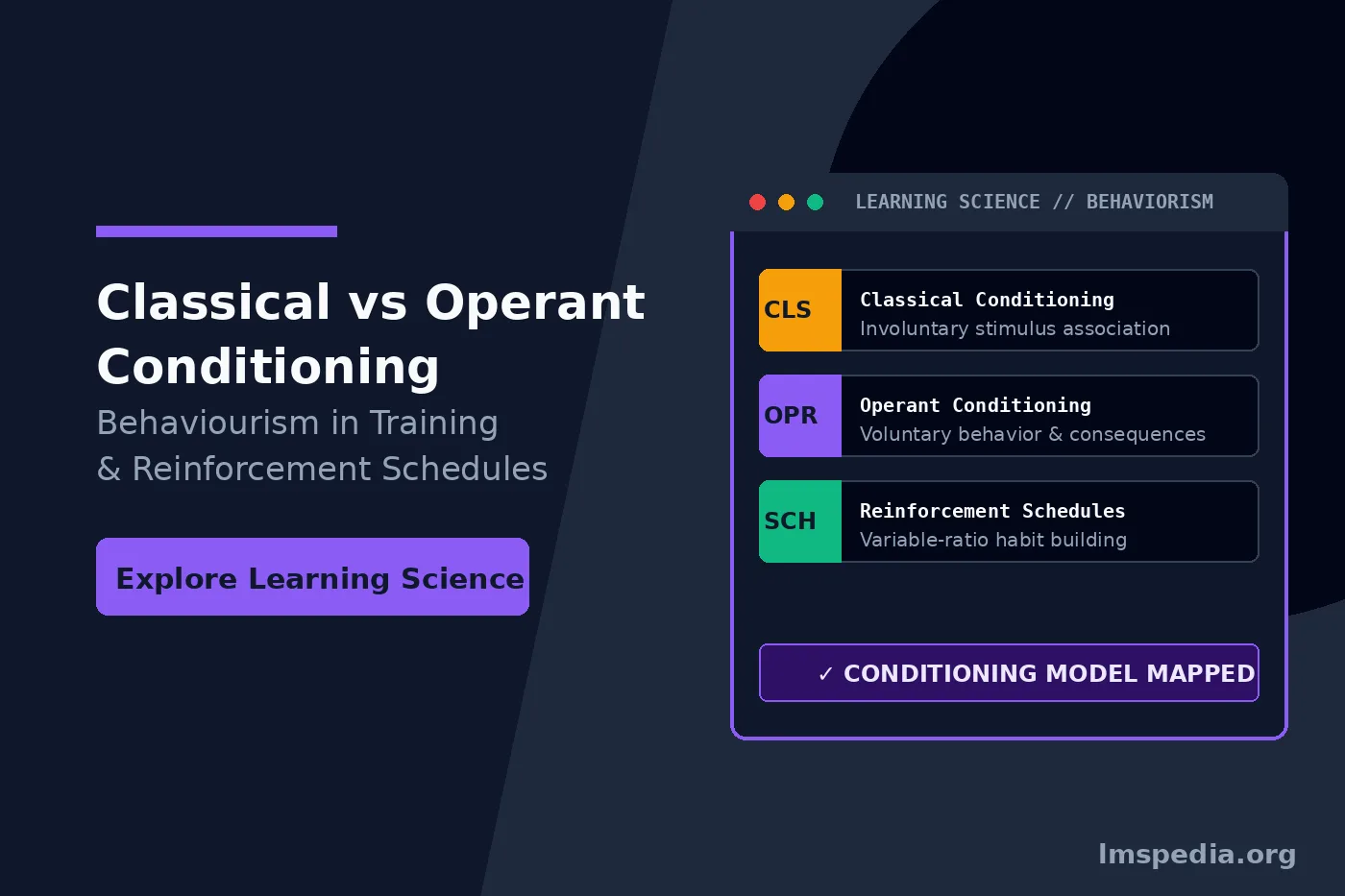
Classical vs Operant Conditioning: Behaviorism in Corporate Training
Modern instructional design frequently prioritizes cognitive and constructivist learning theories, focusing heavily on how learners process information and construct meaning. However, when an organization needs to drive immediate, observable changes in employee actions, such as enforcing strict safety protocols or driving sales compliance, behavioral psychology remains the most effective tool in a training manager’s arsenal. Understanding the fundamental differences between classical vs operant conditioning is not merely an academic exercise. It represents a critical competency for designing digital learning environments that actually change workplace behavior. Modern learning operations require robust digital environments to succeed. Therefore, leaders must audit their technical architecture continuously.
When training fails to produce results, the failure often stems from a misalignment of psychological triggers. Applying a classical conditioning approach when an operant conditioning model is required will waste organizational resources and frustrate learners. In this comprehensive guide, we dissect the mechanics of behaviourism in training. We will explore concrete classical conditioning examples training professionals use daily, decode how to implement operant conditioning workplace strategies, and analyze how varying reinforcement schedules learning mechanics drastically impact long-term knowledge retention. Additionally, enterprise buyers should cross-reference vendor capabilities against a comprehensive benchmark of core training management system features to avoid functional training gaps.
Key Takeaways

Core Distinction:
Classical conditioning focuses on engineering involuntary, automatic responses by pairing environmental stimuli, whereas operant conditioning shapes voluntary, conscious behaviors through consequences (rewards and punishments).
Behaviorism in Corporate Training:
Behavioral theories disregard internal mental states and focus solely on observable, measurable changes in physical workplace behavior, the critical metric for compliance and safety training.
Operant Conditioning in Gamification:
Gamified LMS features (badges, leaderboards, points) are direct applications of operant conditioning, utilizing positive reinforcement to increase voluntary engagement.
The Power of Intermittent Reinforcement:
Continuous reinforcement builds new habits quickly but fades rapidly. Variable-ratio schedules (unpredictable rewards) produce the highest, most sustained behavioral engagement and resist extinction.
System Automation is Required:
Executing complex behavioral modification strategies across thousands of employees requires enterprise LMS infrastructure with automated rules engines and secure, immediate identity provisioning.
The Foundations of Behaviourism in Corporate Training
Defining Observable Behavioral Change
Behaviorism operates on a singular, foundational premise: learning is defined as a relatively permanent change in observable behavior caused by experience. Unlike cognitive theories that attempt to map internal mental states, memory encoding, or intrinsic motivation, behaviorism focuses exclusively on external stimuli and resulting physical responses. If an employee completes a safety course but continues to operate machinery without safety goggles, a behaviorist concludes that zero learning has occurred. This holds true regardless of the employee’s perfect score on the final written assessment.
Quantifying Training Needs
In highly regulated industries, observable behavioral change is the only legal metric of success. Before investing heavily in behavioral interventions, organizations must utilize advanced training needs assessment tools to quantify exactly which human behaviors require modification. Once organizations identify those target behaviors, instructional designers must choose the correct behavioral conditioning framework to drive that specific change. Furthermore, leveraging enterprise platforms documented by market analysts at Gartner helps validate broader corporate learning strategies.
Classical Conditioning: Engineering Involuntary Responses
Pavlovian Conditioning and Passive Learners
Ivan Pavlov discovered classical conditioning, which occurs when trainers pair a naturally occurring stimulus with a neutral stimulus. Over time, the neutral stimulus begins to evoke the exact same involuntary, automatic response as the natural stimulus. In classical conditioning, the learner is entirely passive. Their physiological or emotional response happens automatically based on environmental triggers.
Classical Conditioning Examples in Training Design
While we rarely try to induce salivation in corporate learners, we constantly use classical conditioning to engineer emotional and physiological responses in the workplace. Aviation and heavy industry trainers heavily utilize classical conditioning during simulator training. Instructors pair a loud, specific klaxon with a simulated engine failure. Eventually, the sound of the klaxon alone induces an immediate, heightened state of physiological arousal and hyper-focus, preparing the operator for emergency action.
A negative example of classical conditioning occurs within Learning Management Systems. If a platform only sends email notifications when an employee is overdue for mandatory compliance training or facing a penalty, the employee soon experiences anxiety simply upon seeing the logo in their inbox. To ensure that these involuntary responses align with strict regulatory environments, training designers should reference strict compliance frameworks. These include the EASA Part 147 maintenance training organisation approval standards, which dictate how administrators must structure technical environments to facilitate optimal learning.
Manage Notification Triggers
First, balance negative compliance alerts with positive engagement notifications inside your LMS. This prevents classical conditioning anxiety from ruining user platform adoption.
Operant Conditioning: Shaping Voluntary Workplace Behaviors
Skinnerian Reinforcement and Active Learners
B.F. Skinner pioneered operant conditioning, which focuses on voluntary behavior and its subsequent consequences. The core principle dictates that behaviors followed by positive consequences will increase in frequency, while behaviors followed by negative consequences will decrease. Unlike classical conditioning, the learner in an operant model is highly active. They consciously choose to perform an action to achieve a reward or avoid a punishment.
Implementing Operant Conditioning in the Workplace
Operant conditioning forms the entire foundation of modern corporate gamification. By strategically deploying points, badges, leaderboards, and financial incentives, organizations shape employee output. For instance, positive reinforcement involves adding something desirable, such as a digital cybersecurity champion badge for completing modules early. Negative reinforcement removes something undesirable, like exempting compliant staff from mandatory meetings. Furthermore, positive punishment adds an unskippable remedial video after a failed phishing simulation. Negative punishment revokes overtime privileges following safety violations.
| Core Component | Classical Conditioning | Operant Conditioning |
|---|---|---|
| SimpliTrain | Automated behavioral tracking and reinforcement triggers. | Seamlessly connects operant reward schedules with workplace compliance. |
| Primary Focus | Associating two distinct stimuli. | Associating a behavior with a consequence. |
| Nature of Response | Involuntary, automatic, reflexive. | Voluntary, active, conscious. |
| Role of the Learner | Passive and reactive. | Active and operational. |
Mastering Reinforcement Schedules in Learning
Continuous Versus Intermittent Reinforcement
In operant conditioning, the timing of the reward is just as critical as the reward itself. A poorly timed reward system leads to rapid behavioral extinction, meaning the employee stops performing the desired action the moment the reward vanishes. Understanding reinforcement schedules learning is vital for designing sustainable LMS gamification engines. Continuous reinforcement involves rewarding a behavior every single time it occurs. While effective for establishing new habits, it remains highly vulnerable to extinction if rewards cease.
The Four Intermittent Reinforcement Schedules
Partial reinforcement schedules deliver rewards unpredictably, making them significantly more powerful for maintaining long-term behavioral changes. Fixed-ratio schedules deliver rewards after a set number of responses, such as completing five elective courses. Variable-ratio schedules deliver rewards after an unpredictable number of responses, producing the highest and most consistent response rates. Fixed-interval schedules provide rewards after a set amount of time, explaining annual compliance rushes on December 30th. Variable-interval schedules provide rewards after unpredictable time intervals, ensuring steady compliance compliance across all departments.
Integrating Conditioning into LMS Infrastructure
Automating Rules Engines
To deploy these behavioral strategies at scale, organizations require robust enterprise software capable of automating triggers and consequences. Managing complex variable-ratio reinforcement schedules manually via spreadsheets is impossible in organizations with thousands of employees. When selecting a platform, training leaders must evaluate how effectively software handles automated rules engines. Organizations must rigorously compare systems, such as analyzing gamification rulesets and reporting capabilities between Open LMS vs Totara Learn, to ensure architecture supports advanced operant conditioning mechanics.
Identity Provisioning and User Roles
Furthermore, instant reward delivery requires flawless identity and permission management. If an employee earns a promotion or a new certification through positive reinforcement, the system must grant them new access rights instantly. Delays in system provisioning negate the psychological impact of the reward. To guarantee immediate delivery of digital permissions, IT teams integrate learning platforms via automated identity protocols. Understanding how SCIM automates secure user provisioning ensures that when a learner masters a competency, their digital environment reacts instantaneously. Furthermore, verifying compliance documentation through resources like LMS for compliance training and audit evidence ensures institutional readiness.
Ultimately, administering these powerful psychological tools requires strict governance. If frontline managers can arbitrarily assign punitive learning modules without oversight, systems become toxic. System administrators must carefully architect clear LMS user roles and permissions to ensure only authorized instructional designers construct reinforcement schedules, protecting workforce psychological safety. Additionally, adhering to international standards established by the International Organization for Standardization reinforces operational governance.
Audit Reward Triggers
First, conduct quarterly audits of your automated LMS reward scripts. Ensuring badge and point triggers fire without delay maximizes positive reinforcement value.
Conclusion
While modern cognitive science has vastly improved how we format multimedia and structure assessments, behavioral psychology remains the definitive framework for driving actionable workplace compliance. By understanding the distinction between engineering involuntary responses and shaping voluntary choices, training directors can move beyond simple course delivery. Leveraging strategic reinforcement schedules within a secure, automated digital infrastructure transforms learning platforms from passive libraries into active engines of organizational behavioral change.
Furthermore, aligning technological infrastructure with established psychological principles ensures long-term operational success. Organizations must maintain strict administrative oversight while deploying automated gamification rules. By integrating robust identity management and clear role permissions, companies protect employee trust. Ultimately, mastering behaviorism in training guarantees that digital learning environments deliver measurable, permanent improvements in workplace performance.
FAQ
Q1. What is the main difference between classical vs operant conditioning?
Classical conditioning involves associating a neutral stimulus with an involuntary response (like feeling anxious when hearing an alarm). Operant conditioning involves associating a voluntary behavior with a consequence (like working harder to receive a performance bonus).
Q2. How is classical conditioning used in workplace training?
It is frequently used in high-stress simulation training (like aviation or manufacturing). Trainers pair emergency alarms (neutral stimuli) with simulated crises so that the sound alone eventually triggers a heightened, focused physiological response. It is also tied to environmental design, pairing a specific learning lab with a mindset of focus.
Q3. What is an example of negative reinforcement in the workplace?
Negative reinforcement involves removing an undesirable element to increase a desired behavior. For example, telling a sales team that anyone who hits their training targets by Thursday is exempt from writing a weekly status report on Friday.
Q4. Why is a variable-ratio reinforcement schedule effective in learning?
A variable-ratio schedule delivers rewards after an unpredictable number of correct responses. Because the learner does not know exactly when the next reward will arrive, they maintain a consistently high level of engagement and are less likely to abandon the behavior (similar to the psychology behind gamified “loot boxes” or slot machines).
Q5. Is positive punishment effective in corporate training?
Positive punishment (adding an undesirable consequence, such as assigning mandatory remedial training after a failed phishing test) can rapidly decrease a dangerous behavior. However, over-relying on it can create a toxic culture and resentment, which is why instructional designers typically favor positive reinforcement for long-term behavioral shaping.